资产负债率

Search documents
益生股份(002458.SZ):2025年中报净利润为615.51万元
Xin Lang Cai Jing· 2025-08-01 01:30
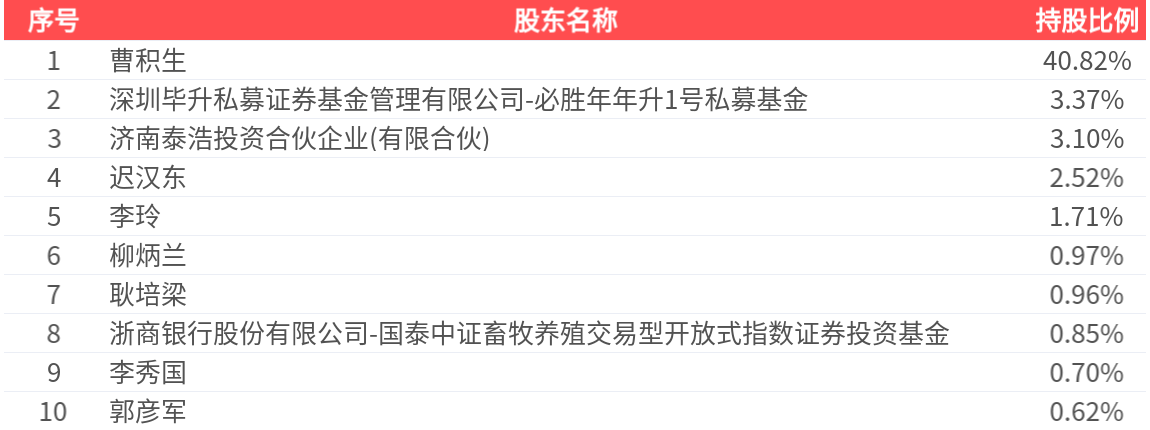
公司最新资产负债率为42.35%。 2025年8月1日,益生股份(002458.SZ)发布2025年中报。 公司营业总收入为13.21亿元。归母净利润为615.51万元。经营活动现金净流入为1.43亿元。 公司最新总资产周转率为0.18次。最新存货周转率为2.91次,较去年同期存货周转率增加0.65次,同比较去年同期上涨29.10%。 公司股东户数为4.80万户,前十大股东持股数量为6.15亿股,占总股本比例为55.63%,前十大股东持股情况如下: | 序号 | 股东名称 | 持股 | | --- | --- | --- | | l | 曹积生 | 40.8. | | 2 | 深圳毕升私募证券基金管理有限公司-必胜年年升1号私募基金 | 3.37 | | 3 | 济南泰浩投资合伙企业(有限合伙) | 3.10 | | 4 | 迟汉东 | 2.52 | | 5 | 李玲 | 1.71 | | ଚି | 柳炳兰 | 0.97 | | 7 | 耿培梁 | 0.96 | | 8 | 浙商银行股份有限公司-国泰中证畜牧养殖交易型开放式指数证券投资基金 | 0.85 | | g | 李秀国 | 0.70 | | 10 | ...


煤炭行业财务总监薪酬淮河能源最高为122万云维股份行业垫底为13万
Xin Lang Cai Jing· 2025-07-31 04:34
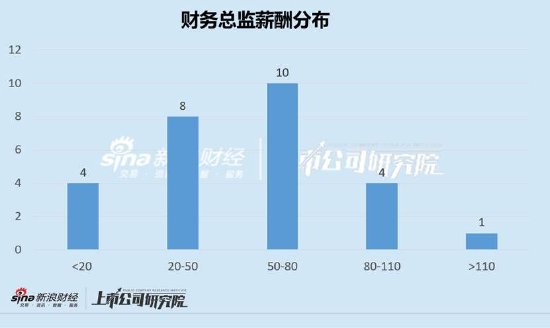
Group 1 - The total salary scale for CFOs in A-share listed companies in 2024 reached 4.27 billion yuan, with over 21% of CFOs earning more than 1 million yuan annually [1] - In the coal industry, the average salary for CFOs in 2024 is 1.38 million yuan, with an average per capita salary of 530,000 yuan [1] - The overall asset-liability ratio for the coal mining and washing sector in 2024 is 44.53%, a decrease of 0.25 percentage points year-on-year [2] Group 2 - In the coal industry, there are 4 CFOs earning below 200,000 yuan, 8 between 200,000 and 500,000 yuan, 10 between 500,000 and 800,000 yuan, 4 between 800,000 and 1.1 million yuan, and 1 above 1.1 million yuan [2] - The top 10 companies in terms of CFO salaries in the coal industry include Huaihe Energy, Shanxi Coking Coal, and Wuchan Zhongda, with Huaihe Energy's CFO earning 1.22 million yuan [2] - The CFO of Anyuan Coal Industry, Zhang Haifeng, has a salary of 570,000 yuan and has a background in accounting [2][3] Group 3 - The age distribution of CFOs in the coal industry is primarily between 49 and 58 years, with the oldest being Zhang Antai from Antai Group, aged 62, earning 146,500 yuan [3] - The educational background of CFOs in the coal industry is mainly bachelor's and master's degrees, with 15 holding bachelor's degrees, 8 holding master's degrees, and only 2 with associate degrees [3] - Daya Energy's CFO has a salary below the industry average and faced penalties for inaccurate financial disclosures [2]


煤炭行业财务总监薪酬淮河能源最高为122万 云维股份行业垫底为13万
Xin Lang Zheng Quan· 2025-07-31 03:24
登录新浪财经APP 搜索【信披】查看更多考评等级 专题:专题|2024年度A股董秘数据报告:1144位董秘年薪超百万 占比超21% 作为上市公司核心管理层关键成员,财务总监CFO的地位与作用至关重要。新浪财经《2024年度A股 CFO数据报告》显示,2024年A股上市公司财务总监CFO群体薪酬规模合计达42.70亿元,平均年薪为 81.48万元。 从煤炭行业看,2024年财务总监薪酬为1,382万元;从人均薪酬看,2024年煤炭行业财务总监人均薪酬 为53万元。 安源煤业财务总监为张海峰,年薪为57万,1982年9月出生,本科学历,高级会计师,中共党员。曾任 尚庄煤矿生产科科员,财务科科员,主办科员,副科长,丰城矿务局财务处科长,江西丰矿集团有限公 司财务部副部长,安源煤业集团股份有限公司财务证券部高级主管,主任会计师,副部长兼江西江能煤 矿管理有限公司财务总监,副部长(主持工作),部长,董事会秘书。现任安源煤业集团股份有限公司 党委委员,财务总监,丰城港华燃气有限公司董事长。 大有能源财务总监薪酬低于行业均值。值得注意的是,其因财务信息披露不准确领罚单。 2024年5月28日,大有能源披露《关于会计差错更正 ...


宁德时代(300750.SZ):2025年中报净利润为304.85亿元
Xin Lang Cai Jing· 2025-07-31 01:05
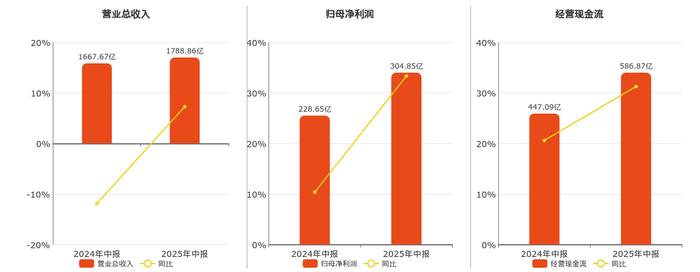
2025年7月31日,宁德时代(300750.SZ)发布2025年中报。 公司最新总资产周转率为0.22次,较去年同期总资产周转率减少0.02次,同比较去年同期下降7.09%。 最新存货周转率为2.03次,较去年同期存货周转率减少0.59次,同比较去年同期下降22.53%。 公司营业总收入为1788.86亿元。归母净利润为304.85亿元。经营活动现金净流入为586.87亿元。 公司股东户数为22.64万户,前十大股东持股数量为29.25亿股,占总股本比例为64.16%,前十大股东持 股情况如下: 公司最新资产负债率为62.59%。 公司最新毛利率为25.02%,较去年同期毛利率减少1.51个百分点。最新ROE为10.34%,较去年同期ROE 减少1.32个百分点。 公司摊薄每股收益为6.92元。 | 序号 | 股东名称 | 持股比例 | | --- | --- | --- | | J | 厦门瑞庭投资有限公司 | 22.47% | | 2 | 香港中央结算有限公司 | 13.31% | | 3 | 黄世霖 | 10.22% | | 4 | 宁波联合创新新能源投资管理合伙企业(有限合伙) | 6.23% | ...

智微智能(001339.SZ):2025年中报净利润为1.02亿元
Xin Lang Cai Jing· 2025-07-31 01:03
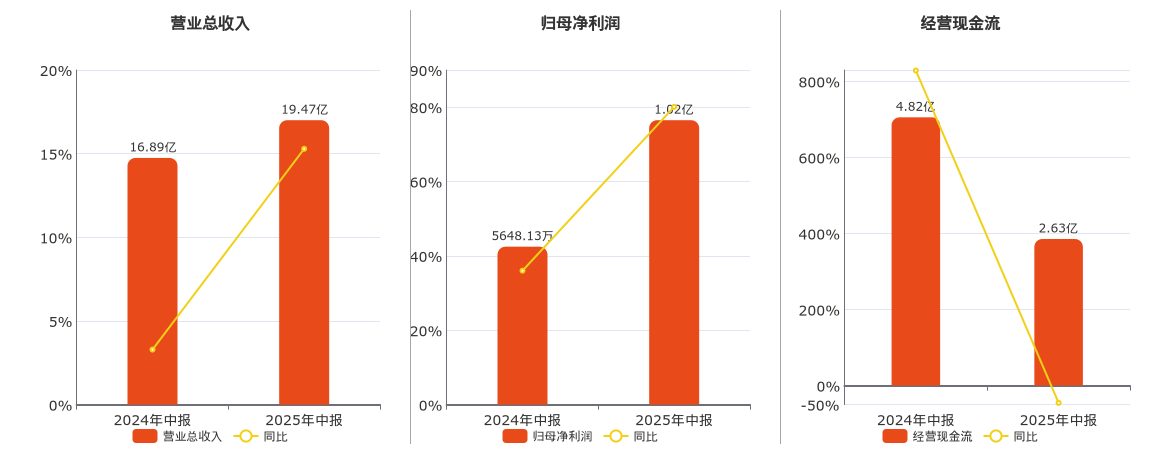
公司摊薄每股收益为0.41元。 公司最新总资产周转率为0.36次,较去年同期总资产周转率减少0.12次,同比较去年同期下降24.81%。最新存货周转率为1.32次,较去年同期存货周转率减 少0.34次,同比较去年同期下降20.29%。 公司股东户数为3.84万户,前十大股东持股数量为1.82亿股,占总股本比例为72.46%,前十大股东持股情况如下: | 序号 | 股东名称 | 持股 | | --- | --- | --- | | 1 | 袁微微 | 39.6 | | 2 | 郭旭辉 | 30.2 | | 3 | 香港中央结算有限公司 | 0.49 | | ব | 东台智展企业管理合伙企业(有限合伙) | 0.32 | | 5 | 中国银行股份有限公司-易方达供给改革灵活配置混合型证券投资基金 | 0.32 | | 6 | 中国农业银行股份有限公司 宝盈策略增长混合型证券投资基金 | 0.30 | | 7 | 招商银行股份有限公司-南方中证1000交易型开放式指数证券投资基金 | 0.28 | | 8 | 马新成 | 0.27 | | g | 中国农业银行股份有限公司-宝盈科技30灵活配置混合型证券投资基金 | ...
冠通期货早盘速递-20250730
Guan Tong Qi Huo· 2025-07-30 10:15
Group 1: Hot News - China and the US agreed to extend the suspension of 24% of US reciprocal tariffs and China's countermeasures for 90 days during the Sino-US economic and trade talks in Stockholm from July 28th to 29th [2] - The IMF raised China's GDP growth forecast for 2025 by 0.8 percentage points to 4.8% and for 2026 by 0.2 percentage points to 4.2%, and also adjusted the global economic growth forecast for 2025 to 3% [2] - From January to June, the total operating income of state-owned enterprises was 40.745 trillion yuan, a year-on-year decrease of 0.2%, and the total profit was 2.18 trillion yuan, a year-on-year decrease of 3.1%. The asset-liability ratio at the end of June was 65.2%, a year-on-year increase of 0.3 percentage points [2] - The China Photovoltaic Industry Association clarified that some self-media news about the anti-involution work in the photovoltaic industry, especially in polysilicon, was seriously inconsistent with the actual situation [3] - US President Trump announced a 10 - day deadline for Russia to reach a cease - fire agreement with Ukraine and threatened economic punishment if Russia did not act [3] Group 2: Sector Performance - Key sectors to focus on include urea, lithium carbonate, coking coal, PVC, and PP [4] - Night - session performance: Non - metallic building materials rose 2.75%, precious metals 27.10%, oilseeds 11.77%, non - ferrous metals 2.78%, soft commodities 21.03%, coal - coking - steel - ore 15.29%, energy 3.31%, chemicals 11.90%, grains 1.14%, and agricultural and sideline products 2.92% [4] Group 3: Asset Performance - In the equity category, the Shanghai Composite Index rose 0.33% daily, 4.80% monthly, and 7.70% year - to - date; the S&P 500 fell 0.30% daily [8] - In the fixed - income category, the 10 - year Treasury bond futures fell 0.25% daily, 0.70% monthly, and 0.73% year - to - date [8] - In the commodity category, WTI crude oil rose 3.91% daily, 0.11% monthly, and fell 6.91% year - to - date; London spot gold rose 0.36% daily, 1.03% monthly, and 26.29% year - to - date [8] - In other categories, the US dollar index rose 0.26% daily, 0.93% monthly, and fell 9.05% year - to - date; the CBOE Volatility Index remained unchanged daily, fell 10.76% monthly, and 13.95% year - to - date [8]
辉煌科技(002296.SZ):2025年中报净利润为1.35亿元、较去年同期上涨19.50%
Xin Lang Cai Jing· 2025-07-30 01:40
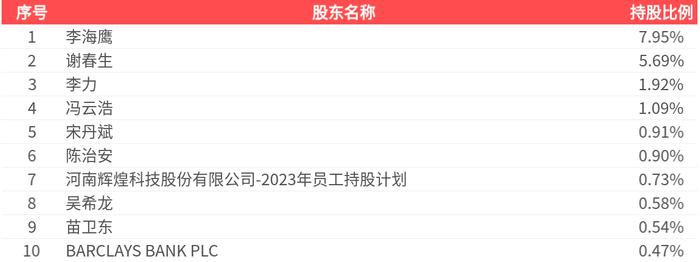
Core Insights - The company reported a total revenue of 404 million yuan for the first half of 2025, an increase of 71.08 million yuan compared to the same period last year, marking a year-on-year growth of 21.34% [1] - The net profit attributable to shareholders reached 135 million yuan, up by 21.96 million yuan from the previous year, reflecting a year-on-year increase of 19.50% [1] - The company achieved a net cash inflow from operating activities of 55.27 million yuan [1] Financial Metrics - The latest debt-to-asset ratio stands at 25.02% [2] - The gross profit margin is reported at 57.34% [3] - Return on equity (ROE) is at 5.67%, an increase of 0.38 percentage points compared to the same period last year [3] - The diluted earnings per share (EPS) is 0.35 yuan, an increase of 0.06 yuan year-on-year, representing a growth of 18.95% [3] - The total asset turnover ratio is 0.13 times, remaining stable compared to the previous year, with a year-on-year increase of 2.26% [3] - The inventory turnover ratio is 0.34 times, an increase of 0.10 times from the previous year, reflecting a year-on-year growth of 41.51% [3] Shareholder Information - The number of shareholders is 41,800, with the top ten shareholders holding a total of 80.91 million shares, accounting for 20.77% of the total share capital [3] - The largest shareholder is Li Haiying, holding 7.95% of the shares [3]

国邦医药(605507.SH):2025年中报净利润为4.56亿元
Xin Lang Cai Jing· 2025-07-30 01:13
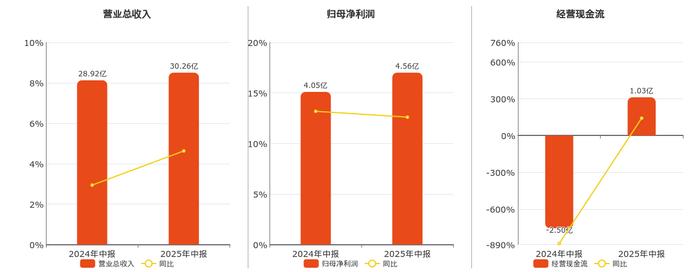
Core Insights - Guobang Pharmaceutical (605507.SH) reported its 2025 mid-year financial results, highlighting a total revenue of 3.026 billion yuan and a net profit attributable to shareholders of 456 million yuan [2]. Financial Performance - The company's total revenue reached 3.026 billion yuan, with a net profit of 456 million yuan [2]. - Operating cash flow showed a net inflow of 103 million yuan [2]. - The latest gross profit margin was recorded at 26.85%, while the return on equity (ROE) stood at 5.65% [5]. - The diluted earnings per share were reported at 0.82 yuan [6]. Balance Sheet Metrics - The current asset-liability ratio is 25.41%, which reflects an increase of 0.52 percentage points compared to the same period last year [4]. - The total asset turnover ratio remained stable year-on-year, although it decreased by 0.88% compared to the previous year [6]. - The inventory turnover ratio was 1.55 times, showing a decrease of 0.02 times year-on-year, which is a decline of 0.97% compared to the same period last year [6]. Shareholder Structure - The number of shareholders is approximately 25,000, with the top ten shareholders holding a total of 357 million shares, accounting for 63.85% of the total share capital [6]. - The largest shareholder is Xinchang Ander Trading Co., Ltd., holding 23.08% of the shares [6].

金杯电工(002533.SZ):2025年中报净利润为2.96亿元
Xin Lang Cai Jing· 2025-07-30 01:10
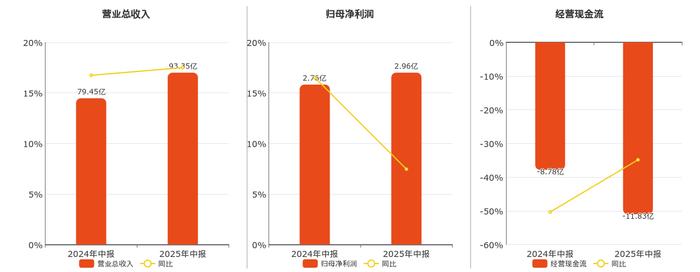
Core Insights - The company reported a total operating revenue of 9.335 billion yuan and a net profit attributable to shareholders of 296 million yuan for the first half of 2025 [1] - The company experienced a significant decrease in cash flow from operating activities, with a net outflow of 1.183 billion yuan, a reduction of 306 million yuan compared to the same period last year [1] Financial Performance - The latest asset-liability ratio stands at 59.63%, which is an increase of 3.55 percentage points from the previous quarter and an increase of 7.41 percentage points year-on-year [3] - The company's gross profit margin is 10.32%, reflecting a decrease of 0.67 percentage points compared to the same period last year [4] - The return on equity (ROE) is reported at 7.22% [4] - The diluted earnings per share (EPS) is 0.40 yuan [5] - The total asset turnover ratio is 0.86 times, a decline of 0.03 times or 3.40% year-on-year [5] - The inventory turnover ratio is 5.15 times [5] Shareholder Structure - The number of shareholders is 43,800, with the top ten shareholders holding a total of 313 million shares, accounting for 42.67% of the total share capital [5] - The largest shareholder is Shenzhen Nengxiang Investment Development Co., Ltd., holding 15.69% of the shares [5]

每日债市速递 | 国债期货收盘全线下跌
Wind万得· 2025-07-29 22:28
Group 1: Open Market Operations - The central bank conducted a reverse repurchase operation on July 29, with a fixed rate and quantity tendering of 449.2 billion yuan for a 7-day term, at an interest rate of 1.40%, with the same amount being the bid and awarded [1] - On the same day, 214.8 billion yuan of reverse repos matured, resulting in a net injection of 234.4 billion yuan [1] Group 2: Liquidity Conditions - Continuous net injections by the central bank have eased liquidity in the interbank market, with the overnight repo weighted average rate (DR001) dropping approximately 10 basis points to around 1.36% [3] - The decline in the 7-day term repo rate was slightly smaller, less than 2 basis points [3] - The latest overnight financing rate in the U.S. stands at 4.36% [3] Group 3: Interbank Certificates of Deposit - The latest transaction for one-year interbank certificates of deposit in the secondary market is around 1.675% [6] Group 4: Treasury Futures - Treasury futures closed lower across the board, with the 30-year main contract down 0.78%, the 10-year down 0.25%, the 5-year down 0.17%, and the 2-year down 0.06% [12] Group 5: Economic Data - From January to June, state-owned enterprises reported total operating revenue of 4,074.959 billion yuan, a year-on-year decrease of 0.2%, and total profit of 218.253 billion yuan, down 3.1% year-on-year [13] - By the end of June, the asset-liability ratio of state-owned enterprises was 65.2%, an increase of 0.3 percentage points year-on-year [13] Group 6: U.S. Treasury Borrowing - The U.S. Treasury is expected to increase net borrowing to 1.007 trillion dollars from July to September, a significant increase of over 450 billion dollars compared to the previous estimate of 554 billion dollars, representing an adjustment of nearly 82% [14]