
农业新质生产力

Search documents
2026年中央一号文件点评:聚焦粮食稳产提质,重视农业科技
Shenwan Hongyuan Securities· 2026-02-06 13:59
Investment Rating - The report gives an "Overweight" rating for the agricultural industry, indicating that it is expected to outperform the overall market [3][10]. Core Insights - The 2026 Central Document emphasizes food security and agricultural modernization, reiterating the importance of "new agricultural productivity" and the continuous focus on seed industry revitalization, particularly in biological breeding [4]. - In livestock, there is a shift towards "strengthening" comprehensive regulation of pig production capacity, with a focus on stabilizing the beef and dairy industries, and promoting dairy product consumption [4]. - The document highlights the importance of grain security, aiming to stabilize grain production at around 14 trillion jin, and introduces measures to enhance grain circulation efficiency [4]. - The report outlines the implementation of agricultural technology, including the integration of artificial intelligence with agriculture, and identifies key application scenarios such as drones, IoT, and robotics [4]. - The report suggests three main investment focuses: the recovery of the beef and dairy industries, the expected rebound in the pig cycle, and the continued advancement of the seed industry and biological breeding [4]. Summary by Sections Livestock Industry - The report indicates a comprehensive approach to regulating pig production capacity and acknowledges the success of measures taken to support the beef and dairy industries [4]. - It also mentions the introduction of multiple measures to promote dairy product consumption for the first time [4]. Crop Production - The focus remains on food security, with a commitment to stabilize grain production and enhance the efficiency of grain circulation [4]. - The report introduces a new round of initiatives aimed at increasing grain production capacity, particularly for oilseed crops like soybeans [4]. Seed Industry - The report emphasizes the ongoing implementation of seed industry revitalization actions and the acceleration of biological breeding industrialization [4]. - It notes the continuous mention of biological breeding in the Central Document over the past six years, highlighting its growing importance [4]. Agricultural Technology - The report outlines the path for implementing new agricultural productivity, emphasizing the need for technology integration, particularly in AI applications [4]. Agricultural Trade - The report advocates for the coordination of agricultural trade and production, promoting diversification of agricultural imports and supporting the export of competitive agricultural products [4].



农业农村部部署落实中央一号文件重点工作 分行业培育一批竞争力强的农业龙头企业
Zheng Quan Ri Bao Wang· 2026-02-06 13:47
记者2月6日获悉,为深入贯彻今年中央一号文件精神,日前农业农村部印发《关于落实〈中共中央 国 务院关于锚定农业农村现代化、扎实推进乡村全面振兴的意见〉的实施意见》(以下简称《实施意 见》),部署8方面40项具体工作举措,推动"三农"工作实现新发展新提升。 在"培育壮大乡村富民产业,千方百计促进农民稳定增收"方面,《实施意见》提出四方面举措。其中包 括,发展壮大农业企业。分行业培育一批竞争力强的农业龙头企业,常态化开展对接服务。绘制农产品 产业链"图谱",全产业链打造"链主"企业。认定第九批国家重点龙头企业。实施农业企业家培育计划。 完善农业企业联农带农机制,采取订单采购原料、全链条提供服务、资金技术赋能等方式带动农民参与 产业发展。实施农垦"三大建设"领航行动,加快建设现代农业大基地、大企业、大产业。 在"强化要素支撑保障,推动各项任务落地见效"方面,《实施意见》提出七方面举措。其中包括,完善 乡村振兴多元投入机制。推动优先保障农业农村领域一般公共预算投入,积极争取超长期特别国债,优 化实施"两重"项目和"两新"政策。指导地方按规定落实好土地出让收入用于农业农村相关政策,提升农 业农村领域政府债券使用效能。完 ...
市场最前沿·中央一号文件丨跨国公司如何在中国乡村“播种未来”?
Xin Hua Wang· 2026-02-06 12:58
Core Insights - Multinational companies express willingness to deeply engage in China's agricultural modernization process, as highlighted by the 2026 Central Document No. 1, which outlines a clear roadmap for agricultural development and presents opportunities for foreign companies [1][2][3] Group 1: Agricultural Innovation and Technology - Bayer Crop Science emphasizes its commitment to local research and development in China, investing nearly 600 million yuan in breeding research and establishing four breeding research centers and one breeding base [1] - Cargill focuses on enhancing digital technology for precise nutrition management in feed production, aligning with China's emphasis on agricultural modernization and green transformation [2] - Syngenta's innovation center in Shanghai aims to address major pest control and promote agricultural green development, leveraging the opportunities presented by the 2026 Central Document No. 1 [2] Group 2: Economic Development and Farmer Support - The 2026 Central Document No. 1 highlights the importance of increasing farmers' income and expanding their participation in industrial development, creating more avenues for multinational companies to engage in rural industry [2][3] - Charoen Pokphand Group's investment in a large-scale egg production project in Beijing demonstrates a successful model of collaboration with local governments and farmers, enhancing local employment and income through a cooperative model [3] - The focus on building a win-win platform for rural development and upgrading the entire supply chain from farm to table reflects the commitment of multinational companies to contribute to China's rural revitalization [3]
未来农业什么样?中央一号文件给出答案
Ren Min Ri Bao· 2026-02-06 11:23
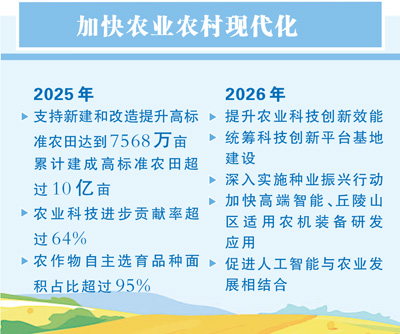
Core Insights - The central document for 2026 emphasizes the integration of technology in agriculture, marking the 14th focus on "three rural issues" since the 18th National Congress of the Communist Party of China [3] - The document highlights the importance of advancing agricultural productivity through technological innovation, including AI, drones, IoT, and robotics [3] Group 1: Technological Advancements - The contribution rate of agricultural technology in China has increased from 54.5% in 2012 to over 64% by 2025, indicating significant progress in agricultural innovation [4] - The comprehensive mechanization rate of crop farming has risen from 57% in 2012 to 76.7% by 2025, showcasing advancements in agricultural equipment [4] Group 2: Transformation of Agriculture - The integration of big data and AI algorithms is transforming traditional agricultural practices, moving from reliance on weather to a more technology-driven approach [5] - Agriculture is evolving into a comprehensive industry that encompasses economic, ecological, social, and strategic functions, necessitating a shift towards new productive forces in agriculture [5] Group 3: Future Outlook - Recent announcements from various provinces highlight the ongoing efforts to integrate technology into agriculture, such as the development of AI breeding platforms and smart agricultural scenarios [6][7] - The continuous progress in technology is expected to bring significant changes to the agricultural sector, suggesting a transformative future for agriculture in China [7]

中央一号文件点名!生物制造迎历史性机遇,这些企业率先入局!
Xin Lang Cai Jing· 2026-02-06 11:20
Core Insights - The 2026 Central Document emphasizes the integration of artificial intelligence with agriculture, promoting the development of agricultural bio-manufacturing as a new productive force [1][3][11] Group 1: Agricultural Bio-Manufacturing - Agricultural bio-manufacturing is expected to break the limitations of traditional agriculture, allowing for production that does not rely on climate or land resources [4][12] - Technologies such as molecular breeding, precision breeding, and gene editing can transform seeds, enabling the production of high-quality agricultural products in various regions [12][14] - The development of bio-manufacturing is crucial for ensuring food security in China, particularly in addressing the low self-sufficiency rate of soybeans, which is below 20% [4][12] Group 2: Technological Advancements - The integration of AI in agriculture is shifting practices from experience-based farming to data-driven management, enhancing efficiency through algorithms [3][11] - The transition to industrialized cell factory models in agriculture is significant for sustainable development, as demonstrated by the efficiency of bio-manufacturing processes [14] Group 3: Industry Initiatives - The first national agricultural bio-manufacturing innovation consortium was established in July 2025, led by major companies and research institutions [15] - Notable companies involved in agricultural bio-manufacturing include Dabeinong, Angel Yeast, and Meihua Biological, among others, which have products recognized in the first batch of bio-manufacturing landmark products [15][17]
筑牢大国粮仓根基 引领农业提质增效
Xin Lang Cai Jing· 2026-02-06 08:35
(来源:千龙网) 作者:谭智心 农业农村部农村经济研究中心研究员 第二,更加注重科技赋能与精准增效,推动现代农业发展从追求质量效益向内涵式增长转型。文件 将"提升农业科技创新效能"置于突出位置,特别部署"因地制宜发展农业新质生产力",要求促进人工智 能与农业发展相结合,拓展无人机、物联网、机器人等应用场景,加快农业生物制造关键技术创新。这 标志着农业提质增效的驱动力,正从依赖资源投入,转向以大数据、人工智能、生物技术等为核心的科 技创新与数据驱动。其深远意义在于,通过精准施肥、智能灌溉、病虫害AI预警、个性化品种选育 等,实现"节本、提质、环保"多重效益的统一。这不仅是提升农产品附加值和竞争力的关键,更是破解 资源环境约束、发展绿色低碳农业的根本出路,引领我国农业迈入以信息和知识为核心要素的智慧生产 新阶段。 第三,更加注重积极防御与内外协调,推动保供策略从内生发展向主动破局方向转变。面对近年来日益 频发的极端天气,农业防灾减灾体系建设成为重点。今年文件专门聚焦"强化农业防灾减灾体系建设", 将防灾上升为系统性工程。文件强调,在预警层面,开展农业气候资源普查和区划,加强监测预报预 警;在硬件层面,推进抗旱应急 ...
“新农具”变“新动能”
Ke Ji Ri Bao· 2026-02-06 08:32
Group 1 - The core viewpoint of the articles emphasizes the integration of emerging technologies such as drones, artificial intelligence, and digital technologies into agricultural practices, which is recognized as a significant advancement in modernizing agriculture in China [1][2][3] - The Central Document No. 1 for this year highlights the importance of developing new agricultural productivity through the application of artificial intelligence and technology, marking the first time drones have been explicitly mentioned in this context [1] - The number of agricultural drones in China has exceeded 300,000, with an annual operational area surpassing 460 million mu, indicating a rapid increase in the adoption of smart agricultural equipment [1] Group 2 - The contribution rate of agricultural science and technology progress in China has surpassed 64%, reflecting the significant impact of technological advancements on agricultural modernization [1] - The "Smart Min Grain" provincial grain storage information management system in Fujian serves as a benchmark for digital grain storage management, showcasing the potential of digital technologies in enhancing agricultural efficiency [2] - Challenges such as digital disempowerment, lagging institutional support, insufficient agricultural technology investment, and fragmented platforms hinder the integration of new technologies into agriculture [2][3] Group 3 - Recommendations for future strategies include enhancing data governance, increasing agricultural technology investment, and strengthening cross-departmental collaboration to facilitate the development and application of artificial intelligence and digital technologies in agriculture [3]
【光明网评】筑牢大国粮仓根基 引领农业提质增效
Huan Qiu Wang· 2026-02-06 08:30
Core Viewpoint - The central document emphasizes the importance of modernizing agriculture and rural areas, focusing on enhancing agricultural production capacity and quality efficiency, while addressing new domestic and international challenges [1]. Group 1: System Integration and Coordination - The document sets a target to stabilize grain production at approximately 1.4 trillion jin and advocates for a systematic approach that balances production capacity, ecological sustainability, and farmer income [2]. - It highlights the need for a new round of actions to enhance grain production capacity, emphasizing the integration of various agricultural elements such as land, seeds, machinery, and techniques [2]. - The introduction of projects aimed at improving grain circulation efficiency marks a shift from a production-centric approach to a balanced focus on production and sales [2]. Group 2: Technological Empowerment and Precision Efficiency - The document prioritizes enhancing agricultural technological innovation, advocating for the integration of AI and modern technologies like drones and IoT in agriculture [3]. - It aims to transition agricultural development from resource-dependent growth to one driven by technological innovation and data, promoting benefits such as cost reduction, quality improvement, and environmental protection [3]. - This shift is seen as crucial for increasing the added value and competitiveness of agricultural products while addressing resource and environmental constraints [3]. Group 3: Proactive Defense and Internal-External Coordination - The document emphasizes the construction of a comprehensive agricultural disaster prevention and mitigation system, addressing the increasing frequency of extreme weather events [4]. - It outlines measures for enhancing monitoring, emergency response, and pest control mechanisms, indicating a systematic approach to disaster management [4]. - The document also stresses the importance of coordinating agricultural trade and production on a global scale, advocating for diversified import channels and support for competitive agricultural enterprises [4]. Conclusion - The three strategic shifts outlined in the document collectively establish a new path for agricultural modernization, focusing on systematic construction, technological innovation, and coordinated internal and external capabilities, laying a solid foundation for rural revitalization and agricultural strength during the 14th Five-Year Plan period [5].
中央一号文件强化生猪产能综合调控,资金积极布局生猪养殖,养殖ETF(159865)近5日资金净流入超2亿元
Mei Ri Jing Ji Xin Wen· 2026-02-06 08:26
Group 1 - The central government has set a target for agricultural and rural modernization, focusing on enhancing grain production capacity by implementing a new round of actions aimed at increasing grain output by 1 trillion jin [1] - Key initiatives include improving soybean production capacity and expanding the production of oilseed crops such as rapeseed and peanuts, while also promoting the breeding of high-quality grain varieties [1] - The agricultural technology sector will see strengthened efforts in core technology breakthroughs and the transformation of research results, with an emphasis on integrating artificial intelligence and agriculture [1] Group 2 - The land system reform is entering a new phase, with a pilot program for extending land contracts for an additional 30 years after the expiration of the second round of land contracts, which is expected to revitalize rural resources [1] - In the livestock sector, there will be a focus on comprehensive regulation of pig production capacity and support for the beef and dairy industries to maintain supply-demand balance [1] - The Livestock ETF (159865) tracks the CSI Livestock Index (930707), which includes listed companies involved in feed, breeding, slaughtering, and meat processing, reflecting the overall performance of the livestock industry [1]
农业农村部:重点抓好八方面工作落实中央一号文件精神
Xin Hua Wang· 2026-02-06 07:45
新华社北京2月6日电 记者6日从农业农村部了解到,为深入贯彻今年中央一号文件精神,农业农村部日 前印发关于落实《中共中央 国务院关于锚定农业农村现代化 扎实推进乡村全面振兴的意见》的实施意 见,部署八方面具体工作举措,推动"三农"工作实现新发展新提升。 一是提升农业综合生产能力和质量效益,保障粮食等重要农产品稳定安全供给。毫不放松抓好粮油生 产,提升畜牧业现代化水平,推进渔业高质量发展,稳定棉糖胶和果蔬等生产,推动构建多元化食物供 给体系。加强耕地保护和质量提升,强化农业防灾减灾体系建设,全面提高农产品质量安全水平,提升 农业对外合作水平。 二是实施常态化精准帮扶,持续巩固拓展脱贫攻坚成果。健全常态化帮扶政策体系,提高监测帮扶精准 性时效性,提升产业和就业帮扶实效,分层分类帮扶欠发达地区。 【纠错】 【责任编辑:薛涛】 四是推进农业发展全面绿色转型,稳步提升可持续发展能力。提升农业资源保护利用水平,加强农业投 入品管理,发展生态低碳农业。 五是培育壮大乡村富民产业,千方百计促进农民稳定增收。做强农产品加工流通业,加快提升乡村特色 产业,发展壮大农业企业,强化农业品牌培育。 六是加快补齐农村现代生活条件短板,因 ...