可回收火箭

Search documents
DeepSeek一夜爆火、Labubu引爆全球抢购潮、“史诗级”外卖大战……2025年中国十大商业事件全盘点
Hua Er Jie Jian Wen· 2025-12-29 08:38
Group 1 - The year 2025 is marked as a transformative year in business, driven by DeepSeek's introduction of a cost paradigm that challenges the profitability myths of Silicon Valley [1][2] - DeepSeek's R1 model demonstrated that high-level AI capabilities could be achieved at a fraction of the cost, using only 2,000 GPUs and approximately $6 million, which is less than one-tenth of OpenAI's costs [5] - Following DeepSeek's success, there was a significant market shift, with the Nasdaq China Golden Dragon Index rising over 4% and major Chinese tech companies like Alibaba and Baidu seeing increased stock prices [5] Group 2 - The Chinese government intervened in the stock market during a crisis caused by new U.S. tariffs, with state-owned enterprises purchasing ETFs to stabilize the market [7][9] - The establishment of a "stabilizer" role for the Central Huijin Investment Company and the People's Bank of China provided a liquidity backstop, enhancing investor confidence [9] Group 3 - Pop Mart's LABUBU character became a global phenomenon, leading to a surge in sales and a 170%-175% year-on-year revenue increase in Q1 2025, with significant growth in the Americas and Europe [10][12] - Pop Mart's stock price soared over 200% in the first half of 2025, with major investment banks raising their target prices significantly [12] Group 4 - JD.com entered the food delivery market, intensifying competition with Alibaba and Meituan, leading to aggressive subsidy wars and record order volumes [16][18] - The competition is characterized by significant discounts and promotional offers, indicating a shift towards a new market dynamic in instant retail [20] Group 5 - Alibaba rebranded its AI application to "Qwen," aiming to compete directly with OpenAI's ChatGPT, focusing on consumer applications and integrating with its e-commerce platforms [21][23] - ByteDance's "Doubao" AI assistant faced challenges in compatibility with major applications, highlighting the difficulties of integrating new technology into existing ecosystems [24][26] Group 6 - China officially launched L3 autonomous driving vehicles, marking a significant step towards commercial application in the automotive industry, with expectations for the market to exceed 1.2 trillion yuan by 2030 [27][29] - The first L3 vehicles were approved for use, showcasing advancements in technology and safety standards [28] Group 7 - The Chinese GPU industry is experiencing a collective breakthrough, with companies like Moore Threads and Nanjing Huazhong Technology preparing for IPOs, reflecting a strong market demand for domestic chips [30][31] - These companies are adopting different strategies to capture market share, with a focus on innovation and production capabilities [32] Group 8 - China achieved significant milestones in nuclear fusion research, with the EAST device setting a world record for stable operation at 100 million degrees Celsius for over 1,000 seconds [33][34] - The country is positioning itself as a global leader in fusion energy, with numerous international collaborations and advancements in technology [34] Group 9 - China's commercial space sector is entering a new era with the successful test flights of reusable rockets, which are expected to reduce launch costs significantly [35][37] - The government is supporting the commercial space industry through funding and policy initiatives, aiming for scalable and cost-effective satellite launches [37]


商业航天专家小范围交流
2025-12-29 01:04
Summary of Key Points from the Conference Call Industry Overview - The commercial aerospace sector in China is primarily dominated by state-owned rockets, such as the Long March 6A and Long March 8A, with low participation from commercial rockets, indicating a reliability gap [1][9]. - The G60 and StarNet projects have distinct functionalities, with G60 using Ku-band and lacking laser communication capabilities, while StarNet employs Ka-band and includes laser communication, enhancing data processing and network flexibility [1][5]. Core Insights and Arguments - SpaceX offers significantly lower launch service costs at $2,000 per kilogram, compared to Long March 6A at approximately ¥50,000 per kilogram and Long March 12 at about ¥70,000 per kilogram. Although commercial companies claim they can reduce costs to ¥20,000 per kilogram, they lack reliability validation [1][10][11]. - Rocket engine costs account for the largest share (55%-60%) of total rocket costs, followed by structural components (approximately 30%). The application of 3D printing technology in engine manufacturing can significantly reduce costs, as demonstrated by SpaceX and domestic companies [1][12][17]. - In 2025, China is expected to achieve progress in reusable rockets, with the first flights of Zhuque 3 and Changcheng 12A, although neither achieved complete success. The next launch of Zhuque 3 is anticipated in April 2026, aiming for the first successful recovery [1][14][15]. Future Projections - In 2025, the state-owned rockets are projected to conduct about 50 to 60 launches, while the commercial sector may see 50 to 80 launches, depending on operational conditions and capacity [3][24]. - StarNet plans to launch 324 enhanced satellites in three batches in 2026, while G60 aims to complete the deployment of 540 satellites by adopting a multi-satellite launch mode [2][3]. Additional Important Insights - The reliability gap between commercial rockets and state-owned rockets is attributed to manufacturing processes and testing phases. State-owned engines undergo extensive ground testing, while many commercial companies opt for flight tests to save costs, which may overlook potential failures [1][13]. - The current bottleneck in rocket launch capacity is critical for the development of space computing and 6G communication, emphasizing the need for companies with established capabilities and competitive advantages [24][25]. - The emergence of commercial rocket companies introduces competition, but they are unlikely to completely replace traditional state-owned enterprises due to established relationships and stable supply chains [22].
A股盘前播报 | 财政部最新部署!继续支持消费以旧换新
智通财经网· 2025-12-29 00:45
Macro - The Ministry of Finance plans to significantly boost consumption in 2026 by implementing more proactive fiscal policies and continuing to allocate funds to support the replacement of consumer goods [1] Market - Silver prices surged over 5% to exceed $83, reaching a historical high before experiencing a pullback, with 57% of retail traders anticipating prices will exceed $100 per ounce next year [2] - The Shanghai and Shenzhen stock exchanges announced a series of fee reduction measures for 2026, estimating total fee reductions to exceed 1.9 billion yuan, covering major categories such as stocks, funds, and bonds [3] Policy Focus - The Shanghai Stock Exchange has refined listing standards for commercial rocket companies, confirming the mainline status of the commercial aerospace sector [5] - The Ministry of Industry and Information Technology has established a standardization committee to define the future of humanoid robots and embodied intelligence, with a focus on new technology iterations and component market trends [8] Market Discussion - ByteDance is expected to procure Ascend chips from Huawei in 2026, with total orders potentially exceeding 40 billion yuan, indicating significant changes in the domestic computing power landscape [9]
电话会、研报井喷!分析师“肝到冒烟”,商业航天投资主线地位确认?
Zheng Quan Shi Bao Wang· 2025-12-28 23:12
Core Insights - The commercial aerospace sector has gained significant attention in the capital markets and investment research circles, with a surge in related reports and conference calls in the past week [1][2] - Analysts from various sectors, including telecommunications, computing, and machinery, are increasingly crossing over to study commercial aerospace, indicating a shift in focus from traditional defense and military analysis [2][3] - A total of 14 commercial aerospace-related companies have been investigated by institutions this month, with some companies receiving attention from over 50 institutions [5] Group 1: Research and Reports - There has been an explosion of deep-dive reports and conference calls focused on commercial aerospace, with 26 themed calls held in the past week, some attracting over 500 participants [3][2] - Notable reports include those from Zhongyou Securities and Guotai Junan, covering topics such as the evolution of space computing and investment perspectives in the new phase of commercial aerospace [2][3] - The research community is actively exploring the commercial aerospace supply chain, with multiple firms releasing series of reports on various aspects of the industry [3] Group 2: Institutional Interest - Institutions have shown heightened interest in commercial aerospace stocks, with 14 companies being targeted for research, including Guanglian Aviation and Chaojie Co., which have received significant institutional attention [5][6] - Guanglian Aviation has engaged in partnerships to integrate into the regional aerospace ecosystem, while Chaojie Co. focuses on manufacturing components for commercial rockets [5] Group 3: Investment Opportunities - Analysts believe that the commercial aerospace industry is at a historic development turning point, with some institutions suggesting that its status as an investment mainline may be confirmed [6][8] - The recent policy changes, such as the Shanghai Stock Exchange's guidelines for commercial rocket companies, are expected to further stimulate the industry [7] - Key investment areas identified include the commercial rocket supply chain and satellite manufacturing, which are anticipated to benefit from increased launch demand and technological advancements [7][8]



一周26场会!这个赛道大火,相关公司被调研
券商中国· 2025-12-27 23:25
Core Viewpoint - The commercial aerospace sector is experiencing a surge in interest from the capital market and research circles, with numerous reports and conferences emerging in a short period [1][2]. Group 1: Market Activity - In the past week, there has been a significant increase in research reports and conference calls focused on commercial aerospace, with 26 themed calls attracting over 500 participants in some cases [2][3]. - Analysts from various sectors, including telecommunications, computing, and mechanical engineering, are increasingly engaging in cross-sector research on commercial aerospace, indicating a shift in focus from traditional defense and military analysis [2][3]. Group 2: Company Research and Interest - A total of 14 commercial aerospace-related companies have been investigated by institutions this month, with companies like Guanglian Aviation and Chaojie Co. receiving attention from over 50 institutions [5][6]. - Guanglian Aviation has been actively collaborating with Wenchang International Aerospace City and is in the process of acquiring Tianjin Yuefeng, a company specializing in aerospace equipment manufacturing [5][6]. - Chaojie Co. has reported significant interest, with 80 institutions conducting research, focusing on the manufacturing of commercial rocket components [5][6]. Group 3: Policy and Strategic Developments - The Shanghai Stock Exchange has released guidelines for commercial rocket companies to list on the Sci-Tech Innovation Board, marking a significant step for the industry [7]. - The national strategy to elevate China as a "space power" has positioned commercial aerospace as a new growth engine, prompting analysts to recommend investments in the commercial rocket and satellite manufacturing sectors [8]. Group 4: Future Outlook - Analysts predict that the commercial aerospace industry is on the verge of a historic development turning point, with investment opportunities becoming more apparent [6][9]. - The cost of launching satellites is expected to decline significantly, facilitating market expansion and the transition from technology validation to rapid growth [9].

商业航天:破局上天瓶颈,解锁太空算力
China Post Securities· 2025-12-26 05:05
Investment Rating - The industry investment rating is "Outperform" [1] Core Insights - The report emphasizes the transition from a "one-time" era to a reusable rocket model, reshaping the commercial aerospace sector. China has elevated commercial aerospace to a strategic level, planning a constellation of thousands of satellites to compete in the space economy. The industry is following the low-cost, high-frequency technology paradigm validated by SpaceX's Falcon 9, with costs potentially dropping below $1,000/kg as operational capacity increases [2][3][4] - The next phase for commercial aerospace is the industrialization of space computing power. With breakthroughs in reusable rockets and mass manufacturing, the sector is entering a scalable era, focusing on commercial pathways for space computing power, which is gaining attention due to its low energy costs and minimal heat dissipation [2][3][4] Summary by Sections Section 1: Transition to Reusable Rockets - The report discusses the policy elevation of commercial aerospace in China, marking a new development stage with significant government support and strategic planning [10][11] - Key challenges include high costs, low launch frequency, and limited payload capacity, which are being addressed through advancements in reusable rocket technology and industrial production [15][21][23] Section 2: Industrialization of Space Computing Power - The report highlights the growing global demand for AI computing power and the limitations faced by ground data centers, positioning space computing as a high-value application area [2][3] - The cost structure of space data centers is analyzed, showing significant capital expenditure (Capex) advantages compared to ground facilities, with a ten-year total cost potentially being less than 50% of ground operations [2][3] Section 3: Investment Recommendations - The report suggests focusing on companies involved in commercial aerospace and space computing, including but not limited to StarMap Control, China Aerospace Science and Technology Corporation, and others [2][3][4]


A股强势主线!商业航天投资机会有哪些?
Zhong Guo Zheng Quan Bao· 2025-12-26 04:28
Core Viewpoint - The commercial aerospace sector in China is experiencing significant growth, driven by recent successful satellite launches and supportive policies, leading to increased investor confidence and market activity [1][2]. Group 1: Recent Developments - On December 26, China successfully launched 17 low-orbit satellites using the Long March 8 rocket, marking a successful mission and contributing to the rising interest in the commercial aerospace sector [1]. - Since November 21, the commercial aerospace theme index has increased by over 33%, indicating a strong market response [1]. Group 2: Industry Trends - The commercial aerospace theme is entering a "warming" phase, with improved top-level design and new policy support clarifying the development blueprint for the industry [2]. - The acceleration of low-orbit satellite launches is expected to lead to a normalization and high-frequency launch phase in the domestic commercial aerospace sector, benefiting the entire industry chain [2]. Group 3: Future Outlook - By 2026, a series of new commercial rockets are expected to undergo their first flights or recovery tests, potentially marking the beginning of a new era in reusable rocket technology in China [3]. - SpaceX plans to launch its third-generation Starlink satellites in the first half of 2026, alongside the introduction of its Starship V3 for orbital payload transport [3]. Group 4: Investment Opportunities - The commercial aerospace sector is seen as entering a "fast lane" of development, with significant investment opportunities in areas such as space computing and reusable rockets [4]. - The low-orbit communication satellite chain is currently highlighted as a leading segment with strong fundamentals and order support [4]. Group 5: Relevant Companies - Companies involved in terminal and edge-side technologies include Guobo Electronics, Haige Communications, China Satellite, and others [5]. - In the space computing sector, key players include Aerospace Electronics, Fenghuo Communications, and Shunhao Co., among others [5]. - Satellite manufacturing companies include Shanghai Hanyun, Fudan Microelectronics, and others [7]. - Rocket launch companies include Western Materials, Plittech, and others [7].
A股突发!一则重磅消息传来!
天天基金网· 2025-12-25 08:35
Core Viewpoint - The article highlights a significant breakthrough in the field of superconducting magnetic levitation, where the team from the National University of Defense Technology successfully accelerated a ton-class test vehicle to 700 km/h within two seconds, marking the fastest speed globally for superconducting electric magnetic levitation tests. This advancement is expected to provide new momentum for China's aerospace and rail transportation sectors [2][4]. Group 1: Technological Breakthrough - The National University of Defense Technology's magnetic levitation team achieved a record speed of 700 km/h for a ton-class vehicle, breaking global records in this category [4]. - This achievement is a result of 10 years of research and development, overcoming key technical challenges in high-speed electromagnetic propulsion, electric levitation guidance, and high-field superconducting magnets [4]. - The technology is anticipated to enhance the capabilities of space launch systems, allowing for increased payload capacity and reduced launch costs, which is seen as a major benefit for the commercial aerospace sector [2][4]. Group 2: Market Reaction - Following the announcement, commercial aerospace stocks experienced a surge, with nearly 40 stocks in the sector hitting the daily limit or rising over 10% [2]. - The overall commercial aerospace sector saw a rise of over 3%, with specific companies like Superjet Co., Haoshi Electromechanical, and Guanglian Aviation reaching a 20% increase [6]. Group 3: Policy and Industry Development - The Shanghai government has introduced measures to accelerate the development of the aerospace industry, including financial support for satellite manufacturing and commercial operations [6]. - The establishment of the first commercial aerospace electromagnetic launch verification platform in Sichuan is expected to double the satellite payload capacity of rockets, significantly reducing launch costs and enabling high-frequency launches [5]. Group 4: Future Prospects - The article discusses the potential for China's commercial aerospace sector to achieve 100 launches per year by 2030, with a projected cost of approximately 100 million yuan per launch, leading to an annual output value of 85 billion yuan in rocket launches and satellite manufacturing [9]. - The commercial aerospace industry is evolving from a focus on launch manufacturing to a more integrated ecosystem, emphasizing the importance of reusable rocket technology and satellite internet infrastructure [10].



全球航天,进入“周更时代”
财联社· 2025-12-24 08:34
Core Viewpoint - The article discusses the launch of the Commercial Aerospace Industry Alliance Fund at the Third China Commercial Aerospace Development Conference, highlighting the growth and investment opportunities in the commercial aerospace sector in China [4]. Group 1: Fund and Investment - The fund has an initial issuance scale of 1 to 2 billion, with a long-term goal of expanding to 10 billion, and a duration of 10 years, aiming for approximately 70% project exit [4]. - Investment directions focus on four key areas: low Earth orbit satellite constellations and satellite internet, reusable launch vehicles and rocket launch services, new materials and devices for commercial aerospace, and space resource development and emerging space services [4]. Group 2: Launch Statistics and Projections - As of November, the global average monthly launches exceed 26, indicating a shift to a "weekly launch era," with an expected total of over 320 launches for the year, setting a historical record [4]. - Currently, there have been 325 space launches globally, with 4,026 spacecraft in orbit, including 87 launches from China (84 successful), and 23 missions executed by private commercial rocket companies, placing 324 spacecraft into orbit [4]. Group 3: Future Missions and Technological Developments - The China Manned Space Engineering Office has announced plans for four missions in 2026, including the Tianzhou-10 and Shenzhou-23 and 24 missions, with the Mengzhou-1 mission set to use the Long March 10A reusable rocket for the first time [5]. - The Long March 10B reusable rocket is expected to achieve its first flight conditions by April 2026 [5]. - The recent launch of the Long March 12A rocket provided key engineering data for future recovery of rocket stages, despite not achieving the recovery goal in this mission [5]. Group 4: Low Earth Orbit Satellite Internet Development - China’s low Earth orbit satellite internet construction is entering a new phase of intensive deployment, with major companies like Xingwang Group and Yuanxin Satellite planning large-scale satellite tenders in 2026 [6]. - This round of tenders is expected to significantly increase satellite demand and drive collaborative development across the entire industry chain, from rocket to satellite manufacturing and payload support [6]. - East Wu Securities predicts that commercial rockets will transition from a phase of quantity to quality by 2026, marking the beginning of a new era of rocket recovery in China, with a "supply-demand resonance" expected to drive rapid expansion in the aerospace industry [6].

30股集体涨停!商业航天迎来密集催化,这些标的或受益
2 1 Shi Ji Jing Ji Bao Dao· 2025-12-24 07:12
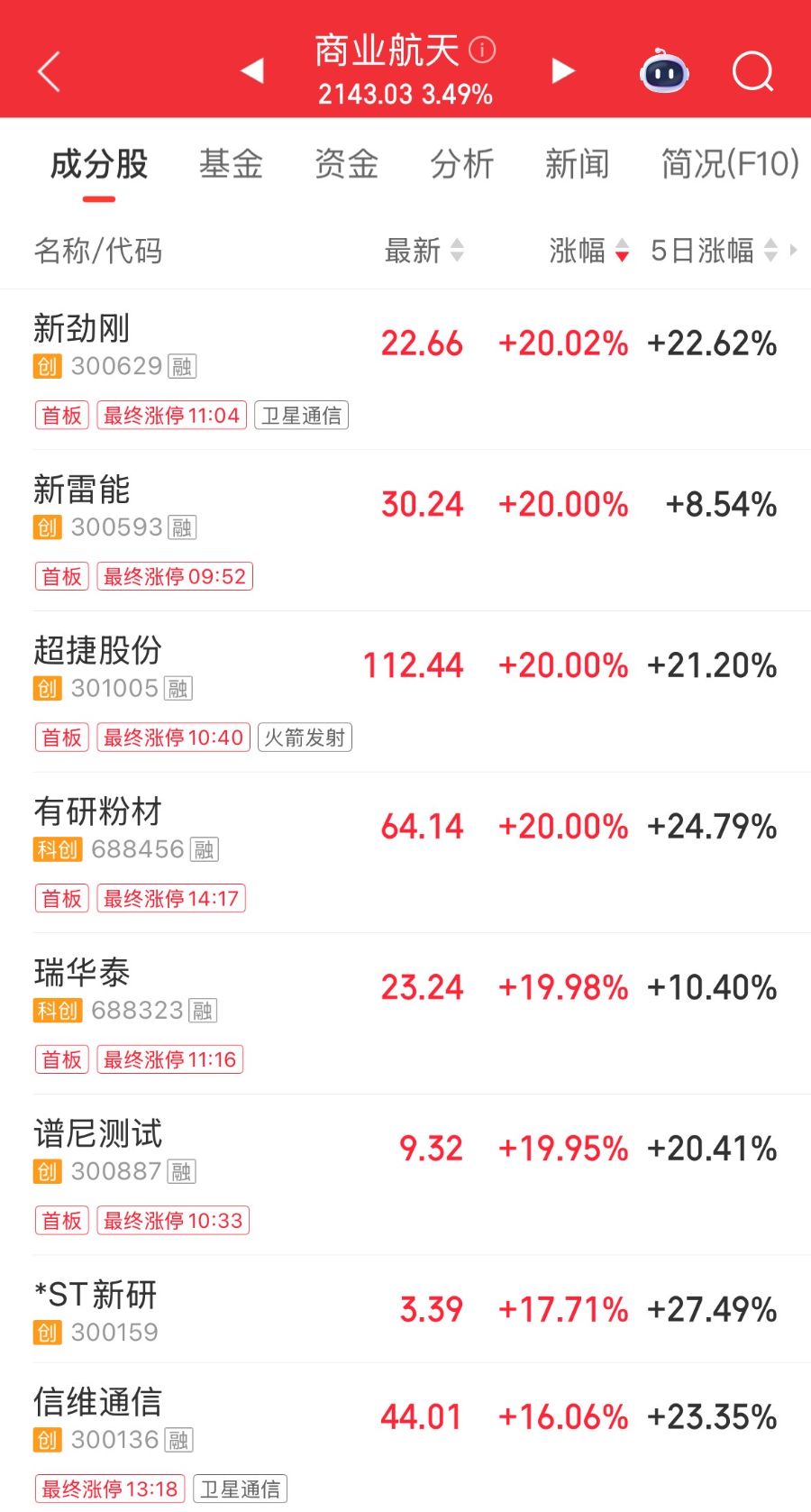
Core Viewpoint - The commercial aerospace sector is experiencing a significant surge, with a collective rise in stock prices and a focus on key developments and policies during the recent Commercial Aerospace Development Conference held in Beijing [5]. Group 1: Market Performance - As of December 24, 30 stocks within the commercial aerospace sector reached their daily limit up, indicating strong market enthusiasm [1]. - Notable stocks that hit the 20cm limit include Xin Jingang, Xin Leino, Chaojie Co., Youyan Powder Materials, Ruihua Tai, and Puni Testing, while Shenjian Co. recorded five consecutive limit-ups [1]. Group 2: Industry Developments - The 2025 Commercial Aerospace Development Conference focused on three main areas: interpretation of national policies, discussion on key technology collaboration and industry ecosystem construction, and establishment of a collaborative platform for government, industry, academia, and research [5]. - China's frequent rocket launches, including the successful launch of the Long March 12甲 rocket, are contributing to the accumulation of valuable data and practical experience for future technological iterations [5]. Group 3: Investment Insights - According to CITIC Securities, high-potential investment areas include space computing power and reusable rockets, while low-orbit communication satellite chains currently have fundamental logic and order support [5]. - Open Source Securities projects that by 2030, China could achieve 100 rocket launches per year at a cost of approximately 100 million yuan per launch, with the annual output value of rocket launches and satellite manufacturing expected to reach 85 billion yuan [5]. Group 4: Stock Performance Data - The table of stock performance in the commercial aerospace sector shows significant annual growth rates for various companies, with notable performers including: - Sui Rui New Materials (276.52%), Aerospace Power (261.90%), and Chaojie Co. (220.80%) [6]. - The satellite payload segment also shows strong performance, with companies like Zhenlei Technology (208.86%) and China Satellite (120.26%) leading the growth [6].