多资产策略

Search documents
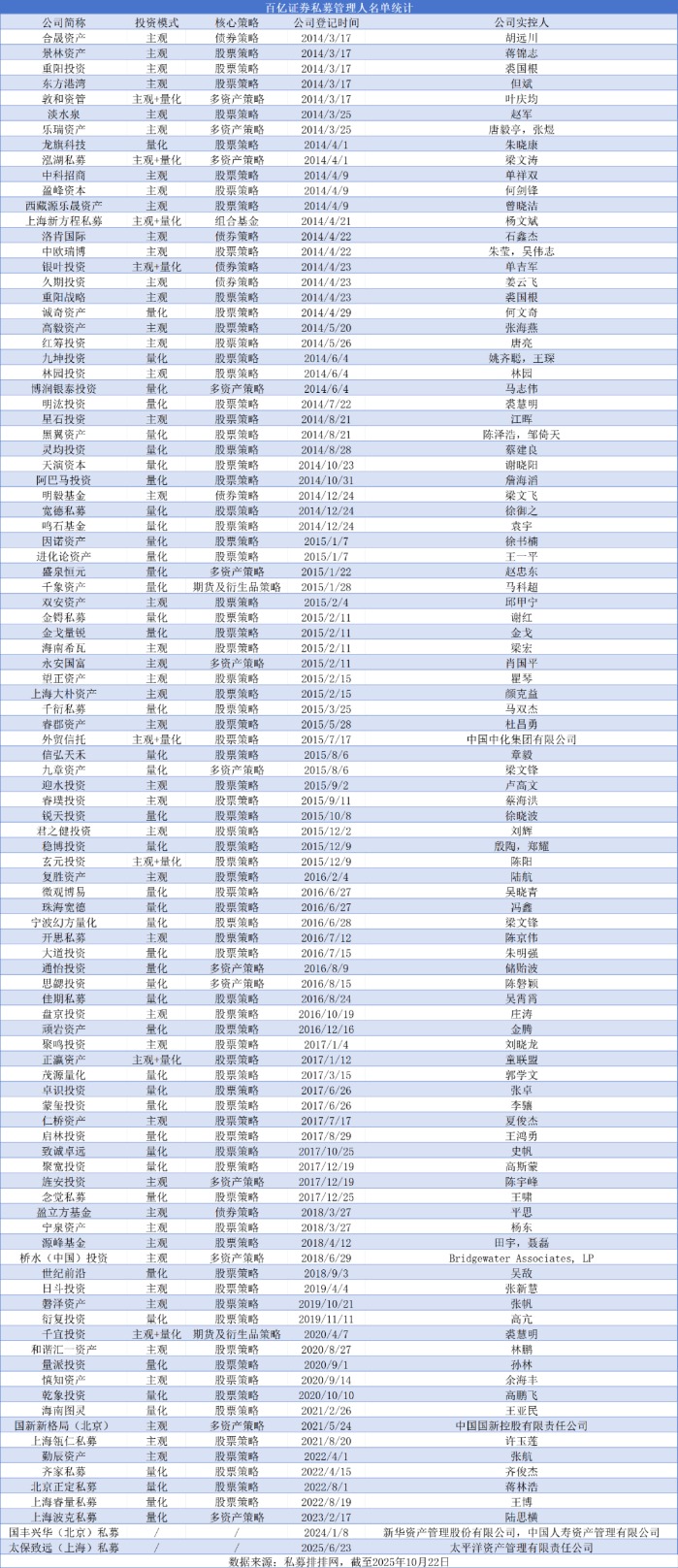
百亿私募数量突破100家 量化私募和主观私募占据绝大多数份额
Zhong Guo Ji Jin Bao· 2025-10-22 10:16
Core Insights - The number of private equity funds with over 10 billion yuan in assets has reached 100, marking a significant milestone in the industry as it reflects the recovery of the market and the growth of fund performance and scale [2][3]. Group 1: Growth of Private Equity Funds - As of October 22, 2025, the number of private equity funds exceeding 10 billion yuan has increased by 4 from the end of September, with notable new entrants including Dadao Investment and the return of Shanghai New Equation and Wangzheng Asset [2]. - The current distribution of the 100 funds shows that quantitative funds lead with 46, followed closely by subjective funds at 44, while mixed strategy funds account for 8 [2][3]. Group 2: Market Dynamics - The increase in the number of large private equity funds is attributed to the stabilization of the A-share market, which has improved returns on equity assets, leading to a rise in both fund performance and scale [3]. - There is a growing recognition of leading private equity firms, resulting in a concentration of funds towards those with stable performance and mature strategies, reinforcing the "head effect" in the industry [3]. Group 3: Investment Strategies - Stock strategies dominate the core strategies of the funds, with 76 out of 100 funds focusing on this area, reflecting the current market's favorable conditions for stock selection [4]. - The rise in multi-asset strategies indicates an increasing demand for risk diversification, as these strategies can mitigate the volatility of single assets and provide more stable returns [5].

百亿私募数量再次突破100家大关 量化和主观私募占比超九成
Zheng Quan Shi Bao Wang· 2025-10-22 07:12
Group 1 - The number of private equity firms with over 10 billion yuan in assets has surpassed 100, reaching 101 as of October 22, 2025, an increase of 5 from 96 at the end of September [1] - Among the 101 firms, quantitative private equity firms are the most numerous, with 47 firms accounting for 46.53%, followed by subjective private equity firms with 44 firms at 43.56%, and mixed strategy firms with 8 firms at 7.92% [1] - The new entrants in October include 2 subjective and 2 quantitative strategy firms, along with 1 mixed strategy firm [1] Group 2 - Stock strategies dominate the core strategies of the private equity firms, with 77 firms employing this strategy, representing 76.24% of the total [2] - Multi-asset strategies account for 12.87% with 13 firms, while bond strategies make up 5.94% with 6 firms [2] - The increase in the number of billion-yuan private equity firms is attributed to the stabilization of the A-share market, leading to improved performance and scale of private equity products [2] Group 3 - The expansion of private equity firms is primarily driven by subjective private equity firms due to their flexibility in adapting to market changes and macroeconomic conditions [3] - Some subjective private equity managers possess extensive investment experience and strong stock-picking abilities, which attract continuous capital inflow [3] - Market conditions are currently characterized by structural valuation concerns, with a focus on sectors like AI applications and cyclical industries nearing capacity clearance [3]
桥水创始人达利欧给中国投资者的超实用投资建议
雪球· 2025-10-20 13:01
Core Viewpoint - The article emphasizes the importance of constructing a diversified investment portfolio to achieve returns that outpace inflation in a low-interest-rate environment, as suggested by Ray Dalio, founder of Bridgewater Associates [8][13]. Group 1: Investment Strategies - In a low-interest-rate environment, simply holding cash is insufficient to beat inflation, which has averaged 2.5% annually in China over the past 30 years [8][12]. - A diversified asset portfolio is essential, comprising at least 10 uncorrelated assets to significantly reduce risk while maintaining expected returns [16][18]. - Gold is recommended as a stabilizing asset in the portfolio, despite its 50% increase this year, due to its characteristics as a hard currency that is not subject to inflationary pressures [20][22]. Group 2: Geographic Diversification - Investors should diversify not only across asset classes but also geographically, including both domestic and international assets to mitigate risks associated with reliance on a single economy [25][27]. - For instance, during the 2022 downturn in U.S. stocks due to aggressive Fed rate hikes, having exposure to Japanese stocks could have provided a hedging effect [29]. Group 3: Timing and Rebalancing - Timing the market is discouraged; instead, a long-term investment approach that focuses on growing with the economy is advocated [33]. - Regular rebalancing of the investment portfolio is crucial to maintain target asset proportions, which helps manage risk and avoid concentration in high-performing assets [35][37]. - The discipline to rebalance, especially after significant market movements, is essential for effective portfolio management [39].

百亿元级私募阵营持续扩大
Zheng Quan Ri Bao· 2025-10-19 17:44
Group 1 - The number of domestic private equity firms with over 10 billion yuan in assets has increased to 96, with 5 new firms added in September 2025 [1] - Among the 96 firms, quantitative strategies dominate, with 45 firms (46.88%) employing this approach, followed closely by 42 firms using subjective strategies [1] - The trend of global expansion is evident, with 65 out of 96 firms (67.71%) obtaining Hong Kong's Type 9 license [1] Group 2 - Stock strategies remain the primary focus for 74 firms (77.08%), while multi-asset and bond strategies are used by 12 and 6 firms, respectively [2] - In the first three quarters of 2025, the average return for 62 reporting firms was 28.80%, with 98.39% of firms achieving positive returns [2] - The performance of quantitative private equity firms was particularly strong, with an average return of 31.90%, surpassing the 24.56% average return of subjective firms [2][3] Group 3 - Among the 32 firms with average returns exceeding 30%, 24 are quantitative firms, representing 75% of this group [3] - Factors contributing to the strong performance of quantitative firms include market style alignment, systematic operations reducing emotional interference, and ongoing strategy iteration and risk control upgrades [3]
私募备案量暴增近九成!前三季度,私募交出亮眼成绩单
券商中国· 2025-10-19 05:51
Core Viewpoint - The private equity fund market is experiencing a significant rebound, with new product issuances increasing and many funds surpassing the 10 billion yuan mark [1] Group 1: Market Growth and Product Issuance - In the first three quarters, a total of 8,935 private equity securities products were registered, representing a substantial year-on-year increase of 89.38% from 4,718 products [2][3] - The growth in registration numbers is attributed to three main factors: improved market conditions, regulatory guidance enhancing transparency and compliance, and active expansion by institutions [3] - Stock strategies remain the dominant force, with 5,849 products registered, accounting for 65.46% of the total, and showing a year-on-year growth of 99.35% [3] Group 2: Performance of Private Equity Funds - The average return for private equity funds in the first three quarters was 25%, significantly outperforming the Shanghai and Shenzhen 300 Index [2][5] - Among the five major strategies, stock strategies led with an average return of 31.19%, with 93.52% of the 5,976 funds achieving positive returns [5][6] - Quantitative long strategies showed exceptional performance, with an average return of 35.95% and a positive return rate of 96.71% [6] Group 3: Growth of Billion-Yuan Private Equity Funds - The average return for the 62 billion-yuan private equity funds reached 28.80%, with 98.39% of them reporting positive returns [7] - A total of 14 funds achieved returns exceeding 40%, while 18 funds had returns between 30% and 40%, indicating strong overall profitability [7] - The number of billion-yuan private equity funds increased to 96 by the end of September 2025, up from 91 at the end of August [8][9] Group 4: Industry Structure and Competition - The registration structure indicates a shift in the competitive landscape, with top quantitative private equity funds dominating the registration rankings [8] - Among the 26 private equity firms with at least 40 registered products, 23 are billion-yuan institutions, highlighting a significant head effect [8] - The industry is witnessing increased concentration, with leading firms expanding while smaller firms actively seek breakthroughs [8]

前三季度备案私募产品同比增长近90% 股票策略备案量占据主导地位
Zheng Quan Shi Bao Wang· 2025-10-17 09:45
Core Viewpoint - The private equity securities product registration market has significantly rebounded in 2025, with a total of 8,935 products registered in the first three quarters, representing a substantial increase of 89.38% compared to the same period last year [1] Group 1: Product Registration Overview - The stock strategy products dominate the market with 5,849 registrations, accounting for 65.46% of the total, and showing a year-on-year increase of 99.35% [1] - Multi-asset strategies follow with 1,278 registered products, making up 14.30% of the total, and experiencing an 84.68% year-on-year growth [1] - Futures and derivatives strategies have 913 registered products, representing 10.22% of the total, with a year-on-year increase of 66.00% [2] Group 2: Quantitative Private Equity Products - Quantitative private equity products have shown remarkable performance, with 3,958 products registered, accounting for 44.30% of all private equity securities products, and a year-on-year increase of 102.66% [2] - Within quantitative products, stock strategy quant products lead with 2,865 registrations, making up 72.39% of the total [2] - The quantitative CTA strategy has 509 registered products, representing 12.86% of the total, benefiting from favorable market trends [3]
13家理财公司,9月规模回落8700亿!“含权”产品逆势增长
券商中国· 2025-10-17 07:20
Core Viewpoint - In September, bank wealth management products experienced a significant decline in scale after several months of net inflows, with a total reduction of approximately 870 billion yuan across 13 out of 14 major wealth management companies [2][5]. Group 1: Scale Changes in Wealth Management Products - As of the end of September, the total scale of the top 14 wealth management companies was 24.19 trillion yuan, a decrease of about 830 billion yuan from the end of August [5]. - The decline was primarily driven by a notable drop in fixed-income products, particularly pure bond wealth management products, which saw a reduction of approximately 6.7 trillion yuan [5][6]. - Among the 14 companies, state-owned banks accounted for over 75% of the total decline, with a combined decrease of about 6.54 trillion yuan [5][4]. Group 2: Performance of Different Product Types - Cash management products also saw a decline, with a total balance of 5.67 trillion yuan, down approximately 280 billion yuan from the previous month [6]. - Conversely, wealth management products with equity assets, such as "fixed income plus" and mixed products, experienced growth, with a total increase of about 110 billion yuan in September [6]. Group 3: Sales Channels and Strategies - The sales structure and channels have become crucial factors influencing the changes in wealth management scales, with many companies increasing their reliance on external sales channels [8]. - By the end of September, the external sales scale of the 14 wealth management companies exceeded 6.94 trillion yuan, with four companies having external sales accounting for over 50% of their total sales [8]. Group 4: Growth of Equity-Linked Products - The issuance of equity-linked wealth management products has seen a "volume growth" trend, with 49 existing equity products and 1,056 mixed products issued this year, significantly surpassing last year's figures [11]. - The interest in IPO investments has also increased, with wealth management companies participating in IPOs, such as the case of Chery Automobile's listing in Hong Kong [12]. Group 5: Future Strategies and Opportunities - To capitalize on the upward cycle of the stock market, wealth management companies are advised to optimize their strategies by increasing allocations to equity and other risk assets while maintaining a balanced approach [14]. - Multi-asset strategies are seen as a key solution, with a focus on diversifying revenue sources and controlling product value fluctuations [14].

幻方、明汯、世纪前沿、蒙玺等66家私募全部产品新高!30只“双十基金”创历史新高!
私募排排网· 2025-10-16 03:46
Core Insights - In September 2023, A-shares indices reached new highs, with the Shanghai Composite Index rising 0.64%, while the Shenzhen Component and ChiNext Index increased by 6.54% and 12.04% respectively [2] - A total of 2,993 private equity products achieved historical net value highs in September, representing approximately 62.22% of products established for over a year [2] - Among these products, 1,125 were quantitative, and 1,868 were non-quantitative, with stock strategy products being the most prevalent [2][3] Product Types - Stock strategy products accounted for 1,931, approximately 64.52% of the total, followed by multi-asset strategy products (443), futures and derivatives strategy products (339), bond strategy products (173), and combination fund products (107) [2] - The majority of products (1,252) came from private equity firms with assets under management below 500 million, while 429 products were from firms with over 10 billion [3] High-Performing Private Equity Firms - A total of 66 private equity firms had all their products reach historical highs in September, with 40 being subjective private equity firms, 19 quantitative, and 7 combining both strategies [4][5] - Among these, 8 firms with over 10 billion in assets included notable names such as Fusheng Asset and Ningbo Huanfang Quantitative [5] Notable Products - The "Double Ten Fund" category, which includes products established for over 10 years with annualized returns exceeding 10%, featured 30 products, predominantly subjective long products [13] - The top-performing products in the quantitative long category had a threshold return of over ***% [16] Investment Strategies - The quantitative long strategy had 476 products achieving historical highs, with the top five returns coming from firms like Huanrong Investment and Longyin Tiger Roar [16] - For subjective long strategies, 606 products reached new highs, with the top five returns from firms such as Shanghai Geru Private Equity and Beijing Xiyue Private Equity [19] Multi-Asset and Derivatives Strategies - Multi-asset strategy products numbered 268, with the top five returns coming from firms like Juku Investment and Yiku Capital [28] - In the futures and derivatives strategy category, 149 products reached historical highs, with a focus on quantitative and subjective CTA strategies [33]

震荡市不想躺平又怕回撤?博时资本红利增强策略&波动增利策略:一边收息一边薅波动
私募排排网· 2025-10-14 09:04
Core Viewpoint - In the current volatile capital market, asset management institutions must maintain stability and long-term growth, with Bosera Capital exemplifying this through its multi-asset strategy and over 2.24 trillion yuan in managed assets [2][3]. Group 1: Company Overview - Bosera Capital was established in February 2013 with a registered capital of 850 million yuan and is a subsidiary of Bosera Fund, which is primarily controlled by China Merchants Securities [8][6]. - The company has issued over 1,500 products and has a cumulative management scale exceeding 2.24 trillion yuan [2]. - Bosera Capital shares a risk control system with its parent company, ensuring comprehensive risk monitoring and compliance management [10]. Group 2: Investment Strategy - The investment strategy framework of Bosera Capital includes various strategies such as fixed income, fixed income plus, quantitative stock selection, quantitative derivatives, ETF rotation, volatility enhancement, and overseas thematic FOF strategies [3][12]. - The investment strategies are designed to complement those of the parent company, providing differentiated products [12]. Group 3: Volatility Enhancement Strategy - The volatility enhancement strategy aims to capture market fluctuations and enhance returns through non-linear grid trading and futures pricing [15]. - The flagship product, "Bosera Rongxiang Enhanced Income No. 1," is tailored for volatile markets and aims to achieve excess returns while controlling drawdowns [15]. - The strategy's returns are derived from four main sources: volatility profits, basis spread profits, index returns, and cash returns [16]. Group 4: Performance and Risk Management - Historical performance shows that the volatility enhancement strategy has achieved positive returns for nine consecutive years from 2016 to 2024, with annualized returns significantly outperforming the CSI 500 index during downturns [22][24]. - The strategy has demonstrated strong risk control, with maximum drawdowns significantly lower than the CSI 500 index during adverse market conditions [24]. Group 5: Dividend Enhancement Strategy - The fixed income plus quantitative dividend enhancement strategy focuses on high-dividend, low-volatility stocks while maintaining a significant allocation to bonds [34]. - The strategy benefits from favorable policies encouraging cash dividends and stock buybacks, enhancing the selection of potential investment targets [37]. - The strategy employs a rigorous selection process to ensure sustainable high dividends and robust company fundamentals [39][40]. Group 6: AI Integration - Bosera Capital aims to integrate AI technology into various aspects of its strategies, including factor development, return prediction, and model optimization [43]. - The use of AI is expected to enhance the efficiency of investment research and decision-making processes [43].

诺贝尔奖金124年没花完,反而增值200倍!怎么做到的?
雪球· 2025-10-10 13:00
以下文章来源于做配置的小雪 ,作者做配置的小雪 做配置的小雪 . 曾经幻想暴富,现实变成暴负,投资只能慢慢变富~ ↑点击上面图片 加雪球核心交流群 今年一共有6个奖项,每个奖项奖金是1100万瑞典克朗,也就是说,今年一年的奖金支出就有6600万。 但是在124年前,诺贝尔只留下了3100万瑞典克朗,如果只靠这笔钱,连今年的奖金都不够支付,更别提过去一个多世纪的巨额奖金了。 但事实是, 诺贝尔留下的这笔资产,不仅没有花完,还比最初的金额增值了200倍,诺奖单项奖金也从最初的15万瑞典克朗,涨到了1100万瑞典 克朗。 一、从3100万到61亿,诺奖靠多资产策略让钱生钱 诺贝尔的遗产由诺贝尔基金会管理,基金会负责拿着钱去做投资,不过,投资之路并不是一成不变,一共经历了三个阶段: 1、保守起步:局限于安全资产 基金成立初期,受诺贝尔的遗嘱限制,只能投资安全资产,比如国债和定期存款。 这种策略虽然保住了本金,但是收益率极低,在前50年里,收益率仅2%~3%,甚至无法跑赢通胀,到了1945年,诺奖单项奖金的实际购买力, 相比1901年已经缩水超过七成,基金会一度入不敷出,难以保证奖金顺利支出。 2、历史性转折:拥抱股票 ...