太空AI

Search documents
马斯克:建造核聚变反应堆“愚蠢至极”
Xin Lang Cai Jing· 2025-12-15 08:15
Core Viewpoint - Elon Musk publicly criticized nuclear fusion power, stating that building small nuclear fusion reactors on Earth is economically foolish, as the sun itself is a massive, free nuclear fusion reactor capable of meeting all energy needs in the solar system [1][6]. Group 1: Solar Energy Advocacy - Musk has previously predicted that solar energy will become the most important energy source for human civilization [3][8]. - In a 2023 podcast, Musk mentioned that a solar panel measuring 100 miles by 100 miles could meet the entire electricity demand of the United States [3][8]. - Musk's latest plan involves deploying 100 GW of solar-powered AI satellites annually, which would equate to about a quarter of the total electricity consumption of the U.S. [3][8]. Group 2: Space Energy Solutions - Musk emphasized that as computing clusters grow, the demand for power and cooling will exceed what ground infrastructure can support [3][8]. - To achieve a sustained computing capacity of 200 GW to 300 GW, large and expensive power plants would need to be built, as a typical nuclear power plant generates about 1 GW [3][8]. - In space, continuous solar energy can be utilized without the need for batteries, as sunlight is always available, and solar panels would be cheaper due to the absence of glass or frames, with cooling achieved through radiation [3][8]. Group 3: Tesla's Solar Business - Tesla's solar business is undergoing a revival, with the company announcing the production of new solar panels at its Buffalo, New York factory, with the first products expected to be delivered in Q1 2026 [4][9]. - Last year, Tesla's solar installation volume hit a low point, leading the company to stop publicly reporting related data [4][9].


马斯克公开唱衰核聚变发电 计划每年部署100GW的太阳能AI卫星
Ge Long Hui· 2025-12-15 07:48
Core Viewpoint - Elon Musk publicly criticized the construction of small nuclear fusion reactors, deeming it economically foolish compared to the energy provided by the sun, which he describes as a massive, free nuclear fusion reactor [1]. Group 1: Nuclear Fusion Critique - Musk stated that building small nuclear fusion reactors on Earth is "extremely foolish" [1]. - He emphasized that the energy produced by the sun can meet the energy demands of the entire solar system [1]. Group 2: Solar Energy Initiative - Musk's latest proposal includes deploying 100 GW of solar energy AI satellites annually, which would equate to about a quarter of the total electricity consumption of the United States [1].

卫星产业ETF(159218)四连升冲击历史高点!臻镭科技、航天电子、派克新材领衔
Sou Hu Cai Jing· 2025-12-15 02:09
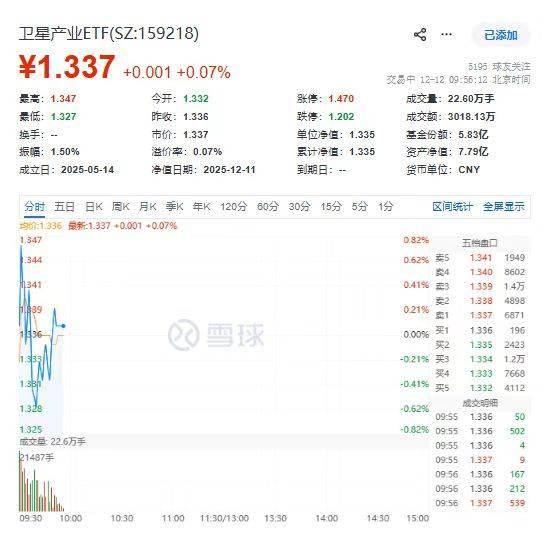
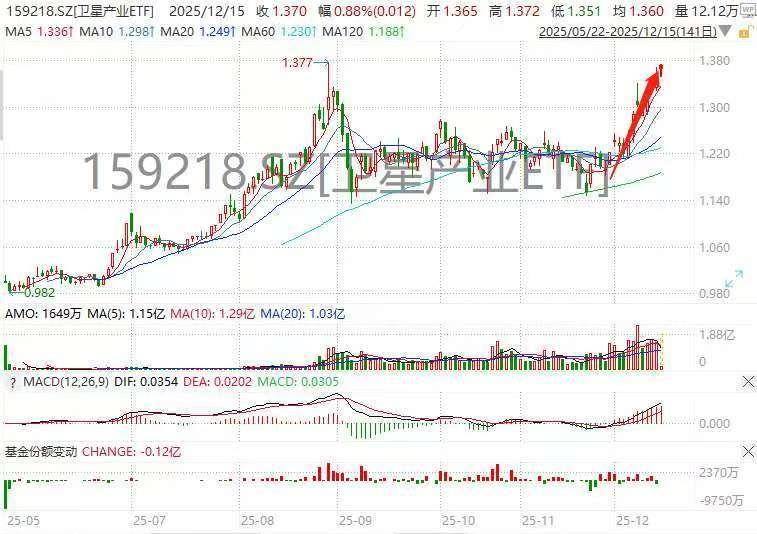
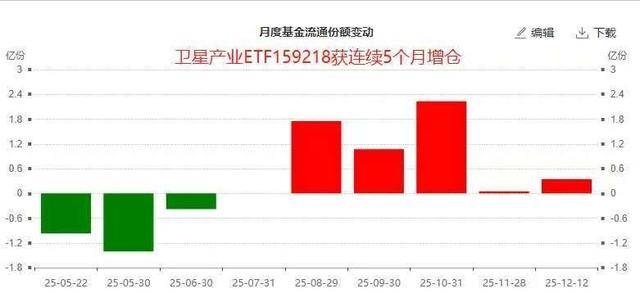
12月15日,卫星板块再度冲高。截至9时34分,表征板块的卫星产业ETF(159218)放量涨0.74%,盘中冲击四 连升逼近历史高点;成分股臻镭科技、航天电子、派克新材涨幅居前。 【从实验室突破到战略警觉:卫星产业迎来历史性转折】 全球空天经济正经历从商业探索到国家战略层面的深刻转型,这一趋势在资本市场得到明确反映。数据显 示,首只卫星产业ETF(159218)已实现连续5个月资金净流入,充分体现市场对卫星产业链长期价值的认 可。 【商业闭环加速构建】 产业链近期取得系列进展:长征系列火箭在12月9日连续成功发射,推动低轨卫星组网进入常态化阶段。同 时,可重复使用火箭技术稳步推进,预计三至五年内复用次数有望提升至5-10次,为产业链提供明确的降 本增效预期。 前沿技术方面,上海交通大学与国星宇航于12月11日签约共建国内首个"太空计算联合实验室",重点突破 星载智能计算、在轨数据处理等关键技术,标志着我国在"太空AI"领域迈出自主技术体系建设的关键步 伐。 【战略安全成为新焦点】 随着商业航天快速发展,太空的战略安全属性正被全球重新定义。军事专家近日在接受权威媒体采访时指 出,日本正加速发展反卫星、在轨服务 ...

从“太空AI”实验室到“太空珍珠港”警示:卫星产业站在历史拐点
Sou Hu Cai Jing· 2025-12-15 01:59
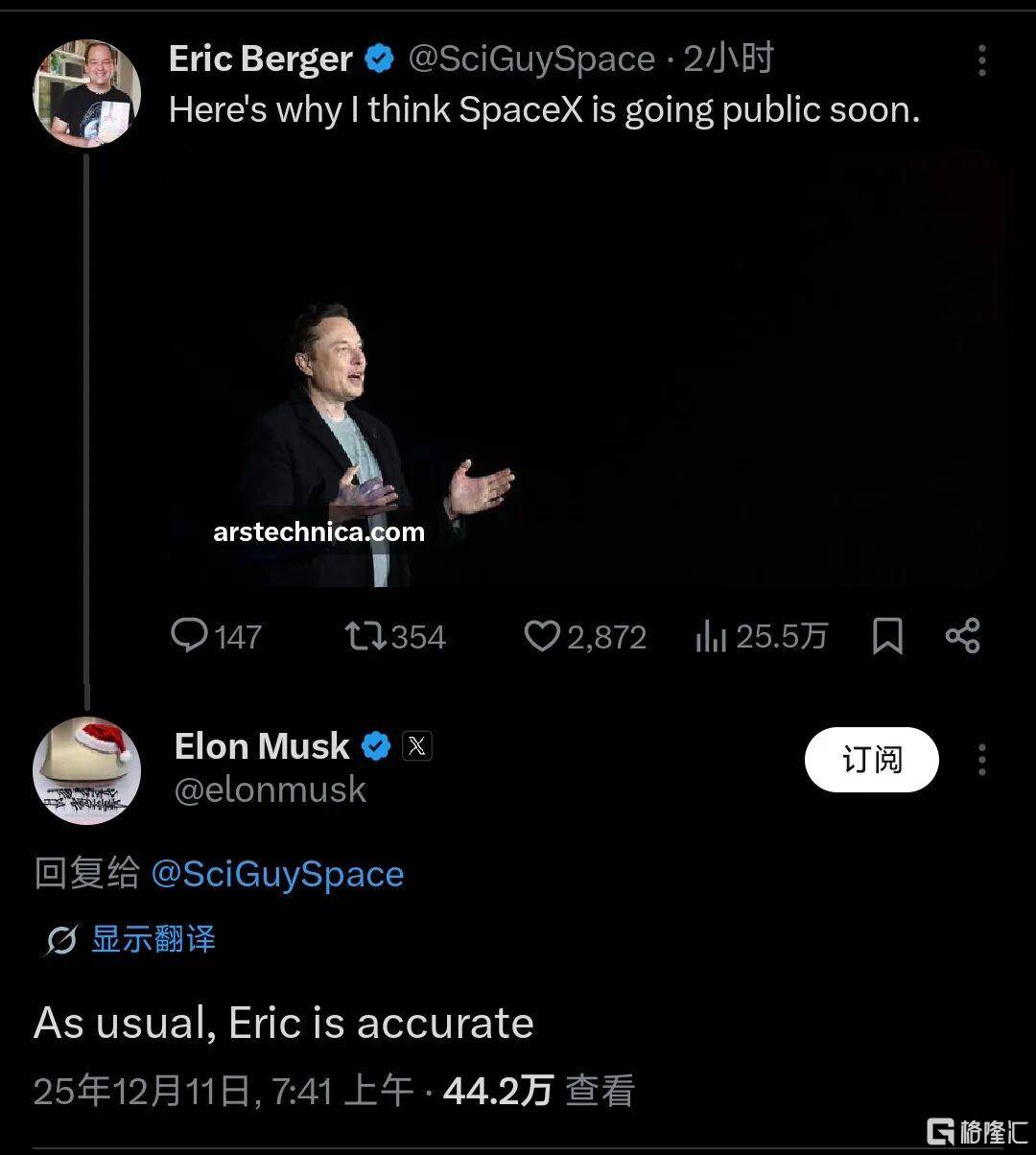
【商业闭环加速形成:从发射成本到太空算力】 近期,产业链各环节捷报频传。12月9日,长征六号改与长征四号乙火箭接连成功发射,将卫星互联网 低轨组网与遥感观测任务推向常态化。而实现成本革命的可重复使用火箭正稳步推进。业界专家分析认 为,即便明年成功实现技术验证,初期的复用次数预计在3次左右,三五年后才可能提升至5到10次。这 为产业链提供了明确的成本下降与产能爬坡预期。 全球范围内的"空天经济"热潮正从商业探索、技术竞赛,向更广阔的国家战略层面延伸。这一变化也清 晰的反应在二级市场。数据显示,截至12月12日,首只卫星产业ETF(159218)已实现连续5个月的资金净 流入,映射出资本市场对卫星产业链长期价值的共识。 综合来看,当前卫星产业正面临一个前所未有的复杂局面:一方面是商业化带来的成本降低与市场爆发 (如SpaceX的IPO),另一方面是大国竞争加剧带来的战略紧迫性。无论是应对潜在的"太空珍珠港", 还是抢占"太空AI"的科技制高点,建设强大、自主、完备的太空基础设施体系都已成为国家发展的必选 项。 在这一宏大背景下,卫星产业ETF(159218)所覆盖的,正是从火箭发射、卫星制造、地面设备到核心元 器 ...
SpaceX凭什么值1.5万亿美元?
Sou Hu Cai Jing· 2025-12-13 11:27
Core Viewpoint - SpaceX plans to go public with a valuation of $1.5 trillion, aiming to raise over $30 billion, driven by the need for capital to fund its ambitious projects and employee compensation [1][3][9]. Financial Overview - SpaceX's projected revenue for 2025 is $15.5 billion, which is insufficient compared to its anticipated expenses, including $17 billion for acquiring EchoStar's spectrum licenses and significant R&D costs for the Starship program [3][4]. - The company has a current cash flow that is positive but not sufficient for its extensive capital needs [3][6]. Employee Compensation and Stock Liquidity - As of September 2023, SpaceX has approximately 13,000 employees, with salaries ranging from $185,000 to $230,000, leading to an annual payroll of around $2.6 billion [6][7]. - Employees hold significant stock options, and the upcoming IPO is seen as a necessary avenue for them to liquidate their shares, as private market liquidity is limited [9][10]. Starlink Business Potential - Starlink is expected to contribute significantly to SpaceX's valuation, with projections of 7.65 million active subscribers by late 2025, potentially generating over $9.18 billion in revenue [11][20]. - The marginal cost of adding new Starlink users is nearly zero, allowing for high profit margins compared to traditional telecom companies [13][20]. Launch Services and Market Dominance - SpaceX is projected to dominate the global launch market, with plans for 150 launches in 2024 and potentially over 200 in 2025, capturing 90% of the market share [25][27]. - The company’s launch services, including contracts with NASA and the military, are expected to generate substantial revenue, further solidifying its market position [25][27]. Future Growth and Valuation - The potential for SpaceX's valuation to reach $1.5 trillion is based on optimistic growth projections, particularly from Starlink and the Starship program, which could revolutionize transportation and logistics [38][39]. - The company is seen as creating an incremental market with significant growth potential, contrasting with traditional industries like oil, which face stagnation [38]. Risks and Market Dynamics - The valuation of SpaceX is heavily tied to Elon Musk's leadership, and any issues with regulatory approvals or market conditions could impact its growth trajectory [40]. - The transition to a public company will subject SpaceX to the pressures of quarterly earnings reports, which may conflict with its long-term vision [40].
SpaceX IPO内部定价曝光:421美元一股,估值8000亿美元
Hua Er Jie Jian Wen· 2025-12-13 11:02
Group 1 - SpaceX has set its latest internal stock price at $421 per share, leading to a valuation of $800 billion, potentially creating the largest IPO in history [1][2] - The valuation has doubled in less than six months from $212 per share ($400 billion valuation), surpassing OpenAI's $500 billion valuation and reclaiming the title of the world's "unicorn" leader [2] - The company is preparing for a potential IPO in 2026, aiming to raise over $30 billion, with Elon Musk targeting a total valuation of $1.5 trillion [2] Group 2 - The upcoming funding will primarily focus on three core areas: supporting the "crazy launch frequency" of the Starship rocket, building a cutting-edge "space AI data center," and establishing a lunar base [3][5] - SpaceX conducts two tender offers annually, allowing employees and shareholders to cash out or increase their holdings, with the current pricing being part of this mechanism [3] - Despite optimistic market expectations, the CFO has emphasized that the timing and valuation of the IPO remain uncertain, and the company may decide against proceeding based on market conditions [3]
一度“濒死”的SpaceX,何以剑指史上最大IPO?
财联社· 2025-12-13 08:38
Core Viewpoint - SpaceX is planning to go public in mid-2026, aiming to raise over $30 billion, with a target valuation of $1.5 trillion, potentially making it the largest IPO in history [2][3]. Group 1: Financial Health and IPO Plans - SpaceX has maintained positive cash flow for years and conducts regular stock buybacks to provide liquidity to employees and investors [3]. - The anticipated fundraising will exceed Saudi Aramco's previous record of $29 billion, indicating strong investor confidence [3]. Group 2: Vision and Technological Innovation - Elon Musk's vision of Mars colonization drives SpaceX's operations, requiring significant resources and innovative technologies [6][7]. - The estimated cost to establish a Mars settlement is around $1 trillion, necessitating approximately 10,000 Starship launches [6]. Group 3: Cost Reduction and Competitive Advantage - SpaceX has significantly reduced rocket manufacturing costs through innovations like reusable rocket technology, achieving a marginal launch cost of nearly $15 million [9]. - The company has created a self-reinforcing business model, leveraging its low launch costs to build the largest satellite communication network, Starlink, which generates substantial cash flow for further projects [9].
太空算力,上海出手了
Xin Lang Cai Jing· 2025-12-12 14:14
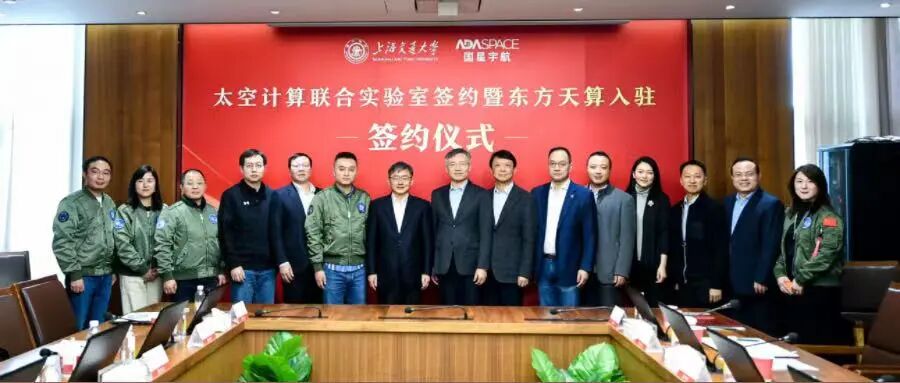
Core Viewpoint - The establishment of China's first space computing joint laboratory by Shanghai Jiao Tong University and Guoxing Aerospace marks a significant step in advancing the country's autonomous space computing capabilities, amidst a global race for space-based AI infrastructure [2][4][12]. Group 1: Ground Computing Limitations - Ground-based data centers are reaching their energy and scale limits, with global data center electricity consumption projected to reach 415 terawatt-hours in 2024, accounting for approximately 1.5% of total global electricity usage [2][12]. - The demand for computing power is expected to expand significantly, with predictions indicating that global computing capacity will increase by over 70 times in the next decade [2][12]. - Countries and companies are increasingly looking to space for new computing supply directions, leveraging natural advantages such as cold sources and abundant solar radiation [2][12]. Group 2: Collaboration Between Academia and Industry - On December 12, Shanghai Jiao Tong University and Guoxing Aerospace signed an agreement to establish the first domestic space computing joint laboratory, supported by the Shanghai Municipal Science and Technology Commission [4][14]. - The collaboration will focus on key areas such as the development of autonomous space computing chips, satellite robotics for in-orbit maintenance, and in-orbit additive manufacturing [6][16]. - The establishment of the joint laboratory and the industrial platform, Dongfang Tiancan Company, aims to bridge the gap between research and engineering applications, positioning Shanghai as a leader in the space computing sector [6][16]. Group 3: Technological Advancements - Guoxing Aerospace has achieved significant milestones in space AI, including the world's first deployment of a universal large model in orbit, as disclosed by academician Wang Jian at a conference [7][17]. - The development of China's space computing capabilities follows a clear "three-step" strategy, with key milestones achieved ahead of international events, including the launch of the first AI large model scientific satellite in September 2024 [9][19]. - By May 2025, Guoxing Aerospace successfully launched the world's first 5POPS-level in-orbit computing cluster, establishing itself as a global leader in this field [9][19]. Group 4: Conclusion on Space Computing Leadership - The collaboration between Shanghai Jiao Tong University and Guoxing Aerospace represents a shift from conceptual planning to practical implementation in the space computing arena, contrasting with the more theoretical approaches of international competitors [11][21]. - This partnership not only fills gaps in China's autonomous space computing landscape but also positions the country as a leading practitioner on the global stage [11][21]. - The future landscape of computing is set to be significantly influenced by China's advancements in space-based solutions, with ongoing developments accelerating the realization of these technologies [11][21].
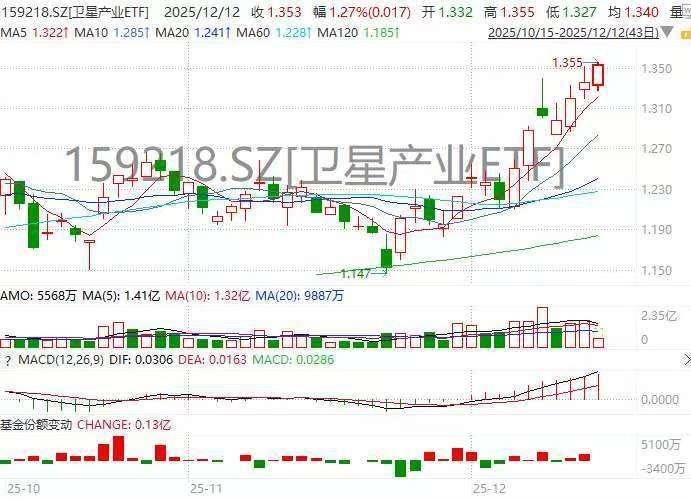
卫星产业ETF(159218)再发力涨超1.4%冲击四连阳!天银机电、西部超导、派克新材领衔
Sou Hu Cai Jing· 2025-12-12 02:37
风险提示:基金有风险,投资需谨慎。 分析指出,巨头资本化与前沿技术突破,共同构成了本轮卫星产业投资热的坚实底座。 当SpaceX的IPO 为行业树立起前所未有的价值标杆,当"太空AI"打开从千亿到万亿的崭新想象空间,当国内火箭与卫星 制造能力迈入"低成本、高频次"新阶段,卫星产业ETF(159218)作为一揽子投资这些核心趋势的金融产 品,其受到资金的持续追逐与重仓,便成为顺理成章的市场选择。 12月12日,卫星板块再走强。截至10时17分,表征板块的卫星产业ETF(159218)涨1.35%,一度涨1.42% 冲击四连阳;成分股天银机电、西部超导、派克新材涨幅居前。 ...

SpaceX史诗级IPO来袭!卫星产业ETF(159218)强势上攻冲击三连升!年内份额倍增领跑同类
Sou Hu Cai Jing· 2025-12-12 02:14
Group 1 - The satellite sector is experiencing a strong performance, with the satellite industry ETF (159218) showing a 0.07% increase and a trading volume of approximately 300 million CNY, leading its peers [1] - The ETF has seen a remarkable year-to-date share expansion of 438.88%, reaching a historical high [1] - Key developments driving the satellite sector include SpaceX's upcoming IPO valued at approximately 1.5 trillion CNY and significant advancements in "space AI" technologies [1] Group 2 - The narrative of upgrading from "space networking" to "space intelligence" positions the satellite industry ETF (159218) as a central channel for capital allocation in this promising future [2]