存储超级周期

Search documents
“订单排期到了明年” 存储超级周期下的众生相:谁在兑现 谁在挣扎
Zhong Guo Ji Jin Bao· 2026-01-31 23:42
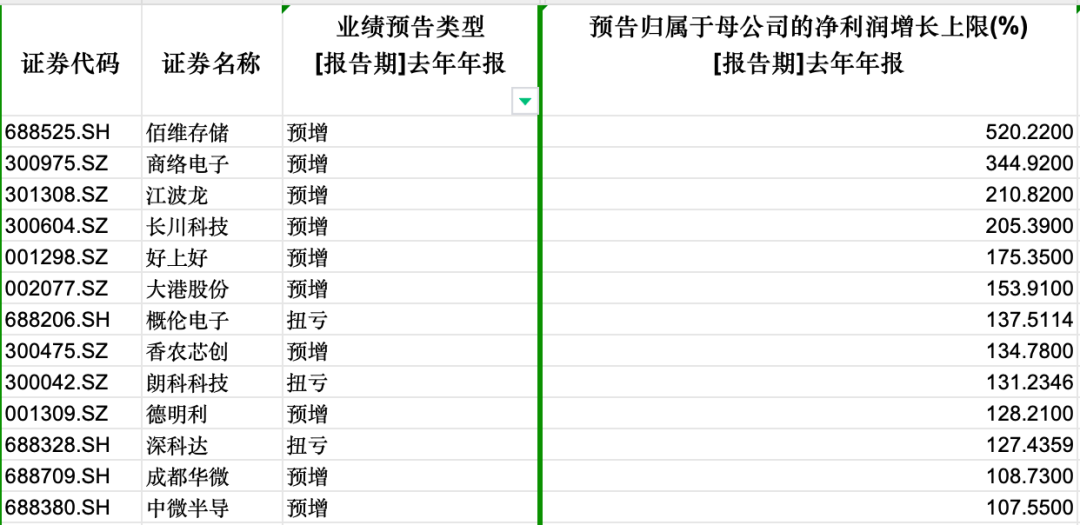
Core Viewpoint - The storage chip market is experiencing a "super cycle" driven by AI, leading to significant price increases and improved profitability for storage companies, while terminal manufacturers face pressure to raise prices or reduce specifications [1][3][7]. Group 1: Market Dynamics - The storage market is emerging from a low point, with many companies reporting substantial profit increases due to stabilizing prices driven by AI demand [1][2]. - As of January 29, 2026, 52 storage-related companies in the A-share market have issued performance forecasts for 2025, with 25 companies expecting profit increases, and 31 companies reporting year-on-year net profit growth [1][2]. - Notable profit increases include Bawei Storage with a projected growth of 520.22%, Shangluo Electronics at 344.92%, and Jiangbolong at 210.82% [2]. Group 2: Price Trends - Market research indicates that storage prices are expected to rise by 40% to 50% in Q1 2026 and by approximately 20% in Q2 2026, surpassing historical highs [3][4]. - Companies like Jiangbolong attribute their recovery to the stabilization of storage prices and increased demand from AI servers, leading to a supply-demand imbalance [2][5]. Group 3: Competitive Positioning - Storage manufacturers are shifting focus from consumer markets to enterprise-level markets, such as data centers and AI servers, where profit margins are higher due to lower price sensitivity [5][6]. - Companies are investing in technology and production capabilities to enhance their competitive edge, with Jiangbolong planning to raise 3.7 billion yuan for technology development and production expansion [6]. Group 4: Impact on Terminal Manufacturers - Terminal manufacturers are facing significant cost pressures due to rising component prices, leading to a projected 14.8% decrease in global laptop shipments in Q1 2026 [7][8]. - Major brands like Lenovo and Dell have begun raising prices on their products, with Lenovo increasing prices by 500 to 1500 yuan on mid-to-high-end models [8][9]. - The rising costs of memory components are impacting the profitability of smartphone manufacturers, with companies like Transsion Holdings reporting a 54.11% decline in net profit due to increased supply chain costs [9].


“产线的机器已经开足了马力,订单排期到了明年,连客户要货的电话都不敢接了,怕得罪人。”存储超级周期下的众生相:谁在兑现,谁在挣扎
Zhong Guo Ji Jin Bao· 2026-01-31 13:05
Core Insights - The storage chip market is experiencing a "super cycle" driven by AI, leading to significant price increases and improved profitability for storage companies, while terminal manufacturers face pressure to raise prices or reduce specifications [1][2][3] Group 1: Market Dynamics - The storage market is emerging from a low point, entering a new upward cycle, with 52 storage-related companies in A-shares reporting positive earnings forecasts for 2025, including 25 companies with expected profit growth [2] - Storage price increases are the primary factor behind the improved performance of these companies, with some reporting profit growth exceeding 100% [2] - Market research indicates that storage prices are expected to rise by 40% to 50% in Q1 2026 and by approximately 20% in Q2 2026, surpassing historical highs [3] Group 2: Competitive Positioning - Storage manufacturers are ramping up production to meet the surging demand from AI applications, with significant increases in memory requirements for AI servers compared to standard servers [4][5] - Companies are shifting focus from consumer markets to enterprise-level markets, where customers prioritize stability and reliability over price, allowing for better profit margins [5] - Companies like Jiangbolong are enhancing their capabilities through partnerships and new product launches, including a 37 billion yuan fundraising plan to invest in core technology and production processes [5][6] Group 3: Challenges for Terminal Manufacturers - Terminal manufacturers are facing significant cost pressures due to rising prices of components, including CPUs and storage, leading to a projected 14.8% decrease in global laptop shipments in Q1 2026 [7][8] - Major brands like Lenovo and Dell have begun to raise prices on their products, with increases ranging from 10% to 30%, while some brands are even canceling low-end models due to cost pressures [8][9] - The financial impact of rising component costs is evident, with companies like Transsion Holdings reporting a 54.11% decline in net profit due to increased supply chain costs [9][10]
HDD双寡头吃满“AI基建红利”!继希捷之后,西部数据也实现炸裂式增长,净利润激增296%
Sou Hu Cai Jing· 2026-01-30 00:43
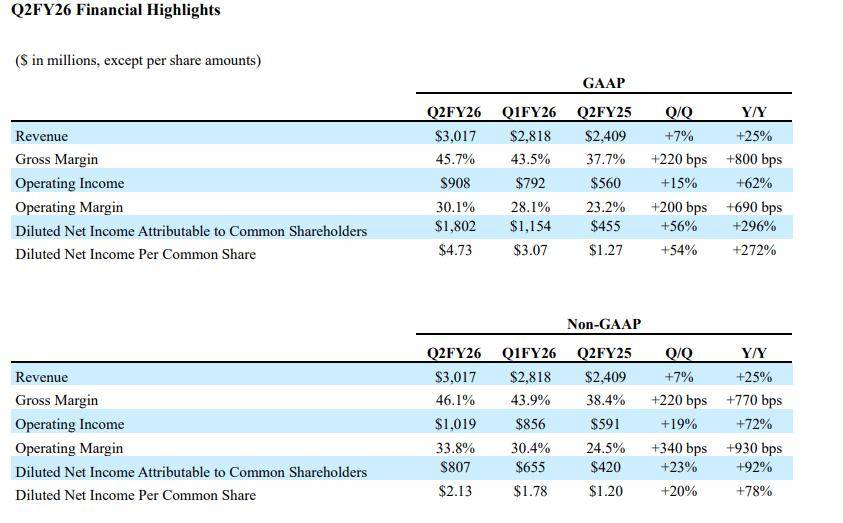
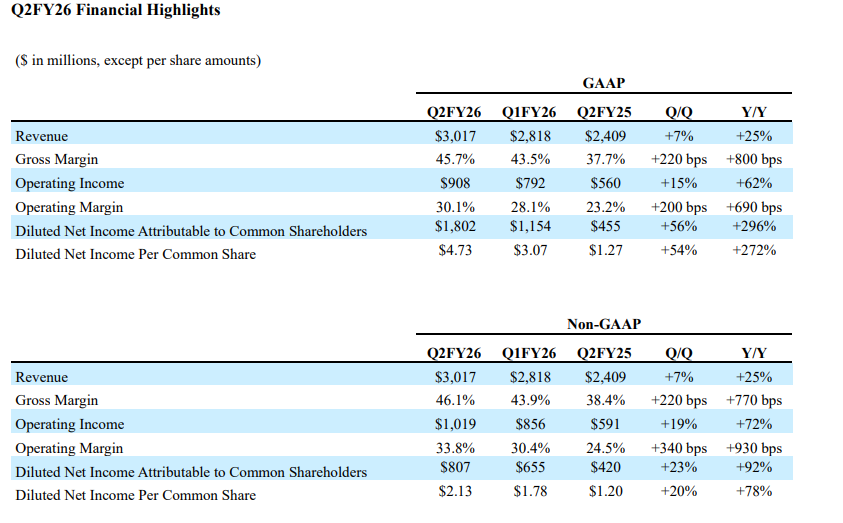
Core Viewpoint - Western Digital Corporation (WDC) reported strong quarterly results and future outlook, driven by unprecedented demand for high-capacity HDDs due to the AI data center boom, exceeding Wall Street expectations [1][2][6]. Financial Performance - For Q2 FY26, Western Digital's total revenue increased by 25% year-over-year to $3.02 billion, surpassing analyst expectations of approximately $2.95 billion [2][3]. - The adjusted gross margin under non-GAAP was 46.1%, exceeding the expected 44.5% [2]. - Free cash flow was approximately $653 million, also above the forecast of $637 million [2]. - The adjusted EPS was $2.13, higher than the anticipated $1.93, with net profit increasing by 92% year-over-year to about $807 million [2][3]. Market Outlook - The company expects Q3 FY26 diluted EPS to range between $2.15 and $2.45, significantly above the consensus estimate of $1.99 [3]. - Total revenue for the upcoming quarter is projected to be between $3.1 billion and $3.3 billion, again exceeding analyst expectations [3]. Industry Context - The demand for enterprise-level high-capacity HDDs and SSDs is being driven by the rapid expansion of AI data centers, with major tech companies investing heavily in AI infrastructure [6][11]. - Western Digital, along with Seagate and SanDisk, has seen stock prices rise significantly, with Western Digital's stock increasing by 285% in 2025 and 60% since 2026 [1][6]. - The storage industry is experiencing a "super cycle," with a strong focus on nearline HDDs and enterprise SSDs to meet the growing storage needs of AI applications [7][11]. Supply Strategy - Western Digital and Seagate are not rushing to increase HDD production capacity, adhering to a "supply discipline" to avoid past cycles of overproduction and price wars [12][13]. - The company aims to enhance output through product structure and technology upgrades rather than expanding capacity aggressively [12].


HDD双寡头吃满“AI基建红利”! 继希捷之后 西部数据(WDC.US)也实现炸裂式增长 净利润激增296%
智通财经网· 2026-01-30 00:07
| | | GAAP | | | | --- | --- | --- | --- | --- | | | Q2FY26 Q1FY26 | Q2FY25 | 0/0 | Y/Y | | Revenue | $3,017 $2,818 | $2.409 | +7% | +25% | | Gross Margin | 45.7% 43.5% | 37.7% | +220 bps | +800 bps | | Operating Income | $908 $792 | $560 | +15% | +62% | | Operating Margin | 30.1% 28.1% | 23.2% | +200 bps | +690 bps | | Diluted Net Income Attributable to Common Shareholders | $1,802 $1,154 | $455 | +56% | +296% | | Diluted Net Income Per Common Share | $4.73 $3.07 | $1.27 | +54% | +272% | 智通财经APP获悉,与闪迪、希捷共同 ...
?铠侠股价疯涨1200%之后,存储老兵奉命驾驭超级周期! 力争将eSSD抬至AI算力时代的C位
Zhi Tong Cai Jing· 2026-01-29 07:28
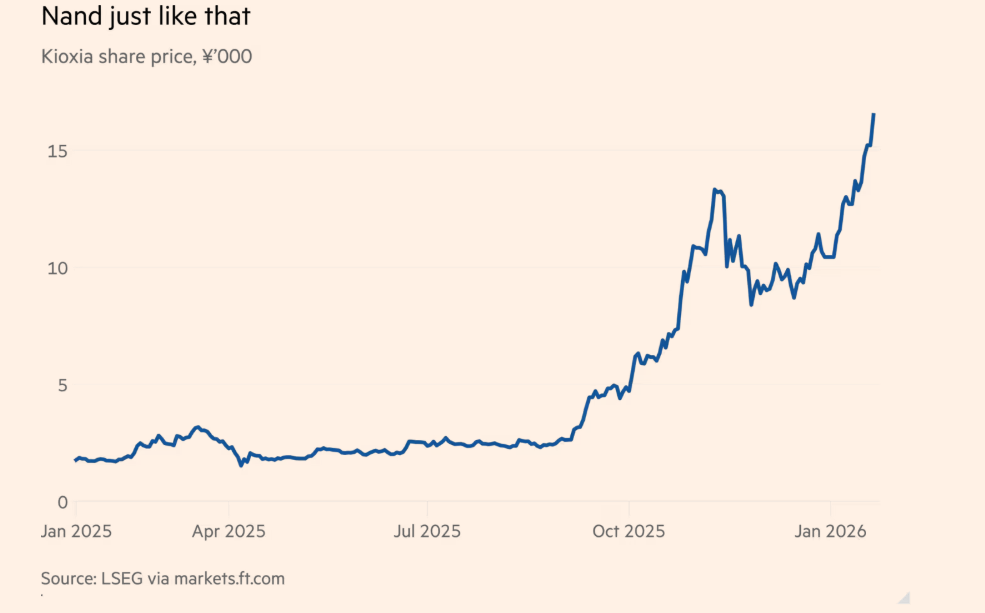
(原标题:?铠侠股价疯涨1200%之后,存储老兵奉命驾驭超级周期! 力争将eSSD抬至AI算力时代的C 位) 智通财经APP获悉,总部位于日本的全球NAND闪存领军者铠侠(Kioxia Holdings Corp.)提拔在存储领域 深耕多年的资深老兵——即执行副总裁大田博夫出任首席执行官兼总裁,此举旨在NAND闪存从周期品 一跃成为AI算力基础设施领域的最核心部件之际,加速扩大其在蓬勃发展的存储芯片市场中的市场份 额。在当前AI推理端算力洪流所带来的近乎"无止境"存储需求的宏大增长背景下,NAND闪存领军者铠 侠所主导的企业级数据中心SSD(即eSSD)可谓爆棚成为全球AI算力投资主题的最火热主线之一。 据了解,现年63岁的大田将接替现年70岁的早坂信夫,后者将出任铠侠高级执行顾问。这家苹果智能手 机iPhone的最核心存储芯片供应商在周四的一份声明中表示,此次领导层变更将在6月举行的年度股东 大会获得股东批准后正式生效。 在刚刚过去的2025年,存储芯片股票以及存储类高端产品股票毋庸置疑是全球股票市场最火热的投资主 题之一,在2026年开年同样如此——比如数据中心企业级SSD存储组件领军者闪迪(SNDK.U ...
铠侠股价疯涨1200%之后,存储老兵奉命驾驭超级周期! 力争将eSSD抬至AI算力时代的C位
Zhi Tong Cai Jing· 2026-01-29 07:16
总部位于日本的全球NAND闪存领军者铠侠(Kioxia Holdings Corp.)提拔在存储领域深耕多年的资深老兵——即执行副总裁大田博夫出任首席 执行官兼总裁,此举旨在NAND闪存从周期品一跃成为AI算力基础设施领域的最核心部件之际,加速扩大其在蓬勃发展的存储芯片市场中的 市场份额。在当前AI推理端算力洪流所带来的近乎"无止境"存储需求的宏大增长背景下,NAND闪存领军者铠侠所主导的企业级数据中心 SSD(即eSSD)可谓爆棚成为全球AI算力投资主题的最火热主线之一。 据了解,现年63岁的大田将接替现年70岁的早坂信夫,后者将出任铠侠高级执行顾问。这家苹果智能手机iPhone的最核心存储芯片供应商在 周四的一份声明中表示,此次领导层变更将在6月举行的年度股东大会获得股东批准后正式生效。 在刚刚过去的2025年,存储芯片股票以及存储类高端产品股票毋庸置疑是全球股票市场最火热的投资主题之一,在2026年开年同样如此—— 比如数据中心企业级SSD存储组件领军者闪迪(SNDK.US)2026年以来累计涨幅已经超过122%,闪迪2025年全年涨幅更是高达580%。即便经 历了涨势如虹般的2025年超级牛市轨迹,以 ...
铠侠股价疯涨1200%之后,存储老兵奉命驾驭超级周期! 力争将eSSD抬至AI算力时代的C位
智通财经网· 2026-01-29 07:13
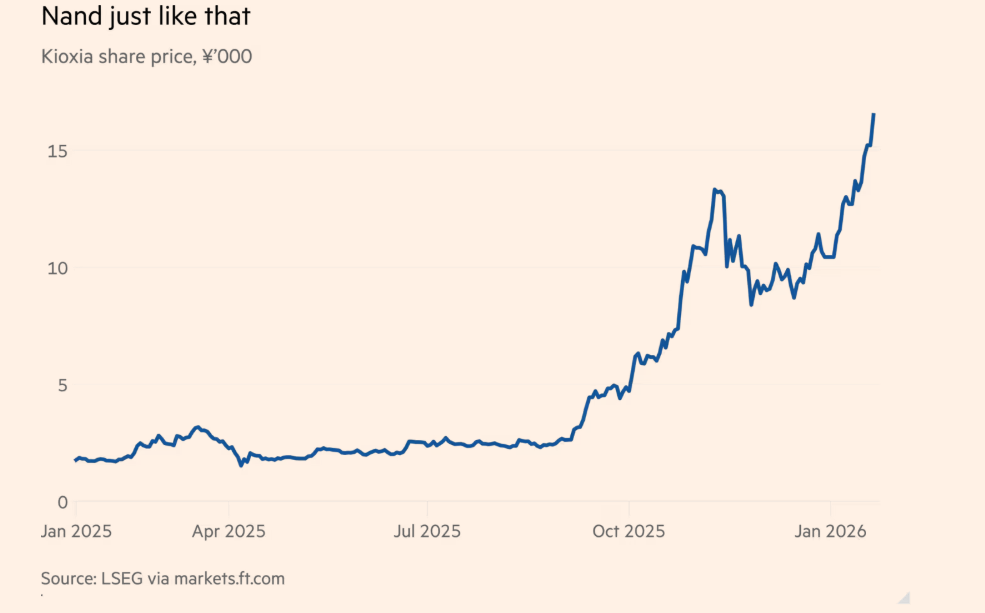
智通财经APP获悉,总部位于日本的全球NAND闪存领军者铠侠(Kioxia Holdings Corp.)提拔在存储领域深耕多年的资深老兵——即执行副总 裁大田博夫出任首席执行官兼总裁,此举旨在NAND闪存从周期品一跃成为AI算力基础设施领域的最核心部件之际,加速扩大其在蓬勃发展 的存储芯片市场中的市场份额。在当前AI推理端算力洪流所带来的近乎"无止境"存储需求的宏大增长背景下,NAND闪存领军者铠侠所主导 的企业级数据中心SSD(即eSSD)可谓爆棚成为全球AI算力投资主题的最火热主线之一。 据了解,现年63岁的大田将接替现年70岁的早坂信夫,后者将出任铠侠高级执行顾问。这家苹果智能手机iPhone的最核心存储芯片供应商在 周四的一份声明中表示,此次领导层变更将在6月举行的年度股东大会获得股东批准后正式生效。 在刚刚过去的2025年,存储芯片股票以及存储类高端产品股票毋庸置疑是全球股票市场最火热的投资主题之一,在2026年开年同样如此—— 比如数据中心企业级SSD存储组件领军者闪迪(SNDK.US)2026年以来累计涨幅已经超过122%,闪迪2025年全年涨幅更是高达580%。即便经 历了涨势如虹般的202 ...
HBM定价权在手!SK海力士Q4营收、利润双双刷新纪录
智通财经网· 2026-01-28 10:17
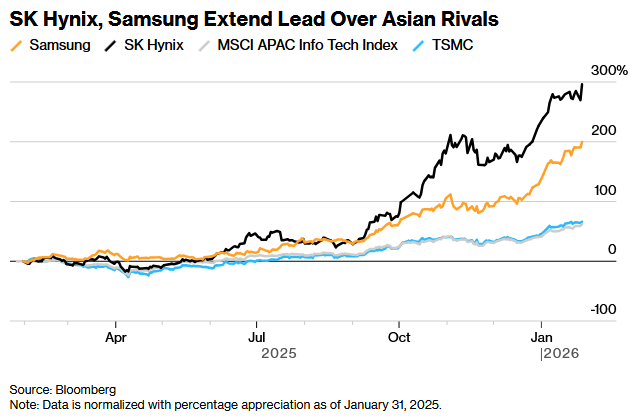
SK海力士还披露计划在下月注销约价值12.24万亿韩元(约合86亿美元)的库存股,作为提高股东回报的 更广泛努力的一部分。该公司重申正在考虑在美国上市,但尚未就此做出决定。该公司将于周四举行财 报电话会议。另一家存储巨头三星也将于周四公布完整的2025年第四季度业绩。 智通财经APP获悉,得益于人工智能(AI)领域持续强劲的需求同时推高了先进和传统存储芯片的价格, 韩国存储芯片巨头SK海力士公布了创纪录的季度营收和利润。数据显示,SK海力士2025年第四季度营 收同比增长66%至32.827万亿韩元,好于分析师共识预期的32.132万亿韩元;营业利润同比激增137%,至 创纪录的19.2万亿韩元,且超过分析师共识预期的17.7万亿韩元。 SK海力士在英伟达(NVDA.US)等公司设计的AI芯片组所需的高带宽内存(HBM)领域成功建立了令人羡 慕的领先优势,占据了HBM市场61%的份额。SK海力士表示:"HBM营收同比增长逾一倍,为公司在 去年的创纪录业绩做出了重大贡献。" 此外,存储芯片行业产能向高端存储产品倾斜(如HBM)挤压了传统存储产品的产能,供应短缺推高了服 务器、个人电脑和移动设备中使用的通用DRA ...
HDD需求狂飙 “存储超级周期”叙事再强化! 希捷(STX.US)业绩全线超预期 高呼2026年产能售罄
智通财经网· 2026-01-28 01:54
智通财经APP获悉,与闪迪、西部数据共同位列美国三大存储产品领军势力的希捷科技(STX.US)周二美股收盘后公布季度业绩 以及未来展望,数据显示出全球科技企业对于高性能近线HDD与企业级数据中心SSD近乎"无止境"炸裂式需求推动之下,这家 存储巨头季度业绩与业绩展望指引均全线超出华尔街分析师预期。希捷的这份全线超预期式强劲增长业绩,可谓全面强化三大 存储芯片原厂——三星、SK海力士与美光科技,以及西部数据和闪迪等存储产品巨头们强势领衔的所谓"存储超级周期"繁荣增 长叙事。 市场最为聚焦的业绩展望方面,希捷科技管理层给出的2026财年第三财季的营收和利润均显著高于华尔街分析师一致预期,全 面凸显出随着企业加速扩大人工智能应用规模带来AI算力需求指数级扩张,其企业级HDD与SSD高性能数据存储设备需求持续 强劲。 包括Meta、微软以及谷歌在内的全球最大规模科技巨头们正愈发激进向AI数据中心以及密切相关联的AI基础设施投资领域数万 亿美元规模,用于训练和高效率运行超大参数大语言模型(LMM)。这种AI算力需求持续井喷式扩张所带来的堪称无止境存储需 求激增,正在史无前例地惠及西部数据、希捷以及闪迪等传统存储型硬件供 ...
2家半导体公司部分芯片涨价,机构称本轮存储超级周期至少延续至2027年(附概念股)
Zhi Tong Cai Jing· 2026-01-28 00:35
Group 1 - Two semiconductor companies, Zhongwei Semiconductor and Guokewi, have announced price increases for their chip products due to tight supply and rising costs, with price adjustments ranging from 15% to 80% depending on the product [1] - The price surge in storage chips is primarily driven by the explosive demand for AI servers, leading to a structural shortage in traditional consumer electronics and industrial control chip supplies [1] - TrendForce reports that DDR5 DRAM chip prices have increased by 314% year-on-year in Q4, with expectations of a further 55% to 60% rise in traditional DRAM contract prices in the current quarter [2][3] Group 2 - Analysts predict that the current storage supercycle will last until at least 2027, with significant new supply not expected until early 2028, suggesting strong demand and tight supply conditions will persist [3] - Major companies like Samsung and SK Hynix plan to raise server DRAM prices by 60% to 70% in Q1 2026, indicating a trend of price increases across the semiconductor industry [2][3] - Companies such as SMIC and Hua Hong Semiconductor reported revenue growth, with SMIC achieving $2.382 billion in Q3, a 9.7% year-on-year increase, and Hua Hong Semiconductor reaching $635.2 million, a 20.7% increase [4]