
带量采购

Search documents
【私募调研记录】彤源投资调研佩蒂股份、三友医疗
Zheng Quan Zhi Xing· 2025-08-28 00:12
Group 1: Petty Co. (佩蒂股份) - Petty Co. has launched baking grain products under the Jueyan brand, aligning with its brand positioning [1] - The company plans to establish a high-end brand at its New Zealand factory, targeting both domestic and international markets [1] - In Q2, the gross profit margin increased due to cost advantages and economies of scale from the Southeast Asia factory, with expectations for stable growth throughout the year [1] - The online sales channel is significant, primarily driven by e-commerce platforms, with trends showing growth in both mid-high and mid-low end pet food consumption [1] - Sales expense ratio remains stable, although there are fluctuations due to promotional activities [1] - The Southeast Asia factory has high capacity utilization, with plans to increase pet snack production capacity by approximately 5,000 tons by the end of next year [1] Group 2: Sanyou Medical (三友医疗) - In the first half of 2025, Sanyou Medical achieved revenue of 249.76 million yuan, a year-on-year increase of 17.77%, and a net profit of 36.60 million yuan, up 2,083.64% [2] - The company’s market share has risen due to the impact of centralized procurement and medical insurance policies [2] - The revenue from the Waterwood Tianpeng segment reached 73.99 million yuan, growing by 64.80%, while Implanet's overseas revenue was 580.90 thousand euros, up 41.10%, with the U.S. market growing by 444% [2] - Domestic sales of ultrasonic bone knives exceeded 42 million yuan, with a growth rate of over 50% [2] - Multiple products have been approved for market launch, and the company is advancing its layout in sports medicine, AI, and surgical robotics [2] - The company has implemented its first equity incentive plan, focusing on incentivizing sales, R&D, and management personnel [2]

威高血净: 山东威高血液净化制品股份有限公司2025年半年度报告
Zheng Quan Zhi Xing· 2025-08-27 16:31
Core Viewpoint - Shandong Weigao Blood Purification Products Co., Ltd. reported a significant increase in revenue and net profit for the first half of 2025, reflecting strong growth in the blood purification industry driven by favorable government policies and increasing healthcare awareness among the population [1][2]. Company Overview and Financial Indicators - The company achieved an operating income of approximately 1.76 billion yuan, representing an 8.52% increase compared to the same period last year [2]. - The total profit reached approximately 264.16 million yuan, a 10.89% increase year-on-year [2]. - The net profit attributable to shareholders was approximately 220.24 million yuan, marking a 10.11% increase from the previous year [2]. - The company's net assets increased by 21.45% to approximately 6.80 billion yuan, and total assets grew by 16.11% to approximately 8.12 billion yuan [2]. Industry Context - The blood purification industry is characterized by high knowledge intensity and capital requirements, making it a crucial part of China's healthcare system [3]. - The treatment penetration rate for End-Stage Renal Disease (ESRD) patients in China is expected to rise significantly, with projections indicating that by 2030, the treatment rates for blood dialysis and peritoneal dialysis will reach 54.29% and 7.53%, respectively [4]. - Recent policies promoting bulk purchasing in the medical device sector are expected to increase industry concentration, leading to the exit of smaller companies and a stronger market position for larger firms [4]. Business Operations - The company specializes in the research, production, and sales of blood purification medical products, including blood dialysis machines and related consumables, and is one of the most comprehensive manufacturers in this field in China [5]. - The company has developed key technologies in blood dialysis, achieving performance metrics that meet or exceed those of leading international brands [5]. - The sales strategy combines direct sales and a robust distribution network, covering over 6,000 hospitals and dialysis centers across China [6][7]. Management and Development - The company has invested approximately 70.18 million yuan in research and development, accounting for 3.98% of its operating income, and has obtained multiple patents to enhance its technological edge [9][10]. - The management has focused on improving compliance, operational management, and digital transformation to enhance efficiency and risk management [8][9]. - The company aims to expand its market presence both domestically and internationally, with a strategic focus on becoming a leading global provider of blood purification solutions [10][11].
国药控股(01099) - 海外监管公告
2025-08-25 10:07
香港交易及結算所有限公司及香港聯合交易所有限公司對本公告之內容概不負責,對其準確性或完整性 亦不發表任何聲明,並明確表示,概不就因本公告全部或任何部分內容而產生或因倚賴該等內容而引致 之任何損失承擔任何責任。 中國,上海 2025 年 8 月 25 日 於本公告日期,執行董事為連萬勇先生及孫京林先生;非執行董事為趙炳祥先生、陳啟宇先生、祖敬先 生、邢永剛先生、陳玉卿先生、文德鏞先生及馮蓉麗女士;獨立非執行董事為李培育先生、吳德龍先生、 俞衛鋒先生、石晟昊先生及陳威如先生。 * 本公司以其中文名稱及英文名稱「 Sinopharm Group Co. Ltd. 」根據香港公司條例註冊為非香港公司。 海外監管公告 国药控股股份有限公司 本公告乃根據香港聯合交易所有限公司證券上市規則第 13.10B 條作出。 公司债券中期报告 以下公告的中文原稿將由國藥控股股份有限公司於 2025 年 8 月 25 日於上海證券交易所網站 (http://www.sse.com.cn)發佈,僅供參閲。 承董事會命 國藥控股股份有限公司 董事長 趙炳祥 (2025 年) 二〇二五年八月 0 国药控股股份有限公司公司债券中期报告(202 ...
惠泰医疗: 2025年半年度报告
Zheng Quan Zhi Xing· 2025-08-21 16:59
Core Viewpoint - Shenzhen Huatai Medical Devices Co., Ltd. reported significant growth in revenue and profit for the first half of 2025, driven by advancements in its product offerings and market expansion in the medical device sector [6][8]. Company Overview and Financial Indicators - The company achieved a revenue of approximately RMB 1.21 billion, representing a 21.26% increase compared to the same period last year [6]. - The total profit reached approximately RMB 479.34 million, marking a 23.46% increase year-on-year [6]. - The net profit attributable to shareholders was approximately RMB 425.16 million, reflecting a 24.11% increase compared to the previous year [6]. - The company's net assets increased to approximately RMB 2.79 billion, an 11.05% rise from the end of the previous year [6]. Industry Position and Main Business - The company operates in the specialized equipment manufacturing industry, specifically in the medical instruments and devices sector [8]. - The domestic electrophysiology market is gradually closing the gap with foreign brands, with Huatai Medical emerging as a key player alongside established foreign companies like Johnson & Johnson and Abbott [8]. - The company has made significant strides in the atrial fibrillation treatment market, breaking the monopoly of foreign brands with its newly registered magnetic positioning pressure sensing ablation catheter [8][9]. Product Development and Market Expansion - The company has a comprehensive product line in electrophysiology and interventional medical devices, focusing on coronary access and cardiac electrophysiology [8]. - The PFA (Pulsed Field Ablation) technology has gained attention for its effectiveness and safety in treating atrial fibrillation, with over 800 procedures completed using this technology [14]. - The coronary intervention device market is shifting towards domestic brands, with Huatai Medical's products gaining significant market share in areas like microcatheters and contrast kits [8][9]. Research and Development - The company has consistently increased its R&D investment, with expenditures reaching approximately RMB 29.05 million in the first half of 2025, accounting for 12.95% of its revenue [18]. - Recent product registrations include high-density mapping catheters and pressure sensing RF ablation catheters, enhancing the company's competitive edge in the electrophysiology field [18]. Market Strategy and Sales Performance - The company has expanded its market coverage, with a notable increase in the number of hospitals using its coronary products, which grew by over 18% year-on-year [15]. - Huatai Medical has actively engaged in brand-building activities, conducting over 80 promotional events across various provinces, enhancing its market presence [16].


从“ 招鲜”到“武器库” 振东制药:以创业创新实现药企的“新陈代谢”
Quan Jing Wang· 2025-08-14 08:07
Core Viewpoint - The pharmaceutical industry in China is facing a collective crisis, with companies like Zhendong Pharmaceutical needing to adapt and innovate to survive in a changing market landscape [1] Company Overview - Zhendong Pharmaceutical, established in 1995, has evolved from a traditional Chinese medicine company to a comprehensive pharmaceutical enterprise, engaging in various stages from cultivation to sales [2] - The company became the first in Shanxi Province to list on the Shenzhen Stock Exchange's Growth Enterprise Market in January 2011, marking a significant milestone in its growth trajectory [2] Historical Performance - The company's flagship product, "Yanshu Injection," generated nearly 300 million yuan in revenue in 2007, accounting for over 80% of total revenue [2] - By 2016, this product still contributed approximately 700 million yuan, representing 21% of the company's total revenue [2] Challenges Faced - The expiration of patents in 2017 and stricter regulations on auxiliary drugs significantly reduced the market space for Zhendong's traditional products, marking a turning point for the company [3] - The company's annual report for 2024 indicated that the decline in performance was partly due to price reductions from centralized procurement policies [4] Strategic Responses - Zhendong Pharmaceutical acquired Kangyuan Pharmaceutical in 2016, enhancing its portfolio with OTC products and creating synergies with existing offerings [3] - The company has shifted its focus from traditional marketing to a new consumer-oriented approach, establishing a four-pronged marketing system that includes clinical, OTC, grassroots, and e-commerce channels [6] Innovation and R&D - The company has increased its R&D investment to 351 million yuan in 2024, maintaining a commitment to keep R&D spending above 10% of revenue [8] - Zhendong is actively developing multiple innovative drug pipelines, including a new generation of live biotherapeutics for bacterial vaginosis treatment, expected to be submitted for approval in 2025 [8] Future Outlook - The transition from relying on a single product to building a diverse product portfolio is seen as a sign of maturity and stability for Zhendong Pharmaceutical [9]

美国药价,为何是全球最高的?
Hu Xiu· 2025-07-24 06:35
Core Viewpoint - The article discusses the complexities and challenges of drug pricing in the United States, highlighting the significant price disparities compared to Europe and the underlying factors contributing to these differences. Group 1: Trump's Executive Order and Its Implications - Trump's executive order aimed to reduce drug prices by 30%-80%, but lacked a clear implementation plan, leading to confusion and a rise in pharmaceutical stock prices instead of a decline [2][4][5]. - The historical context reveals that U.S. law prohibits the government from negotiating drug prices directly with pharmaceutical companies, rooted in the philosophy of maintaining a separation between government and business [6][10][13]. Group 2: Drug Pricing Mechanisms - Drug prices in the U.S. are significantly higher than in other developed countries, with some medications costing 5-10 times more [15][52]. - The pricing mechanism involves multiple channels, including government insurance and commercial insurance, each with different pricing strategies and negotiation dynamics [29][30]. Group 3: Global Drug Price Comparisons - In Europe, drug prices are generally lower, with examples showing that the same medication can cost around $500 in Europe compared to $1000 in the U.S. [52][53]. - The article notes that while some rare disease medications are still expensive, the overall trend shows that U.S. drug prices are often higher due to various market dynamics and negotiation practices [56][58]. Group 4: Industry Dynamics and Future Considerations - The pharmaceutical industry is characterized by a complex interplay of innovation, pricing strategies, and regulatory frameworks, which influence the development and pricing of new drugs [47][68]. - The introduction of negotiation mechanisms in the U.S. under the IRA Act reflects a shift towards more competitive pricing, similar to practices seen in other countries [67][68].

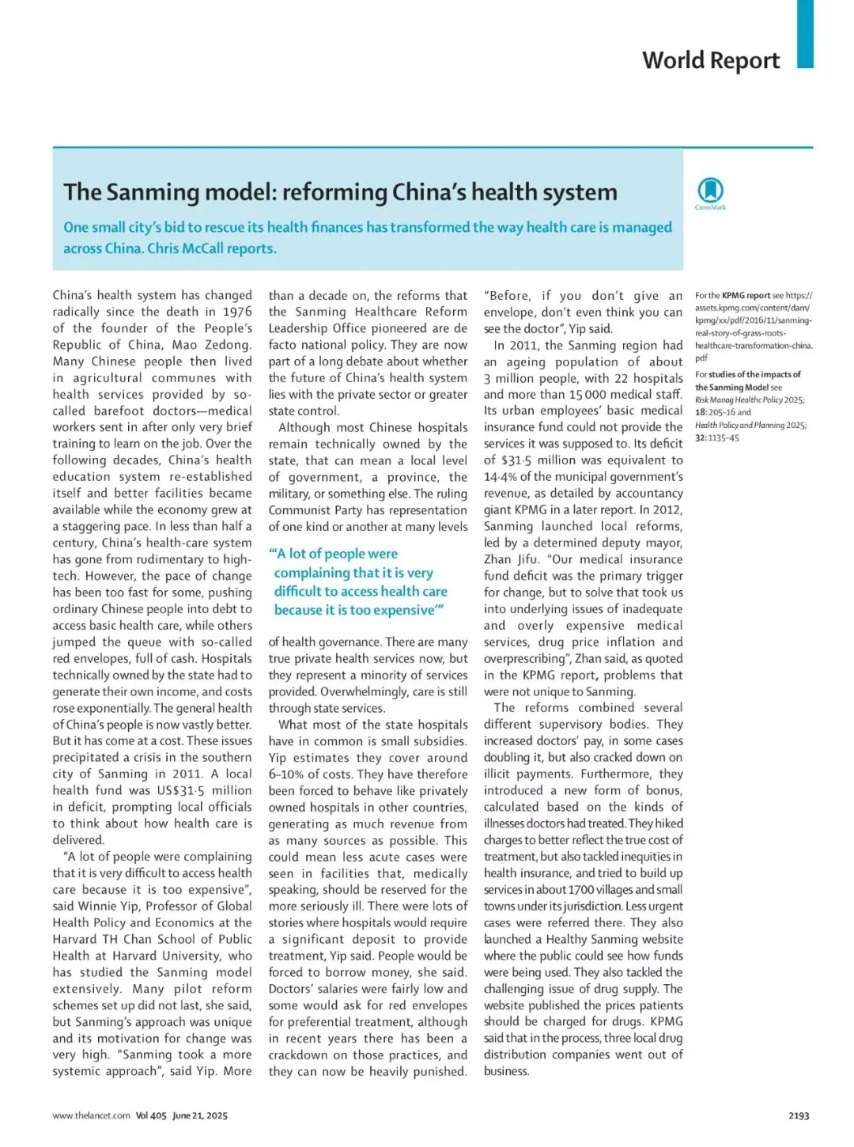
柳叶刀:三明模式正在引领中国卫生体系改革进程
Di Yi Cai Jing· 2025-07-11 00:35
Core Insights - The Sanming model serves as a successful example of healthcare reform in China, emphasizing transparency, restructuring the drug supply chain, and reforming the health insurance distribution mechanism, thus providing a "Chinese solution" for global healthcare reform [1][3][24] Healthcare System Background - China's healthcare system has evolved significantly since 1976, transitioning from rudimentary services to advanced healthcare, but rapid changes have led to increased costs and accessibility issues for ordinary citizens [4][6] - In 2011, Sanming faced a healthcare crisis with a local health fund deficit of $31.5 million, equivalent to 14.4% of the municipal government's revenue, prompting urgent reforms [10][21] Sanming Model Reforms - The Sanming reforms, initiated in 2012, aimed to address the healthcare fund deficit and underlying issues such as high medical costs and drug price inflation, leading to a systemic approach to healthcare delivery [10][11][22] - Key reforms included increasing doctors' salaries, implementing a new bonus system based on treated illnesses, and enhancing transparency through the "Healthy Sanming" website, which disclosed fund usage [11][24] Financial Outcomes - By 2015, the Sanming healthcare fund had turned from a deficit into a surplus of $19.5 million, demonstrating the effectiveness of the reforms [13][24] - The Chinese government has since recognized the Sanming model, encouraging other regions to adopt similar policies, particularly in health insurance innovation [13][24] Drug Supply Chain Transformation - The Sanming model introduced a two-invoice system for drug procurement, significantly reducing drug costs and eliminating excessive mark-ups in the supply chain, which has been replicated nationwide [15][25] - Between 2018 and 2022, the prices of 294 key drugs in China decreased by an average of 53% due to these reforms, while their quality improved [16][25] Broader Implications and Challenges - While the Sanming model has shown success in controlling costs and improving healthcare access, its applicability in larger cities like Shanghai and Beijing remains limited due to different healthcare dynamics [18][26] - Experts suggest that while some elements of the Sanming model can be adapted for densely populated areas, the overall model may not be easily transferable to all regions of China [19][20][26]
浙江震元: 浙江震元股份有限公司2024年向特定对象发行股票募集说明书(修订稿)
Zheng Quan Zhi Xing· 2025-07-02 16:36
Group 1 - The company plans to issue A-shares to specific investors, pending approval from the Shenzhen Stock Exchange and the China Securities Regulatory Commission (CSRC) [2][3][4] - The final issuance price will be no less than 85% of the average trading price of the company's shares over the 20 trading days prior to the pricing date [3][4][5] - The total number of shares to be issued will not exceed 25% of the company's total share capital, amounting to a maximum of 83,530,821 shares [5][6] Group 2 - The funds raised will be allocated to specific projects, including the construction of a production base for amino acids and an enhancement project for raw materials [6][7] - The company may adjust the investment priorities and amounts based on the actual net amount raised and project urgency if the net proceeds are less than planned [6][7] - The company has committed to using the raised funds in compliance with relevant regulations and will replace any pre-invested funds once the raised funds are available [6][7] Group 3 - The company operates in the pharmaceutical industry, which is subject to strict regulatory oversight from various government bodies, including the National Medical Products Administration and the National Healthcare Security Administration [19][20] - The pharmaceutical industry is characterized by significant competition and regulatory challenges, including drug approval processes and pricing regulations [19][20][21] - The company’s business encompasses pharmaceutical distribution, manufacturing, and health services, with a focus on both commercial and industrial sectors [19][20]

人民同泰: 致同会计师事务所关于公司2024年年度报告的信息披露监管问询函的回复
Zheng Quan Zhi Xing· 2025-07-01 16:30
Core Viewpoint - The company, Harbin Pharmaceutical Group People's Tongtai Pharmaceutical Co., Ltd., has provided detailed responses to inquiries regarding its financial disclosures, particularly focusing on customer and supplier relationships, accounts receivable, and cash flow management [1][3][6]. Financial Performance - The company's top five customers generated sales of 1.754 billion yuan, accounting for 17.46% of total annual sales, while the top five suppliers had procurement amounts of 1.742 billion yuan, representing 14.85% of total annual purchases [1]. - The end-of-period accounts receivable from the top five debtors amounted to 1.060 billion yuan, making up 24.92% of total accounts receivable [1]. Customer and Supplier Relationships - Major customers in the medical distribution business include public hospitals, private hospitals, community health service centers, and clinics, while suppliers consist of joint ventures and domestic pharmaceutical companies [1]. - The company has identified 47 overlapping customers and suppliers, primarily in the pharmaceutical commercial sector, indicating a need for mutual procurement to meet market demands [2][3]. Accounts Receivable Management - The company has established a dual management standard for credit limits and terms for all credit sales customers, with varying credit periods based on customer type [3]. - The total accounts receivable as of 2024 was 4.256 billion yuan, with a bad debt provision of 202.1 million yuan [3]. Cash Flow and Financial Health - The ratio of cash received from sales to operating income has remained consistent over the past five years, indicating stable cash flow management [4][6]. - The company has implemented measures to control credit risk and improve accounts receivable collection, including a comprehensive management system and regular customer evaluations [3][4]. Other Payables - As of the end of the reporting period, the company reported other payables of 365 million yuan, with significant amounts related to logistics projects and employee settlement fees [8][9]. - The company has clarified that the majority of its other payables are not related to transactions with related parties, ensuring compliance with disclosure requirements [9].

健友股份: 南京健友生化制药股份有限公司公开发行可转换公司债券2025年跟踪评级报告
Zheng Quan Zhi Xing· 2025-06-27 16:25
Core Viewpoint - Nanjing Jianyou Biochemical Pharmaceutical Co., Ltd. maintains a stable credit rating of AA for both the company and its convertible bonds, reflecting its strong market position in heparin production and sales, despite facing challenges in raw material pricing and market fluctuations [1][3][4]. Company Overview - The company specializes in the research, production, and sales of a full range of heparin products, including heparin sodium raw materials and low molecular weight heparin preparations, along with anti-tumor preparations and other sterile injectables [7][12]. - As of the end of 2024, the company reported total assets of 95.10 billion yuan and total equity of 64.88 billion yuan, with an operating income of 39.24 billion yuan and a profit of 9.92 billion yuan [7][12]. Financial Performance - In 2024, the company achieved a total profit of 9.92 billion yuan, recovering from a loss in the previous year, with a gross profit margin of 43.28%, although this was a decline from 48.45% in 2023 [5][14]. - The company’s total debt decreased by 20.68% to 20.79 billion yuan by the end of 2024, with a cash-to-short-term debt ratio of 1.67, indicating strong liquidity [5][14]. Market Position and Industry Analysis - The global heparin market is projected to grow at a compound annual growth rate (CAGR) of 5% to 7%, driven by an aging population and increasing prevalence of cardiovascular diseases [11][12]. - The company holds a competitive advantage in research and development, with 49 ongoing projects and a research investment of 532 million yuan, accounting for 13.57% of total revenue in 2024 [4][5]. Risks and Challenges - The company faces risks related to raw material supply, currency fluctuations, and trade tensions, particularly with a significant portion of its revenue (76.75% in 2024) coming from overseas sales [4][6]. - The price of standard heparin raw materials has been on a downward trend, impacting the company's revenue from this segment, which decreased by 21.05% to 7.87 billion yuan in 2024 [14][19]. Future Outlook - The company is expected to enhance its competitive edge as it expands its formulation business and continues to launch new pharmaceutical products [3][11]. - The stable cash reserves and reduced debt burden suggest that the company’s ability to service its convertible bonds will remain strong, with potential for credit rating upgrades if overseas market expansion and capital strength improve significantly [3][4].
