
政策不确定性

Search documents
瑞银警告:债市恐慌将推高金价,2026投资机会转向大宗商品而非科技股
Jin Shi Shu Ju· 2026-01-22 03:13
瑞银董事总经理兼高级投资组合经理迈克尔·津恩(Michael Zinn)表示,地缘政治和宏观经济方面的恐 慌正在将主权债券收益率推向危险的高位,黄金是主要受益者,而大宗商品、小盘股和国际股票很可能 在美国中期选举前抢走大型科技股的风头。 津恩还指出,今年秋季的美国中期选举是波动性增加的驱动力,也是投资者需要保持谨慎的另一个原 因。 "波动性更大了,"他说。"在四年周期中,今年通常是平均回报最差的一年——这是季节性分析,当然 不能保证。但我们看到,随着美国国内对可负担性的推动,存在很多相互矛盾的趋势,我们显然注意到 关于信用卡及其可收取利率水平的讨论。上周,电力生产商被单独点名,他们现在在讨论采用一种不同 的拍卖方式,而大型数据中心超大规模企业可能需要自己出资建设发电厂来供电。我认为存在一些潜在 政策,更多民粹主义的猛烈举措可能会扰乱市场。" 津恩在周二接受BNN Bloomberg采访时,被问及他对美国对格陵兰岛的威胁持续影响市场有多担心时, 他表示市场似乎更关注日本的固定收益债券收益率。 "这似乎将是一个充满政策不确定性的一年,而这只是其中的又一个例子,"他说。"今年是美国的中期 选举年。我想说,这在一两周 ...
德国经济研究所:美国政策不确定性令德美经贸关系承压
Sou Hu Cai Jing· 2026-01-21 11:10
Group 1 - The report from the German Economic Institute indicates that the economic relationship between Germany and the United States has significantly deteriorated since President Trump took office in January 2025, primarily due to policy uncertainty affecting German investments and exports to the U.S. [1] - From February to November 2025, German direct investment in the U.S. amounted to €10.2 billion, a sharp decline from nearly €19 billion during the same period the previous year, representing a year-on-year decrease of approximately 45% [1]. - The long-term data from 2015 to 2024 shows that German companies' investment levels in the U.S. last year were over 24% lower than the average [1]. Group 2 - German exports to the U.S. have also weakened significantly, with a year-on-year decline of about 9% from February to October 2025 [1]. - Specific sectors have been notably affected, with automotive and parts exports down nearly 19%, machinery exports decreasing by about 10%, and chemical product exports dropping by over 10% [1]. - The economist Samina Sultan from the German Economic Institute stated that rising uncertainty has a clear suppressive effect on investment and trade, undermining corporate confidence and the transatlantic economic relationship, which in turn diminishes the attractiveness and long-term competitiveness of the U.S. as an investment destination [1]. Group 3 - According to a report from the Kiel Institute for the World Economy, the additional costs from U.S. tariffs are primarily borne by American importers and consumers rather than foreign exporters [2]. - The study, based on over 25 million U.S. import shipping data amounting to approximately $4 trillion, reveals that U.S. tariff revenues increased by about $200 billion in 2025, with foreign exporters only shouldering about 4% of the tariff burden [2]. - The research suggests that the actual effect of U.S. tariff policy resembles a consumption tax on imported goods, with costs absorbed domestically, ultimately harming the U.S. economy [2].
央行需求持续支撑金价 瑞银看好黄金战略配置价值
Xin Lang Cai Jing· 2026-01-21 07:26
瑞银分析师Matt Bance在报告中指出,寻求外汇储备多元化的各国央行持续且对价格不敏感的需求,有 望为黄金提供"持久支撑"。 金价破纪录的走势印证了瑞银长期看好黄金作为战略性投资组合多元化工具的观点。他补充称,这也证 实了政策不确定性等利好黄金的宏观环境依然存在。 鉴于"政策制定反复无常"引发美元担忧及美联储受审查的背景下,作为被认为游离于法币体系之外的资 产,黄金将持续受益。 他指出贵金属板块普遍走强,特别是白银走势"尤为显著"。 瑞银分析师Matt Bance在报告中指出,寻求外汇储备多元化的各国央行持续且对价格不敏感的需求,有 望为黄金提供"持久支撑"。 金价破纪录的走势印证了瑞银长期看好黄金作为战略性投资组合多元化工具的观点。他补充称,这也证 实了政策不确定性等利好黄金的宏观环境依然存在。 鉴于"政策制定反复无常"引发美元担忧及美联储受审查的背景下,作为被认为游离于法币体系之外的资 产,黄金将持续受益。 他指出贵金属板块普遍走强,特别是白银走势"尤为显著"。 责任编辑:王许宁 责任编辑:王许宁 ...
对价格“不敏感”的央行需求或将支撑黄金
Ge Long Hui· 2026-01-21 06:42
格隆汇1月21日|T. Rowe Price分析师Matt Bance在一份报告中指出,由于各国央行寻求分散储备,对黄 金的需求持续且基本不受价格影响,黄金或将获得"持久支撑"。他表示,黄金的破纪录涨势凸显了该机 构长期以来对黄金作为战略投资组合多元化工具的积极看法。他还补充道,这也证实了黄金能够增值的 宏观环境依然存在,例如政策不确定性。此外,鉴于美元在"政策制定不稳定"和美联储受到密切关注的 情况下仍面临压力,黄金作为一种游离于法定货币体系之外的资产,也从中受益。他还指出,更广泛的 贵金属板块也呈现强势,其走势"十分显著",尤其是白银。 ...
央行政策成胜负手 日元波动性将持续放大
Jin Tou Wang· 2026-01-21 02:27
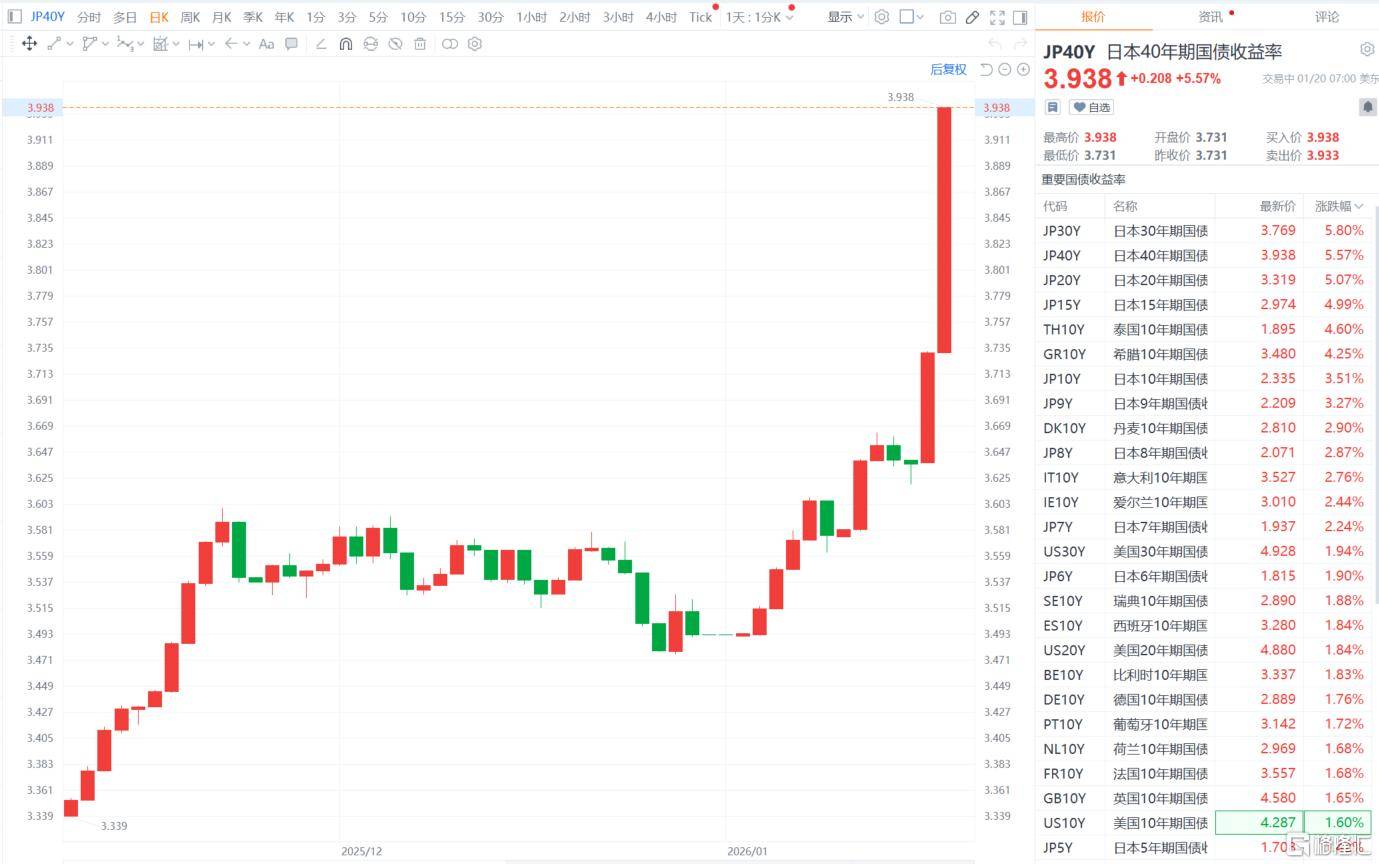
Group 1 - The global financial market experienced severe shocks due to movements in the sovereign debt market, driven by U.S. President Trump's latest tariff comments and concerns over Japan's fiscal discipline following the announcement of early elections [1] - A clear shift in market logic occurred, moving from traditional "interest rate shock" narratives to "risk-off shock" driven by sovereign credit and policy uncertainties [1] - Key market indicators showed a comprehensive sell-off in U.S. Treasuries, with long-term yields rising sharply, and the yield curve steepening significantly [1] Group 2 - The Japanese government bond (JGB) market faced a "crash-level" sell-off, with the 30-year bond yield surging by 35 basis points and the 40-year yield nearing a 50 basis point increase, indicating a severe reassessment of Japan's fiscal outlook [2] - The auction results for 20-year bonds were weak, with a bid-to-cover ratio dropping to 3.19 from 4.10, reflecting a depletion of market demand [2] - The USD/JPY exchange rate was trading around 157.80, showing slight declines and testing key support levels, with potential for further downward movement if critical support is breached [2] Group 3 - The short-term outlook for USD/JPY is heavily dependent on the Bank of Japan's (BoJ) response, particularly regarding its bond purchasing operations [3] - If the BoJ increases bond purchases to stabilize the market, it may temporarily alleviate selling pressure on JGBs but could also lead to a depreciation of the yen [3] - Conversely, if the BoJ shows tolerance towards rising yields, it may exacerbate the trust crisis in JGBs, prompting capital outflows and potentially strengthening the yen [3]
调查:特朗普宣誓就职满一年 美国就业市场降温
Xin Lang Cai Jing· 2026-01-20 16:03
责任编辑:张俊 SF065 特朗普于2025年1月20日宣誓就任美国第47任总统。 据《商业内幕》编撰的特朗普当选首年成绩单显示,尽管家庭持续支出,但招聘疲软且政策不确定性 高,瑞银(UBS)指出大多数主要政策影响已前置。 特朗普于2025年1月20日宣誓就任美国第47任总统。 据《商业内幕》编撰的特朗普当选首年成绩单显示,尽管家庭持续支出,但招聘疲软且政策不确定性 高,瑞银(UBS)指出大多数主要政策影响已前置。 责任编辑:张俊 SF065 ...
高市豪赌引爆日债“血崩”,全球债市“瑟瑟发抖”!
Sou Hu Cai Jing· 2026-01-20 14:15
Core Viewpoint - Japan's fiscal outlook is increasingly concerning, leading to a sudden collapse in the bond market, with long-term bond yields reaching record highs [1][4]. Group 1: Bond Market Reaction - The yield on Japan's 40-year government bonds rose by 5.5 basis points to 4%, marking the highest level since its issuance in 2007 and the highest in over 30 years [1]. - The 30-year bond yield jumped to 3.875%, the 20-year yield increased to 3.35%, and the 10-year yield surpassed 2.3%, reaching its highest level since 1999 [2]. - The collapse in Japanese bonds has caused turmoil in the global bond market, with U.S. 30-year bond yields rising nearly 9 basis points to 4.925% and 10-year yields reaching 4.286%, both new highs since September of the previous year [4]. Group 2: Political and Fiscal Factors - Prime Minister Kishi announced the dissolution of the Diet and scheduled elections for February 8, betting her political career on winning a majority [5]. - Kishi's call for a mandate for "significant policy changes" has raised concerns about fiscal loosening [5]. - Plans to suspend the 8% food consumption tax for two years could lead to an estimated annual tax reduction of about 5 trillion yen, exacerbating fears over Japan's high debt and rising yields [6]. Group 3: Debt and Economic Implications - Japan's public debt is among the highest globally, with debt-to-GDP ratio exceeding 230% [7]. - The reduction in food consumption tax, a key source of fiscal revenue, is expected to widen the fiscal gap, necessitating increased government bond issuance, which will pressure bond prices and elevate yields [8]. - Investor bidding has become more conservative due to deepening concerns over fiscal deterioration [9]. Group 4: Market Sentiment and Future Outlook - A weak auction of 20-year bonds triggered further sell-offs in Japanese government bonds [10]. - Since the announcement of a $135 billion fiscal spending plan in November, Japanese bond yields have been on the rise, reflecting market anxiety over holding long-term Japanese debt [11]. - The upcoming Bank of Japan's interest rate decision is being closely watched, with expectations that rates will remain unchanged, although there is growing concern about the impact of the yen's exchange rate on inflation [12][15].

纽约金银价格19日再创新高
Xin Hua Cai Jing· 2026-01-20 01:37
纽约商品交易所黄金期货市场交投最活跃的2026年2月黄金期价19日上涨1.77%,收于每盎司4676.7美元 /盎司。 周末地缘政治紧张局势再度升温,为贵金属价格注入新的动力,避险需求推动黄金和白银价格分别创下 历史新高,突破每盎司4690美元和94美元。 黄金对关税新闻的强烈反应凸显了市场情绪已从单纯关注增长或通胀转向将政策不确定性作为主要驱动 因素。市场分析人士预计本周贵金属市场将出现显著波动,动荡的经济环境可能进一步增强黄金、白银 的避险吸引力。 世界经济论坛最新报告指出,由于全球经济领导人将地缘经济对抗视为今年的首要风险,其次是国家间 冲突、极端天气、社会两极分化以及虚假信息和错误信息,贵金属价格或将保持强劲上涨势头。 当天3月交割的白银期货价格上涨6.49%,收于每盎司94.28美元。 美国总统特朗普17日在社交媒体上宣布,将从2月1日起对来自丹麦、挪威、瑞典、法国、德国、英国、 荷兰和芬兰的输美商品加征10%关税,并宣称加征关税的税率将从6月1日起提高至25%,直到相关方就 美国"全面、彻底购买格陵兰岛"达成协议。此举引发市场对跨大西洋贸易关系的担忧,推动买入贵金属 的避险需求升温。 特朗普在社交 ...
日元跌跌不休之谜,从政策模糊到地缘风险,谁在做空日本经济?
Sou Hu Cai Jing· 2026-01-20 01:37
Core Viewpoint - The Bank of Japan's decision to raise interest rates by 0.25% to 0.75% marks the first rate hike in 30 years, but instead of strengthening the yen, it has led to a significant depreciation of the currency, contrary to typical expectations of interest rate hikes [1][3]. Group 1: Interest Rate Hike and Market Reaction - The initial expectation was that the rate hike would stabilize the declining yen and help control high inflation, but the yen fell sharply against the dollar following the announcement [3][6]. - Within a month of the rate hike, the yen's exchange rate against the dollar dropped by over 3%, marking the largest monthly decline of the year [5]. Group 2: Factors Behind Yen Depreciation - The lack of clarity in the Bank of Japan's policy regarding future rate hikes has created uncertainty in the market, leading to a sell-off of the yen [11]. - The Japanese government's approach of increasing public spending through debt issuance has raised concerns about the sustainability of its debt, which exceeds 260% of GDP [13]. - The strength of the US dollar, supported by higher interest rates from the Federal Reserve, has attracted global capital away from the yen [15]. - Geopolitical tensions, particularly related to statements from the Japanese government regarding Taiwan, have increased market risk aversion, further pressuring the yen [17]. - A general loss of confidence in the Japanese economy, driven by unclear policies, fiscal mismanagement, and geopolitical issues, has led to a significant depreciation of the yen [19][26]. Group 3: Impact on Japanese Economy and Society - The depreciation of the yen has resulted in imported inflation, making essential goods more expensive for consumers, while government subsidies have not kept pace with rising costs [20][22]. - Small and medium-sized enterprises, which constitute 99% of Japanese businesses, are facing severe challenges due to increased import costs and thin profit margins, leading to a 15% year-on-year increase in bankruptcies [24]. Group 4: Future Outlook for the Yen - The yen's future remains bleak unless three critical issues are addressed: the persistent interest rate differential with the US, the unsustainable fiscal situation, and ongoing geopolitical risks [26][28]. - Without significant policy changes and improved economic management, the yen could continue to depreciate, potentially reaching alarming levels against the dollar [30].
【环球财经】地缘局势再度升温为贵金属注入新动力 纽约金银价格19日再创新高
Xin Hua Cai Jing· 2026-01-19 23:58
Group 1 - The core viewpoint of the articles highlights the rising prices of precious metals, particularly gold and silver, driven by geopolitical tensions and increased demand for safe-haven assets [1][2]. - On January 19, 2026 gold futures rose by 1.77%, closing at $4,676.70 per ounce, while silver futures for March delivery increased by 6.49%, closing at $94.28 per ounce [1][3]. - The announcement by U.S. President Trump regarding the imposition of tariffs on goods from several European countries has heightened concerns over transatlantic trade relations, further boosting the demand for precious metals [1]. Group 2 - The World Economic Forum's latest report indicates that global economic leaders view geopolitical economic confrontation as the primary risk for the year, which may contribute to sustained strong upward momentum in precious metal prices [2]. - The market sentiment has shifted from focusing solely on growth or inflation to prioritizing policy uncertainty as a key driver, suggesting potential volatility in the precious metals market [1].
