
社会主义市场经济体制

Search documents
“十五五”时期 中国将着重办好这些事
Yang Shi Xin Wen· 2025-10-23 13:20
Core Points - The Fourth Plenary Session of the 20th Central Committee of the Communist Party of China was held from October 20 to 23, 2025, in Beijing, where a work report by Xi Jinping was discussed and the proposal for the 15th Five-Year Plan was approved [1] Economic Development - The session emphasized the construction of a modern industrial system, focusing on strengthening the real economy and promoting intelligent, green, and integrated development [2] - It highlighted the need to accelerate the establishment of a strong domestic market and create a new development pattern that enhances domestic circulation [4][5] Technological Innovation - There is a strong push for high-level self-reliance in technology, aiming to enhance the national innovation system and boost independent innovation capabilities [3] Market Economy - The session called for the establishment of a high-level socialist market economy system to enhance the momentum for high-quality development [6][7] International Cooperation - It stressed the importance of expanding high-level opening-up and creating a win-win cooperation environment, while promoting trade innovation and bilateral investment [8][9] Agricultural Modernization - The meeting underscored the importance of modernizing agriculture and rural areas, focusing on solving "three rural issues" and promoting urban-rural integration [10][11] Regional Development - There is a focus on optimizing regional economic layout and promoting coordinated regional development to enhance overall economic growth [12][13] Cultural Development - The session aims to stimulate cultural innovation and development, promoting socialist culture with strong ideological and spiritual influence [14] Social Welfare - It emphasized the need to improve people's livelihoods and promote common prosperity through various social policies [15] Environmental Sustainability - The meeting called for a comprehensive green transformation of economic and social development, aiming for carbon neutrality and ecological safety [16] National Security - There is a commitment to modernizing the national security system and enhancing public safety governance [17][18] Military Modernization - The session outlined goals for achieving high-quality military modernization and strengthening national defense capabilities [19][20]
“十五五”时期,中国将着重办好这些事
Yang Shi Xin Wen· 2025-10-23 12:13
Core Points - The Fourth Plenary Session of the 20th Central Committee of the Communist Party of China was held from October 20 to 23, 2025, in Beijing, where a work report by Xi Jinping was discussed and the proposal for the 15th Five-Year Plan was approved [1] Economic Development - The focus during the 15th Five-Year Plan period will be on building a modern industrial system and strengthening the foundation of the real economy, emphasizing intelligent, green, and integrated development [2] - There will be an emphasis on optimizing traditional industries while nurturing emerging and future industries, alongside promoting high-quality development in the service sector [2] Technological Advancement - The plan aims to accelerate high-level self-reliance in technology, enhancing the national innovation system and boosting independent innovation capabilities [3] - Key areas include original innovation and tackling core technologies, integrating technological and industrial innovation, and advancing digital China initiatives [3] Domestic Market - The strategy will focus on expanding domestic demand, linking consumer and investment needs, and fostering a positive interaction between supply and demand [4][5] - Efforts will be made to stimulate consumption and increase effective investment while removing barriers to a unified national market [5] Economic System - The establishment of a high-level socialist market economy will be prioritized, enhancing the driving force for high-quality development [6][7] - The plan includes activating various business entities and improving the market-oriented allocation of resources [7] International Cooperation - The strategy includes expanding high-level opening-up and creating a win-win cooperation landscape, maintaining a multilateral trade system, and promoting international circulation [8][9] Agricultural Development - The modernization of agriculture and rural areas will be a key focus, addressing rural issues and promoting urban-rural integration [10] - Enhancements in agricultural production capacity and quality, along with rural development, will be prioritized [11] Regional Development - The plan aims to optimize regional economic layouts and promote coordinated regional development, enhancing the effectiveness of major productivity layouts [12][13] Cultural Development - There will be a push to invigorate cultural innovation and development, promoting socialist culture with strong ideological and international influence [14] Social Welfare - The strategy emphasizes improving people's livelihoods and promoting common prosperity, focusing on employment, income distribution, education, and social security [15] Environmental Sustainability - The plan aims for a comprehensive green transformation of economic and social development, focusing on carbon neutrality and ecological safety [16] National Security - The modernization of the national security system and capabilities will be prioritized to ensure social order and vitality [17][18] Military Modernization - The strategy includes achieving the centenary goals of the military and advancing the modernization of national defense and armed forces [19][20]
“十五五”时期,中国将着重办好这些事
财联社· 2025-10-23 12:08
Core Points - The article discusses the key tasks and strategies outlined in the work report presented at the Fourth Plenary Session of the 20th Central Committee of the Communist Party of China, focusing on economic and social development for the upcoming five years [1][2]. Group 1: Economic Development Strategies - Emphasis on building a modern industrial system to strengthen the foundation of the real economy [2][3] - Accelerating high-level technological self-reliance to lead the development of new productive forces [2][3] - Expanding domestic markets and constructing a new development pattern [2][3] Group 2: Agricultural and Rural Development - Prioritizing agricultural modernization and promoting comprehensive rural revitalization [2][3] - Enhancing agricultural production capacity and quality, while improving rural living conditions [2][3] Group 3: Cultural and Social Development - Stimulating cultural innovation and development to enrich socialist culture [4] - Increasing efforts to improve people's livelihoods and promote common prosperity [5][6] Group 4: National Security and Defense - Modernizing the national security system and capabilities to ensure a higher level of safety [5][6] - Advancing the modernization of national defense and the military to achieve strategic goals [6][7] Group 5: Environmental Sustainability - Committing to a comprehensive green transformation of economic and social development to build a beautiful China [7][8] - Promoting carbon neutrality and enhancing ecological safety [7][8]


中国共产党第二十届中央委员会第四次全体会议公报
国家能源局· 2025-10-23 09:37
Core Viewpoint - The Fourth Plenary Session of the 20th Central Committee of the Communist Party of China emphasizes the importance of achieving socialist modernization and outlines the strategic goals and principles for the upcoming "15th Five-Year Plan" period, focusing on high-quality development, technological self-reliance, and comprehensive reforms [4][6][8]. Summary by Sections Achievements and Challenges - The session acknowledges significant achievements during the "14th Five-Year Plan" period, highlighting resilience against international challenges and the COVID-19 pandemic, leading to new major accomplishments in national development [5]. - It recognizes the complex and changing environment for development, balancing strategic opportunities with risks and uncertainties [6]. Strategic Goals for the "15th Five-Year Plan" - The main goals include achieving high-quality development, enhancing technological independence, and improving social civilization and living standards by 2035 [8]. - The plan aims for a significant increase in economic, technological, and national defense strength, with a target of reaching the income levels of moderately developed countries [8]. Economic Development Principles - The session emphasizes principles such as the Party's leadership, prioritizing people, high-quality development, comprehensive reforms, and balancing development with security [7]. - It stresses the importance of a modern industrial system, focusing on the real economy and promoting intelligent, green, and integrated development [8][9]. Technological and Market Development - Accelerating technological self-reliance is highlighted as crucial for leading new productive forces, with a focus on innovation and integration of education, technology, and talent [9]. - The session calls for building a strong domestic market and enhancing the socialist market economy to support high-quality development [9][10]. Rural and Regional Development - The importance of modernizing agriculture and rural areas is emphasized, with a focus on urban-rural integration and improving living conditions in rural areas [10]. - The session advocates for optimizing regional economic layouts to promote coordinated development across regions [10]. Cultural and Social Development - The need to stimulate cultural innovation and improve the quality of life for citizens is stressed, with a commitment to common prosperity and enhancing public services [11][12]. - Environmental sustainability is prioritized, with goals for green transformation and ecological safety [12]. National Security and Governance - The session underscores the modernization of the national security system and the importance of maintaining social stability and public safety [12][15]. - It emphasizes the need for effective governance and the Party's self-reform to ensure robust economic and social development [14]. Conclusion - The session concludes with a call for unity among the Party and the people to achieve the goals set forth in the "15th Five-Year Plan," reinforcing the commitment to socialist modernization and national rejuvenation [16].
中国共产党第二十届中央委员会第四次全体会议公报
证监会发布· 2025-10-23 09:31
Core Viewpoint - The Fourth Plenary Session of the 20th Central Committee of the Communist Party of China emphasizes the importance of achieving socialist modernization and outlines the strategic goals and principles for the upcoming "15th Five-Year Plan" period, focusing on high-quality development, technological self-reliance, and comprehensive reforms [3][6][8]. Summary by Sections Achievements and Challenges - The session acknowledges significant achievements during the "14th Five-Year" period, highlighting resilience against challenges such as the pandemic and international risks, leading to new major accomplishments in national development [4][5]. Strategic Goals for the "15th Five-Year Plan" - The main goals include achieving notable results in high-quality development, significantly improving technological self-reliance, and enhancing social civilization and living standards by 2035 [8][9]. Economic Development Principles - The session outlines key principles for economic development, including adherence to the Party's leadership, prioritizing high-quality growth, and integrating effective market mechanisms with proactive government involvement [7][10]. Modernization of Industries - Emphasis is placed on building a modern industrial system, focusing on the real economy, and promoting intelligent, green, and integrated development across various sectors [9][10]. Technological Innovation - The need for high-level technological self-reliance is highlighted, with a focus on enhancing the national innovation system and fostering deep integration between technological and industrial innovation [9][10]. Domestic Market and Economic Structure - The session stresses the importance of expanding the domestic market and creating a new development pattern that promotes effective interaction between supply and demand [10][11]. Agricultural and Rural Development - The importance of modernizing agriculture and rural areas is emphasized, with a focus on ensuring the integration of urban and rural development and enhancing agricultural productivity [11][12]. Cultural and Social Development - The session calls for the promotion of cultural innovation and the development of a socialist culture that resonates with the public, alongside efforts to improve living standards and achieve common prosperity [12][13]. Environmental Sustainability - A commitment to green transformation and ecological protection is reiterated, with goals to achieve carbon neutrality and enhance ecological security [13]. National Security and Defense - The session emphasizes the modernization of national security systems and capabilities, alongside the need for high-quality development in defense and military modernization [13][14]. Party Leadership and Governance - The importance of the Party's self-revolution and governance effectiveness is highlighted as essential for achieving the goals set for the "15th Five-Year Plan" [14][15].

加快建设新型能源体系!二十届四中全会公报发布
Xin Hua She· 2025-10-23 09:15
Core Points - The Fourth Plenary Session of the 20th Central Committee of the Communist Party of China was held from October 20 to 23, 2025, in Beijing, focusing on the development of the 15th Five-Year Plan [1] - The session emphasized the importance of achieving high-quality development and the need for continuous efforts to realize socialist modernization [4][5] Group 1: Achievements and Goals - The session recognized significant achievements during the 14th Five-Year Plan period, highlighting the resilience of the economy and advancements in various sectors despite global challenges [3] - The main goals for the 15th Five-Year Plan include substantial improvements in high-quality development, technological self-reliance, and social progress by 2035 [6] Group 2: Economic and Social Development Strategies - The session outlined strategies for economic and social development, emphasizing the need for a modern industrial system and the importance of the real economy [6][7] - It called for the acceleration of high-level technological self-reliance and the construction of a strong domestic market to enhance economic resilience [7][8] Group 3: Governance and Policy Framework - The session stressed the importance of adhering to Marxist principles and the need for comprehensive reforms to ensure effective governance and high-quality development [5][12] - It highlighted the necessity of maintaining party leadership and enhancing the party's capacity to lead economic and social development [11][12] Group 4: Social Welfare and Environmental Sustainability - The session emphasized improving people's livelihoods and promoting common prosperity as key objectives, alongside enhancing public services and social security systems [9][12] - It also focused on green transformation and ecological protection, aiming for a sustainable development model that balances economic growth with environmental stewardship [9][10]
中国共产党第二十届中央委员会第四次全体会议公报
券商中国· 2025-10-23 09:01
Core Viewpoint - The Fourth Plenary Session of the 20th Central Committee of the Communist Party of China emphasizes the importance of achieving socialist modernization and outlines the strategic goals and principles for the upcoming "15th Five-Year Plan" period, focusing on high-quality development, technological self-reliance, and comprehensive reforms [3][4][5]. Summary by Sections Achievements and Challenges - The session highlights significant achievements during the "14th Five-Year" period, noting that China has faced complex international situations and domestic challenges, yet has made substantial progress in economic strength, technological capabilities, and overall national power [4]. - The leadership under Xi Jinping has effectively navigated through severe challenges, including the pandemic, leading to new major accomplishments in the party and national endeavors [4]. Strategic Goals for the "15th Five-Year Plan" - The "15th Five-Year Plan" is identified as a critical period for solidifying the foundation for socialist modernization, with a focus on high-quality development and addressing both opportunities and risks in a complex environment [5][6]. - The session sets ambitious goals for 2035, including significant improvements in economic, technological, and national defense capabilities, aiming for per capita GDP to reach the level of moderately developed countries [7]. Economic Development Principles - Key principles for economic and social development during the "15th Five-Year Plan" include maintaining the party's leadership, prioritizing high-quality development, and deepening reforms [7]. - The session emphasizes the need for a modern industrial system, focusing on the real economy, innovation, and sustainable development [8]. Technological and Market Development - The session calls for accelerating technological self-reliance and innovation, enhancing the national innovation system, and fostering a strong domestic market [8][9]. - It stresses the importance of expanding high-level opening-up and promoting international cooperation to create a win-win situation [9]. Social and Cultural Development - The session highlights the need to enhance cultural innovation and development, ensuring that socialist core values are promoted and that cultural industries are advanced [10]. - It emphasizes improving people's livelihoods and promoting common prosperity through effective social policies and public services [10]. Environmental and Safety Considerations - The session underscores the importance of green transformation and ecological protection, aiming for a beautiful China through sustainable practices [11]. - It also stresses the need for a robust national security system and effective governance to maintain social stability [11][12]. Party Leadership and Governance - The session reiterates the necessity of strong party leadership and the importance of self-reform within the party to ensure effective governance and economic development [12][13]. - It calls for a unified effort from all sectors of society to achieve the goals set forth in the "15th Five-Year Plan" [13][15].

深刻认识五年规划彰显的制度优势(深入学习贯彻习近平新时代中国特色社会主义思想)
Ren Min Wang· 2025-10-20 22:08
Core Viewpoint - The article emphasizes the significance of China's five-year plans in guiding economic and social development, highlighting their role in achieving national goals and maintaining stability in the face of changing circumstances [1][5][14]. Group 1: Institutional Advantages of Centralized Leadership - The centralized leadership of the Communist Party ensures that the five-year plans reflect strategic intentions and effectively mobilize resources for national development [2][6]. - Since the first five-year plan in 1953, China has implemented 14 plans, which have been crucial in transforming the country from an agricultural society to a major industrial power [3][4]. Group 2: Role of Five-Year Plans in Economic Development - The five-year plans have evolved from directive plans in a command economy to strategic, guiding frameworks that emphasize quality and comprehensive development [10][11]. - The plans facilitate the integration of market mechanisms with government initiatives, ensuring effective resource allocation and promoting high-quality development [11][12]. Group 3: Long-term Strategic Vision - The continuity of five-year plans demonstrates a long-term strategic commitment to national goals, allowing for sustained progress towards modernization and national rejuvenation [14][15]. - Each five-year plan serves as a milestone in China's modernization journey, marking significant achievements in economic and social development [15]. Group 4: National Coordination and Regional Development - The concept of "one chessboard" promotes coordinated regional development, allowing different areas to leverage their comparative advantages while contributing to national objectives [16][17]. - The implementation of regional strategies has enhanced the overall coherence of economic development across diverse regions, fostering a unified national market [18][19].
六个“新”字看成绩丨改革开放迈出新步伐
Xin Hua She· 2025-10-14 15:00
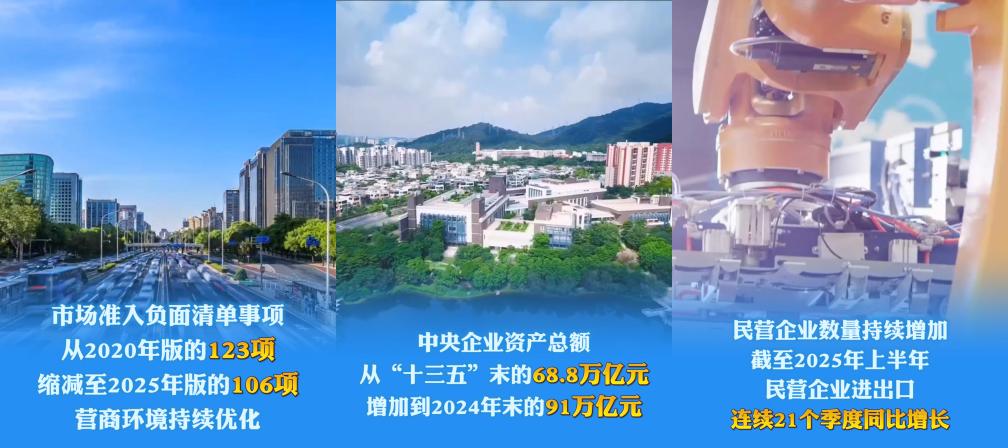
Core Points - The "14th Five-Year Plan" period marks the beginning of a new journey towards building a modern socialist country and advancing towards the second centenary goal [2] - Significant achievements have been made in promoting development, enhancing vitality, and strengthening momentum through comprehensive reforms and multi-faceted breakthroughs [2] Group 1: Economic Structure - A high-level socialist market economic system is being solidly constructed [2] - The domestic circulation's leading position is continuously consolidated [7] - The quality of domestic and international dual circulation is steadily improving [11] Group 2: Trade and Openness - A diversified trade pattern is accelerating its formation [4] - Institutional openness is continuously expanding [5] - The spatial layout of domestic circulation is gradually optimized [14]
对标对表抓住关键全力突破 加快提升竞争力创新力影响力
Zheng Zhou Ri Bao· 2025-10-11 00:59
Core Viewpoint - The meeting led by the municipal party secretary emphasizes the importance of advancing the comprehensive reform pilot for market-oriented allocation of factors to enhance economic vitality and urban competitiveness, aligning with national development strategies [1]. Group 1: Reform Objectives - The pilot reform aims to adapt to global economic trends, improve resource allocation efficiency, and stimulate economic and social development [1]. - The initiative is positioned as a strategic effort to fulfill the responsibilities of a national central city and support the province in becoming a national unified market hub [1]. Group 2: Key Focus Areas - The reform will establish a "1+7+N" pilot scheme to coordinate the market-oriented allocation of various factors, including technology, land, talent, data, capital, and environmental resources [2]. - Emphasis will be placed on data and talent as key variables, along with technology and environmental resources as major influencing factors [2]. Group 3: Implementation Strategy - The plan includes specific initiatives such as enhancing digital governance, building innovation ecosystems, expanding cross-border e-commerce, and developing agricultural trading platforms [2]. - A strong leadership and coordination mechanism will be established to ensure effective implementation and regular progress monitoring [2].