红利类资产

Search documents
银行LOF基金: 鹏华中证银行指数型证券投资基金(LOF)2025年中期报告
Zheng Quan Zhi Xing· 2025-08-27 15:49
Fund Overview - The fund is named Penghua CSI Bank Index Securities Investment Fund (LOF) and is managed by Penghua Fund Management Co., Ltd. [1] - The fund aims to closely track the benchmark index with a target of keeping the average tracking deviation within 0.35% daily and annual tracking error within 4% [2][3]. Financial Performance - As of June 30, 2025, the fund's A share net value growth rate was 14.28%, while the benchmark growth rate was 12.34% [10]. - The fund's total net assets reached approximately 549.89 million RMB, with a total of 383,194,556.67 shares outstanding [14]. Investment Strategy - The fund employs a passive index investment strategy, constructing an investment portfolio based on the benchmark weights of constituent stocks [2]. - Adjustments to the stock investment portfolio will be made based on changes in the benchmark index constituents and their weights, as well as market conditions [2][9]. Market Context - The banking sector performed well in the first half of 2025, driven by a preference for dividend-paying assets amid an asset shortage [9]. - The fund's performance is influenced by macroeconomic factors, including fiscal policies and trade negotiations, which have affected market sentiment and capital flows [10][11]. Management and Compliance - Penghua Fund Management Co., Ltd. has been managing assets totaling 1.25 trillion RMB across various funds, demonstrating extensive experience in investment management [6]. - The fund management strictly adheres to regulations and has implemented fair trading practices to ensure equitable treatment of different investment portfolios [7][8].


创100ETF融通: 融通创业板交易型开放式指数证券投资基金2025年中期报告
Zheng Quan Zhi Xing· 2025-08-27 11:18
Core Viewpoint - The report outlines the performance and financial status of the Rongtong ChiNext ETF for the first half of 2025, highlighting a net asset value of 0.8221 RMB per share and a net value growth rate of 2.04% during the reporting period [2][5][8]. Fund Overview - Fund Name: Rongtong ChiNext ETF - Fund Manager: Rongtong Fund Management Co., Ltd. - Fund Custodian: China Construction Bank Co., Ltd. - Total Fund Shares at Reporting Period End: 131,484,790 shares [1][2]. - Investment Objective: To closely track the underlying index with minimal tracking deviation [1]. Financial Performance - Realized Income for the Period: 1,268,617.46 RMB - Total Profit for the Period: 4,406,569.71 RMB - Average Fund Share Profit for the Period: 0.0307 RMB - Average Net Value Profit Rate for the Period: 3.92% [2]. - Net Asset Value at Period End: 108,087,787.68 RMB, with a cumulative net value growth rate of -17.78% [2][8]. Market Context - The A-share market showed resilience amid external pressures, with the Shanghai Composite Index rising by 2.76% in the first half of 2025 [5]. - The ChiNext Index, as a core broad-based index for technology growth assets, is positioned for strategic allocation due to its valuation level of 32.4 times PE (TTM), indicating significant room for valuation recovery [6]. Investment Strategy - The fund employs a passive index investment strategy, primarily using a full replication method to construct an index investment portfolio [1][4]. - The investment strategy includes stock investment, bond investment, asset-backed securities investment, and stock index futures investment [1]. Risk Management - The fund management adheres to strict risk control measures and fair trading principles, ensuring that all investment decisions are made in the best interest of fund holders [4][5]. - No abnormal trading activities were reported during the period [4]. Future Outlook - The A-share market is expected to show a trend of oscillating upward in the second half of 2025, with a focus on "technology innovation" and "dividend" assets [6]. - The fund's valuation practices are conducted in accordance with established guidelines to minimize valuation discrepancies [6][7].

央企红利50ETF: 融通中证诚通央企红利交易型开放式指数证券投资基金2025年中期报告
Zheng Quan Zhi Xing· 2025-08-27 09:43
Core Viewpoint - The report provides an overview of the performance and financial status of the Rongtong Zhongzheng Chengtong Central Enterprise Dividend ETF for the first half of 2025, highlighting its investment strategy and compliance with regulations [1][2][3]. Fund Overview - Fund Name: Rongtong Zhongzheng Chengtong Central Enterprise Dividend ETF - Fund Manager: Rongtong Fund Management Co., Ltd. - Fund Custodian: Agricultural Bank of China Co., Ltd. - Fund Contract Effective Date: January 22, 2025 - Total Fund Shares at Period End: 245,905,090 shares [3][4]. Investment Strategy - The fund aims to closely track the benchmark index, targeting a tracking deviation of no more than 0.2% on a daily basis and 2% annually [3]. - The fund employs a fully passive investment strategy, primarily using a replication method to construct an index investment portfolio based on the benchmark weights of constituent stocks [3][4]. Financial Performance - As of June 30, 2025, the fund's net asset value was RMB 254,313,164.88, with a net asset value per share of RMB 1.0342 [22][21]. - The fund's net profit for the reporting period was RMB 11,406,906.45, resulting in a net profit margin of approximately 3.86% [22][21]. - The fund's share value growth rate for the reporting period was 3.42%, outperforming the benchmark index return of 2.22% [12][22]. Market Context - The report notes that the A-share market showed resilience amid external pressures, with the Shanghai Composite Index rising by 2.76% in the first half of 2025 [13]. - The market outlook for the second half of 2025 suggests a potential upward trend driven by policy support and structural opportunities, particularly in technology innovation and dividend assets [14][13]. Compliance and Governance - The fund management strictly adheres to relevant laws and regulations, ensuring fair treatment of all investment portfolios and compliance with the fund contract [11][17]. - The fund's valuation process is overseen by a valuation committee to minimize discrepancies and ensure accurate reporting [15][12].

40家基金公司最新研判!3700点后A股会怎么走?
天天基金网· 2025-08-21 11:36
Core Viewpoint - The article presents a generally optimistic outlook for the A-share market in the medium term, while acknowledging that the Hong Kong stock market may underperform in the short term but holds long-term investment value [3][4]. Institutional Consensus - A-share market is expected to benefit from liquidity easing, favorable market sentiment, and supportive policy environment, with a potential shift from a structural bull market to a comprehensive bull market [3]. - The Hong Kong market is seen as having long-term allocation value due to its historically low valuations and continuous inflow of southbound funds, despite short-term challenges [4]. Major Disagreements - There are significant differences in views regarding the bond market and the consumer sector [5]. Asset Assessment Hot Industries - Some institutions believe the bond market faces headwinds due to a bullish stock market, making it difficult to achieve excess returns, while others see potential for allocation opportunities if the stock market experiences volatility [7]. - In the consumer sector, some institutions express concerns over slowing domestic demand and weak durable goods consumption, while others highlight the positive impact of national strategies to expand domestic demand [7]. Common Points - Both A-share and Hong Kong markets see investment value in technology and dividend-paying assets, with a focus on sectors like artificial intelligence and innovative pharmaceuticals [8][11]. - The AI and computing power sectors are viewed as having significant long-term investment opportunities, driven by technological advancements and policy support [12][15]. Divergent Views - In the computing power sector, there are differing opinions on the pace of domestic substitution, with some institutions optimistic about rapid progress while others caution against potential obstacles [16]. - The innovative pharmaceutical sector is seen as having solid long-term prospects despite recent pullbacks, with concerns about external policy impacts [17][18]. Industry-Specific Insights - The robotics industry is viewed neutrally to optimistically, closely tied to AI developments, with varying predictions on the timing of AI applications' explosion in the sector [19][20]. - The non-ferrous metals industry is influenced by policy and industrial demand, with expectations of price and profit increases amid tightening supply and strong demand from the electric vehicle sector [21][22]. - The military industry shows significant development opportunities, supported by increasing defense budgets and technological advancements, although opinions differ on how quickly these benefits will be reflected in stock prices [25][26].

连续6个交易日揽金超7亿!银行板块集体发力,助推红利ETF(510880)成红利类ETF吸金主力
Xin Lang Ji Jin· 2025-08-21 04:06
Group 1 - The banking sector in A-shares showed strong performance with all 42 bank stocks either rising or remaining stable, leading to increased attention on dividend indices like the Shanghai Dividend Index [1] - The Hongli ETF (510880) has seen active trading since August 13, with an average daily trading volume of 376 million yuan and a total net inflow of 766 million yuan over six consecutive trading days, making it the only dividend-themed ETF to achieve over 700 million yuan net inflow during this period [1] - As of August 20, the latest scale of the Hongli ETF (510880) reached 18.214 billion yuan, making it one of the few dividend-themed ETFs with a scale exceeding 10 billion yuan [1] Group 2 - Under the current environment of declining risk-free rates and increasing long-term capital inflow, dividend assets with strong fundamentals are expected to remain a key focus for core allocations [2] - The Hongli ETF (510880) has achieved positive returns for four consecutive years from 2021 to 2024, with a total profit of 3.394 billion yuan in 2024, marking the sixth consecutive year of profitability since 2019 [2] - The Hongli ETF (510880) has attracted 418,300 investors, making it the only dividend-themed ETF with over 400,000 investors during this period [2] Group 3 - Huatai-PB Fund has developed a range of dividend-themed ETFs, including the first low-volatility dividend ETF and a QDII mode ETF for high-dividend Hong Kong stocks, managing a total of 42.2 billion yuan in dividend-themed ETFs as of August 20 [3]
红利类资产蓄势吸金!红利ETF(510880)连续五个交易日吸引资金逆势布局
Xin Lang Ji Jin· 2025-08-20 04:36
Group 1 - The core viewpoint of the articles highlights the recent performance and investor interest in the dividend-themed ETF, specifically the Hongli ETF (510880), which has seen significant inflows and trading activity despite a general market pullback in dividend assets [1][2] - The Hongli ETF (510880) has recorded a trading volume exceeding 300 million CNY daily since August 6, with a total net inflow of 745 million CNY over five consecutive trading days from August 13 to August 19, making it the only dividend-themed ETF to achieve over 700 million CNY in net inflows during this period [1] - As of August 19, the Hongli ETF (510880) has reached a fund size of 18.062 billion CNY, indicating strong market enthusiasm for dividend assets, and it has consistently delivered positive annual returns for four consecutive years from 2021 to 2024 [1][2] Group 2 - The Hongli ETF (510880) has generated a profit of 3.394 billion CNY in 2024, marking the sixth consecutive year of profitability since 2019, with a total profit of 7.643 billion CNY for its investors [2] - The number of holders for the Hongli ETF (510880) has reached 418,300 as of December 31, 2024, making it the only dividend-themed ETF in the market with over 400,000 holders [2] - The Hongli ETF (510880) has distributed dividends totaling 4.298 billion CNY over its 18-year history, with 18 dividend distributions, and is part of a broader range of dividend-themed ETFs managed by Huatai-PineBridge, which has a total management scale of 42.1 billion CNY as of August 19 [2]
高毅资产邱国鹭:穿越周期看金融行业投资
高毅资产管理· 2025-08-08 10:06
Core Viewpoint - The financial industry is undergoing a value reassessment during the interest rate down cycle, with significant differences in the underlying logic of banks, insurance, and brokerage firms [2][6]. Group 1: Banking Sector - The banking sector is facing three main concerns: declining interest margins, potential bad debts, and future credit demand post-economic restructuring [7]. - The net interest margin for listed banks has been on a downward trend, currently around 1.5%, which may not cover operational costs and potential bad debts [7]. - Despite concerns about bad debts, the asset quality of banks has been gradually improving, with non-performing loan ratios decreasing over the years [9]. - The real estate sector's downturn has raised concerns about banks' bad debts, but recent policy changes have restored some market confidence [9]. - There is a significant disparity in the performance and asset quality among different banks, with some achieving over 10% annual profit growth while others face negative growth [12][13]. Group 2: Insurance Sector - The insurance industry is influenced by stock market performance, policy sales, and long-term bond interest rates, with a strong correlation observed historically [19][20]. - The current low interest rate environment poses a risk of interest margin loss for insurance companies, but recent improvements in policy sales are noted [23]. - The aging population is expected to drive insurance demand growth, and the suppressed demand during the pandemic is gradually being released [29]. Group 3: Brokerage Sector - Mergers and acquisitions are expected to be a key theme for the brokerage sector this year, alongside a recovery in market trading volume [32]. - The brokerage business may face challenges in proprietary trading, particularly in bond investments, which have contributed significantly to profits in the past [32]. - The potential for a revival in IPO activities is being closely monitored, especially in the Hong Kong market [32].

银行股午后持续走强,多只银行相关ETF涨超1.5%
Sou Hu Cai Jing· 2025-08-05 06:40
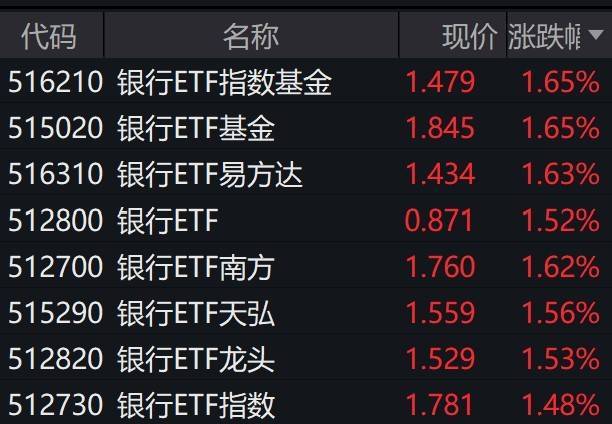
Group 1 - Bank stocks continued to strengthen in the afternoon, with Shanghai Pudong Development Bank rising over 4%, and Qilu Bank, Zheshang Bank, CITIC Bank, and Agricultural Bank rising over 2% [1] - Several bank-related ETFs rose over 1.5% due to market influence [1] Group 2 - Various bank ETF index funds showed positive performance, with the Bank ETF Index Fund at 1.479 (up 1.65%), Bank ETF Fund at 1.845 (up 1.65%), and others also reflecting similar increases [2] - Institutions indicate that in a low interest rate and asset scarcity environment, dividend-paying assets with stable ROE capabilities may still possess strong resilience and attractiveness, potentially becoming important long-term investment options amid short-term market volatility [2] - Following the reduction in reserve requirements and interest rates, the downward space for risk-free rates has opened up, while the National Financial Regulatory Administration is promoting the entry of insurance funds into the market, highlighting the dividend value of state-owned banks [2]




震荡行情红利类资产吸引力渐强!头部ETF品种布局踊跃、交投活跃
Xin Lang Ji Jin· 2025-08-01 05:48
Group 1 - The A-share market experienced a collective pullback on July 31, with increasing attractiveness of dividend assets characterized by "high dividend + low volatility + counter-cyclical attributes" [1] - The two leading dividend ETFs, the Dividend Low Volatility ETF (512890) and the Dividend ETF (510880), saw significant trading volumes of 625 million and 639 million yuan respectively, with increases of 20.5% and 44.6% compared to the previous trading day, accumulating over 450 million yuan in total [1] - The Dividend ETF (510880), established on June 11, 2017, has attracted a total of 626 million yuan in net subscriptions over four consecutive trading days, making it the only dividend-themed ETF with net inflows exceeding 600 million yuan during this period [1] Group 2 - The Dividend Low Volatility ETF (512890) has gained 2.796 billion yuan in funding since July, reaching a fund size of 21.366 billion yuan as of July 31, marking it as the only low volatility dividend ETF in the A-share market exceeding 20 billion yuan [2] - Since its establishment on December 19, 2018, the Dividend Low Volatility ETF (512890) has consistently achieved positive returns every full year, ranking first among its peers in terms of five-year returns as of June 30 [2] - The latest fund annual report indicates that the Dividend Low Volatility ETF (512890) has 829,800 account holders, making it the only dividend-themed index fund with over 800,000 account holders in the market [2] Group 3 - The Hong Kong stock market has also seen increased volatility, with defensive assets represented by dividend assets attracting capital attention [3] - The Hong Kong Dividend ETF (513530), which invests in the CSI Hong Kong Stock Connect High Dividend Investment Index through the QDII model, has recorded net inflows for 11 consecutive trading days since July 17, with its fund size approaching 3 billion yuan as of July 31 [3] - Huatai-PineBridge Fund, one of the first ETF managers in China, has over 18 years of experience in dividend index investment, managing a total of 42.8 billion yuan across its dividend-themed ETFs as of July 31 [3]
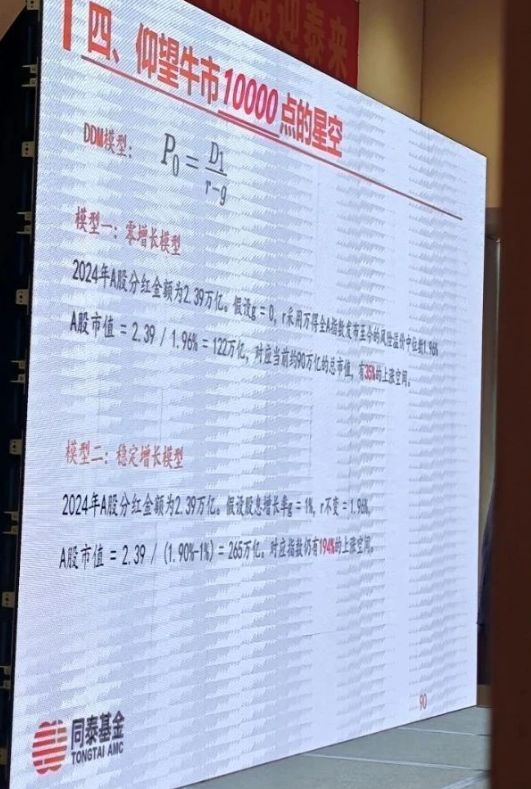
同泰基金内部推演万点行情引发热议 模型演算是怎么回事?机构目前有多乐观?
Mei Ri Jing Ji Xin Wen· 2025-07-27 05:54
Core Viewpoint - The circulating PPT regarding the A-share market valuation, titled "Bull Market 10,000 Points," has attracted market attention, but it is an internal sharing document from Tongtai Fund, not a definitive market indicator [1][2]. Group 1: Market Valuation and Models - The PPT includes references to the Dividend Discount Model (DDM) and its branches for estimating future valuation ranges, which are common quantitative tools used by professional institutions [2][3]. - The DDM is suitable for mature companies with stable and predictable dividends, but the reliance on a single model for market predictions is deemed unobjective by professionals [3][4]. - Various valuation models, including DCF, PE, and PB, are commonly used in conjunction to validate findings, emphasizing the importance of cross-verification in financial analysis [4]. Group 2: Market Trends and Strategies - Despite a strong performance in the A-share market recently, there is confusion regarding asset allocation directions, with no clear mainline trend identified in the second-quarter reports from many fund managers [4][5]. - The rapid rotation of market sectors, such as the recent decline in previously popular sectors like water and infrastructure, contrasts with the resurgence of AI and robotics concepts [4]. - Future investment strategies should focus on dividend assets and index-based allocations, with a cautious approach to market participation [4][5].