绿色可持续发展

Search documents
响应“十五五”规划指引 珀莱雅以科技创新谋发展
Zhong Guo Jing Ji Wang· 2025-12-10 04:53
"十五五"规划建议明确提出"加快高水平科技自立自强",并将"科技自立自强水平大幅提高"列入"十五 五"时期经济社会发展的主要目标之一,始终把科技创新摆在国家战略核心位置。而科技创新也正是珀 莱雅公司自创立以来持续深耕的核心驱动力。 "十五五"规划建议将"加快经济社会发展全面绿色转型,建设美丽中国"列为"十五五"时期核心战略任 务。珀莱雅股份始终将绿色可持续发展作为企业责任与战略,深度锚定"美丽中国"建设要求,全面推进 从生产到消费的全链条绿色发展。 数据显示:2024年,公司研发投入达2.1亿元,同比增长21.21%,研发团队的人数达389人。目前,公司 已在杭州、上海和巴黎设立三大研发与科创中心,逐步构建起"本土需求响应+国际技术协同"的创新网 络,持续夯实全球科研根基。 据2025年半年报披露,公司已累计拥有专利240项,其中包括国家授权发明专利124项、实用新型专利22 项及外观设计专利94项。在行业标准建设方面,公司至今已参与制定国家标准21项、行业标准6项,持 续引领行业规范与发展。 党的二十届四中全会审议通过的"十五五"规划建议,明确提出"坚持把发展经济的着力点放在实体经济 上,坚持智能化、绿色化 ...

友达:Micro LED成本每2年降低50%
WitsView睿智显示· 2025-12-08 09:33
Core Viewpoint - AUO (友达光电) is undergoing a significant transformation from a traditional display panel manufacturer to a vertically integrated solution provider, focusing on three pillars: Display Technology, Mobility Solutions, and Vertical Solutions, driven by AI and sustainability initiatives [3][4][8]. Group 1: Business Transformation - The display business is expected to decrease to less than 50% of total revenue as AUO diversifies its operations into automotive and other sectors [3][11]. - AUO has optimized its product structure internally and expanded externally through acquisitions, such as the purchase of automotive parts manufacturer BHTC, to enhance its business scope [4][19]. - The company has established three subsidiaries focusing on different areas: AUO Display +, AUO Mobility Solutions Corporation, and ADTTech, to drive strategic development [4][8]. Group 2: Product Innovations - At the "Smart AUO Exhibition," the company showcased a range of innovative display products utilizing LTPS, Mini LED, and Micro LED technologies, including various specialized displays for medical and automotive applications [6][10]. - The smart mobility business, which includes in-car displays and control systems, is projected to grow by 20% in revenue in 2024, supported by strong customer demand and new projects [8][19]. Group 3: Market Position and Strategy - AUO's revenue from smart mobility and vertical solutions has reached 44% of total revenue, with a target to exceed 50% by 2027 [11]. - The company is leveraging its existing strengths in semiconductor manufacturing and automation to gain a competitive edge in the Micro LED market, focusing on niche applications in automotive and healthcare [12][14]. - AUO's acquisition of BHTC is aimed at enhancing its service capabilities in the European and American automotive markets, with expectations of significant revenue growth from this segment [19][23]. Group 4: Technological Advancements - Micro LED costs are expected to decrease by 50% every two years, driven by advancements in chip size reduction and manufacturing processes [18]. - AUO has achieved a 95% equipment connectivity rate and a 90% data cloud coverage in its smart manufacturing initiatives, significantly improving production efficiency [26][28]. Group 5: Sustainability Efforts - AUO is committed to building a green and resilient industrial ecosystem, having received national recognition for its digital and green development achievements [28].


圣奥化学再次入选精细化工双榜单
Zhong Guo Hua Gong Bao· 2025-12-08 02:35
Core Viewpoint - The recent 25th Fine Chemical Industry (Ningdong) Conference highlighted the achievements of Shengao Chemical, which ranked 29th in the "Top 100 Fine Chemicals in China 2025" and 6th in the "Top 10 Innovative Development Enterprises in Fine Chemicals 2025," showing significant improvement from 2024 [1] Group 1: Company Performance - Shengao Chemical has established a strong presence in the polymer additives sector, with a strategic layout across five global production bases, covering over 50 countries and regions [1] - In 2024, the company invested 193 million yuan in R&D, focusing on the development of green and environmentally friendly anti-aging agents, refining plastic additive products, and expanding the flame retardant product chain [1] - The company has achieved breakthroughs in several key technology areas and has received multiple national-level honors [1] Group 2: Sustainability Efforts - Shengao Chemical is making strides towards green sustainability, with a 27.03% reduction in comprehensive energy consumption per ten thousand yuan of output compared to 2020 [1] - The company has also reduced carbon dioxide emissions per ten thousand yuan of output by 20.8% compared to 2020 [1] - A total of 16 carbon reduction projects have been implemented, achieving a carbon reduction of over 20,000 tons of CO2 equivalent through process improvements and enhanced energy utilization [1]
中国电力附属天门清洁能源与山东院订立工程总承包合同
Zhi Tong Cai Jing· 2025-12-05 09:55
天门风电项目位于风能资源丰富且具备有利条件发展大型可再生能源基地的乡村地区,已被湖北省政府 指定为全国两个农村能源革命试点县项目,以推动清洁低碳能源转型。预计工程建成后,该等项目将优 化当地能源结构,促进乡村振兴,加深国家实现"双碳"目标(即2030年前碳排放达峰及2060年前实现碳 中和)的承诺,以及提升本集团的获利能力。该等项目的投资符合本公司绿色可持续发展的战略目标。 中国电力(02380)发布公告,2025年12月5日,天门清洁能源(本公司一家非全资拥有的间接附属公司)与 山东院分别订立了工程总承包合同I及工程总承包合同II。根据该等总承包合同,山东院将以总代价人民 币9.39亿元(约相等于10.32亿港元)为岳口佛子山项目及干驿皂市项目提供项目勘察、设计、设备采购、 建筑安装,以及其他技术支援服务。 本集团通过中国的采购与招标平台及网络(包括中国电力设备信息网及国家电投电子商务平台),遵循严 谨竞争的公开市场招标过程才授予山东院每份该等总承包合同。该等总承包合同各自应付的代价与其他 公司就市场可比较项目所收取的现行价格相符或较之条款更佳。董事认为,该等总承包合同的代价及其 相关条款均不逊于独立第三方 ...

登康口腔以创新与责任引领口腔健康产业高质量发展
Bei Ke Cai Jing· 2025-12-04 10:41
Core Insights - The company, Dengkang Oral Care, was awarded the title of "Most Respected Enterprise - Consumer Leader" at the 2024-2025 Annual Meeting of Respected Enterprises, recognizing its excellence in operational management, innovation, and social responsibility [1][2] - Dengkang Oral Care has shown strong growth in the sensitive toothpaste market, with a revenue increase of 16.66% and a net profit increase of 15.21% year-on-year as of Q3 2025, indicating robust market competitiveness and profitability [1] - The company maintains a leading position in the sensitive toothpaste sector, with its core brand "Lengsuaning" holding over 60% market share in the offline market [1] Innovation and Product Development - Dengkang Oral Care emphasizes innovation, having developed industry-leading sensitive technology and launched high-end products such as medical research-based sensitive repair toothpaste to meet diverse consumer needs [1] - The company is optimizing its product structure and building a matrix of popular products to cater to personalized consumer demands [1] Sustainability and Social Responsibility - The company is committed to green sustainable development, utilizing photovoltaic and other energy-saving technologies to promote low-carbon transformation [2] - Dengkang Oral Care actively engages in public welfare initiatives, contributing to rural revitalization and oral health education, reflecting its corporate social responsibility [2] - The company has received multiple ESG ratings, including an A grade from Wind and Huazheng, and was awarded the Best ESG Management Listed Company in the 2024 Crystal Ball Awards [2] Future Outlook - The company plans to continue its operational philosophy of compliance, innovation, lean management, and high-quality development, aiming to enhance consumer oral health care products and solutions [2]
研判2025!中国槟榔行业产业链、销量、进出口、竞争格局及发展趋势分析:行业销量回升,未来产品朝着健康化方向发展[图]
Chan Ye Xin Xi Wang· 2025-12-04 01:17
Core Insights - The demand for betel nut products is increasing due to rising living standards, with betel nut serving both as a stimulant and a social medium, particularly among male consumers [1][7] - Betel nut companies are innovating their products by introducing various flavors and improving packaging to attract younger consumers, despite health risks associated with long-term consumption [1][7] - The betel nut industry experienced a decline in sales in 2022, with a year-on-year decrease of 19.3%, but is projected to recover in 2024 with sales reaching 3 billion packs, a year-on-year increase of 14.1% [1][8] Industry Overview - Betel nut, a tropical plant, is primarily grown in Southeast Asia and tropical regions, with various forms including fresh, salted, and dried betel nuts [3][4] - The industry chain includes cultivation, initial processing, deep processing, and sales, with a growing emphasis on health awareness impacting sales [4][7] Market Dynamics - The betel nut market is characterized by high concentration, with leading companies like Kouweiwang, Huange, and Pangge dominating the market through innovation and strong marketing strategies [11] - Smaller companies face challenges due to stricter national policies, leading to increased market concentration [11] Import and Export Trends - China primarily imports betel nuts due to limited domestic cultivation, with significant increases in import volume and value in 2025 [8][9] - Major import sources include Myanmar and Indonesia, benefiting from geographical proximity and abundant supply [9][10] Future Trends - The industry is expected to focus on product innovation and health transformation, with investments in research and development to create healthier betel nut products [12][13] - Brand building and marketing strategies will evolve, emphasizing online and offline integration to enhance consumer engagement [13] - Sustainable development practices will become essential, promoting eco-friendly cultivation and processing methods to align with global green initiatives [14]

人民日报海外版丨中国有色集团“安全、绿色、高效、低耗”合作实践获得海外伙伴高度认可
Xin Lang Cai Jing· 2025-12-02 11:44
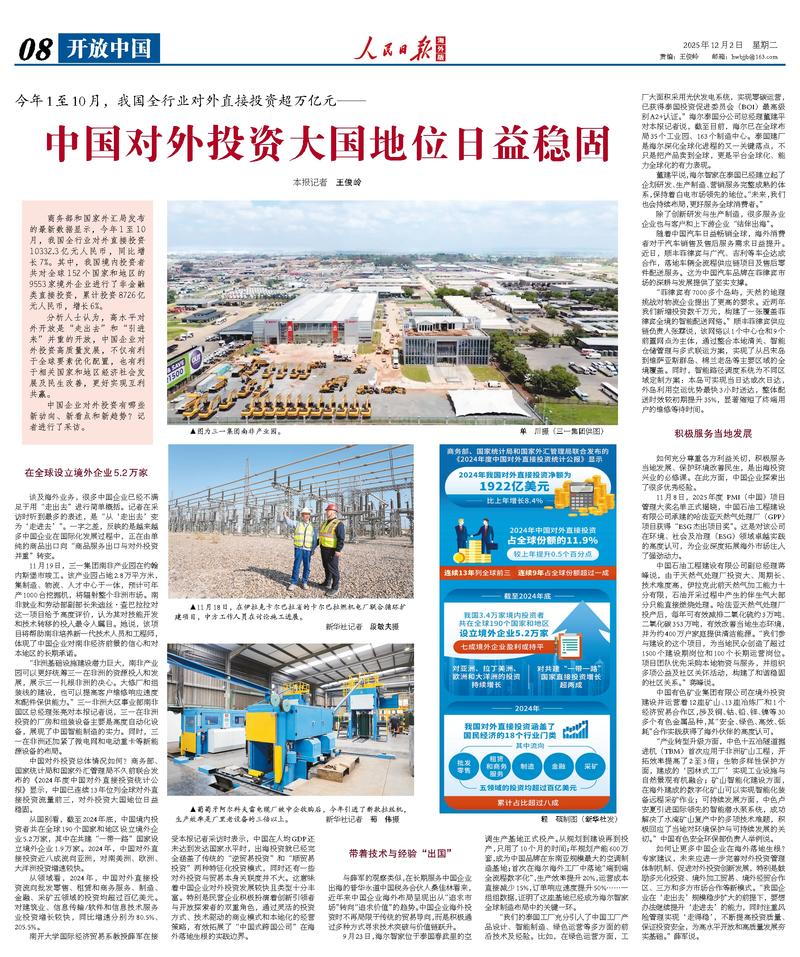
Core Insights - China's total foreign direct investment (FDI) exceeded 1 trillion yuan from January to October this year, marking a 7% year-on-year increase, solidifying its position as a major global investor [8][29] - Chinese enterprises are shifting from merely "going out" to "going in," indicating a transition from simple product exports to a dual focus on product service exports and foreign investment [10][33] - The report highlights the importance of high-level openness, which balances outbound and inbound investments, benefiting global resource allocation and local economic development [8][29] Investment Overview - In the first ten months of this year, China's FDI reached 10,332.3 billion yuan, with domestic investors making non-financial direct investments in 9,553 overseas enterprises across 152 countries and regions, totaling 8,726 billion yuan, a 6% increase [8][29] - China has established 52,000 overseas enterprises in 190 countries and regions, with 19,000 of these in Belt and Road Initiative countries [13][36] Sectoral Trends - In 2024, investments in wholesale and retail, leasing and business services, manufacturing, finance, and mining each exceeded 10 billion USD, with construction and information technology sectors seeing significant growth rates of 80.5% and 205.5% respectively [15][38] - The investment landscape is diversifying, with private enterprises playing a crucial role in innovation and exploration, utilizing flexible investment strategies and localized business models [15][39] Case Studies - SANY Group's South Africa industrial park, covering 28,000 square meters, is expected to produce 1,000 excavators annually, showcasing China's commitment to local economic development and skills training [12][35] - Haier's air conditioning production base in Thailand, which became operational in just 10 months, is now the largest of its kind in Southeast Asia, emphasizing digitalization and green operations [39][40] Local Development and ESG Practices - Chinese enterprises are increasingly focused on respecting local interests and contributing to environmental and social governance (ESG), as demonstrated by the recognition of China National Petroleum Engineering's project in Iraq for its outstanding ESG practices [18][41] - The construction of the Al-Hafaya gas processing plant is expected to significantly reduce local emissions and create thousands of jobs, reflecting a commitment to sustainable development [20][44] Future Directions - Experts suggest enhancing the management system for outbound investments and promoting innovative development, particularly in diversified investments and overseas processing trade [22][45] - The emphasis is on improving the ability to "go in" while ensuring risk management and investment quality to support high-level openness and quality development [22][45]
斩获殊荣!重庆西岸网络小额贷新客户服务引领2025行业新风向
Sou Hu Cai Jing· 2025-12-02 09:08
Core Insights - The event themed "Boosting Consumption and Quality Service Responsibility" was successfully held in Chengdu, focusing on consumer responsibility and service quality enhancement [1] - Nu Skin (如新) was awarded the "Customer Service Innovation Typical Case" and two of its customer service representatives were recognized as "Typical Customer Service Figures," highlighting the company's excellence in consumer rights protection and service innovation [1][5] Group 1: Consumer Rights and Service Innovation - Nu Skin has integrated consumer rights protection into its core business strategy, viewing it as both a legal obligation and a commitment to ESG principles [3] - The company employs a "6S Quality Measures" system throughout the product lifecycle to ensure high standards of quality and safety [3] - Nu Skin is set to launch the "Prysm iO" smart health management platform, utilizing advanced technologies to provide personalized health solutions [3] Group 2: Service Assurance and Customer Satisfaction - The company adheres to a "Customer-Centric" philosophy, offering a comprehensive after-sales service mechanism, including a 30-day no-reason return policy [4] - In 2023, Nu Skin achieved full online processing for after-sales services, with return and machine after-sales processing rates reaching 100% and over 90%, respectively [4] - The company emphasizes green and sustainable development throughout its supply chain, earning the "Waste-Free Factory" title for its innovative headquarters project [4] Group 3: Future Commitment and Contributions - The dual recognition of "Customer Service Innovation Typical Case" and "Typical Customer Service Figures" reflects Nu Skin's long-standing commitment to product innovation, quality assurance, and sustainable development [5] - The company aims to continue enhancing its productivity through technology and service excellence, contributing to a healthy consumption environment and the "Healthy China" initiative [5]

深化对高效能治理重大命题的认识
Jing Ji Ri Bao· 2025-12-01 22:26
Core Viewpoint - High-quality development is the primary task for building a modern socialist country, and efficient governance is the institutional guarantee and key to achieving high-quality development [1][2]. Understanding the Internal Relationship between Development and Governance - High-quality development embodies innovation, coordination, green, openness, and sharing, while efficient governance emphasizes modern governance under the Party's comprehensive leadership [2][3]. - High-quality development and efficient governance are interdependent and mutually reinforcing, where the absence of one undermines the other [2][3]. Unified Relationship of Mutual Promotion - High-quality development requires higher productivity, while efficient governance focuses on optimizing resource allocation and social operation rules [3]. - Efficient governance provides a solid foundation for high-quality development, especially during economic transitions, by creating a fair competitive market and stable social environment [3]. - The demands of high-quality development push for continuous optimization and upgrading of governance capabilities and systems [3]. Dynamic Adaptation of Collaborative Transformation - Efficient governance injects stability and new momentum into high-quality development through institutional innovation [4]. - High-quality development drives the governance system to respond and transform in real-time, promoting a positive cycle between institutional supply and development momentum [4]. Coordinated Progress through Positive Interaction - Efficient governance provides the institutional basis for sustainable high-quality development, creating a cycle of coordinated progress [5][6]. - The process of high-quality development enhances governance capabilities, leading to a more scientific, legal, and intelligent governance approach [5][6]. Strategic Pathways and Key Tasks - The 14th Five-Year Plan emphasizes enhancing high-quality development through efficient governance, requiring top-level design, resource optimization, and feedback mechanisms [7][8]. Strengthening Top-Level Design - A systematic approach is necessary for promoting high-quality development and efficient governance, focusing on strategic planning and legal guarantees [8]. Optimizing Resource Allocation - Efficient governance aims to break down barriers to resource flow and guide rational allocation, supporting the development of new productive forces [9]. Promoting Digital Empowerment - The integration of digital technologies into governance enhances decision-making and policy execution, creating a sustainable growth engine for high-quality development [10]. Improving Feedback Mechanisms - Establishing a robust feedback mechanism is essential for identifying and responding to new demands in the high-quality development process [11].
路甬祥:科技驱动新质生产力,促进绿色可持续发展
中国能源报· 2025-12-01 10:23
Group 1: Core Concepts - The article emphasizes the importance of new productive forces driven by technology, which enhances global production efficiency while promoting green and sustainable development [1][3] - The 20th National Congress of the Communist Party of China calls for accelerating high-level technological self-reliance to lead the development of new productive forces [3] Group 2: Green Intelligent Manufacturing - Green intelligent manufacturing integrates environmental protection and sustainable development throughout the manufacturing process, improving production efficiency and product quality while reducing resource consumption and pollution [5] - This system employs energy-efficient equipment and optimized processes to minimize waste, with real-time monitoring to prevent excessive energy consumption and reduce defective products [5][6] - The use of recyclable or biodegradable materials is encouraged to alleviate long-term environmental burdens, with some companies adopting renewable plant fibers or recycled plastics [5] Group 3: Supply Chain Management - Green intelligent manufacturing includes the green management of supply chains, assessing and reducing environmental impacts at every stage from raw material procurement to waste disposal [6] - Companies can lower carbon footprints by selecting local suppliers, using eco-friendly packaging, and designing products for easy disassembly and recycling [6] Group 4: Employee Engagement - Successful implementation of green intelligent manufacturing relies on employee engagement, necessitating systematic training to enhance environmental awareness and skills [7] - Continuous education fosters recognition of the importance of green manufacturing and encourages proactive environmental measures among employees [7] Group 5: Renewable Energy Technologies - Green renewable energy technologies aim to reduce pollution and greenhouse gas emissions, including solar, wind, hydro, geothermal, and biomass energy [8][9] - Solar energy technologies encompass photovoltaic and solar thermal systems, while wind energy utilizes turbines to convert wind energy into electricity [9] - Hydropower, geothermal energy, and biomass energy also play significant roles in transitioning to a sustainable energy structure [10] Group 6: Green Transportation Technologies - Green transportation technologies significantly reduce environmental impacts, including electric vehicles (EVs) and hydrogen fuel cell vehicles (FCEVs), which minimize greenhouse gas emissions [11][12] - Public transportation benefits from green technologies, such as natural gas buses and electric buses, which lower pollutant emissions compared to traditional diesel vehicles [13] - Intelligent transportation systems enhance traffic management, reducing congestion and carbon emissions through real-time monitoring and optimization [14] Group 7: Green Data Technologies - Green data technologies focus on minimizing energy consumption and carbon emissions throughout the data lifecycle, supporting the development of smart cities [15][16] - Applications of green data include traffic management, energy management, and environmental monitoring, contributing to overall urban sustainability [17] - Challenges include the increasing demand for data storage and processing, which raises energy consumption concerns, and the high costs associated with developing green data technologies [18]