
股票估值

Search documents
关于景顺长城基金管理有限公司旗下基金调整持有股票估值价格的公告
Xin Lang Cai Jing· 2025-12-26 19:01
Group 1 - The core viewpoint of the announcement is that Invesco Great Wall Fund Management Co., Ltd. will change the valuation method for its securities investment funds, excluding ETFs, to the index yield method for shares of "Zhongwei Company" (stock code: 688012.SH) starting from December 26, 2025 [1] - The company will closely monitor the subsequent operational status and other significant matters related to the aforementioned stock and will conduct reasonable assessments [1] - Once the stock resumes trading and exhibits active market trading characteristics, the company will revert to using the closing price for valuation, and the relevant ETFs will return to using the net asset value for valuation without further announcements [1]

Consumer Fear and Tariffs: Why Powell’s Stock Market Valuation Warning is More Dire Now
Yahoo Finance· 2025-12-26 18:08
Market Valuation and Economic Outlook - The S&P 500's forward P/E ratio was around 21 in September, above the long-term average of 16, indicating a thin margin of safety for investors [1] - Powell's comments highlighted that stock prices had significantly outpaced historical norms, with mega-cap technology stocks making up nearly 40% of the index value, surpassing levels seen during the 1999 dot-com bubble [2] - Elevated valuations, combined with trade wars and declining consumer confidence, have created a concerning risk profile for investors [3] Trade Policies and Economic Impact - The current aggressive tariff policies have introduced significant economic uncertainty, with consumer sentiment dropping to levels not seen since the COVID-19 pandemic [4] - Tariffs are raising costs for U.S. businesses and households, with Goldman Sachs reporting that they are paying 82% of these duties, reigniting inflation concerns [8] - The uncertainty surrounding trade policies is hindering long-term capital investments, leading to slower hiring and declining manufacturing orders for nine consecutive months [9] Consumer Sentiment and Spending - The Consumer Sentiment Index fell to 50.4 in November, the second-lowest in history, indicating deep concerns among Americans regarding their finances and business conditions [10][11] - Approximately 71% of households expect unemployment to rise in 2026, which historically precedes negative labor market outcomes [12] - The disconnect between high stock valuations and low consumer confidence is evident, as consumer spending drives about 70% of U.S. economic activity [13] Wall Street Forecasts and Market Risks - Despite the dire economic indicators, Wall Street forecasts a 15% to 20% increase in the S&P 500 for 2026, assuming AI spending will offset tariff disruptions [14] - The assumptions behind these forecasts are increasingly questionable, with historical data suggesting declines when the Shiller CAPE ratio exceeds 39 [15] - The risk for investors is that the optimistic forecasts ignore signs of an economic slowdown, leaving the S&P 500 vulnerable to significant drawdowns [16] Investment Strategy Recommendations - Investors are advised to recognize the shifting risk/reward dynamics and consider increasing allocations to dividend-paying stocks and high-quality bonds to enhance portfolio durability [17]
Pagaya Technologies After The Reset: Growth Still Works, Price Finally Does Too
Seeking Alpha· 2025-12-22 15:30
Core Insights - The article emphasizes the importance of quantitative research, financial modeling, and risk management in equity valuation and market trends to identify high-growth investment opportunities [1] Group 1: Company Analysis - The company has a strong focus on corporate earnings and financial statement analysis, aiming to provide actionable investment ideas [1] - The investment approach combines rigorous risk management with a long-term perspective on value creation [1] Group 2: Industry Trends - There is a particular interest in macroeconomic trends that influence market dynamics and investment opportunities [1] - The article highlights the significance of stress testing and model validation in understanding market risks and opportunities [1]



施罗德投资:2026年股票投资应采取主动模式管理估值风险,寻求多元投资机遇
Bei Jing Shang Bao· 2025-12-18 03:18
Core Viewpoint - The investment landscape for 2026 is characterized by high stock valuations, driven by significant investments from hyperscalers in data centers and cloud infrastructure, drawing parallels to the 1999-2000 internet bubble [1][2] Group 1: Stock Market Valuation - Current stock valuations are high compared to historical levels but have not reached extreme levels [2] - Some investors are considering reducing risk exposure, particularly those managing defined benefit pension plans, while most investors remain invested due to the need for returns that outpace inflation [2][3] Group 2: Investment Strategies - Passive investment in stock indices is a common choice, but it carries risks due to concentration in a few tech companies, which can lead to significant idiosyncratic stock risk [3] - Active management is suggested as a way to navigate risks, with a focus on calculated risk decisions based on various factors supporting the stock market [3][4] Group 3: Economic Outlook - The risk of a recession in the U.S. is low, with a stable labor market and healthy balance sheets for private enterprises, suggesting positive returns from the stock market [4] - The company is closely monitoring large-cap companies for investment returns, particularly those transitioning from free cash flow generators to significant capital spenders [4] Group 4: Diversification Opportunities - The company is seeking diversification opportunities beyond AI, noting the benefits of regional diversification and strong performance of value investments outside the U.S. [5] - Emerging market bonds are providing better yields compared to developed market bonds, and alternative investments like insurance-linked securities and infrastructure debt may offer additional yield opportunities [5]
ServiceNow: Buy The Dip In NOW Stock?
Forbes· 2025-12-17 19:45
Core Viewpoint - ServiceNow's stock dropped 11% following the announcement of a $7 billion acquisition of Armis, leading to analyst downgrades and investor concerns [2][3] Valuation and Performance - ServiceNow's current stock price of approximately $780 is considered appealing, but its high valuation makes it sensitive to negative surprises, presenting a challenging entry point [3] - The company's price-to-sales (P/S) ratio is 15.2 compared to 3.2 for the S&P 500, and its price-to-earnings (P/E) ratio stands at 111.4 versus 23.5 for the benchmark [11] - ServiceNow's revenues have grown significantly, with a 21.1% increase from $10 billion to $13 billion over the last 12 months, compared to 6.0% growth for the S&P 500 [11] - The operating income for the last four quarters totaled $1.8 billion, resulting in an operating margin of 13.9%, which is lower than the S&P 500's 18.8% [11] Financial Strength - ServiceNow's balance sheet is strong, with a debt of $2.4 billion and a market capitalization of $162 billion, leading to a low debt-to-equity ratio of 1.2% compared to 21.2% for the S&P 500 [11] - The company has a cash-to-assets ratio of 24.8%, significantly higher than the S&P 500's 6.9%, indicating strong liquidity [11] Growth and Profitability - ServiceNow's average revenue growth rate over the past three years is 22.3%, outperforming the S&P 500's 5.5% [11] - The company's profit margins are above most companies in the Trefis coverage universe, reflecting strong profitability [8] Resilience During Downturns - ServiceNow's stock has shown slightly better performance than the S&P 500 during recent downturns, indicating moderate resilience [10] - The overall assessment of ServiceNow's performance across key metrics is categorized as "Very Strong" for growth and financial stability, and "Strong" for profitability [15]


[12月14日]美股指数估值数据(美股牛熊市有啥特点,美股也有长熊市吗)
银行螺丝钉· 2025-12-14 13:42
Core Viewpoint - The article discusses the current state of global stock markets, particularly focusing on the valuation of U.S. stocks and the characteristics of bull and bear markets, while also introducing investment opportunities through global index funds. Group 1: Global Stock Market Overview - This week, global stock markets experienced slight fluctuations with minimal movement [1][2][3][4] - The U.S. stock market has seen a slight decline, while non-U.S. markets have shown slight increases [2][3] - A-shares in China also experienced a slight increase, indicating a stable market environment [4] Group 2: Valuation Insights - Despite significant increases in U.S. stock indices over the years, they have rarely reached overvaluation, mostly remaining at normal valuation levels [5][6] - As of October this year, U.S. stocks touched high valuation levels, but have since corrected back to a normal high valuation [7][8] - The growth in earnings over the past two years has helped absorb some of the high valuations in the U.S. stock market [9] Group 3: Bull and Bear Market Characteristics - U.S. stock markets have experienced long bull and bear cycles, with each cycle lasting 15-20 years [12][13][14] - Long bear markets typically occur during economic recessions, as seen in the 1970s and from 2000 to 2010 [15][16] - The current economic environment has not yet entered a recession, and earnings growth remains the primary driver for stock index increases [22][23] Group 4: Investment Opportunities - Historical data indicates that significant undervaluation opportunities in global stock indices occurred in 2018, 2020, and 2022 [29] - The article highlights the introduction of a global index investment advisory portfolio that diversifies across various stock markets [34][35] - The portfolio aims to track global stock market performance, although there are current purchase limits for domestic investors [37] Group 5: Book Promotion - A new edition of the book "The Long-Term Investment Guide" has been released, which includes updated data and new chapters [40] - The book emphasizes that stocks are the best long-term investment vehicle, encouraging asset allocation towards equities [41][42]

估值周报:最新A股、港股、美股估值怎么看?-20251213
HUAXI Securities· 2025-12-13 07:49
A-share Market Valuation - The current PE (TTM) for the A-share market is 17.14, with a historical average of 25.72[7] - The Shanghai Composite Index has a PE (TTM) of 14.04, while the CSI 300 Index stands at 13.16[9] - The growth of the A-share market is influenced by both earnings changes and valuation changes, with contributions to index fluctuations analyzed[12] Hong Kong Market Valuation - The Hang Seng Index has a current PE (TTM) of 11.93, with a historical maximum of 22.67 and a minimum of 7.36[58] - The Hang Seng Technology Index shows a current PE (TTM) of 23.72, indicating a significant valuation compared to other sectors[62] US Market Valuation - The S&P 500 Index has a current PE (TTM) of 29.04, with historical values ranging from a minimum of 11.21 to a maximum of 41.99[83] - The NASDAQ Index currently stands at a PE (TTM) of 42.03, reflecting a high valuation compared to historical averages[89] Sector-Specific Valuation Insights - Non-bank financials, food and beverage, and non-ferrous metals sectors in A-shares are currently at historically low PE levels[23] - The technology sector, including computing and electronics, is experiencing high PE levels, indicating potential overvaluation[23] Risk Factors - Potential risks include policy effectiveness falling short of expectations, corporate earnings not meeting forecasts, and significant market volatility[103]
美股明年能否接着“狂欢”?知名投行:若经济衰退来袭,或迅速暴跌20%!
Sou Hu Cai Jing· 2025-12-13 03:08
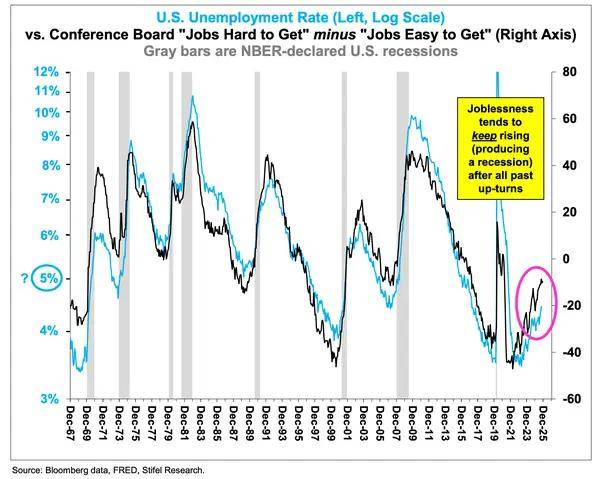
Group 1 - The core viewpoint is that if the U.S. economy remains strong through 2026, the S&P 500 index is expected to rise by 9%, but investors should prepare for a potential 20% drop in case of a recession [1] - Stifel estimates a 25% probability of a recession occurring, despite it not being the base case for major Wall Street firms [1] - The labor market shows signs of instability, with rising unemployment and layoffs, which could lead to reduced consumer spending, negatively impacting an economy where 68% of GDP comes from consumer spending [1] Group 2 - The current stock valuations are at historical highs, which may pose challenges for investors, as the median market correction during recessions since World War II has been 20% [1] - Barry Bannister emphasizes that the price-to-earnings ratio becomes crucial when the S&P 500 is perceived as overvalued [2] - High-volatility stocks, such as Palantir and GameStop, have seen significant declines, indicating a potential early warning for a broader market downturn [2] Group 3 - The S&P 500's equity risk premium is nearing levels seen during the late 1990s and early 2000s dot-com bubble, suggesting heightened risk in current valuations [4] - Bannister's fundamental prediction is for the S&P 500 to achieve positive returns by 2026, but he advises establishing hedging positions with defensive stocks [6] - Recommended defensive ETFs include the Consumer Staples Select Sector SPDR Fund (XLP), Invesco S&P 500 Low Volatility ETF (SPLV), JPMorgan Equity Premium Income ETF (JEPI), and iMGP DBi Managed Futures Strategy ETF (DBMF) [6]
Buy or Sell Carvana Stock?
Forbes· 2025-12-12 13:37
Core Insights - Carvana's stock has experienced a remarkable recovery, rising from below $5 in late 2022 to nearly $472 in 2025, significantly outperforming the S&P 500's 17% increase and CarMax's 50% decline [2][3] Financial Performance - Carvana's revenue has grown at an average rate of 11.6% over the past three years, with a notable 46% increase from $13 billion to $18 billion in the last twelve months, and a 54.5% year-over-year growth to $5.6 billion in the latest quarter [7] - The company generated $1.7 billion in operating income over the past year, achieving an operating margin of 9.4%, which, while improved from previous losses, remains below the S&P 500's average of nearly 19% [8] - Operating cash flow was approximately $666 million, resulting in a cash flow margin of 3.6%, while net income of $629 million reflects a 3.4% net margin, indicating that Carvana is functional but not yet a margin leader [9] Valuation Metrics - Carvana's market capitalization exceeds $100 billion, with a price-to-sales ratio of around 2.9x, slightly below the S&P 500's 3.2x, but its price-to-earnings ratio is approximately 92 times, over three times the S&P 500's 23 [4][6] - The stock's valuation implies expectations of extremely strong and sustained profitability, with significant risks associated with any shortfall in performance [6] Financial Stability - Carvana has a debt total of $5.6 billion, resulting in a debt-to-equity ratio of roughly 5.5%, which is better than the S&P average, and a cash-to-assets ratio near 27%, significantly higher than the broader market's single-digit level [10] Market Behavior - The stock has shown high volatility, with a 99% decline during the inflation shock of 2022, compared to a 25% decline for the S&P 500, and a recovery period of 947 days, which is approximately double that of the index [11][12] - Carvana's stock tends to react sharply to earnings, projections, and operational updates, indicating a high-beta characteristic [13] Investment Considerations - Carvana's turnaround is genuine, and its inclusion in the S&P 500 adds credibility, but the current stock price reflects much of the anticipated growth, suggesting that investors are paying a premium for future performance [14]


SK海力士筹备美国上市
Sou Hu Cai Jing· 2025-12-11 03:08
Core Viewpoint - SK Hynix is considering issuing American Depositary Receipts (ADRs) and plans to list in the United States, which could broaden its investor base and address its low stock valuation [1] Group 1: Company Overview - If successful, SK Hynix will become the ninth South Korean company to be listed in the U.S. [1] - The company has seen its market capitalization exceed that of Micron Technology due to recent strong gains [1] Group 2: Financial Metrics - SK Hynix's price-to-earnings (P/E) ratio stands at 10.8, significantly lower than Micron Technology's P/E ratio of 24.7 [1] - The company's profitability is notably higher than that of Micron, indicating it is still undervalued [1] Group 3: Shareholder Value Initiatives - SK Hynix has developed a plan to enhance shareholder value, with stock prices potentially reaching 910,000 KRW [1]
