
防风险

Search documents
证监会最新发声
21世纪经济报道· 2026-01-11 11:40
Core Viewpoint - The article emphasizes the importance of enhancing the coordination between investment and financing in the capital market to promote high-quality development and better serve the real economy [1][3][4]. Group 1: Enhancing Long-term Investment - The China Securities Regulatory Commission (CSRC) aims to increase the proportion of long-term funds entering the market, with various long-term funds holding approximately 23 trillion yuan in A-share market value by the end of last year, a 36% increase from the beginning of the year [1]. - The scale of equity funds grew from 8.4 trillion yuan at the beginning of last year to around 11 trillion yuan [1]. Group 2: Strengthening Regulatory Effectiveness - The CSRC is committed to strict enforcement against severe illegal activities to enhance investor trust and confidence, focusing on significant cases and improving investor education and protection systems [2]. Group 3: Importance of Financing Function - Investment and financing are fundamental functions of the capital market, and a lack of financing capability undermines the market's ability to serve the real economy [3][4]. - Imbalances in investment and financing can increase market volatility and vulnerability, necessitating better alignment in terms of products, terms, risk characteristics, and preferences [4]. Group 4: Quality of Listed Companies - Improving the quality of listed companies is crucial for promoting investment and financing coordination, as high-quality companies attract stable long-term investments [5]. - The article highlights the need for a virtuous cycle where high-quality companies lead to better returns for investors, thereby enhancing financing efficiency [5]. Group 5: Protecting Small Investors - Protecting the legitimate rights and interests of small investors is a priority, given that over 250 million A-share investors are primarily small investors who face disadvantages in information access and risk identification [5]. Group 6: Seizing Development Opportunities - The article notes the global acceleration of technological revolutions and industry changes, which require the capital market to adapt and seize opportunities for high-quality development [6]. Group 7: Reforming Capital Market Structures - The CSRC plans to deepen reforms in the Sci-Tech Innovation Board and the Growth Enterprise Market, enhancing services for technology innovation companies throughout their lifecycle [7]. Group 8: Improving Dividend Stability - There is a push for listed companies to enhance their value creation capabilities, improve governance, and ensure stable, sustainable, and predictable dividends for shareholders [8].


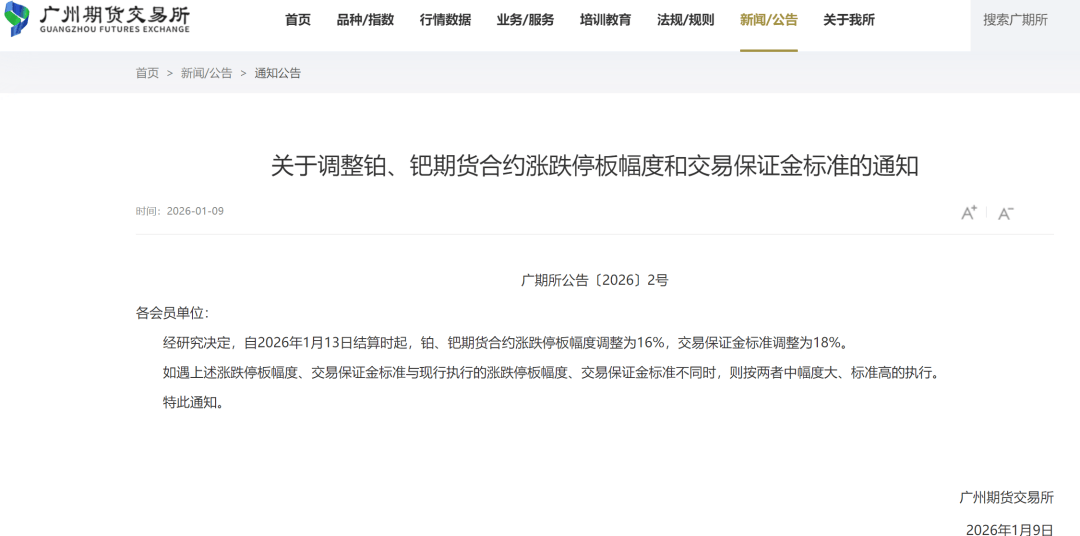
广期所再出手,修改钯铂金保证金和涨跌板,有何影响?
Sou Hu Cai Jing· 2026-01-11 02:13
Core Viewpoint - The recent adjustments in the futures contracts for platinum and palladium by the Guangzhou Futures Exchange aim to control risks and stabilize the market, reflecting a strategic move to balance speculation and fundamental market conditions [1][3]. Group 1: Market Performance - The first trading week of the year saw a positive start for the Chinese stock market and commodities, particularly for precious metals, which rebounded significantly after a period of decline [1]. - Palladium and platinum, which have experienced significant volatility over the past month, are highlighted as new entrants in the precious metals market [1]. Group 2: Regulatory Changes - The Guangzhou Futures Exchange announced an increase in the price fluctuation limits for platinum and palladium futures contracts to 16% and raised the trading margin requirement to 18%, effective January 13, 2026 [2]. - The previous fluctuation limit was 13%, and the margin requirement was 15%, indicating a 3 percentage point increase in both cases [2]. Group 3: Impact of Adjustments - The combination of increased margin requirements and fluctuation limits is intended to reduce leverage and curb speculation, while potentially increasing short-term volatility but guiding the market back to fundamental values in the long term [3]. - The core objectives of these adjustments are to lower leverage, mitigate risks, and maintain liquidity in the market [3]. Group 4: Market Guidance - The differentiated adjustments, such as lower margins for hedging compared to speculation, reflect a policy direction that encourages hedging while suppressing speculative activities, aiming to align the market with the needs of the real economy [4]. - The future performance of platinum and palladium will be significantly influenced by international price movements, indicating a strong correlation with global market trends [5].
全省金融系统工作会议召开
Da Zhong Ri Bao· 2026-01-10 01:06
Core Viewpoint - The meeting emphasized the importance of aligning the financial system's actions with the central government's scientific judgment on the economic situation, focusing on risk prevention, strong regulation, and promoting high-quality development [1] Group 1: Financial System Objectives - The financial system is required to effectively prevent risks, strengthen regulation, and promote high-quality development as the main line of work for 2026 [1] - There is a call to enhance party-building efforts and improve the management system for party activities within the financial sector [1] - The meeting highlighted the need for a coordinated approach to mitigate various intertwined risks and to combat illegal financial activities [1] Group 2: Regulatory and Development Strategies - The meeting stressed the importance of consolidating and strengthening financial regulation, ensuring strict entry standards, and enforcing regulatory compliance [1] - A commitment to promoting high-quality development was made, with a focus on expanding and improving the financial sector's capabilities [1] - The implementation of a "ten-hundred-thousand" plan for nurturing listed resources was discussed, alongside increased financial support for key areas such as domestic demand, technological innovation, and small and micro enterprises [1]
信托业分类改革成效显著 新旧发展模式“换轨”
Xin Lang Cai Jing· 2026-01-09 19:44
Core Insights - The trust industry in China is undergoing significant transformation, with a focus on high-quality development driven by a "1+N" policy framework aimed at strong regulation, risk prevention, and promoting transformation [1][3][4] Policy Framework - The "1+N" policy framework is being refined, with the State Council's opinions emphasizing the trust industry's critical role in the financial system and its service to the real economy [3] - The revised "Trust Company Management Measures" clarifies the legal status and functional positioning of trust companies, guiding them to shift from financing platforms to trustee services [3][4] Industry Growth - By mid-2025, the total trust asset scale reached 32.43 trillion yuan, marking a year-on-year growth of 20.11% [6] - The asset management trust and asset service trust have replaced traditional financing and channel trust models, becoming the main drivers of asset scale growth [6][7] Revenue and Profitability - The trust industry achieved a revenue of 34.36 billion yuan in the first half of 2025, with a profit of 19.68 billion yuan, reflecting a structural optimization in earnings sources [7] - The shift towards net value-based income from investment management and service fees indicates an improvement in the quality of earnings [7] Risk Management - Significant progress has been made in risk management, with successful resolution of major risks, including the restructuring of Sichuan Trust and the bankruptcy proceedings of Huaxin Trust [8][9] - The industry has seen a reduction in non-performing rates and risk project scales, enhancing overall risk mitigation capabilities [9] Future Outlook - The end of the transition period in May 2026 will serve as a critical juncture for the trust industry, focusing on completing compliance adjustments and fostering sustainable business models [10][11] - Challenges remain, including the need for effective management of complex legacy assets and the cultivation of new business models amid competitive pressures [10][11]

山东省金融系统工作会议召开
Zheng Quan Shi Bao Wang· 2026-01-09 10:43
Core Viewpoint - The Shandong Provincial Financial System Work Conference emphasizes the importance of aligning actions with the central government's economic strategies, focusing on risk prevention, regulatory strength, and promoting high-quality development for 2026 [1] Group 1: Financial System Objectives - The provincial financial system is urged to unify thoughts and actions with the central and provincial government's scientific judgments on the economic situation [1] - Key tasks for 2026 include effectively preventing risks, enhancing regulatory measures, and promoting high-quality development [1] Group 2: Risk Management and Regulation - There is a strong emphasis on risk prevention, including the reform of small and medium-sized financial institutions and combating illegal financial activities [1] - The conference calls for strict regulatory enforcement, including rigorous entry standards and accountability measures [1] Group 3: Development Initiatives - The financial sector is encouraged to enhance capacity and quality, utilizing appropriate monetary policy to support key areas such as domestic demand, technological innovation, and small and micro enterprises [1] - The implementation of the "Ten-Hundred-Thousand" plan for cultivating listed resources is highlighted as a priority [1]
山东召开全省金融系统工作会议
Qi Lu Wan Bao· 2026-01-09 10:22
Core Viewpoint - The meeting emphasized the importance of aligning the financial system's actions with the central government's scientific judgment on the economic situation, focusing on risk prevention, regulatory strength, and promoting high-quality development [1] Group 1: Financial System Objectives - The financial system is required to effectively prevent risks, strengthen regulation, and promote high-quality development as the main line of work for 2026 [1] - There is a call for enhancing party-building efforts and improving the management system to ensure integrity and discipline within the financial sector [1] Group 2: Risk Management and Regulation - The meeting highlighted the need for effective and orderly risk prevention, promoting reforms in small and medium-sized financial institutions, and combating illegal financial activities [1] - It is essential to consolidate and strengthen financial regulation, ensuring strict entry standards and accountability in regulatory enforcement [1] Group 3: Promoting High-Quality Development - The financial sector is urged to focus on high-quality development, enhancing capacity and quality, and making full use of moderately loose monetary policies [1] - The implementation of the "Ten-Hundred-Thousand" plan for cultivating listed resources is emphasized, along with increased financial support for key areas such as domestic demand expansion, technological innovation, and small and micro enterprises [1]
上清所:2025年集中清算业务规模819万亿元 同比增长13.6%
智通财经网· 2026-01-09 03:12
Core Insights - The Shanghai Clearing House held a work meeting on January 8, 2026, to summarize its 2025 performance and outline goals for 2026, emphasizing the importance of adhering to the principles of Xi Jinping's thought and the directives from the 20th National Congress of the Communist Party [3][4]. Group 1: 2025 Performance Summary - In 2025, the total scale of centralized clearing business reached 819 trillion yuan, with central counterparty clearing business accounting for 272 trillion yuan, representing year-on-year growth of 13.6% and 29% respectively [4]. - By the end of 2025, the bond custody scale was 50 trillion yuan, reflecting a year-on-year increase of 12.6% [4]. Group 2: Strategic Goals for 2026 - The Shanghai Clearing House aims to enhance its financial infrastructure by focusing on risk awareness and bottom-line thinking, while promoting quality and efficiency in its operations [5]. - The organization plans to strengthen political leadership, improve service quality, and innovate in foreign exchange clearing products and services, while ensuring the safety and stability of its operations [5]. - There is a commitment to expand cross-border connectivity and enhance international cooperation, particularly in the areas of bond products and clearing services [5].
河南省银行业保险业加力服务实体经济
Sou Hu Cai Jing· 2026-01-05 00:55
Group 1 - The banking and insurance sectors in Henan have shown significant growth during the "14th Five-Year Plan" period, with total assets reaching nearly 15 trillion yuan and total liabilities at 14.85 trillion yuan, marking a 50% increase compared to the end of the "13th Five-Year Plan" [1] - The balance of deposits in the banking sector increased from 7.76 trillion yuan to 11.79 trillion yuan, a growth of 52.07%, while the loan balance rose from 6.41 trillion yuan to 9.27 trillion yuan, reflecting a 44.58% increase [1] - The insurance industry also experienced robust growth, with the insurance depth and density at 4.25% and 2761.43 yuan per person respectively by the end of 2024, with the insurance density increasing by 9.49% compared to the end of the "13th Five-Year Plan" [1] Group 2 - The financial sectors are focusing on five key areas: technology finance, green finance, inclusive finance, pension finance, and digital finance, which are crucial for high-quality development in serving the real economy [2] - The loan balance in these five areas reached nearly 3.13 trillion yuan, showing a growth of 13.8% compared to the same period in 2024 [2] - The number of inclusive small and micro credit clients reached 2.311 million, with a loan balance of 1.311046 trillion yuan, representing an increase of over 70% since the beginning of the "14th Five-Year Plan" [2]
2025年债市复盘系列之二:再见2025:信用债复盘
Huachuang Securities· 2025-12-31 13:25
1. Report's Industry Investment Rating - Not provided in the content 2. Core View of the Report - In 2025, credit bond coupon value returned, and the expansion of ETFs brought a structural market. Credit risk events occurred sporadically, and the policy focus was on debt resolution and risk prevention. The net financing scale of credit bonds increased by nearly one trillion, and yields rose across the board [4][8]. 3. Summary According to the Table of Contents I. Annual Summary: Credit Bond Coupon Value Returned, and ETF Expansion Brought a Structural Market - Throughout 2025, the credit bond market was affected by various factors such as capital prices, policies, and market sentiment. The credit spread showed a trend of widening, narrowing, and then fluctuating. Overall, the 1y AA+ medium - and short - term note yield was reported at 1.78%, with the credit spread narrowing by 34BP to 23BP; the 3y AA+ medium - and short - term note yield rose by 6BP to 1.97%, with the credit spread narrowing by 21BP to 28BP; the 5y AA+ medium - and short - term note yield rose by 14BP to 2.18%, with the credit spread narrowing by 21BP to 37BP; the 10y AA+ medium - and short - term note yield rose by 30BP to 2.65%, with the credit spread widening by 2BP to 63BP [4][8][9]. II. Annual Major Events: Credit Risk Events Occurred Sporadically, and the Policy Focus was on Debt Resolution and Risk Prevention (1) Urban Investment: Debt Resolution and Arrears Clearance Accelerated, and Credit Risk Sentiment Decreased - **Hot Events**: In 2025, debt resolution continued, and two trillion in replacement bonds were issued, with Jiangsu issuing 251.1 billion yuan. The clearance of arrears accelerated, using both fiscal and financial means. The number of non - standard credit risk events in urban investment decreased significantly, and Inner Mongolia exited the list of key provinces, while Jilin met the exit criteria [21][22][28]. - **Regulatory Policies**: The central government supported the improvement and implementation of a package of debt - resolution plans. It required the implementation of debt replacement policies, regarded non - increase of implicit debt as an "iron - clad discipline", accelerated the stripping of the government financing function of local financing platforms, and promoted market - oriented transformation, as well as the clearance of local government arrears to enterprises [2][33]. (2) Real Estate: Vanke's Bond Extension at the End of the Year Slightly Exceeded Market Expectations, and Policies Continuously Promoted the Market to Stabilize and Recover - **Hot Events**: In 2025, Shenzhen Metro Group provided over 20 billion yuan in loans to Vanke to help it pay the principal and interest of its bonds in the public market. However, due to limited remaining credit, Vanke faced liquidity pressure and announced bond extensions at the end of the year. Only the motion to extend the grace period was passed in the bondholder meetings [39][40]. - **Regulatory Policies**: In 2025, real estate policies focused on demand, supply, and real - estate enterprise financing, aiming to promote market stability and build a new development model. On the demand side, it was necessary to release the potential of rigid and improved housing demand; on the supply side, high - quality urban renewal and the construction of "good houses" were emphasized; on the enterprise side, the reasonable financing needs of real - estate enterprises were supported, and the risk of debt default was prevented [44][46][47]. (3) Finance: AVIC Industry Finance, Tianan Property Insurance, and Jiutai Rural Commercial Bank Attracted Attention, and Active Measures were Taken to Prevent Financial Risks - **Hot Events**: The Ministry of Finance issued 500 billion yuan in special treasury bonds to support large banks in replenishing core tier - one capital. AVIC Industry Finance announced voluntary delisting, and the off - market bond payment plan was not approved. Tianan Property Insurance and Tianan Life Insurance defaulted on their bonds, and Jiutai Rural Commercial Bank's secondary capital bonds were significantly discounted [3][50][58]. - **Regulatory Policies**: In 2025, the central government adhered to preventing and resolving key financial risks and strictly adhered to the bottom - line of preventing systemic financial risks. It also issued high - quality development management measures for industries such as trust companies, asset management companies, commercial banks, and insurance companies to standardize their development [3][59][60]. (4) Others: The Science and Technology Bond and Credit Bond ETF Markets Developed Rapidly, and the Bond "South - Bound Connect" was Planned to be Extended to Non - Bank Institutions - **Bond Market "Science and Technology Board"**: Policies required the construction of a "science and technology board" in the bond market to support the issuance of science and technology innovation bonds. In 2025, the net financing of science and technology innovation bonds increased by nearly one trillion yuan year - on - year [65]. - **Credit Bond ETF**: In 2025, 8 benchmark - making credit bond ETFs and 24 science and technology innovation bond ETFs were listed, and the market scale expanded rapidly, reaching over 45 billion yuan by the end of the year [70]. - **Bond "South - Bound Connect"**: The scope of domestic investors in the Bond "South - Bound Connect" was planned to be expanded to non - bank institutions, and Hong Kong market bonds attracted market attention [72]. III. Review of the Primary and Secondary Markets of Credit Bonds: The Net Financing Scale Increased by Nearly One Trillion, and Yields Rose Across the Board (1) Primary Market: Industrial Bonds and Financial Bonds were the Main Supply Sources, and Urban Investment Bonds Continued to Shrink - In 2025, the net financing of credit bonds increased by 953.8 billion yuan year - on - year. Industrial bonds, supported by new science and technology bond policies, were the main supply source. The issuance of financial bonds accelerated in the third quarter due to the strong performance of the equity market, while the net supply of urban investment bonds continued to shrink [73]. (2) Secondary Market: Yields Generally Rose, Credit Spreads Narrowed Significantly at the Short - to - Medium End and Slightly Widened at the Long End - In 2025, the yields of credit bonds generally rose, especially at the medium - to - long end. The credit spreads showed a differentiated trend, narrowing significantly at the short - to - medium end and slightly widening at the long end. Non - financial bonds performed better than financial bonds [83].


各部委各地学习中央经济工作会议“划重点”
GOLDEN SUN SECURITIES· 2025-12-24 14:18
Group 1: Policy Implementation - Various departments are refining their implementation of the Central Economic Work Conference's spirit, focusing on "stability while seeking progress" and "quality improvement" as the main themes[3] - Emphasis on accelerating the disbursement of funds and implementing major projects ahead of schedule to ensure a strong start in 2026[2] - The central government plans to maintain a necessary fiscal deficit and debt scale, with the overall fiscal deficit expected to be similar to that of 2025[4] Group 2: Economic Growth Strategies - Aiming to cultivate new consumption growth points worth trillions, with increased investment in consumer infrastructure and social welfare projects[6] - The government is focusing on expanding domestic demand, supporting "two new" and "two heavy" projects, and implementing the "15th Five-Year Plan" major projects[6] - The central bank may consider lowering reserve requirements and interest rates in the first quarter of 2026 to stimulate economic activity[2] Group 3: Risk Management and Market Stability - A commitment to prevent financial risks, ensuring that no major defaults occur, particularly in the real estate sector[10] - The government is taking measures to stabilize the real estate market while balancing the needs of residents and property companies[10] - Continuous efforts to promote the stock market narrative and attract long-term investments, including reforms in the Sci-Tech Innovation Board and commercial real estate REITs pilot programs[10]