
陆海统筹

Search documents
推动海洋经济高质量发展
Jing Ji Ri Bao· 2025-09-16 00:04
Group 1 - The core viewpoint emphasizes the importance of high-quality development of the marine economy, focusing on innovation-driven growth, efficient collaboration, industrial upgrading, harmonious human-ocean relationships, and cooperative win-win strategies [1][2][3] - The national marine production value is projected to exceed 10 trillion yuan in 2024, marking a 5.9% increase from the previous year, accounting for 7.8% of the GDP [1] - Coastal provinces are actively promoting the marine economy as a key growth driver, with several provinces implementing policies to support high-quality marine economic development [1] Group 2 - The global marine landscape is undergoing significant changes, with major economies intensifying their focus on marine strategies, leading to increased competition [2] - Strengthening and expanding the marine industry is identified as a core pathway to achieve high-quality marine economic development and enhance national strategic resource reserves and global competitiveness [2] - There is a strong emphasis on transforming traditional marine industries, fostering emerging industries, and integrating marine and digital economies to elevate the supply chain towards high-end, intelligent, and green development [2] Group 3 - A coordinated approach between land and sea is essential for the effective development of marine resources, requiring comprehensive planning and steady progress [3] - The establishment of a collaborative and efficient policy framework is necessary to support marine economic development, encouraging private investment and participation from specialized enterprises [3] - Active participation in global marine governance and cooperation in marine scientific research and disaster prevention is crucial for enhancing China's influence in international marine rule-making [3]
蹲点调查|海上山东
Sou Hu Cai Jing· 2025-09-15 02:53
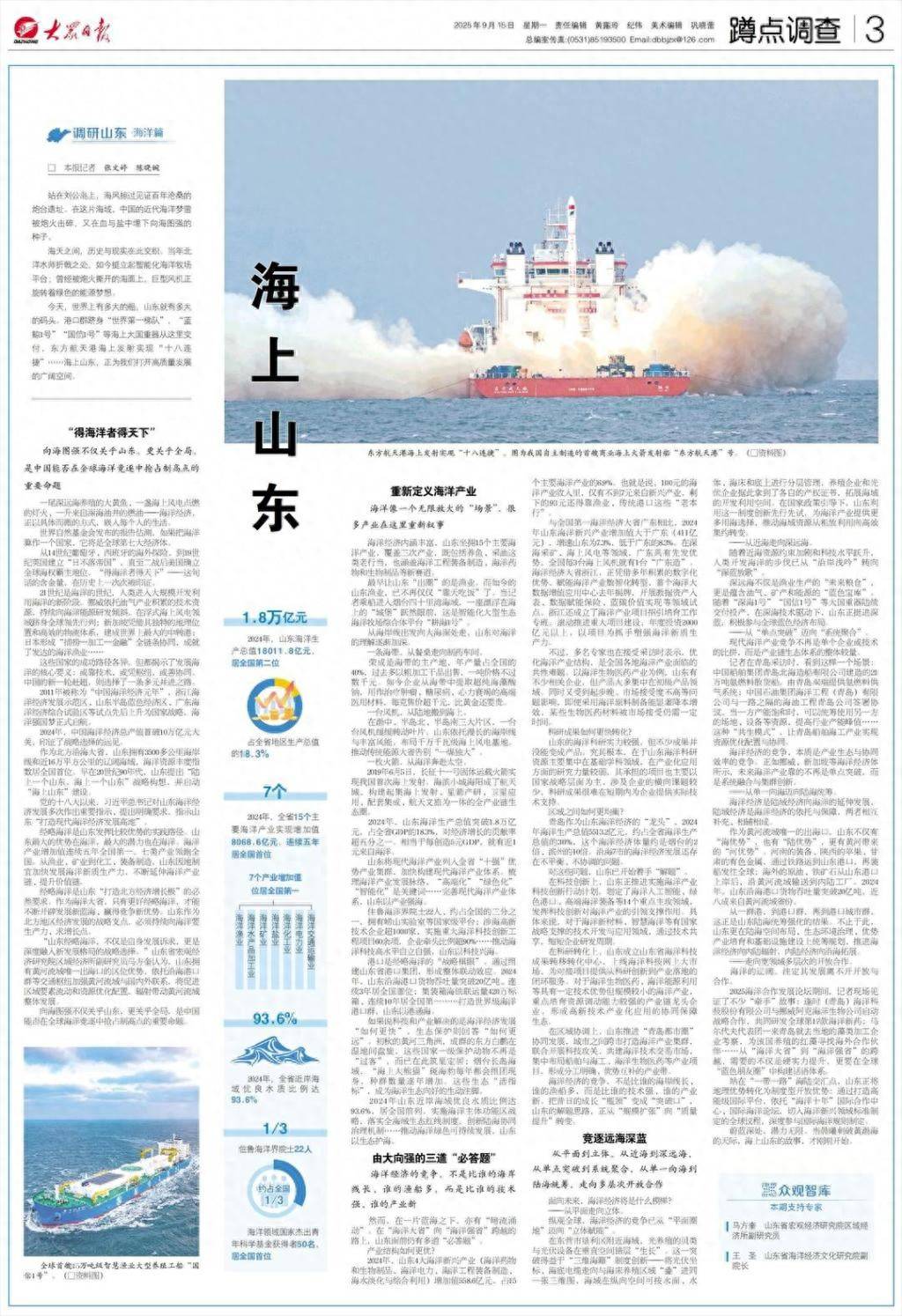
Group 1 - The article emphasizes the importance of marine economy development for Shandong province, highlighting its strategic significance for both local and national growth [10][15][16] - Shandong has a coastline of over 3,500 kilometers and a vast marine area of nearly 160,000 square kilometers, making it a leader in marine resources in China [14][15] - The marine economy in Shandong is projected to exceed 10 trillion yuan by 2024, contributing significantly to the province's GDP [12][24] Group 2 - The marine economy encompasses various industries, including traditional sectors like fishing and oil extraction, as well as emerging fields such as marine engineering, marine pharmaceuticals, and offshore wind power [17][21] - Shandong's marine production value is expected to surpass 1.8 trillion yuan in 2024, accounting for 18.3% of the province's GDP [24][25] - The province aims to enhance its marine industry structure by focusing on high-end, green, and intelligent development [25][30] Group 3 - Shandong is facing challenges in optimizing its industrial structure, with only 6.9% of its marine industry revenue coming from emerging sectors [27][28] - The province's marine scientific research capabilities are strong, but there is a need for faster commercialization of research outcomes [28][29] - There is an imbalance in marine economic development among coastal cities in Shandong, with Qingdao being the leading city [29] Group 4 - The article discusses the shift from nearshore to deep-sea development, highlighting the potential of deep-sea resources for future economic growth [39][40] - Shandong is focusing on creating a collaborative ecosystem among marine industries to enhance overall efficiency and competitiveness [41][42] - The integration of land and sea economies is crucial for Shandong's development, leveraging its geographical advantages [44][45]

广西两项目荣获联合国生态大奖
Guang Xi Ri Bao· 2025-09-12 03:13
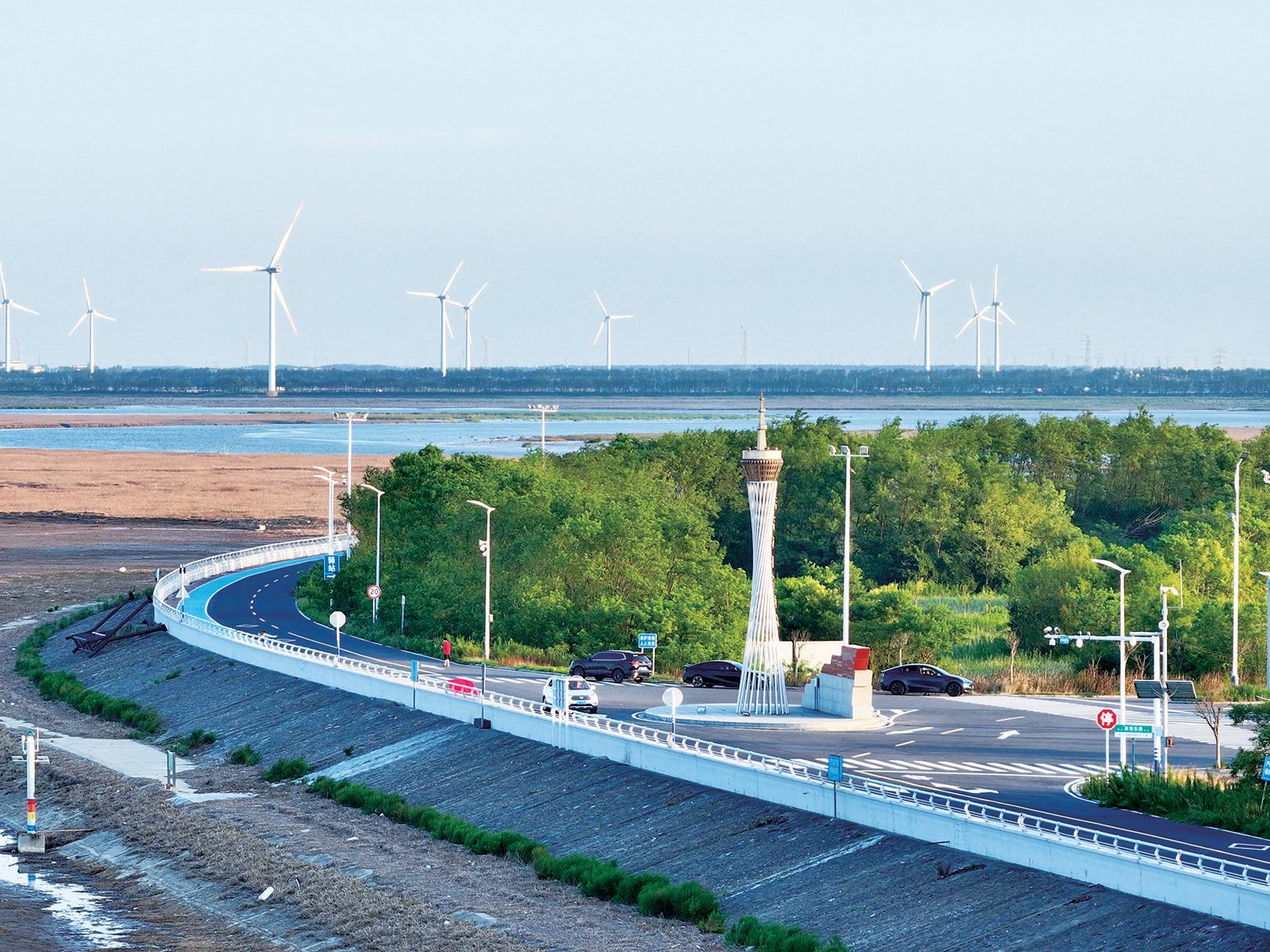
Group 1 - The United Nations "Decade of Ocean Science for Sustainable Development" event highlighted successful marine ecological protection and restoration projects, with notable recognition for projects from Fangchenggang and Qinzhou [1] - Fangchenggang has implemented comprehensive ecological restoration measures since 2012, including ecological revetment, mangrove planting, and shoreline restoration, achieving a natural shoreline retention rate of 59% and planting 113.7 hectares of mangroves [1] - The city has integrated disaster reduction, ecological protection, and cultural leisure into its coastal restoration efforts, significantly enhancing the area's ability to withstand erosion from wind, waves, and currents [1] Group 2 - Qinzhou has adopted a "land-sea coordination and systematic governance" approach, focusing on "ecological priority and green development," and has invested 309 million yuan in the Jin'gu River shoreline ecological restoration project [2] - The project has successfully restored 90.12 hectares of mangroves, repaired 5.3 kilometers of shoreline, and restored 1.47 hectares of seabird habitats, contributing to improved water quality in the bay [2] - The ecological restoration efforts aim to recreate the scenic beauty of "birds nesting in mangroves and fish swimming in clear waters" in the Peacock Bay area [2]
山东:鼓足“蓝色动能”,向海洋强省进发
Xin Hua Wang· 2025-09-06 01:40
Group 1 - The core viewpoint emphasizes the strategic importance of the marine economy in Shandong, which has achieved a marine production value exceeding 1.8 trillion yuan, contributing 23.9% to the province's GDP [1] - Shandong aims to enhance its marine economy by innovating and implementing a layered spatial management system for marine usage, allowing for diverse marine activities to coexist [2] - The integration of port, industry, and city development is a key focus for Shandong, with significant investments in infrastructure and a strong emphasis on collaborative growth among these sectors [3] Group 2 - The province plans to leverage international cooperation through forums and partnerships, aiming to attract global investment and enhance the competitiveness of its marine industries [4] - By 2027, Shandong targets to cultivate 20 marine characteristic industrial clusters and increase marine production value to over 2 trillion yuan [4]
“三重构”激活海洋发展新动能
Zhong Guo Zi Ran Zi Yuan Bao· 2025-09-02 00:39
Core Viewpoint - The article highlights the transformation of Hai'an, Jiangsu Province, into a high-quality marine economy through innovative spatial, mechanism, and environmental restructuring, despite its limited coastline and historical economic challenges [1]. Spatial Restructuring - Hai'an is breaking the land-sea divide to optimize resource allocation, implementing the "Three Adjustments and Three Optimizations" project to prioritize land for marine strategic emerging industries [3]. - The city is enhancing its logistics capabilities by developing a railway logistics hub, integrating with the Yangtze River Delta's logistics network through various rail and waterway connections [5]. Mechanism Restructuring - Hai'an is addressing inefficiencies in project approvals by dismantling departmental barriers and establishing a collaborative service mechanism, which includes a "1+2+N" matrix for project support [7]. - The city has initiated a "Major Project Breakthrough Year" to accelerate the construction of significant projects, with 6 provincial and 51 municipal major projects currently underway [7]. Environmental Restructuring - The city is prioritizing ecological restoration, investing in coastal and wetland rehabilitation projects to enhance resilience against natural disasters while promoting a harmonious relationship between humans and nature [9]. - Hai'an aims to transform its development model by focusing on strategic industry support, revitalizing existing land, and fostering innovation, contributing to the high-quality development of its marine economy [9].
“两山”理念的文化实践:一座省级博物馆如何点“绿”成“金”
Zhong Guo Xin Wen Wang· 2025-08-29 04:02
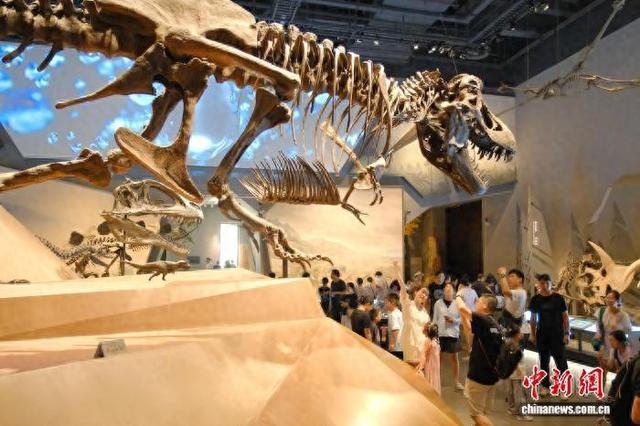
Core Viewpoint - The establishment of the Zhejiang Natural Museum Anji Pavilion represents a significant cultural strategy shift, promoting equal access to public cultural services and enhancing regional development through ecological education and tourism [3][4]. Group 1: Cultural and Ecological Impact - The Anji Pavilion, opened in December 2018, has become a cultural landmark in the Yangtze River Delta, attracting over 740 million visitors and generating approximately 7.5 billion yuan in local tourism revenue in its first year [4]. - The pavilion's design integrates with the natural landscape, creating an immersive experience that emphasizes the harmony between humans and nature, aligning with the "Two Mountains" concept [3][6]. Group 2: Educational Initiatives - The museum has launched innovative educational programs, such as the "Green Water and Green Mountains Study Camp," which engage students in biodiversity protection and sustainable resource use through hands-on learning experiences [6][8]. - A notable project involved recruiting "island breeding bird monitors," which successfully raised public awareness about ecological conservation and transformed passive education into active community engagement [6]. Group 3: Regional Collaboration and Resource Sharing - The "Big Museum and Small Museum" model aims to enhance collaboration between the provincial museum and local rural museums, fostering resource sharing and expanding the reach of scientific education [8][9]. - The museum is also exploring new pathways for cultural resource transformation through the development of creative products and IPs, aiming to promote ecological industry growth in the province [9].
为海洋强省建设强基赋能——自然资源部服务经济大省挑大梁江苏蹲点服务组工作见闻
Zhong Guo Zi Ran Zi Yuan Bao· 2025-08-19 02:37
Group 1 - Jiangsu province, as a marine powerhouse, has a coastline of 954 kilometers and accounts for 25% of the country's tidal flat resources, with marine GDP projected to exceed 1 trillion yuan by 2024, up from 677.65 billion yuan in 2018 [1][2] - The service team from the Ministry of Natural Resources has been instrumental in addressing land and sea use issues, having resolved 20 problems and accelerating the processing of remaining issues to support Jiangsu's marine development [2][4] - The Blue Ocean New Materials project, with a total investment of 50 billion yuan, is a strategic collaboration between China National Petroleum Corporation and Jiangsu, aiming to produce high-end polyolefin materials for various industries, with production expected to start in June 2026 [4][5] Group 2 - The city of Nantong has implemented a "service upon project registration" mechanism, improving efficiency in land and sea use approvals, resulting in 21 approved construction projects this year [5][6] - The service team has conducted 19 meetings and surveyed 28 projects, collecting 71 suggestions to facilitate project implementation and enhance local service levels [8][9] - The Huisheng Marine Equipment Base project, with an investment of approximately 9 billion yuan, is expected to produce 2-3 large floating LNG units annually, contributing an estimated 20 billion yuan in new taxable sales [9][10] Group 3 - The "tenglong huan niao" (replacing old with new) strategy has revitalized previously idle land, with 415 acres of low-efficiency sea area repurposed for new projects, attracting 46 quality projects with a total investment of 55.3 billion yuan [12][13] - The service team is committed to ongoing support for Jiangsu's economic development, encouraging local governments to present issues related to natural resources for resolution [13]
从生态“痛点”到滨海“明珠”,广西犀丽湾生态修复成果丰硕
Zhong Guo Huan Jing Bao· 2025-08-15 09:14
Core Insights - The article highlights the successful ecological restoration of Xili Bay in Qinzhou, Guangxi, transforming it from an environmentally degraded area into a thriving tourist destination [1][5] Group 1: Historical Context - Xili Bay, located in Qinzhou, faced severe ecological challenges due to climate change, overdevelopment, and pollution, leading to significant coastal erosion and a decline in marine biodiversity [2][3] - Prior to 2019, the area was characterized by illegal constructions and overfishing, resulting in a drastic reduction of marine life and threatening the livelihoods of local fishermen [2][3] Group 2: Restoration Efforts - Starting in 2019, Qinzhou initiated a systematic ecological restoration project for Xili Bay, focusing on comprehensive management strategies rather than temporary fixes [3][4] - The restoration involved three phases: removal of illegal structures, beach restoration, and the establishment of marine protected areas with artificial reefs [3][4] Group 3: Results and Achievements - By 2022, the restoration efforts led to significant improvements, including a 63.38% increase in coastal erosion protection efficiency and a substantial rise in biodiversity, with the number of marine species recorded increasing from 37 to 89 [4][6] - Xili Bay was recognized as a national AAA-level tourist attraction in 2023, attracting over 800,000 visitors and generating more than 30 million yuan in revenue for local businesses [5][6] Group 4: Socioeconomic Impact - The ecological restoration has not only improved the environment but also created new economic opportunities, allowing former fishermen to transition into tourism-related businesses [5][6] - The integration of ecological protection with tourism has led to the creation of over 100 direct jobs and has indirectly benefited more than 2,000 fishermen through the shift to eco-tourism [6]
中国经济圆桌会丨自然资源部:确保“蓝色增长极”持续发力
Xin Hua She· 2025-08-13 04:01
Core Viewpoint - The Ministry of Natural Resources emphasizes the importance of coordinating marine resource development and protection to ensure the sustainable growth of the "blue growth pole" in China [1][2]. Group 1: Marine Resource Management - The Ministry will enhance spatial planning and control, integrating marine and island resources into a unified national land and space planning framework [1]. - There will be a focus on improving the efficiency of resource utilization and promoting a more intensive and economical use of marine resources [1]. - The Ministry aims to strengthen land-sea coordination and regional collaboration, enhancing the governance of river basins and marine areas [1][2]. Group 2: Ecological Protection Initiatives - The Ministry has established marine ecological protection red lines and optimized the spatial layout for marine ecological and development areas [2]. - Approximately 200 major projects for marine ecological protection and restoration are supported by central financial resources, leading to the restoration of nearly 1,780 kilometers of coastline and over 795,000 acres of coastal wetlands [2]. - New initiatives include the construction of "blue bays," "beautiful islands," and "beautiful beaches," contributing to a comprehensive protection framework from mountains to oceans [2]. Group 3: Technological and Financial Support - The Ministry will continue to promote technological innovation in green and low-carbon technologies to drive high-quality development in the marine industry [2]. - There will be an increase in support for "blue finance" to enhance the mechanisms for ecological damage compensation and protection [1].
全国首个县级海岸带规划通过验收
Zhong Guo Zi Ran Zi Yuan Bao· 2025-08-12 09:38
Core Insights - The first county-level coastal zone planning document in China, titled "Ruian Coastal Zone and Marine Spatial Planning (2021-2035)," has passed expert review, marking a significant step for Ruian City in balancing coastal resource protection and sustainable marine economic development [1] Group 1: Planning and Development - The planning document is a pioneering exploration under the collaborative model of coastal zone planning at the provincial and municipal levels in Zhejiang Province and Wenzhou City, focusing on detailed spatial layout at the county level [1] - The plan is based on Ruian's unique marine resource endowments, including estuaries, bays, and island groups, and aligns with higher-level marine development strategies [1] - It establishes a spatial pattern of "one estuary and two island groups," detailing spatial zoning and resource classification structures for marine areas, coastlines, and islands [1] Group 2: Research and Support - The coastal zone and marine spatial resource management research team at the Second Institute of Oceanography has leveraged interdisciplinary advantages and long-term work experience to conduct theoretical and practical research on coastal zone spatial planning in Zhejiang [2] - The team has led the development of the provincial pilot "Zhejiang Coastal Zone and Marine Spatial Planning (2021-2035)" and created guidelines for municipal coastal zone planning, providing significant technological support for the "Zhejiang Marine Strong Province" strategy [2]