VIX

Search documents
CBOE’s volatility expert Mandy Xu sees more record market gains next week
CNBC Television· 2025-07-25 21:50
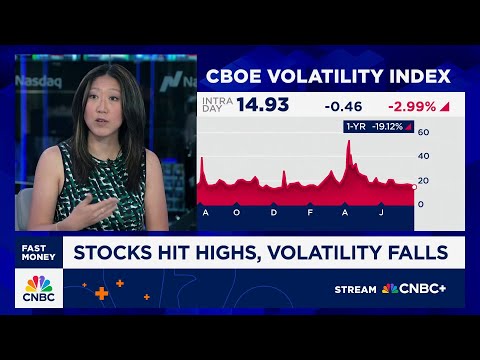
The VIX volatility index falling below 15 for the first time since February. For more, let's bring in Mandy Shu, head of derivatives market intelligence for SIBO Global Markets. Mandy, it's always great to see you. Great to be here.It's not just the VIX. I mean, volatility across asset classes, bond volatility is also very low. What does this tell you.Yeah, to me, I think it's a sign that what we're seeing in the markets is very much fundamentally driven, right. The fact that equities keep making new all-ti ...

The market is underpricing a lot of risk, says DeCarley Trading's Carley Garner
CNBC Television· 2025-07-18 10:58
Market Risk Assessment - The market is currently underpricing risk, including geopolitical risks and potential deleveraging in the system [3] - There is more downside risk than upside potential in the market [5][10] - The equity market generally weakens in late July and early August [4] Investment Strategy - Recommends a risk reversal strategy for clients holding S&P 500 stock, involving selling call options (e.g, 6800 calls in December) to fund the purchase of put options [6][7] - The strategy aims to provide portfolio insurance, capping gains at 6800 but protecting against downside risk [7][8] - Suggests reassessing stock allocation, especially for those stressed by market volatility, and potentially reducing risk exposure [11] Market Outlook - Sees potential for the S&P 500 to reach 6500 based on charting and trend lines [5][9] - Identifies downside risk with potential levels at 5500 or lower [5]
'Fast Money' traders talk Wednesday's big moves in Big Tech
CNBC Television· 2025-07-09 21:45
Market Trends & Sentiment - The market is responding to momentum, led by mega-cap tech stocks [1] - Small caps outperformed, up over 1% [2] - Markets want to go higher in the absence of rockiness, with the VIX sub 16 [3] - The market got a charge from the Fed's potential rate cuts [5] - There's a good setup for the second half of the year with inflation coming down [7] - Retail investors are rushing into riskier areas like Bitcoin and Nvidia [8] Earnings & Growth - Q1 earnings were essentially a pass on uncertainty [2] - Growth is continuing to be strong, defying expectations of a fall [6] Investment Opportunities & Risks - There's still a lot of cash on the sidelines that could re-enter the market as shorter-term rates come down [7] - Nvidia's dominance in the AI space may be chipped away [10] - A company with 125% of sales from China saw its stock rise despite customer concentration risks and customers seeking alternative chip sources [9]


'Fast Money' traders recap Q2 and the first half of 2025
CNBC Television· 2025-06-30 22:02
Market Performance & Sentiment - The first half of the year saw an extraordinary market bounce from the April lows, with significant intra-quarter swings [1][2][3] - Sentiment change was notable, with Meta up almost 30% and JP Morgan up almost 20% [2] - The NASDAQ is on the verge of making a new relative high against the S&P, a key indicator for market players [7] - The S&P and NASDAQ made brief new highs, closing the first half near all-time highs with a VIX below 17 [8][9] Economic Factors & Risks - The first half of the year was one of the worst for the US dollar since the 1970s, with a nearly 7% move lower in the dollar index during Q2 [5] - A weaker dollar is beneficial for multinationals and the big tech trade [9] - The Fed lowered its growth target for the US for the second half of the year [10] - There is confusion regarding the Fed's next move, with scenarios for both lowering and maintaining interest rates [11][12] Sector Performance & Concerns - The reemergence of big tech companies has been a significant driver [6] - While tech may continue to drive the market higher, caution is advised due to potential shifts in the dollar or crude oil prices [9] - Energy, materials, home builders, retail, and pharma sectors are underperforming, indicating a lack of broad-based rally [9][10]

VIX已先行释放回暖情绪,15%的贴水还能维持多久?
Xinda Securities· 2025-06-07 08:11
Quantitative Models and Construction Methods Model Name: IC Hedging Strategy - **Model Construction Idea**: The strategy is based on the analysis of basis convergence factors and optimization strategies as discussed in the Cinda Derivatives Research Report Series III[45] - **Model Construction Process**: - **Backtesting Period**: July 22, 2022, to June 6, 2025[46] - **Spot End**: Hold the total return index of the corresponding underlying index[46] - **Futures End**: Use 70% of the funds for the spot end and short the same nominal principal amount of CSI 500 index futures contracts, occupying the remaining 30% of the funds[46] - **Rebalancing Rules**: Continuously hold the quarterly/monthly contracts until the remaining days to maturity are less than 2 days, then close the position at the closing price of the day and short the next quarterly/monthly contract at the closing price of the day[46] - **Model Evaluation**: The strategy performed well with positive weekly returns due to the expansion of the basis discount[49] Model Name: IF Hedging Strategy - **Model Construction Idea**: Similar to the IC Hedging Strategy, based on basis convergence factors and optimization strategies[45] - **Model Construction Process**: - **Backtesting Period**: July 22, 2022, to June 6, 2025[50] - **Spot End**: Hold the total return index of the corresponding underlying index[50] - **Futures End**: Use 70% of the funds for the spot end and short the same nominal principal amount of CSI 300 index futures contracts, occupying the remaining 30% of the funds[50] - **Rebalancing Rules**: Continuously hold the quarterly/monthly contracts until the remaining days to maturity are less than 2 days, then close the position at the closing price of the day and short the next quarterly/monthly contract at the closing price of the day[50] - **Model Evaluation**: The strategy performed well with positive weekly returns due to the expansion of the basis discount[54] Model Name: IH Hedging Strategy - **Model Construction Idea**: Similar to the IC Hedging Strategy, based on basis convergence factors and optimization strategies[45] - **Model Construction Process**: - **Backtesting Period**: July 22, 2022, to June 6, 2025[55] - **Spot End**: Hold the total return index of the corresponding underlying index[55] - **Futures End**: Use 70% of the funds for the spot end and short the same nominal principal amount of SSE 50 index futures contracts, occupying the remaining 30% of the funds[55] - **Rebalancing Rules**: Continuously hold the quarterly/monthly contracts until the remaining days to maturity are less than 2 days, then close the position at the closing price of the day and short the next quarterly/monthly contract at the closing price of the day[55] - **Model Evaluation**: The strategy performed well with positive weekly returns due to the expansion of the basis discount[58] Model Name: IM Hedging Strategy - **Model Construction Idea**: Similar to the IC Hedging Strategy, based on basis convergence factors and optimization strategies[45] - **Model Construction Process**: - **Backtesting Period**: July 22, 2022, to June 6, 2025[59] - **Spot End**: Hold the total return index of the corresponding underlying index[59] - **Futures End**: Use 70% of the funds for the spot end and short the same nominal principal amount of CSI 1000 index futures contracts, occupying the remaining 30% of the funds[59] - **Rebalancing Rules**: Continuously hold the quarterly/monthly contracts until the remaining days to maturity are less than 2 days, then close the position at the closing price of the day and short the next quarterly/monthly contract at the closing price of the day[59] - **Model Evaluation**: The strategy performed well with positive weekly returns due to the expansion of the basis discount[60] Model Backtesting Results - **IC Hedging Strategy**: - Annualized Return: -2.65% (monthly continuous), -1.77% (quarterly continuous), -0.74% (minimum discount strategy)[49] - Volatility: 3.91% (monthly continuous), 4.81% (quarterly continuous), 4.73% (minimum discount strategy)[49] - Maximum Drawdown: -7.51% (monthly continuous), -8.34% (quarterly continuous), -7.97% (minimum discount strategy)[49] - Net Value: 0.9264 (monthly continuous), 0.9504 (quarterly continuous), 0.9792 (minimum discount strategy)[49] - Annual Turnover: 12 (monthly continuous), 4 (quarterly continuous), 17.55 (minimum discount strategy)[49] - 2025 YTD Return: -2.82% (monthly continuous), -0.36% (quarterly continuous), 0.04% (minimum discount strategy)[49] - **IF Hedging Strategy**: - Annualized Return: 0.63% (monthly continuous), 0.92% (quarterly continuous), 1.46% (minimum discount strategy)[54] - Volatility: 3.05% (monthly continuous), 3.40% (quarterly continuous), 3.19% (minimum discount strategy)[54] - Maximum Drawdown: -3.95% (monthly continuous), -4.03% (quarterly continuous), -4.06% (minimum discount strategy)[54] - Net Value: 1.0181 (monthly continuous), 1.0264 (quarterly continuous), 1.0421 (minimum discount strategy)[54] - Annual Turnover: 12 (monthly continuous), 4 (quarterly continuous), 15.10 (minimum discount strategy)[54] - 2025 YTD Return: -0.53% (monthly continuous), 0.65% (quarterly continuous), 0.85% (minimum discount strategy)[54] - **IH Hedging Strategy**: - Annualized Return: 1.17% (monthly continuous), 2.11% (quarterly continuous), 1.83% (minimum discount strategy)[58] - Volatility: 3.17% (monthly continuous), 3.59% (quarterly continuous), 3.18% (minimum discount strategy)[58] - Maximum Drawdown: -4.22% (monthly continuous), -3.75% (quarterly continuous), -3.91% (minimum discount strategy)[58] - Net Value: 1.0337 (monthly continuous), 1.0613 (quarterly continuous), 1.0529 (minimum discount strategy)[58] - Annual Turnover: 12 (monthly continuous), 4 (quarterly continuous), 16.15 (minimum discount strategy)[58] - 2025 YTD Return: 0.29% (monthly continuous), 1.19% (quarterly continuous), 1.17% (minimum discount strategy)[58] - **IM Hedging Strategy**: - Annualized Return: -5.86% (monthly continuous), -4.16% (quarterly continuous), -3.46% (minimum discount strategy)[60] - Volatility: 4.75% (monthly continuous), 5.80% (quarterly continuous), 5.61% (minimum discount strategy)[60] - Maximum Drawdown: -14.00% (monthly continuous), -12.63% (quarterly continuous), -11.11% (minimum discount strategy)[60] - Net Value: 0.8528 (monthly continuous), 0.8839 (quarterly continuous), 0.9006 (minimum discount strategy)[60] - Annual Turnover: 12 (monthly continuous), 4 (quarterly continuous), 16.02 (minimum discount strategy)[60] - 2025 YTD Return: -7.89% (monthly continuous), -2.89% (quarterly continuous), -1.81% (minimum discount strategy)[60] Quantitative Factors and Construction Methods Factor Name: Cinda-VIX - **Factor Construction Idea**: Reflects the market's expectation of future volatility of the underlying asset, with a term structure to reflect expectations over different periods[63] - **Factor Construction Process**: - **Algorithm Basis**: Based on the methodology discussed in the Cinda Derivatives Research Report Series IV[63] - **Current Values**: As of June 6, 2025, the 30-day VIX values for SSE 50, CSI 300, CSI 500, and CSI 1000 are 17.19, 16.45, 22.33, and 22.89, respectively[63] Factor Name: Cinda-SKEW - **Factor Construction Idea**: Measures the skewness of implied volatility (IV) of options with different strike prices, indicating market expectations of extreme events[68] - **Factor Construction Process**: - **Algorithm Basis**: Captures the skewness in IV to reflect market expectations of future returns distribution[68] - **Current Values**: As of June 6, 2025, the SKEW values for SSE

VIX低位调整,SKEW急涨预警极端风险
Xinda Securities· 2025-05-24 10:08
Quantitative Models and Construction Methods 1. Model Name: Continuous Hedging Strategy - **Model Construction Idea**: The strategy is based on the convergence of basis factors in stock index futures and optimizes hedging through continuous adjustments[47] - **Model Construction Process**: - **Backtesting Period**: From July 22, 2022, to May 23, 2025[48] - **Spot Side**: Hold the total return index of the corresponding underlying index[48] - **Futures Side**: Use 70% of the funds for the spot side and short the futures side with the same nominal principal, occupying the remaining 30% of the funds. After each rebalancing, recalculate the quantities of the spot and futures sides based on the product's net value[48] - **Rebalancing Rules**: Continuously hold quarterly/monthly contracts until the remaining time to maturity is less than 2 days. Close the position at the closing price on that day and simultaneously short the next quarterly/monthly contract at the closing price[48] - **Assumptions**: Equal allocation of principal between the spot and futures sides, excluding transaction fees, impact costs, and the indivisibility of futures contracts[48] 2. Model Name: Minimum Discount Hedging Strategy - **Model Construction Idea**: This strategy selects futures contracts with the smallest annualized basis discount for hedging, aiming to optimize returns[49] - **Model Construction Process**: - **Backtesting Period**: From July 22, 2022, to May 23, 2025[49] - **Spot Side**: Hold the total return index of the corresponding underlying index[49] - **Futures Side**: Use 70% of the funds for the spot side and short the futures side with the same nominal principal, occupying the remaining 30% of the funds. After each rebalancing, recalculate the quantities of the spot and futures sides based on the product's net value[49] - **Rebalancing Rules**: Calculate the annualized basis for all tradable futures contracts on the day of rebalancing and select the contract with the smallest discount for opening a position. Hold the same contract for 8 trading days or until the remaining time to maturity is less than 2 days before selecting a new contract. Even if the result is to hold the original contract, it must still be held for 8 trading days[49] - **Assumptions**: Equal allocation of principal between the spot and futures sides, excluding transaction fees, impact costs, and the indivisibility of futures contracts[49] --- Model Backtesting Results 1. Continuous Hedging Strategy - **IC (CSI 500 Futures)**: - Annualized Return: -2.50% (monthly), -1.64% (quarterly)[51] - Volatility: 3.93% (monthly), 4.83% (quarterly)[51] - Maximum Drawdown: -7.51% (monthly), -8.34% (quarterly)[51] - Net Value: 0.9312 (monthly), 0.9545 (quarterly)[51] - Annual Turnover: 12 (monthly), 4 (quarterly)[51] - 2025 YTD Return: -2.34% (monthly), 0.05% (quarterly)[51] - **IF (CSI 300 Futures)**: - Annualized Return: 0.72% (monthly), 0.99% (quarterly)[56] - Volatility: 3.07% (monthly), 3.41% (quarterly)[56] - Maximum Drawdown: -3.95% (monthly), -4.03% (quarterly)[56] - Net Value: 1.0204 (monthly), 1.0281 (quarterly)[56] - Annual Turnover: 12 (monthly), 4 (quarterly)[56] - 2025 YTD Return: -0.30% (monthly), 0.83% (quarterly)[56] - **IH (SSE 50 Futures)**: - Annualized Return: 1.18% (monthly), 2.14% (quarterly)[60] - Volatility: 3.18% (monthly), 3.61% (quarterly)[60] - Maximum Drawdown: -4.22% (monthly), -3.75% (quarterly)[60] - Net Value: 1.0336 (monthly), 1.0612 (quarterly)[60] - Annual Turnover: 12 (monthly), 4 (quarterly)[60] - 2025 YTD Return: 0.28% (monthly), 1.18% (quarterly)[60] - **IM (CSI 1000 Futures)**: - Annualized Return: -5.76% (monthly), -4.12% (quarterly)[62] - Volatility: 4.76% (monthly), 5.81% (quarterly)[62] - Maximum Drawdown: -14.00% (monthly), -12.63% (quarterly)[62] - Net Value: 0.8595 (monthly), 0.8909 (quarterly)[62] - Annual Turnover: 12 (monthly), 4 (quarterly)[62] - 2025 YTD Return: -7.32% (monthly), -2.55% (quarterly)[62] 2. Minimum Discount Hedging Strategy - **IC (CSI 500 Futures)**: - Annualized Return: -0.61%[51] - Volatility: 4.75%[51] - Maximum Drawdown: -7.97%[51] - Net Value: 0.9829[51] - Annual Turnover: 17.78[51] - 2025 YTD Return: 0.42%[51] - **IF (CSI 300 Futures)**: - Annualized Return: 1.56%[56] - Volatility: 3.20%[56] - Maximum Drawdown: -4.06%[56] - Net Value: 1.0445[56] - Annual Turnover: 14.94[56] - 2025 YTD Return: 1.09%[56] - **IH (SSE 50 Futures)**: - Annualized Return: 1.85%[60] - Volatility: 3.19%[60] - Maximum Drawdown: -3.91%[60] - Net Value: 1.0528[60] - Annual Turnover: 16.36[60] - 2025 YTD Return: 1.16%[60] - **IM (CSI 1000 Futures)**: - Annualized Return: -3.45%[62] - Volatility: 5.62%[62] - Maximum Drawdown: -11.11%[62] - Net Value: 0.9068[62] - Annual Turnover: 16.12[62] - 2025 YTD Return: -1.64%[62] --- Quantitative Factors and Construction Methods 1. Factor Name: Cinda-VIX - **Factor Construction Idea**: Reflects investors' expectations of future volatility in the options market, with a term structure to capture different time horizons[65] - **Factor Construction Process**: - Based on methodologies from international markets, adjusted for China's options market[65] - Captures implied volatility from options prices to reflect market sentiment[65] - **Factor Values**: - 30-day VIX values as of May 23, 2025: - SSE 50: 18.91 - CSI 300: 17.52 - CSI 500: 24.78 - CSI 1000: 26.65[65][66][67] 2. Factor Name: Cinda-SKEW - **Factor Construction Idea**: Measures the skewness of implied volatility across different strike prices, capturing market expectations of extreme risks[72] - **Factor Construction Process**: - Analyzes the slope of implied volatility curves to assess market sentiment on tail risks[72] - Higher SKEW values indicate increased concerns about extreme downside risks[73] - **Factor Values**: - SKEW values as of May 23, 2025: - SSE 50: 107.30 - CSI 300: 108.20 - CSI 500: 101.41 - CSI 1000: 110.79[73][74][79]
【UNFX课堂】揭秘VIX:不只是“恐慌”,更是华尔街和老美的心电图!
Sou Hu Cai Jing· 2025-04-27 03:58
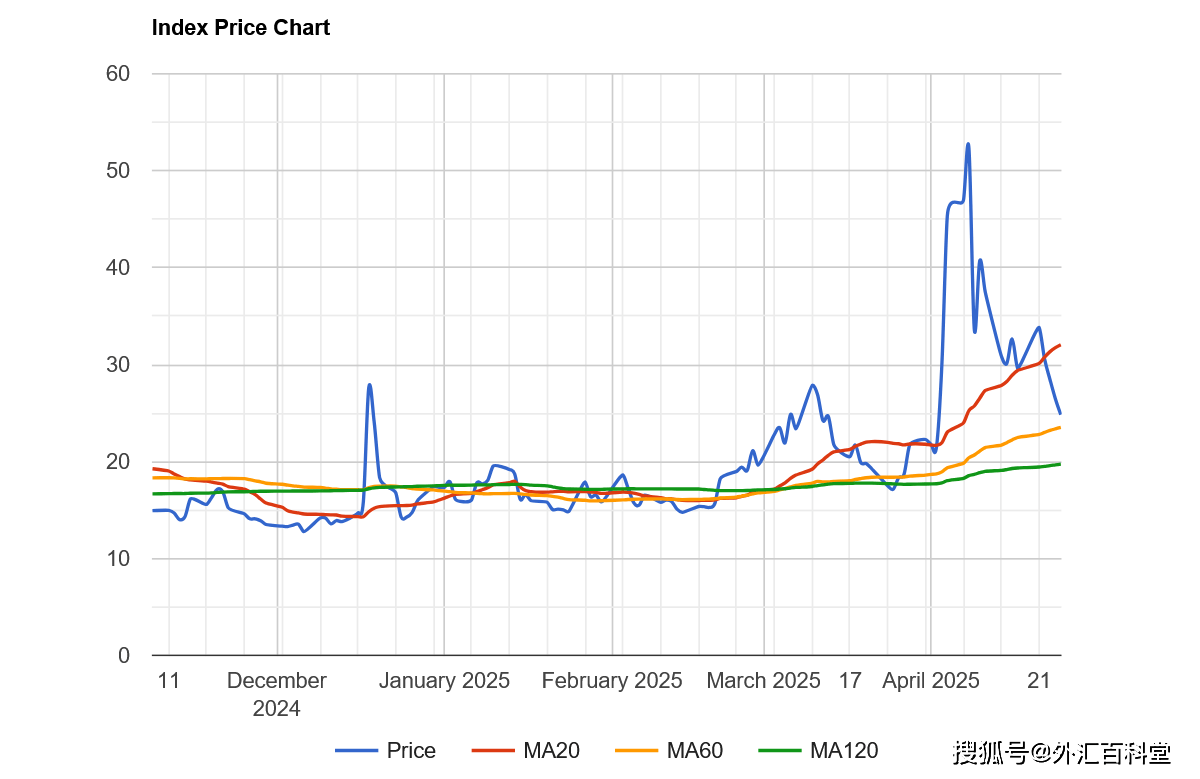
Core Viewpoint - The VIX index, often referred to as the "fear index," reflects the market's expectations of future volatility in the S&P 500 and serves as a barometer for investor sentiment and anxiety in the financial markets [1][6]. Group 1: Understanding VIX - The VIX is created by the Chicago Board Options Exchange and measures the expected volatility of the S&P 500 over the next 30 days, indicating market participants' fears and expectations [1]. - A rising VIX suggests increased market anxiety, often triggered by actions from the Federal Reserve, geopolitical tensions, or disappointing economic data [1][6]. - The VIX is not a neutral indicator; it reflects the genuine concerns of wealthy investors and policymakers regarding asset depreciation and economic instability [1][6]. Group 2: Market Reactions to VIX - When the VIX spikes, the market typically shifts to a "risk-off" mode, leading investors to seek safe-haven assets such as gold and the Japanese yen [4][5]. - A high VIX often correlates with a strengthening dollar, as investors rush to convert their assets into USD for safety, although this relationship can vary depending on market conditions [5][6]. - Conversely, a low VIX may indicate complacency in the market, potentially signaling a buildup of hidden risks, making gold a crucial asset for protection during such times [6][7]. Group 3: Trading Strategies - The signals from the VIX should inform trading strategies in forex and gold markets, guiding decisions on whether to increase exposure to safe-haven assets or take profits [7]. - Understanding the underlying drivers of VIX movements—whether macroeconomic events or technical adjustments—can provide deeper insights into market dynamics [6][7]. - Investors are encouraged to view the VIX as a complex signal rather than a simple number, integrating it with other indicators for a comprehensive market analysis [6][7].