
AI医疗

Search documents
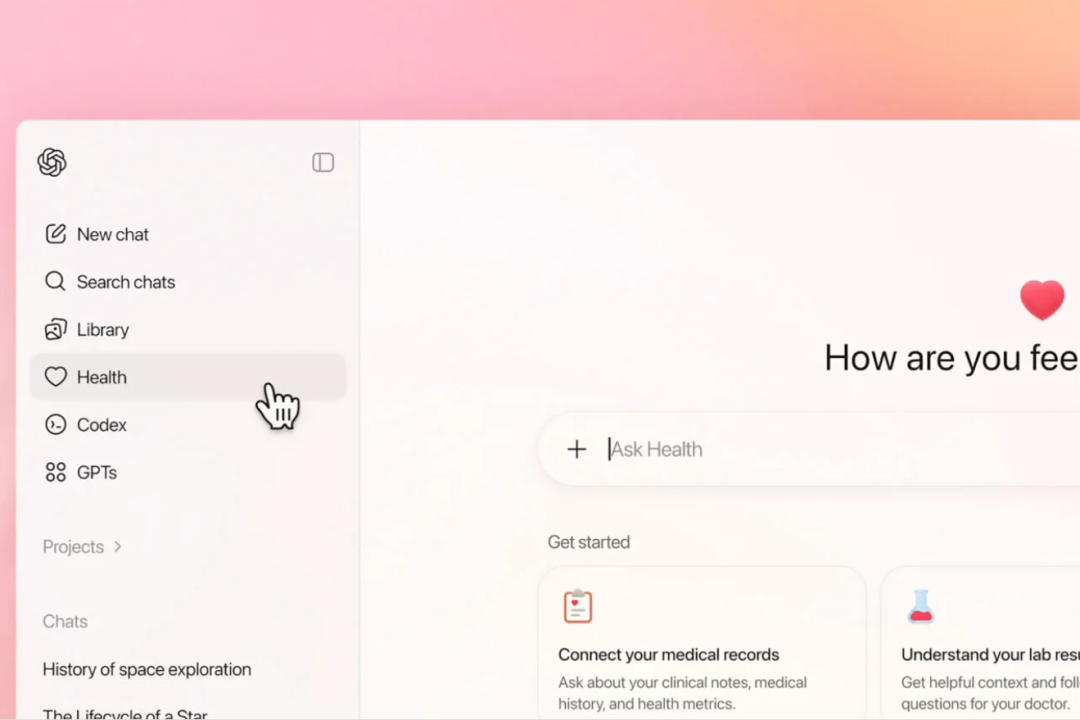
OpenAI押注万亿市场
财联社· 2026-01-08 13:32
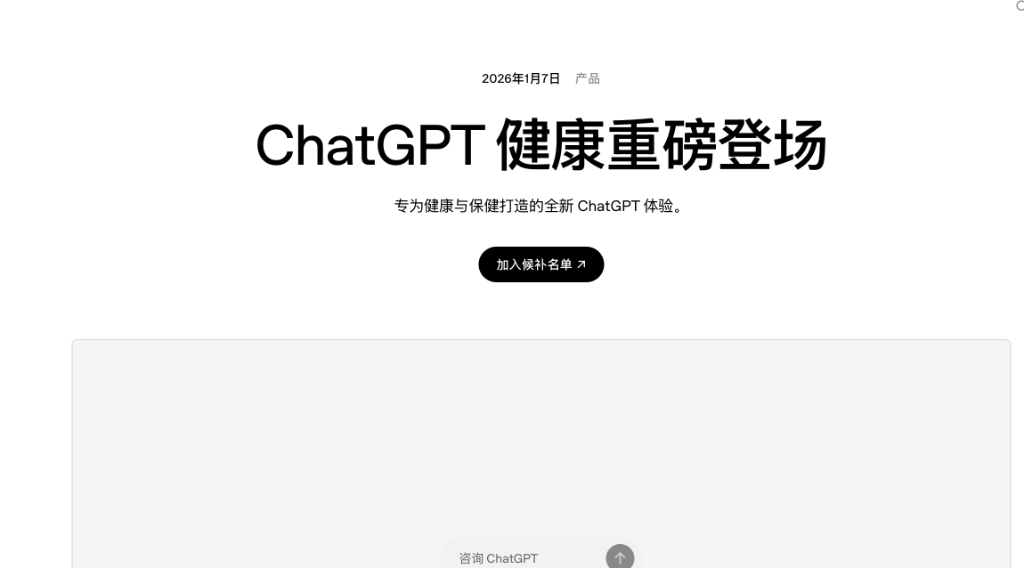
Core Viewpoint - OpenAI has launched "ChatGPT Health," a dedicated space within ChatGPT for health-related conversations, integrating with electronic medical records and health applications to provide personalized health advice [2][3]. Group 1: Product Overview - ChatGPT Health is developed in collaboration with over 260 practicing doctors and can connect with apps like Apple Health and MyFitnessPal to access user data and recent health check results [2]. - The service is designed to assist with daily health inquiries and help users understand health trends, rather than replacing medical professionals [3]. Group 2: Market Potential - OpenAI's analysis indicates that over 230 million users globally inquire about health and wellness on ChatGPT each week [4]. - The global AI healthcare market is projected to grow from approximately $26.65 billion in 2024 to about $505.59 billion by 2033, with a compound annual growth rate (CAGR) of 38.8% [4]. Group 3: Domestic Market Insights - In China, AI healthcare applications have gained market validation, with Ant Group's "Antifufu" app reaching 30 million monthly active users and over 10 million daily inquiries since its launch [4]. - Major internet and AI companies in China are launching AI healthcare applications, with JD.com integrating its AI medical mini-program "Kangkang" into its health app [4]. Group 4: Industry Trends - Citic Securities notes that leading pharmacy platforms have a large active consumer base and established monetization paths, creating a complete ecosystem from medical services to pharmaceuticals [5]. - Guotai Junan Securities highlights that the current AI healthcare wave differs from previous ones due to the clarity of payment sources, as policies in cities like Beijing and Shanghai promote commercial development in the sector [5].


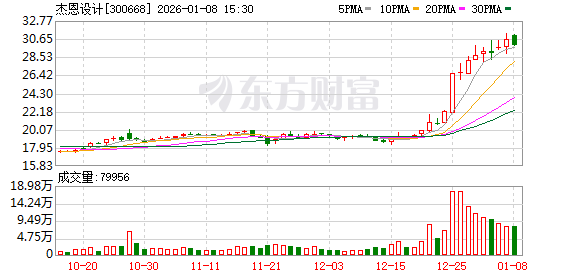
杰恩设计:现阶段未涉及AI医疗、AI医药方面的研究投入
Mei Ri Jing Ji Xin Wen· 2026-01-08 13:26
Group 1 - The core business of the company is to provide market business and service support for vaccine manufacturers, which includes business support services, marketing services, and information services [2] - Currently, the company has not invested in research related to AI healthcare or AI pharmaceuticals [2]

押注万亿AI医疗!OpenAI发布ChatGPT健康版,携手苹果,打造最强健康助手!
Xin Lang Cai Jing· 2026-01-08 11:43
Core Insights - OpenAI has launched its first AI healthcare product, "ChatGPT Health," aimed at enhancing understanding and attention to personal health, following a report indicating over 230 million weekly health-related inquiries on ChatGPT [1][10] - The development of ChatGPT Health took nearly two years, guided by over 260 doctors, and is designed to complement clinical care rather than replace it [1][12] - The product integrates with various health applications, including Apple Health, and will initially be available to a limited user base before expanding to all web and iOS users [1][12] Product Features - ChatGPT Health can interpret medical documents in layman's terms and organize user data to formulate specific questions for healthcare providers [4][15] - The product emphasizes privacy and security, ensuring that all interactions and connected applications are stored separately from other chat content [4][15] - The AI medical assessment framework, HealthBench, was established based on feedback from over 60,000 interactions across 30 key areas, outperforming human doctors in response accuracy by four times [4][15] Strategic Moves - OpenAI has recruited key executives from the healthcare sector, including Nate Gross, co-founder of Doximity, to lead its healthcare strategy [5][16] - The company reports that one in four of its over 800 million users submits health-related questions weekly, with more than 40 million daily inquiries [7][18] - OpenAI collaborates with b.well, a major real-time data company, to assist users in importing health records and other medical data, amidst competition from Google, which has also partnered with b.well [8][19] Industry Positioning - OpenAI is not solely relying on a general-purpose chatbot but is building vertical models on top of its core model, which is crucial in the current competitive landscape among AI giants [8][19] - The company has launched various initiatives in the healthcare sector, including partnerships with pharmaceutical companies for drug development and regulatory discussions with the FDA [9][20] - Sam Altman, CEO of OpenAI, has expressed strong belief in the potential of AI in biotechnology, investing in AI-driven pharmaceutical companies [9][20]
八部门印发“人工智能+”重磅文件,利好AI医疗、AI生物制造!
Xin Lang Cai Jing· 2026-01-08 11:42
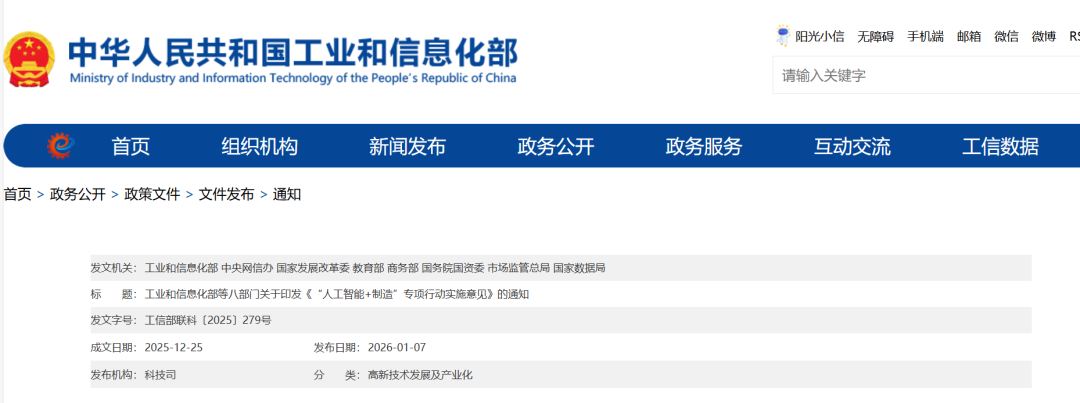
Core Viewpoint - The Ministry of Industry and Information Technology, along with seven other departments, has issued the "Implementation Opinions on the 'Artificial Intelligence + Manufacturing' Special Action," aiming for significant advancements in AI technology and its application in manufacturing by 2027 [1][5]. Group 1: Key Objectives - By 2027, China aims to achieve a safe and reliable supply of key AI technologies, maintaining a leading position in industry scale and empowerment levels [5]. - The document outlines seven key tasks focused on innovation foundation, intelligence upgrading, product breakthroughs, and entity cultivation to promote mutual empowerment between AI technology and manufacturing applications [5]. Group 2: Focus Areas in AI and Manufacturing - The "Guidelines for AI Empowering Key Industries in Manufacturing" specifically highlights AI applications in healthcare, pharmaceuticals, and biomanufacturing [3][5]. - In the pharmaceutical sector, the focus includes enhancing intelligent research and supply management, building AI-driven platforms for drug discovery, and optimizing drug synthesis processes to reduce development time and costs [3][6]. - The biomanufacturing sector aims for comprehensive innovation, utilizing AI to discover high-performance biological components and optimize fermentation processes for industrial strains [7][8][10]. Group 3: Technological Advancements - The initiative emphasizes the development of surgical robots and intelligent diagnostic systems to accelerate innovation in smart medical equipment and its clinical application [4][10]. - It also encourages the development of intelligent systems across various sectors, including healthcare, education, finance, and law, while focusing on the commercialization of AR/VR devices and brain-computer interfaces for industrial inspection and remote healthcare [4][10].
OpenAI 发布ChatGPT健康,押注万亿AI医疗市场
Di Yi Cai Jing· 2026-01-08 08:05
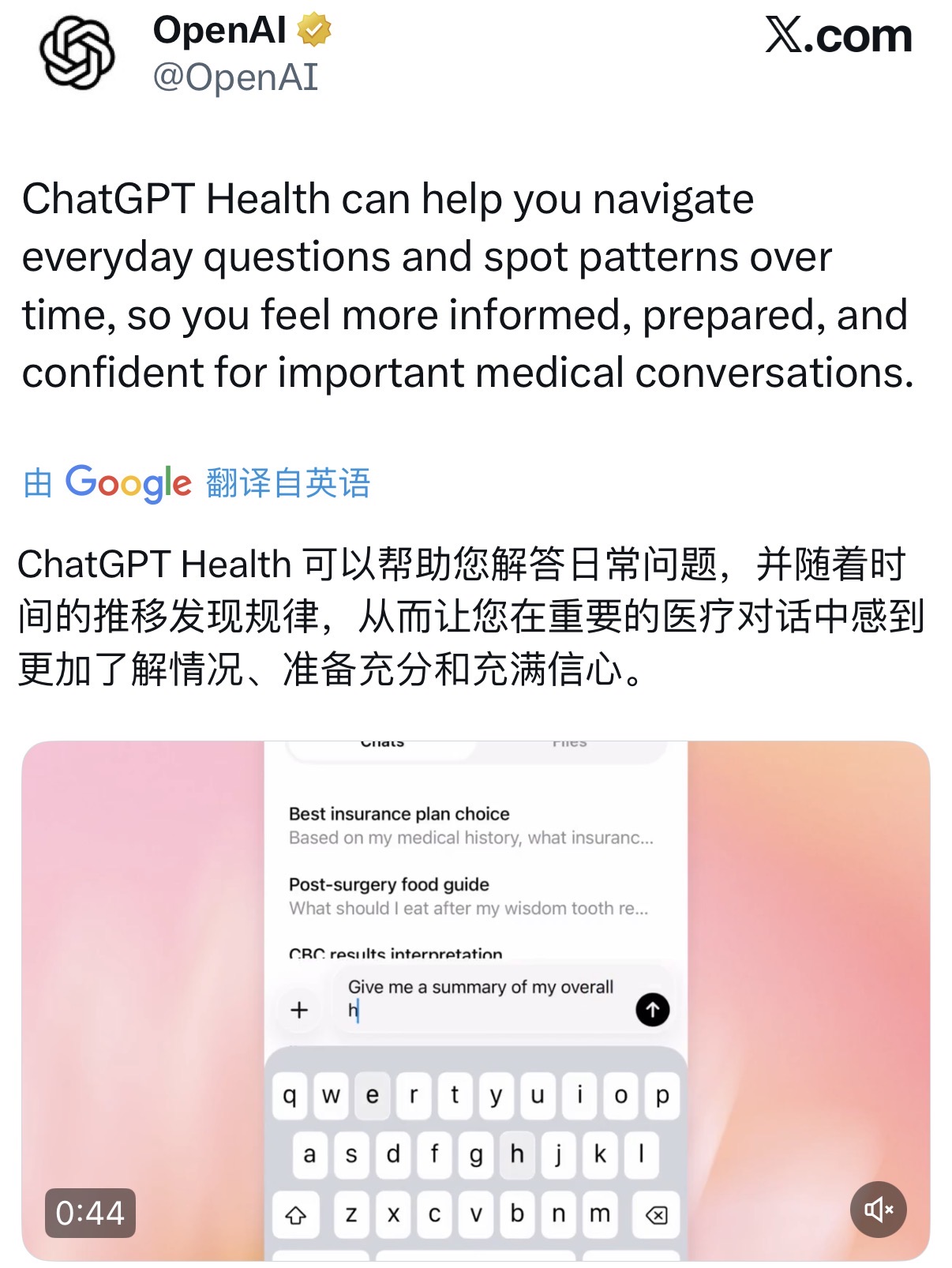
Core Insights - OpenAI is accelerating the application of its technology in the healthcare sector, launching ChatGPT Health to transform the medical system [1][6] - The healthcare market shows significant demand, with over 230 million health-related inquiries made weekly globally [4] Group 1: ChatGPT Health Launch - OpenAI introduced ChatGPT Health, a dedicated space within ChatGPT for health-related conversations, integrating electronic medical records and various health applications [1][4] - The model aims to assist users in understanding medical results, dietary and exercise planning, and making informed decisions regarding insurance options [4] Group 2: Collaboration and Development - OpenAI has collaborated with over 260 practicing doctors from various countries to refine the model's responses, providing more than 600,000 feedback instances across 30 key areas [4][5] - The health mode includes enhanced privacy measures, ensuring that conversations are not used for model training and implementing encryption and isolation technologies [5] Group 3: Market Potential - The global AI healthcare market is projected to grow significantly, from approximately $26.65 billion in 2024 to about $505.59 billion by 2033, with a compound annual growth rate of 38.8% [6] - OpenAI has invested in several healthcare companies, establishing a diversified investment matrix in the medical sector [6] Group 4: Industry Trends - The integration of AI in healthcare is a focal point at events like CES 2026, showcasing innovations in precision medicine, personalized health management, and disease prevention [7]
AI重构C端医疗
Hua Er Jie Jian Wen· 2026-01-08 06:53
Core Insights - The perception that digital healthcare is a false proposition is being challenged by the surge in AI-driven healthcare demand, which has been historically underestimated due to high entry barriers and low frequency of medical needs [1] - The emergence of AI healthcare solutions like Ant Group's "Afu" and OpenAI's Health signifies a shift from traditional search engine-dominated medical information to AI agents managing personal health [5][16] Group 1: Ant Group's "Afu" - Ant Group's "Afu" saw its monthly active users double to over 30 million within a month, with daily inquiries exceeding 10 million [2][6] - "Afu" integrates with major smart device brands and connects to 5,000 hospitals and 300,000 doctors, providing a comprehensive healthcare service from monitoring to consultations [8] - A significant 55% of "Afu" users come from third-tier cities, highlighting the demand for accessible healthcare solutions in underserved markets [8] Group 2: OpenAI's Health - OpenAI launched ChatGPT Health on January 7, 2026, creating a separate entry point for health-related inquiries to address privacy concerns [3][9] - The architecture of ChatGPT Health ensures that health-related data is stored separately, preventing any cross-contamination with other data, thus fostering user trust [10] - OpenAI partnered with b.well Connected Health to address the challenge of fragmented medical data, allowing users to access their medical records seamlessly [12][13] Group 3: AI Healthcare Functionality - ChatGPT Health aims to manage the entire lifecycle of user health by integrating static medical records and dynamic physiological data [14] - The service can generate personalized health recommendations and actionable plans, demonstrating a significant advancement over traditional healthcare models [15] - Both "Afu" and ChatGPT Health are evolving to provide end-to-end healthcare services, reflecting a common demand for AI-driven healthcare solutions in both Eastern and Western markets [15] Group 4: Valuation Logic in AI Healthcare - The competitive landscape of healthcare is shifting from search engine-based information retrieval to conversational AI services, diminishing the value of traditional health information platforms [17] - The role of offline service providers is transforming as they become data asset managers rather than just service providers, emphasizing the value of high-quality real-world data [18] - Trust is becoming a critical currency in AI healthcare, with privacy assurances and data handling practices being central to user engagement and future monetization strategies [19]
AI重构C端医疗
硬AI· 2026-01-08 04:24
Core Insights - The article discusses the emergence of AI in the healthcare sector, highlighting the significant demand for C-end AI medical services, which has been previously underestimated [4][12]. - It emphasizes the transformative impact of Ant Group's "Afu" and OpenAI's "ChatGPT Health" in addressing healthcare needs through advanced AI technologies [6][10]. Group 1: Ant Group's Afu - Ant Group's "Afu" saw its monthly active users double to 30 million within a month, with daily inquiries exceeding 10 million [7][14]. - The application integrates with major smart device brands, linking health data with online consultations and offline medical services, thus covering the entire health ecosystem [16]. - A significant 55% of Afu's users come from third-tier cities and below, indicating a strong demand for accessible healthcare solutions in underserved markets [17]. Group 2: OpenAI Health - OpenAI launched "ChatGPT Health" on January 7, 2026, creating a separate entry point for health-related inquiries to ensure user privacy and data security [19][20]. - The architecture of ChatGPT Health features a near-physical isolation of health data, ensuring that sensitive information remains confidential and is not used for training the main AI model [22][23]. - OpenAI collaborates with b.well Connected Health to address fragmented healthcare data, allowing users to access their medical records seamlessly [26]. Group 3: Market Dynamics and Future Outlook - The article notes a fundamental shift in the competitive landscape of healthcare information, moving from search engine reliance to conversational AI services [33]. - The value of offline healthcare services is being re-evaluated, with a focus on high-quality data becoming a key asset in the AI era [34]. - Trust is highlighted as a critical currency in the AI healthcare space, with OpenAI's privacy commitments potentially driving future monetization strategies [35][36].

港股医药行情火爆!聚焦创新药、AI医疗、脑机接口三大主线
Sou Hu Cai Jing· 2026-01-08 02:38
Group 1 - The Hong Kong pharmaceutical sector is experiencing adjustments in Q4 2025 due to overseas liquidity expectations and market style rotation, leading to a weakening of concerns regarding the bubble in innovative drugs [1] - After the New Year holiday, there has been a resurgence of interest in AI healthcare and brain-computer interface sectors, with funds refocusing on Hong Kong pharmaceuticals, resulting in the Hang Seng Pharmaceutical ETF (159892) achieving a year-to-date increase of over 13% [1] - From a policy perspective, the new medical insurance directory and commercial insurance directory officially took effect on January 1, which is expected to boost the volume of selected drugs; the launch of the Chinese drug price registration system supports the domestic commercialization and international expansion of innovative drugs [1]
港通医疗:持续关注AI医疗发展,努力提高产品智慧化水平
Sou Hu Cai Jing· 2026-01-07 22:42
Group 1 - The core viewpoint of the article is that the company, 港通医疗, is focused on providing medical gas equipment and systems, as well as clean medical equipment and systems, which are integral to the construction of smart hospitals [1] - The company is actively monitoring the development of AI in healthcare and is committed to enhancing the intelligence level of its products to meet the growing demands of modern hospital construction [1] - 港通医疗's response indicates a dedication to addressing medical gas supply and infection control issues within healthcare institutions [1]
研报掘金|华泰证券:继续看好京东健康作为在线医疗电商龙头的地位 目标价升至77.4港元
Ge Long Hui· 2026-01-07 09:02
华泰证券发表研究报告,继续看好京东健康作为在线医疗电商龙头的地位,预期收入增长步伐稳健,利 润率可持续改善,关注接下来新医疗产品供应节奏及首发合作进展、减肥药等产品进入医保名单后的量 价变化趋势、AI医疗应用、O2O业务扩张以及B2C业务医保支付接入等进展。该行预计京东健康2025年 全年收入将按年增长25%至727亿元,非IFRS经营利润达41.1亿元,并将2025至2027年各年非IFRS纯利 预测上调11.6%、15.6%及22.4%,目标价由68.3港元升至77.4港元,维持"买入"评级。 ...
