净息差

Search documents
常熟银行(601128):业绩增长亮眼,资产质量稳健
Tianfeng Securities· 2025-08-08 13:14
Investment Rating - The investment rating for the company is "Buy" with a 6-month outlook maintained [8] Core Views - The company demonstrated strong revenue growth with a 10.10% year-on-year increase in revenue for the first half of 2025, reaching approximately 6.1 billion yuan [2][13] - The net profit attributable to shareholders increased by 13.51% year-on-year, indicating robust profitability [2][5] - Asset quality remains solid, with a non-performing loan ratio of 0.76% and a provision coverage ratio of 489.5% [4][27] Revenue and Profitability - The company's revenue structure shows net interest income of 4.6 billion yuan, accounting for 76.5% of total revenue, while non-interest income surged by 57.30% year-on-year to 1.4 billion yuan [2][21] - The bank's net interest margin stood at 2.58%, slightly down from the previous quarter, while the yield on interest-earning assets was 4.42% [15][18] - The bank's provision for loan losses was increased by 148 million yuan compared to the same period last year, maintaining a high safety buffer [2][13] Asset and Liability Management - As of the first half of 2025, the total interest-earning assets amounted to 393.1 billion yuan, reflecting a year-on-year growth of 9.9% [22][25] - The bank's interest-bearing liabilities reached 356.2 billion yuan, with a year-on-year increase of 10.1% [25][26] - The structure of deposits shows a 3.2% increase in demand deposits year-on-year, contributing to a more favorable funding cost [25][26] Asset Quality - The non-performing loan ratio remained stable at 0.76%, with a slight increase in overdue loans to 1.62% [4][27] - The bank's provision coverage ratio indicates strong risk mitigation capabilities, remaining above 489% [4][27] - The non-performing loan ratio for corporate loans improved to 0.56%, while retail loans saw a slight increase to 1.02% [27][28]

远东宏信(03360.HK)2025年中报点评:资产规模稳定 利润小幅回升
Ge Long Hui· 2025-08-08 11:32
Core Insights - The company experienced a revenue decline of 3.8% year-on-year, totaling 17.4 billion yuan in the first half of 2025, while net profit attributable to ordinary shareholders increased by 3.8% to 2.2 billion yuan [1] - The annualized average ROE for the first half of 2025 was 8.7%, reflecting a slight increase of 0.2 percentage points year-on-year [1] Financial Performance - Total assets as of June 30, 2025, stood at 363.8 billion yuan, a year-on-year increase of 0.6% and a 0.9% increase from the beginning of the year [1] - The balance of loans and receivables was 267.1 billion yuan, showing a year-on-year growth of 0.1% and a 2.5% increase from the start of the year [1] - The net interest margin slightly improved to 4.51%, up 4 basis points year-on-year, with interest-earning asset yield at 8.08%, down 3 basis points [1] Sector Performance - The industrial operation segment saw a revenue decline of 12.6% to 6.3 billion yuan, with the subsidiary Hongxin Jianfa's revenue down 10.8% to 4.4 billion yuan, primarily due to a contraction in material-related businesses [2] - The gross margin for the industrial operation segment fell to 21%, a decrease of 8 percentage points year-on-year, influenced by macroeconomic factors [2] Asset Quality - As of June 30, 2025, the non-performing loan ratio was 1.05%, down 0.02 percentage points from the beginning of the year, while the attention rate decreased to 5.51% [2] - The provision coverage ratio remained stable at 227%, with a credit cost ratio decreasing by 0.25 percentage points year-on-year to 0.23% [2]
商业银行主要监管指标处于健康区间
Jin Rong Shi Bao· 2025-08-08 08:02
金融监管总局近日发布的2025年一季度银行业保险业主要监管指标数据显示,今年一季度,银行业 总资产保持增长,金融服务持续增强。截至一季度末,我国银行业金融机构本外币资产总额458.3万亿 元,同比增长6.7%。银行业金融机构普惠型小微企业贷款余额35.3万亿元,同比增长12.5%;普惠型涉 农贷款余额13.7万亿元,较年初增加7955亿元。 商业银行信贷资产质量总体稳定,但不良贷款余额和不良率均较上季度末有所上升。截至一季度 末,商业银行不良贷款余额3.4万亿元,较上季末增加1574亿元;不良贷款率1.51%,较上季末上升0.01 个百分点。 上海金融与发展实验室首席专家、主任曾刚在接受《金融时报》记者采访时表示,导致不良贷款反 弹的核心因素主要包括宏观经济恢复节奏仍有波动,部分行业和区域企业经营压力犹存;信用风险出清 持续推进,不良认定和暴露更加彻底;叠加普惠小微、涉农等重点领域贷款扩张,风险管理压力加大。 另外,数据显示,截至一季度末,商业银行(不含外国银行分行)资本充足率为15.28%,一级资 本充足率为12.18%,核心一级资本充足率为10.70%,均处在合理区间,比上季末有所下降。曾刚认 为,资本充 ...
中长期大额存单货架越来越空: 低利率重塑银行负债端业态
Zhong Guo Zheng Quan Bao· 2025-08-08 07:20
新一轮降息开启以来,曾经作为银行揽储利器的大额存单日渐稀少。近日,中国证券报记者走访多 家银行了解到,不少全国性银行已停售中长期大额存单,而在售的大额存单在收益率方面与普通定期存 款相比并无明显优势。 业内人士认为,中长期大额存单难觅其踪是金融机构在净息差承压背景下主动进行负债端改革的结 果,反映出银行成本控制与流动性管理策略发生了调整。此外,低利率环境正迫使银行全面重塑负债结 构与经营模式,促使银行从单纯追求规模向追求质量效益转变,这一过程将深刻影响银行业发展格局。 净息差吃紧 长期限存款压降 "目前我行没有发行3年期和5年期的大额存单。"招商银行北京市西城区一家网点的客户经理告诉记 者,"现在我行大额存单最长期限为2年,且2年期大额存单利率与1年期的一样,都是1.4%。" "3年期以上大额存单已经是过去时,目前我们有一款3年期定期存款,利率可上浮至1.75%,无购 买条件限制。"中信银行北京市西城区一家网点工作人员向记者表示。 此外,记者了解到,在收益率方面,大额存单与普通定期存款相比已无明显优势,"现在多数客户 存大额存单,主要是看中了它的可转让特性,其他方面与普通定期存款基本一样。"建设银行北京市丰 ...
营收净利双增长,6家银行率先预喜半年度业绩
Shang Hai Zheng Quan Bao· 2025-08-07 00:04
◎记者 黄坤 截至8月6日,已有浦发银行、杭州银行、常熟银行、宁波银行、齐鲁银行、青岛银行等6家A股上市银 行发布了2025年半年度业绩快报,营收净利均实现正增长,其中5家银行归母净利润同比增幅达两位 数。 6家银行业绩报喜 6家A股上市银行率先披露半年度业绩快报,关键业绩指标浮出水面。 在保持稳健扩表的情况下,上半年,浦发银行、杭州银行、常熟银行、宁波银行、齐鲁银行、青岛银行 的营收、归母净利润均实现同比正增长。 归母净利润方面,常熟银行同比增幅为13.55%,杭州银行、齐鲁银行、青岛银行均超16%,浦发银行为 10.19%,宁波银行为8.23%。 齐鲁银行同步披露了营业收入的具体情况,其中利息净收入同比增长13.57%;手续费及佣金净收入同 比增长13.64%。 齐鲁银行在半年度业绩快报中提到,该行净息差企稳回升。杭州银行近日在投资者关系活动记录表中透 露,预计今年息差整体降幅将好于2024年。 上述头部券商银行业分析师说,虽然净息差整体仍在下降,但得益于存款利率下调,息差压力趋缓。 银行板块景气度上行 基本面企稳向好,支撑了银行股上涨、估值显著修复。截至8月6日,申万银行板块指数年内累计涨幅达 16.1 ...






长安银行VS西安银行:陕西两大城商行的PK
数说者· 2025-08-06 23:32
Core Viewpoint - The article compares two city commercial banks in Shaanxi Province, Chang'an Bank and Xi'an Bank, highlighting their differences in ownership structure, financial performance, and operational focus [2][3][5]. Ownership and Structure - Chang'an Bank was established in 2009 through the merger of several city commercial banks and is primarily state-owned, with over 50% of shares held by provincial state-owned enterprises [2]. - Xi'an Bank was founded in 1997 and has a more diversified ownership structure, with significant foreign investment from the Canadian Imperial Bank of Commerce and local state-owned enterprises [4][5]. Capital Market Presence - Chang'an Bank has not yet listed on any stock exchange, while Xi'an Bank went public in 2019 on the Shanghai Stock Exchange [5]. Operational Scope - Chang'an Bank operates across all 10 cities in Shaanxi Province with a total of 260 branches, while Xi'an Bank also covers the entire province but has a more concentrated revenue base from Xi'an city, accounting for 97.90% of its income [5][6]. Financial Performance - As of the end of 2024, Chang'an Bank reported total assets of 542.29 billion yuan and net profit of 2.176 billion yuan, while Xi'an Bank had total assets of 480.37 billion yuan and net profit of 2.559 billion yuan [7][8]. - Chang'an Bank's revenue heavily relies on net interest income, which constituted 95.30% of its total revenue, compared to Xi'an Bank's 67.44% [15][20]. Asset Quality - Both banks have faced challenges with asset quality, with Chang'an Bank's non-performing loan (NPL) ratio at 1.85% and Xi'an Bank's at 1.72% as of 2024 [23][30]. - Xi'an Bank has a higher provision coverage ratio of 184.06%, indicating better asset quality management compared to Chang'an Bank's 173.44% [7][30]. Employee Compensation - Chang'an Bank's employee costs are higher, with total expenditures of 1.924 billion yuan and an average salary of approximately 380,000 yuan per employee, compared to Xi'an Bank's 1.126 billion yuan and an average salary of about 330,000 yuan [31]. Long-term Trends - Over the past decade, Chang'an Bank's total assets have consistently surpassed those of Xi'an Bank since 2019, indicating a stronger growth trajectory [9]. - Despite fluctuations, Xi'an Bank's net profit has historically been higher, but the gap is narrowing as Chang'an Bank's profitability stabilizes [13][33].

中国银行行业 -探讨股息收益率、根本性变化、风险及 2025 年第二季度盈利预期-China Banks_ Addressing div. yield, fundamental change, risk and 2Q25 earnings expectations
2025-08-06 03:33
Summary of Conference Call on China Banks Industry Overview - The conference call focused on the Chinese banking sector, specifically discussing the performance of covered banks in the A/H share markets, with notable mentions of China Merchants Bank (CMB) and Bank of Communications (BoCom) [1][2]. Key Points and Arguments 1. Market Performance - Since the beginning of the year, A/H share performance of covered banks has increased by 15% and 26% respectively, with CMB outperforming BoCom by 15 percentage points [1]. - The banking sector is viewed as having reached an inflection point, supported by recent market performance and evolving economic conditions [1]. 2. Earnings Expectations - Average projected growth for 2Q25 is 0.3% for both Pre-Provision Operating Profit (PPOP) and net profit for covered banks [2]. - Target prices for A/H shares have increased by 7% to 12% on average due to improved dividend outlook and reduced earnings pressure [2]. 3. Dividend Yields and Fund Flows - Current dividend yields are historically low at 4.2% for A shares and 5.0% for H shares, compared to a 10-year median of 4.7% and 6.4% respectively [3][10]. - Despite low yields, there is an anticipated increase in fund allocation to the banking sector, driven by declining deposit rates and increased interest from non-bank financial institutions and retail investors [3][10]. - The 3-year time deposit rate has fallen to 1.25%, down from 1.95% and 2.60% in early 2024 and 2023 respectively, leading to a shift of funds from bank deposits to non-bank financial products [9][12]. 4. Positive Fundamental Changes - Capital strength and asset quality are improving, with proactive fiscal policies easing local government debt pressures [23]. - Net Interest Margin (NIM) is expected to stabilize sooner than previously projected, with a slower rate of decline anticipated in 2025 [24][27]. - Capital injections have strengthened bank balance sheets, allowing for sustained dividend payments despite short-term earnings pressures [29]. 5. Key Risks - Mortgage risk remains a concern, with expectations that NPL ratios will stabilize in 2026, but a sharper decline in housing prices could delay this stabilization [35][42]. - Manufacturing and export-related sectors pose risks, as they represent approximately 40% of bank loan portfolios, with potential increased provisioning expected in 2026 [35][49]. 6. 2Q25 Earnings Expectations - Revenue growth is under pressure, with large SOE banks expected to maintain loan growth while smaller banks may grow rapidly [52]. - Potential NIM stabilization in 2Q25 is highlighted, with some banks indicating lower deposit costs [59]. - Preliminary results from BONB suggest potential improvement in asset quality, contrary to market expectations [58]. 7. Shareholder Returns - While dividend payouts for 1H25 are unlikely to change, there is potential for increases in 2H25 driven by capital injections and pressure from institutional investors [65]. Other Important Insights - Retail investors are increasingly utilizing high-dividend ETFs rather than direct stock purchases, indicating a shift in investment strategies [21]. - The compression of deposit rates is driving funds into trust products and wealth management, further lowering funding costs for non-bank institutions [16]. This summary encapsulates the key insights and projections regarding the Chinese banking sector as discussed in the conference call, highlighting both opportunities and risks for investors.

货币政策如何护航经济大盘和金融稳定? 强化利率政策执行和监督 疏解金融业“内卷式”竞争
Shang Hai Zheng Quan Bao· 2025-08-04 18:51
Core Viewpoint - The net interest margin (NIM) of commercial banks has become a focal point in discussions about potential monetary policy easing in the second half of the year, particularly as it reached a new low of 1.43% in Q1 2023, reflecting intense competition and disorder in the lending market [1][2] Summary by Sections Monetary Policy and Net Interest Margin - The People's Bank of China emphasizes the need to balance support for economic growth with the health of the banking sector, as the NIM may constrain further interest rate cuts [1][2] - The NIM has been under pressure, declining from 2.08% in Q4 2021 to 1.43% in Q1 2023, primarily due to a low interest rate environment and a continuous decline in the Loan Prime Rate (LPR) [2] Competition and Financial Stability - The intensification of "involution" competition within the financial industry has raised concerns about the stability of the financial system, necessitating regulatory measures to curb excessive competition and ensure reasonable interest rates [3][4] - The central bank's recent meetings have focused on addressing issues related to capital turnover and the chaotic competition within the financial sector [3][4] Balancing Growth and Risk Prevention - Experts suggest that maintaining NIM stability is crucial for future monetary policy easing, as further declines could impact banks' sustainable development and their ability to support the real economy [2][5] - A more refined balance between "stabilizing growth" and "preventing risks" is necessary, with a focus on avoiding excessive monetary easing that could lead to long-term risks [6][7] Regulatory Measures and Future Outlook - The central bank plans to enhance the execution and supervision of interest rate policies to maintain healthy competition in the lending market and improve the transmission of monetary policy [6][7] - Ongoing efforts will include monitoring key financial risks and implementing targeted policies to address issues in local government financing platforms and other critical areas [7]
北京银行净息差困局:规模扩张变“割肉游戏”
市值风云· 2025-08-04 10:08
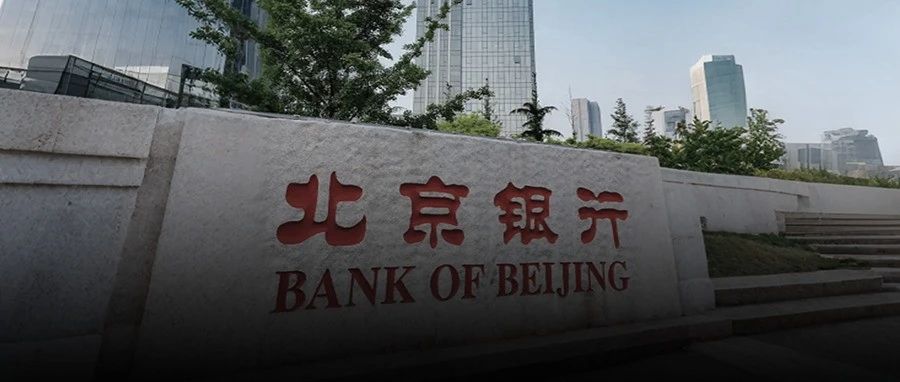
Core Viewpoint - The first quarter report reveals a deep crisis in the scale-driven model during the interest rate down cycle, highlighting a divergence between asset growth and profitability for Beijing Bank [1][6]. Financial Performance - In Q1 2025, Beijing Bank's total assets exceeded 4.5 trillion yuan, growing by 5.9% year-on-year, with total deposits at 2.6 trillion yuan and loans at 2.3 trillion yuan, both maintaining approximately 6% growth [3]. - However, the bank's revenue fell to 17.13 billion yuan, a decrease of 3.2% year-on-year, and net profit attributable to shareholders dropped to 7.67 billion yuan, down 2.4%, marking the first quarterly revenue and profit decline in 12 years [5]. Net Interest Margin - The net interest margin (NIM) for Beijing Bank fell to 1.31% in Q1 2025, a decline of 16 basis points from the previous year, significantly underperforming the industry average of 1.43% [8]. - This low NIM indicates minimal profit margin, as the bank earns only 1.31 yuan for every 100 yuan in deposits after paying interest to depositors [9]. Asset and Liability Pressure - The bank's yield on interest-earning assets dropped by 18 basis points to 3.5% due to continuous LPR adjustments and lower loan rates, while the cost of interest-bearing liabilities decreased to 2.03% [11]. - Despite a 5.9% growth in loan volume, the bank's interest income fell from 12.77 billion yuan to 12.59 billion yuan, indicating that scale expansion did not translate into increased interest income [11][12]. Asset Quality - The non-performing loan (NPL) ratio for Beijing Bank stood at 1.3%, slightly down by 1 basis point from the beginning of the year, which is higher than the average NPL ratio of 1.15% among listed city commercial banks [15]. - The proportion of special mention loans increased from 1.14% in 2020 to 1.79% in 2024, indicating potential risks in asset quality [17]. Capital Adequacy - The bank's provision coverage ratio decreased from 208.8% at the end of 2024 to 198.1%, and the loan loss reserve ratio fell from 2.73% to 2.57%, suggesting a potential reduction in provisions to smooth earnings [18]. - Capital adequacy ratios also declined, with the core Tier 1 capital ratio dropping from 8.95% to 8.64%, indicating increased pressure on risk management [19][21]. Income Structure - Non-interest income decreased by 7.8% year-on-year in Q1 2025, highlighting competitive pressures in retail banking [22]. - Although fee and commission income rose by 24.4% to 1.44 billion yuan, it only accounted for 8.4% of total revenue, insufficient to offset the decline in interest income [22][23].

12.28%营收跌幅与2.62%净利增幅反差:肥西农商银行2025上半年靠减值计提"撑局"
Jin Rong Jie· 2025-08-04 06:29
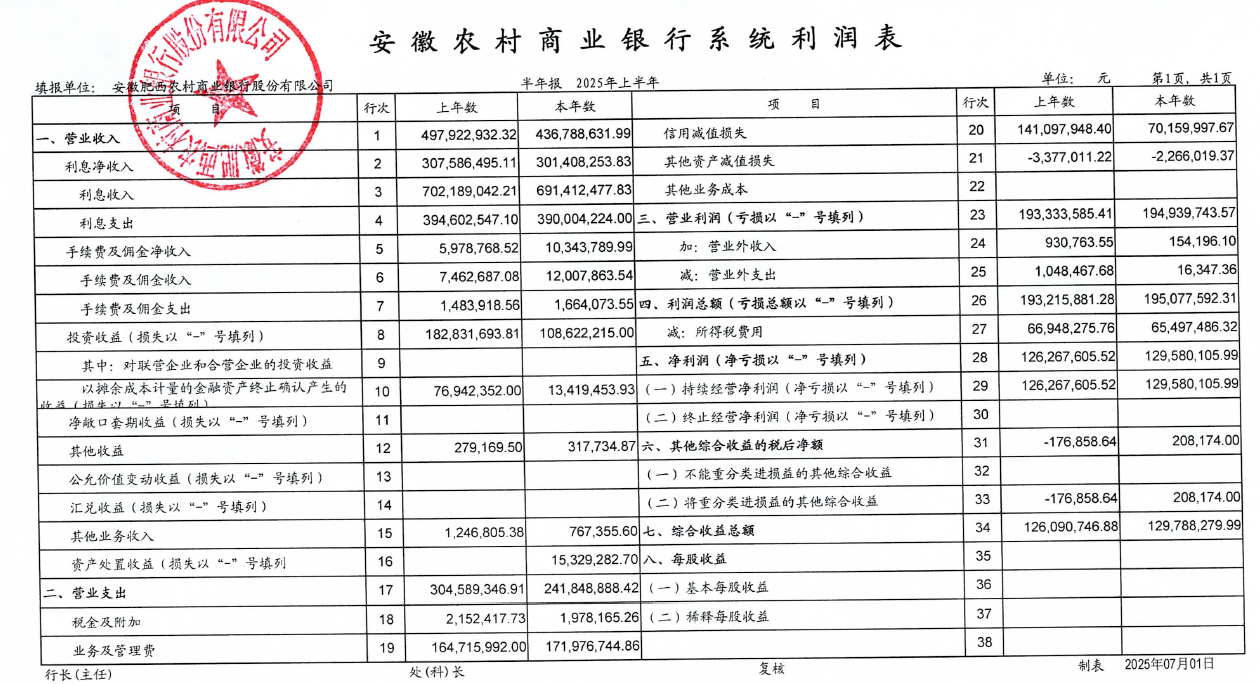
Core Insights - Feixi Rural Commercial Bank reported a decline in operating income by 12.28% year-on-year to 437 million yuan in the first half of 2025, while net profit increased by 2.62% to 130 million yuan, primarily due to a significant reduction in credit impairment losses [1][2][3] - The bank's net interest income, the main revenue source, decreased by 2.01% to 301 million yuan, and investment income fell sharply by 40.59% to 109 million yuan, contributing to the overall revenue decline [1][2] - As of June 2025, total assets reached 50.229 billion yuan, with total liabilities at 47.383 billion yuan, indicating steady growth in asset and liability scale [3] Revenue Composition - Net interest income remains the core revenue source, accounting for 3.01 billion yuan, despite a year-on-year decline [1] - Investment income significantly dropped to 1.09 billion yuan, marking a 40.59% decrease, which has been a major factor in revenue decline [1][2] - Fee and commission income was weak, with net income at only 10 million yuan as of June 2025 [1] Asset Quality and Risks - The bank's deposit structure shows signs of imbalance, with a high proportion of fixed-term deposits, leading to increased funding costs and liquidity management challenges [3] - Although the non-performing loan (NPL) ratio decreased to 1.71% by the end of 2024, overdue loans increased by 32.23% year-on-year, raising concerns about asset quality [3] - A significant portion of extended and renewed loans, amounting to 221 million yuan, is classified as non-performing or under observation, indicating pressure on some borrowers [3] Company Background - Established in February 2010, Feixi Rural Commercial Bank is the first county-level rural commercial bank in Anhui Province, evolving from the Feixi County Rural Credit Cooperative [4] - The bank operates 45 branches, expanding its service area beyond Feixi County to include multiple districts in Hefei City [4]