食品安全

Search documents
湖北公布一批外卖食品安全典型案例
Yang Shi Xin Wen· 2025-11-01 04:57
Core Viewpoint - Hubei province has intensified inspections of food safety responsibilities among platforms and food delivery operators, leading to the crackdown on illegal activities and the enforcement of penalties for violations [1] Summary by Sections Case 1: Food Business License Update Violation - A restaurant in Jia Yu County failed to update its food business license information on the delivery platform after it was canceled, violating regulations [2] Case 2: Unauthorized Sale of Cold Dishes - A restaurant in Xiaogan City was found selling cold dishes without the necessary food business license, leading to penalties including confiscation of illegal gains and fines [3] Case 3: Use of Expired Food Products - A restaurant in Xiantao City was penalized for using expired food products, violating food safety laws, resulting in warnings and fines [4] Case 4: Non-compliance with Food Safety Standards - A bakery in Jingmen City was found using food-related products that did not meet safety standards, leading to corrective orders and fines [5] Case 5: Sale of Contaminated Food - A restaurant in Ezhou City was penalized for selling food that contained foreign objects, violating food safety laws, resulting in fines [6]
摩洛哥食品安全存在结构性风险
Shang Wu Bu Wang Zhan· 2025-10-31 05:14
Core Insights - Morocco's food sovereignty faces structural risks due to increasing reliance on imports for essential food items, impacting national food security and fiscal stability [1][2] Group 1: Food Production and Imports - Since 2019, Morocco's food production has been declining, with an average annual total production of less than 5 million tons, which is only half of the highest production year [1] - The proportion of staple food imports exceeds 70%, with food imports reaching 5.2 million tons in 2022, costing over 2 billion euros [1] Group 2: Government Subsidies and Fiscal Impact - To stabilize domestic food prices, government subsidy expenditures have been rising, with wheat subsidies reaching 134 million USD in 2023 and sugar subsidies projected at 438 million USD in 2024, further increasing fiscal burdens [1] Group 3: Dietary Concerns - Sugar consumption has reached 48 kilograms per person per year, which is four times the recommended nutritional value, while the consumption of traditional healthy foods like legumes has significantly decreased, leading to an imbalanced diet that threatens local residents' health [1] Group 4: Agricultural Development Model - Morocco's agricultural development model has been export-oriented, focusing on high-value export crops, which has led to issues such as over-extraction of groundwater, uneven regional development, and widening gaps between large farms and smallholders [2] - The agricultural system's high dependence on imported fertilizers, seeds, machinery, and feed makes food production and supply chains vulnerable to international market fluctuations, posing structural risks to food security [2] Group 5: Policy Recommendations - MIPA calls for the government to reassess agricultural policies, strengthen local production and short supply chains, support small and medium-sized farmers, and promote healthier and more sustainable consumption patterns [2]
食品安全概念走强,华源控股涨停
Xin Lang Cai Jing· 2025-10-31 02:08
Core Viewpoint - The food safety sector is gaining momentum, with Huayuan Holdings hitting the daily limit up, and several companies such as Shibu Testing, Tailin Bio, Litong Technology, Puni Testing, Sanwei Tiandi, and Huayu Software also experiencing significant gains [1] Company Summary - Huayuan Holdings has reached the daily limit up, indicating strong investor interest and confidence in the company's prospects within the food safety industry [1] - Shibu Testing, Tailin Bio, Litong Technology, Puni Testing, Sanwei Tiandi, and Huayu Software have all seen their stock prices rise, reflecting a broader positive trend in the food safety sector [1]

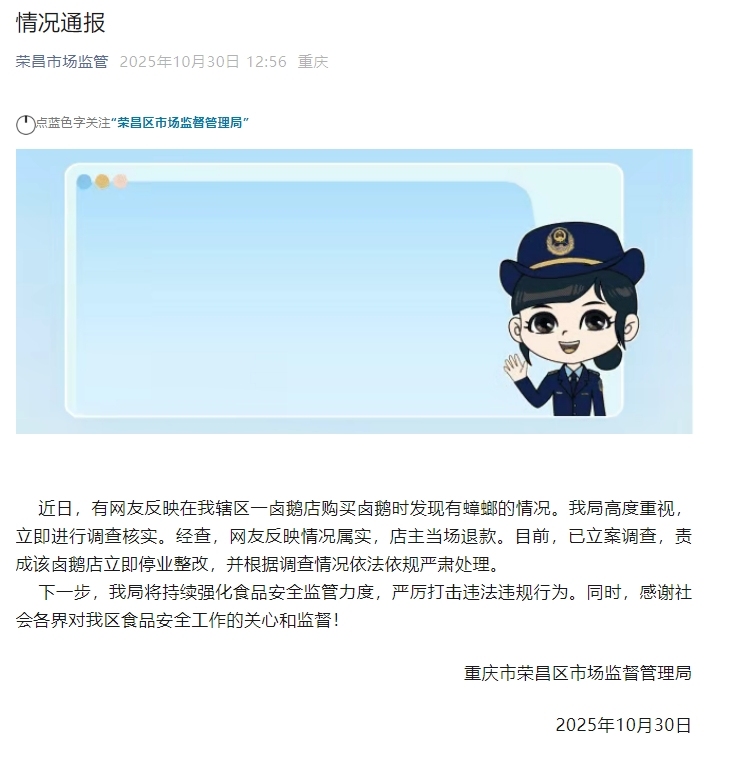
重庆荣昌通报买卤鹅时有蟑螂 :已立案,责成涉事店立即停业整改
Xin Jing Bao· 2025-10-30 06:04
Core Points - A food safety incident was reported involving a duck shop in Chongqing's Rongchang District, where a customer found cockroaches in the purchased product [1] - The local market supervision authority took immediate action, confirming the complaint and issuing a refund to the customer [1] - An investigation has been initiated, leading to the shop being ordered to cease operations for rectification and potential legal consequences based on the findings [1] - The authority emphasized its commitment to enhancing food safety oversight and cracking down on illegal activities in the food industry [1] - Appreciation was expressed towards the public for their vigilance and concern regarding food safety in the region [1]

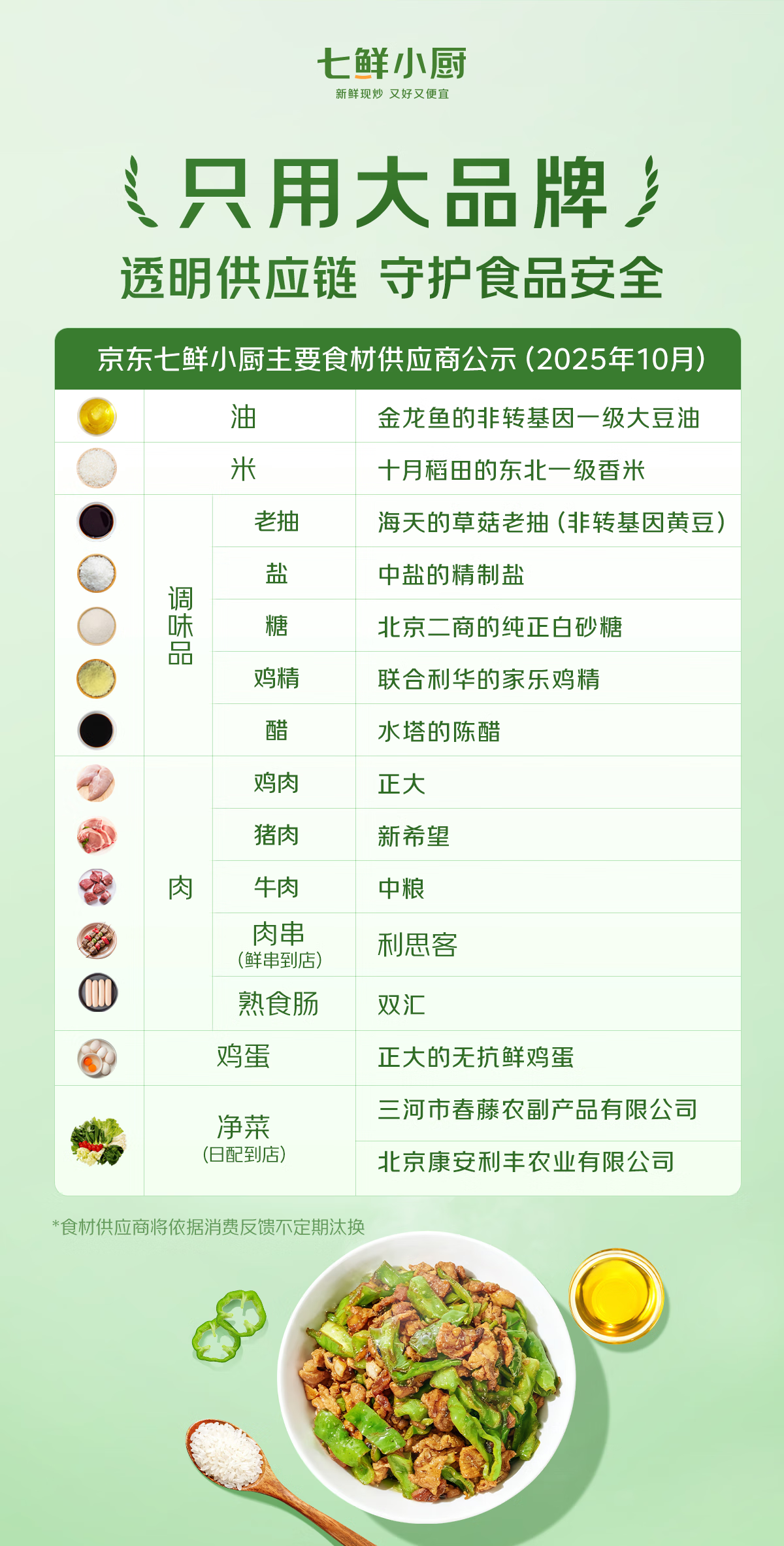
《七鲜小厨公示食材供应商:只用大品牌、供应链透明化,守护食品安全》
Zhong Jin Zai Xian· 2025-10-29 07:24
Core Viewpoint - The food safety issues in the restaurant industry are gaining significant attention, and supply chain transparency is crucial for ensuring consumer confidence in food safety [1] Group 1: Supply Chain Transparency - Seven Fresh Kitchen, a brand under JD Group, has implemented measures such as open kitchen policies and 24-hour live streaming of kitchen operations to enhance food safety standards [1][7] - The company has publicly disclosed its core ingredient suppliers, covering all major categories including vegetables, meat, grains, oils, and condiments [4][5] Group 2: Ingredient Sourcing - Seven Fresh Kitchen sources high-quality ingredients from well-known brands, such as non-GMO soybean oil from Jinlongyu and premium rice from Shiyue Rice [5] - The company emphasizes using local top suppliers for fresh vegetables and conducts thorough checks on supplier qualifications and inspection reports [5] Group 3: Consumer Engagement - The establishment of a three-tiered assurance system from ingredient transparency to kitchen transparency and cooking transparency aims to provide consumers with a reassuring dining experience [7] - Consumers can monitor the cooking process in real-time through the 24-hour kitchen live stream, enhancing their confidence in the food being prepared [7] Group 4: Business Performance - Since its opening, Seven Fresh Kitchen has experienced continuous growth in order volume, significantly boosting the sales of nearby restaurants by over 12% [9] - The brand acts as a "traffic entrance," attracting consumers seeking high-quality takeout, which in turn benefits other quality restaurants in the same delivery area [9] Group 5: Future Plans - Seven Fresh Kitchen plans to share its supply chain with other quality restaurants to promote the prosperity of regional dining services [9]
工作人员在酸菜池中抽烟吐痰,官方通报:依法严惩
第一财经· 2025-10-28 07:39
Group 1 - The local market supervision authority in Xingcheng, Liaoning, has launched an investigation following reports of improper practices at a sauerkraut processing facility, including employees smoking and spitting near food products [1] - All batches of the affected sauerkraut have been seized and will be destroyed according to relevant operational regulations, ensuring they did not enter the market [1] - The involved enterprises are under investigation, and strict legal actions will be taken against any violations and responsible individuals [1][2] Group 2 - The authority expresses gratitude to the public for their vigilance regarding food safety and commits to rigorously investigating any actions that infringe on consumer rights [2]

钢研纳克跌2.02%,成交额1.46亿元,主力资金净流出1607.76万元
Xin Lang Cai Jing· 2025-10-28 05:31
Core Viewpoint - Steel Research Nack's stock price has shown significant growth this year, with a year-to-date increase of 53.89%, indicating strong market performance and investor interest [1][2]. Financial Performance - For the period from January to September 2025, Steel Research Nack achieved operating revenue of 806 million yuan, representing a year-on-year growth of 11.64% [2]. - The net profit attributable to shareholders for the same period was approximately 99.70 million yuan, reflecting a year-on-year increase of 15.08% [2]. Stock Market Activity - As of October 28, Steel Research Nack's stock was trading at 17.99 yuan per share, with a market capitalization of 6.886 billion yuan [1]. - The stock experienced a decline of 2.02% during the trading session on October 28, with a trading volume of 1.46 billion yuan and a turnover rate of 2.13% [1]. - The company has seen a net outflow of main funds amounting to 16.08 million yuan, with significant selling pressure from large orders [1]. Shareholder Information - As of September 30, 2025, the number of shareholders increased to 25,900, a rise of 32.22% compared to the previous period [2]. - The average number of circulating shares per shareholder decreased by 23.74% to 14,607 shares [2]. Dividend Distribution - Since its A-share listing, Steel Research Nack has distributed a total of 159 million yuan in dividends, with 118 million yuan distributed over the past three years [3]. Institutional Holdings - As of September 30, 2025, Hong Kong Central Clearing Limited was the sixth-largest circulating shareholder, holding 1.5539 million shares, an increase of 538,200 shares from the previous period [3].

一家百年商场的食品安全经
Xin Hua Wang· 2025-10-28 01:29
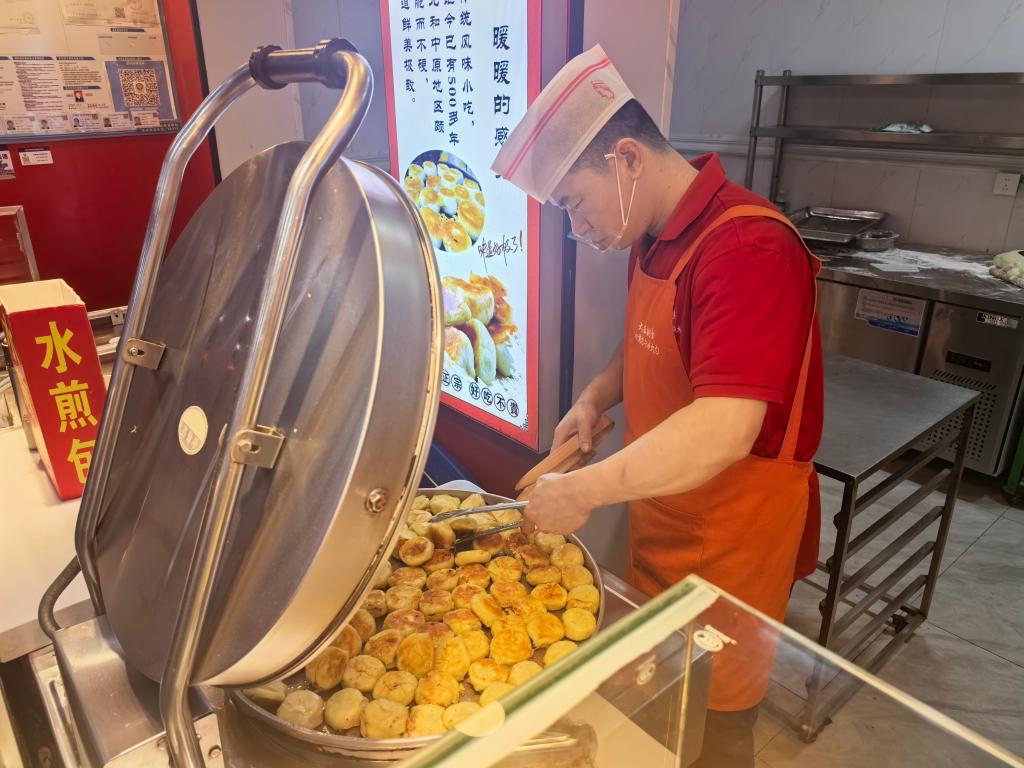
Core Insights - The article highlights the transformation of Shenyang Dadong Food Market into a popular destination, combining traditional food market elements with modern supermarket features, offering over 7,000 products and attracting significant foot traffic [1][4]. Group 1: Market Features - Shenyang Dadong Food Market has a rich history dating back to 1829, evolving through various historical phases and now serving as a "net celebrity check-in spot" [1]. - The market integrates a supermarket area with a specialty food zone, showcasing a diverse range of products including local delicacies like big buns, pot-sticker meat, and handmade sausages [1]. Group 2: Food Safety Measures - The market emphasizes transparency in food safety, with electronic displays showing food origin and safety inspection results, and all suppliers required to provide complete inspection reports [2]. - On-site food preparation allows customers to observe the cooking process, enhancing trust in food quality [2]. - The market's management practices reflect broader regulatory efforts in Liaoning Province to strengthen food safety, including the implementation of a comprehensive safety control system covering procurement, processing, and sales [6]. Group 3: Industry Events - Recent events like the "Shenyang Zhenpin" tasting and selection market attracted buyers from regions such as Beijing-Tianjin-Hebei and the Yangtze River Delta, showcasing local products like fermented sauerkraut [4]. - Companies like Shenyang Wosifude Food Industry Co., Ltd. are innovating in traditional food production, ensuring cleaner and safer products while maintaining traditional flavors [4].
一男子在酸菜池中抽烟并吐痰 辽宁兴城通报
Xin Jing Bao· 2025-10-27 23:21
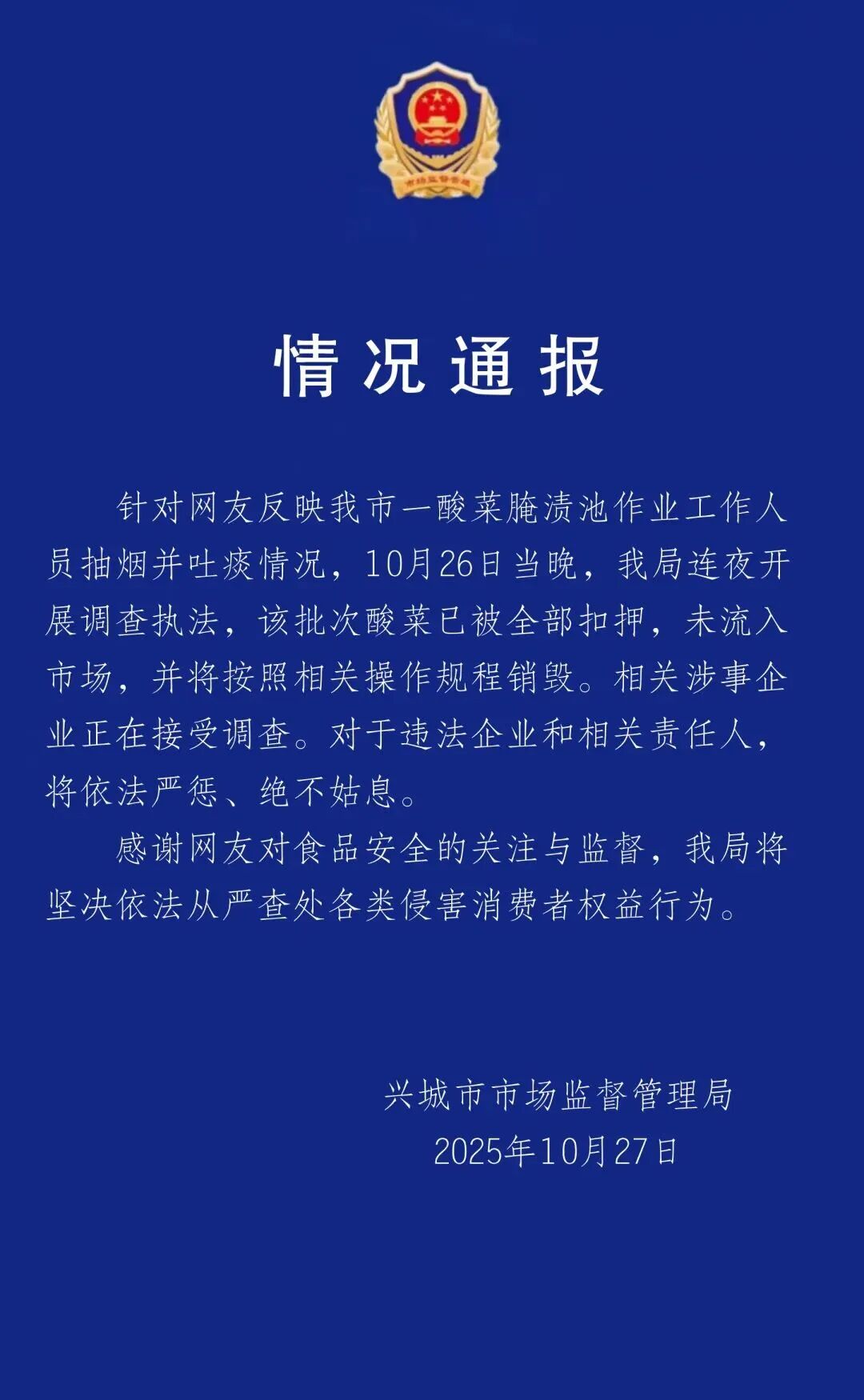
感谢网友对食品安全的关注与监督,我局将坚决依法从严查处各类侵害消费者权益行为。 10月27日,兴城市市场监督管理局发布情况通报: 针对网友反映我市一酸菜腌渍池作业工作人员抽烟并吐痰情况,10月26日当晚,我局连夜开展调查执法,该批次酸菜已被 全部扣押,未流入市场,并将按照相关操作规程销毁。相关涉事企业正在接受调查。对于违法企业和相关责任人,将依法 严惩、绝不姑息。 此前报道: 近日,一段男子在酸菜池中做出不文明行为的视频引发网友关注。视频显示,一男子在疑似酸菜的生产车间中用钢叉把大 量酸菜铲至一旁,长达30秒的视频里,男子一直在吸烟,同时在酸菜池中随地吐痰,有网友表示,此事发生在葫芦岛市。 ▲男子吸烟、吐痰视频截图 (文章来源:新京报) ...
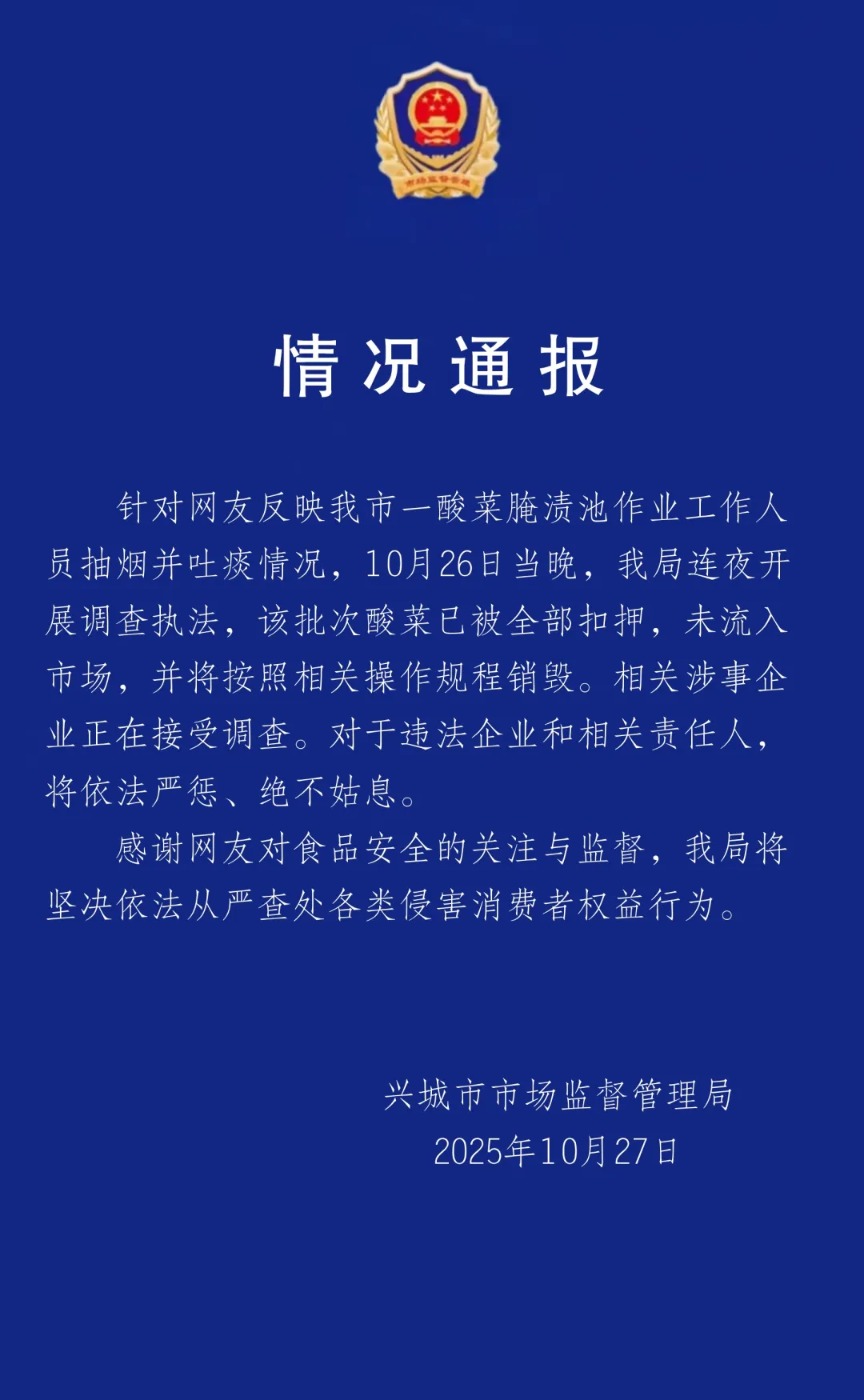
辽宁兴城通报“男子在酸菜池中抽烟并吐痰”:该批次酸菜已被全部扣押,未流入市场,涉事企业正接受调查
Mei Ri Jing Ji Xin Wen· 2025-10-27 15:34
Group 1 - The incident involving a sauerkraut production facility in Liaoning has raised significant public concern due to unsanitary practices observed in a viral video, prompting immediate regulatory action [5][8] - The local market supervision authority has confirmed that all affected sauerkraut batches have been seized and will be destroyed, ensuring they did not enter the market [1][8] - Investigations are ongoing into the responsible company and individuals, with a commitment from authorities to impose strict penalties for any violations of food safety regulations [1][8] Group 2 - The video that sparked outrage showed a worker smoking and spitting while handling sauerkraut, highlighting serious hygiene issues within the food production process [5] - The provincial market regulatory department has intervened, with local officials on-site to manage the investigation and ensure compliance with safety standards [8] - The specific identity of the sauerkraut company involved has not yet been disclosed, and further details are expected from relevant authorities [8]