
绿色低碳转型

Search documents
技术创新推动能源发展迈上新台阶
Shan Xi Ri Bao· 2025-12-18 00:42
在位于延安市安塞区的延长油田杏子川采油厂郝家坪注水项目区,一根根管道将源源不断的水注入 大地深处。 在能源化工园区,"黑色煤海"掀起层层"绿波"; 百米深井下,采煤机轰鸣前行,精准切割煤壁; …… 数据显示,"十四五"时期,陕西煤炭最高年产量达7.8亿吨、较2020年增加1亿吨,天然气、原油产 量分别居全国第三、第四位,能源工业"压舱石"作用凸显。 发展的驱动力源自技术创新。 2000万吨;煤炭产量从1090万吨预计增长至4040万吨,化工品产量从632万吨预计增长至792万吨、增幅 25.32%。 近年来,能源陕西实验室、榆林能源革命创新示范区等加速建设,重点企业、重点项目接续发力, 创新成果不断涌现,陕西能源行业迸发新活力。聚焦高端化、多元化、低碳化发展目标,陕西持续推动 煤化工产业绿色低碳转型。 陕煤集团榆林化学有限责任公司(以下简称"陕煤集团榆林化学")积极拥抱数智化发展浪潮,建成 国内首个化工行业5G应用联合创新实验室,推动煤化工产业生产质效大幅提升。 12月12日,在陕煤集团榆林化学中控室,乙二醇装置副操万帅帅"盯"着自动运转的工厂干活。"厂 区内的1080条巡检路线、598个点位,都实现了数字化 ...
中经评论:煤炭消费负增长不是“终场哨”
Jing Ji Ri Bao· 2025-12-18 00:08
近日,中国煤炭运销协会在煤炭经济运行分析会上,披露了一个引人关注的数据:今年以来,我国 煤炭消费总体偏弱,自2017年以来同比首次出现负增长,预计明年煤炭需求仍有增长空间,煤炭供应将 相对稳定。煤炭消费为何出现下滑?这一数据是短期波动,还是长期趋势的起点?在"十五五"规划建议 明确提出"推动煤炭和石油消费达峰"的背景下,我们该如何理解煤炭角色转变? 煤炭消费下滑首要原因是火电用煤减少。燃煤发电行业仍是煤炭消费主力,今年以来,新能源装机 和发电量快速增长,预计全年风电光伏新增装机约3.7亿千瓦。持续高增长下,新能源规模化替代效应 凸显,煤电装机占比继续下降,煤电发电量受到制约。同时,受房地产市场持续调整等因素影响,钢 铁、建材两大传统耗煤行业煤炭需求也有所减少。 有人认为,煤炭消费下滑是经济动能不足的表现。但事实绝非如此。随着我国能源转型深入推进和 产业结构升级,煤炭消费增速与宏观经济增速的关系,已由密切相关转为弱相关。一方面,在经济高质 量发展要求下,钢铁、建材等高耗能行业不再是简单的规模扩张,而是致力于提质增效和节能减排。单 位产出煤耗持续降低,意味着我们可以用更少的煤支撑经济稳定增长。 另一方面,我国经济 ...
能源广角煤炭消费负增长不是“终场哨”
Jing Ji Ri Bao· 2025-12-17 23:38
Core Insights - China's coal consumption has shown a decline for the first time since 2017, indicating a potential shift in the energy landscape, with expectations for stable coal supply and possible demand growth in the coming year [2][4] Group 1: Coal Consumption Trends - The primary reason for the decline in coal consumption is the reduction in coal used for thermal power generation, as renewable energy sources like wind and solar are rapidly increasing, with an expected addition of approximately 370 million kilowatts of new capacity this year [2] - The relationship between coal consumption growth and macroeconomic growth has weakened, as high-energy-consuming industries are focusing on quality improvement and energy efficiency rather than mere expansion [2][3] Group 2: Future Projections - Short-term projections indicate that coal demand may still have resilience, with expectations for some growth next year, particularly in the coal chemical industry, which is anticipated to maintain high capacity utilization [4] - Long-term forecasts suggest that coal consumption will peak around 2027, transitioning from a primary energy source to a backup energy source, with a gradual reduction in coal use in sectors like steel and construction [4][5] Group 3: Strategic Insights - The focus of energy security is shifting from ensuring large coal supplies to building a multi-source complementary power system, where coal will serve as a reliable regulator and backup power source [5] - Coal's role is evolving from a fuel to an important industrial raw material, particularly in the chemical sector, where it can produce high-end materials and special fuels, thus supporting the transition to a low-carbon economy [5] - A balanced approach to energy transition is necessary, respecting China's resource endowment and ensuring that coal capacity remains sufficient until renewable energy can fully support the system [5]


《中国碳中和与清洁空气协同路径(2025)》报告发布会在海口市召开
Zheng Quan Ri Bao Zhi Sheng· 2025-12-17 13:51
Core Viewpoint - The 2025 Annual Meeting of the Clean Air Policy Partnership (CCAPP) and the seminar on Hainan's "14th Five-Year Plan" for leading air quality and low-carbon development strategies highlighted the importance of collaborative governance in carbon reduction and pollution control during the "14th Five-Year Plan" period [1][2]. Group 1: Achievements and Challenges - Over the past decade, China has made historic achievements in ecological and environmental protection, with economic growth and air quality improvement progressing in tandem, yet structural and trend-related pressures remain [1][2]. - The current improvements in air quality are not stable, necessitating a focus on three areas during the "14th Five-Year Plan": fundamental structural changes in industry, energy, and transportation; comprehensive pollution reduction across key sectors; and the establishment of a management system for air quality with Chinese characteristics [2][5]. Group 2: Hainan's Role and Strategy - Hainan, as China's largest economic special zone and free trade port, is committed to ecological preservation and the strategic goal of becoming a low-carbon island, leveraging its ecological resources and reform platform to achieve collaborative governance of carbon neutrality and clean air [3][4]. - The province aims to enhance cooperation with CCAPP partners to explore unique pathways for collaborative development, showcasing China's ecological civilization achievements [3][4]. Group 3: Policy Implementation and Future Directions - The former chief engineer of the Ministry of Ecology and Environment emphasized the need to address uncertainties in policy implementation affecting carbon and pollution reduction, suggesting measures such as strict control of new coal consumption and promoting clean energy alternatives [5]. - The importance of aligning air quality improvement with carbon peak and Nationally Determined Contributions (NDC) goals was highlighted, advocating for a structured approach to air quality enhancement across regions [5].
《中国碳中和与清洁空气协同路径》报告发布会在海口市召开
Zheng Quan Ri Bao Wang· 2025-12-17 13:30
Core Viewpoint - The 2025 Annual Meeting of the Clean Air Policy Partnership (CCAPP) and the seminar on Hainan's "14th Five-Year Plan" for leading air quality and low-carbon development strategies highlighted the importance of collaborative governance in carbon reduction and pollution control during the "14th Five-Year Plan" period [1][2]. Group 1: Achievements and Challenges - Over the past decade, China has made historic achievements in ecological and environmental protection, with economic growth and air quality improvement progressing in tandem, yet structural and trend-related pressures remain [1][2]. - The current improvements in air quality are not stable, necessitating a focus on three areas during the "14th Five-Year Plan": fundamental structural changes in industry, energy, and transportation; detailed pollution reduction across key sectors; and the establishment of a management system for air quality with Chinese characteristics [2][5]. Group 2: Hainan's Role and Strategy - Hainan, as China's largest economic special zone and free trade port, is committed to ecological preservation and the strategic goal of becoming a low-carbon island, leveraging its ecological resources and reform platform to achieve collaborative governance in carbon neutrality and clean air [3][4]. - The province aims to enhance cooperation with CCAPP partners to explore unique pathways for collaborative development, showcasing China's ecological civilization achievements [3][4]. Group 3: Future Directions and Recommendations - The CEO of the Energy Foundation emphasized the successful synergy of multiple policy goals, including economic growth, energy security, climate change response, and air quality improvement, suggesting that Hainan could become a hub for innovative air management research [4]. - Recommendations for addressing uncertainties in energy development include strict control of new coal consumption, promoting clean energy alternatives, and implementing low-emission upgrades for coal-fired power plants [5].
“十四五”能源成就·投资篇丨比增11%!增势强劲向绿向新
Zhong Guo Dian Li Bao· 2025-12-17 06:51
Core Insights - The energy investment in China is experiencing strong growth, with a projected investment of 3.54 trillion yuan in key energy projects by 2025, representing an 11% year-on-year increase [1] - The "14th Five-Year Plan" has led to significant increases in energy investment, with annual investments surpassing 4 trillion, 5 trillion, and 6 trillion yuan, providing robust support for China's modernization efforts [1][2] Investment Trends - Energy investment accounts for nearly 10% of total fixed asset investment in China, highlighting its critical role in economic stability [2] - Investment in key sectors such as electricity and heat production has seen growth rates exceeding 20%, contributing significantly to overall economic growth [2] - Despite a decline in overall fixed asset investment from January to November 2025, investment in key energy projects has continued to rise, particularly in nuclear power, onshore wind, distributed solar, and grid infrastructure [2] Supply Security - Since 2021, state-owned energy enterprises have been responsible for approximately 80% of crude oil, 70% of natural gas, and 60% of electricity supply, increasing China's energy self-sufficiency from around 80% to over 84% [3] - The coal supply has been reinforced, and oil and gas production has reached historical highs, effectively managing peak electricity loads [3] Technological Advancements - New energy storage capacity has surpassed 100 million kilowatts, making China the world leader in this area [4] - China holds over 40% of global renewable energy patents, with continuous improvements in solar conversion efficiency and offshore wind turbine capacity [4] Green Investment - The "14th Five-Year Plan" marks the fastest transition to green and low-carbon energy in China's history, with renewable energy investments becoming the dominant force in power generation [6] - By 2024, over 80% of investment in power generation will be directed towards renewable energy projects, contributing to a significant reduction in carbon emissions [6] Private Sector Involvement - The threshold for investment in the energy sector has been lowered, leading to a double-digit growth rate in private sector participation in energy projects [8] - Private enterprises are increasingly involved in major energy projects, with significant participation in nuclear power and hydropower projects [8][9] - Recent policies have been implemented to enhance the investment environment for private capital in the energy sector, including support for participation in key projects [8][10]
东西问|于洋:中国小城保亭何以成中欧绿色合作热土?
Zhong Guo Xin Wen Wang· 2025-12-17 02:11
中新社海口12月16日电 题:中国小城保亭何以成中欧绿色合作热土? ——专访海南大学国际商学院副教授于洋 中新社记者 张茜翼 2025年是中欧建交50周年。一个中欧绿色数字创新合作区在海南省保亭黎族苗族自治县推进建设,这是中国两个中欧碳中和合作试点之一。 今年来,保亭频频进入国际视野:11月17日,亮相《联合国气候变化框架公约》第三十次缔约方大会(COP30),分享推进绿色低碳可持续发展的经验;10月 在"从承诺到落实:COP进程中的海南行动"大会上签约一批国际合作项目;6月在巴黎举办"气候挑战赛(海南保亭)欧洲站"活动,签署六项中欧重点合作项 目。 中国这个小城何以成为中欧绿色合作热土?海南大学国际商学院副教授于洋近日接受中新社"东西问"专访,对此进行解答。 现将访谈实录摘要如下: 中新社记者:为什么说绿色是中欧合作的鲜明底色? 于洋:今年《中欧领导人关于应对气候变化的联合声明》再次强调"绿色是中欧合作鲜明底色",表明双方愿意通过更紧密合作,为国际社会提供稳定性和可 预期性。这既是双方共同承担的国际责任,也是现实利益和战略方向的高度契合点。 中欧都把绿色低碳转型置于国家战略的核心位置。无论是中国的"双碳"目 ...

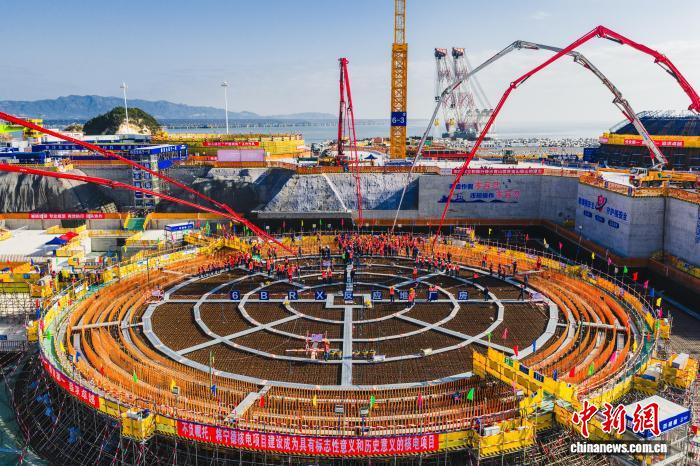
中广核福建宁德核电站6号机组正式开工
Zhong Guo Xin Wen Wang· 2025-12-17 02:11
Core Viewpoint - The construction of the No. 6 unit of the China General Nuclear Power Group (CGN) Fujian Ningde Nuclear Power Plant has officially commenced, marked by the completion of the first concrete pouring for the nuclear island, indicating the start of the main engineering work [1][2]. Group 1: Project Overview - The Ningde nuclear power project is located in Fuding City, Fujian Province, and plans to build six 1 million kilowatt-level nuclear power units in two phases, being the first nuclear power station in Fujian to start construction and production [2]. - The No. 6 unit, which began construction on December 16, 2023, has a total concrete pouring volume of approximately 8,819.2 cubic meters, taking about 55 hours to complete [2]. Group 2: Technological and Management Innovations - The project will leverage technological innovation, utilizing digital tools such as digital sandboxes, integrated digital progress platforms, and smart construction sites, while implementing 26 advanced construction technologies [4]. - The project team has optimized construction logic and resource allocation by drawing on past experiences from CGN's "Hualong One" unit construction, enhancing process control through a daily engineering meeting mechanism to ensure the smooth advancement of key milestones [2][4]. Group 3: Economic and Environmental Impact - The Ningde nuclear power project is expected to continuously inject clean energy into the economic and social development of Fujian Province, aiding in the optimization of the regional energy structure and the transition to a low-carbon economy [4].
大中矿业:积极推进运输环节绿色低碳转型,逐步替换新能源车辆
Jin Rong Jie· 2025-12-17 01:04
Core Viewpoint - The company is actively promoting the transition to green and low-carbon transportation in response to the national "dual carbon" strategy, focusing on the replacement of traditional vehicles with new energy vehicles to reduce carbon emissions and operational costs [1] Group 1: Company Initiatives - The company has replaced all of its official vehicles with new energy vehicles and is gradually converting production vehicles to electric ones [1] - The application of new energy heavy trucks in the transportation fleet is being actively promoted, which not only achieves environmental benefits but also effectively reduces vehicle energy consumption and maintenance costs [1] Group 2: Operational Adjustments - The proportion of new energy equipment in daily operations will be dynamically adjusted based on the operational conditions of each mining area and the vehicle replacement plan [1]
全面绿色转型提速 铺就高质量发展底色
Yang Shi Xin Wen Ke Hu Duan· 2025-12-17 00:35
Core Viewpoint - Green development is a prominent feature of Chinese modernization, emphasizing the importance of ecological protection and a comprehensive green transformation of economic and social development [1] Group 1: Green Energy and Technology - In the first ten months of this year, China's wind power equipment exports exceeded 10 billion, marking a year-on-year growth of 44.9% [2] - By September, the Yangtze River had seen the commissioning of 156 new energy vessels, doubling the previous year's figures, with nearly 70% of global green ship orders coming from China [2] - Renewable energy installed capacity reached 2.22 billion kilowatts, accounting for nearly 60% of the national total, with over one-third of electricity consumption coming from green energy [3] Group 2: Green Industry and Trade - The scale of the green low-carbon industry is projected to reach approximately 11 trillion yuan, with 6,430 green factories and 491 green industrial parks established nationwide [4] - Exports of green products such as new energy vehicles and lithium batteries have seen double-digit growth, making green trade a crucial pillar of China's foreign trade [4] Group 3: Policy and Institutional Framework - The "14th Five-Year Plan" emphasizes accelerating the comprehensive green transformation of economic and social development, with specific policies supporting energy conservation and carbon reduction in key industries [5] - A comprehensive carbon management system is being established, including local carbon assessments and industry-specific carbon controls [5] Group 4: Global Leadership and Cooperation - China is actively leading global climate governance and sharing green development achievements, having signed 55 climate cooperation memorandums with 43 developing countries [4] - The country is committed to enhancing its role in global climate initiatives, marking the tenth anniversary of the Paris Agreement [4]