
新型电力系统

Search documents
卷土重来!盈亏交替的荣信汇科二闯IPO
Bei Jing Shang Bao· 2025-11-27 13:39
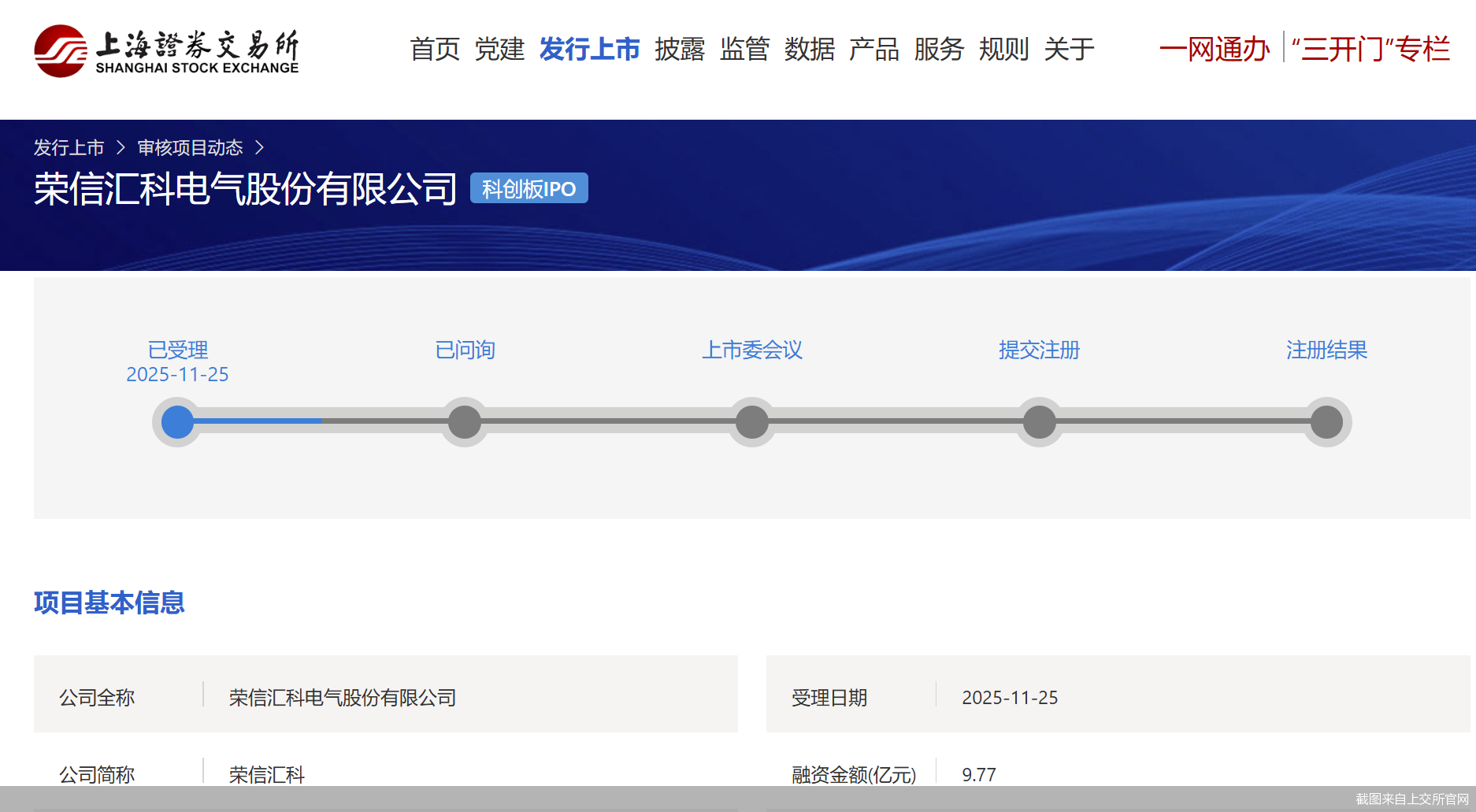
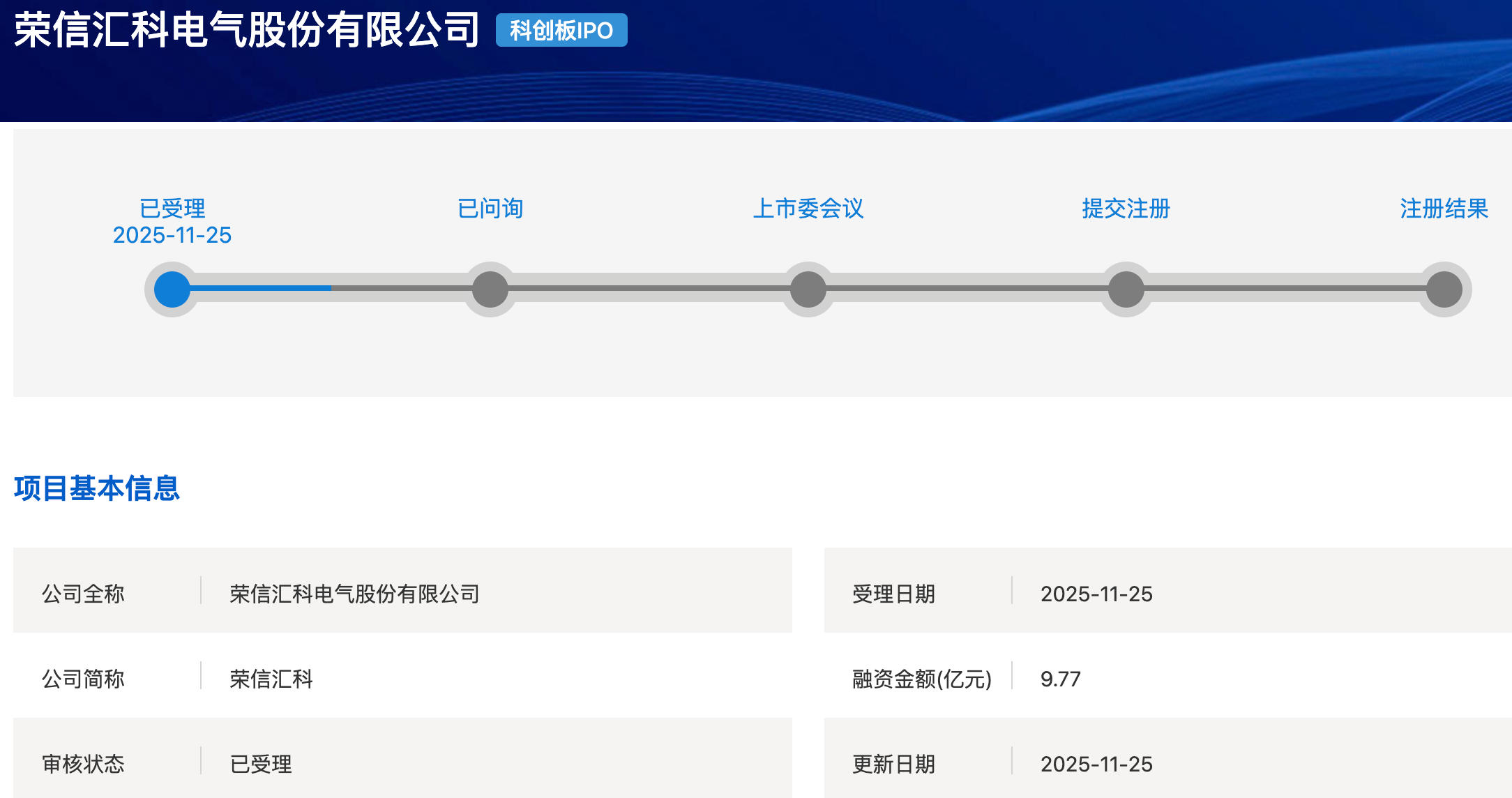
Core Viewpoint - Rongxin Huike Electric Co., Ltd. is attempting to relist on the Sci-Tech Innovation Board (STAR Market) after a previous unsuccessful attempt, with its IPO application accepted on November 25, 2023. The company has shown significant fluctuations in performance, reporting a net loss of 5.37 million yuan in the first half of the year [1][5]. Group 1: IPO Attempt and Financials - Rongxin Huike's IPO application was previously accepted in December 2021 but was withdrawn in June 2022. The current fundraising target has increased from 600 million yuan to 977 million yuan [5]. - The company plans to allocate the raised funds to various projects, including 337 million yuan for offshore wind power equipment, 234 million yuan for green low-carbon flexible power equipment, 256 million yuan for R&D center construction, and 150 million yuan for working capital [5]. - The company's debt-to-asset ratio has been rising, reaching 31.91% at the end of 2022 and projected to rise to 57.36% by mid-2025 [5][6]. Group 2: Performance Fluctuations - Rongxin Huike's revenue and net profit have fluctuated significantly, with revenues of approximately 1.942 billion yuan in 2022 and a projected 2.33 billion yuan in 2023, while net profits have varied from 182 million yuan to losses of 56.28 million yuan [8]. - The company's revenue recognition is heavily influenced by the timing of project completions, leading to substantial quarterly revenue fluctuations [9]. - The company has a backlog of orders exceeding 3.68 billion yuan, which is expected to be delivered over the next 2-3 years, providing a foundation for future performance [9]. Group 3: Inventory and R&D - The company's inventory has been increasing, with values of 401 million yuan in 2022 and projected to reach 1.704 billion yuan by mid-2025, primarily due to the need for substantial stock for ongoing projects [10]. - R&D expenses have also shown significant variability, with amounts ranging from 47.97 million yuan to 21.18 million yuan across the reporting periods, reflecting the company's revenue fluctuations [10]. Group 4: Shareholding Structure - The controlling shareholders of Rongxin Huike include Baiyun Electric Group and Zuo Qiang, with significant involvement from the Hu family [7][11]. - Zuo Qiang has a history in the capital market, previously being a controlling figure in another listed company, and has been involved in the management of Rongxin Huike since its inception [11][12].

国家发改委:全国新型储能装机超过1亿千瓦
Bei Jing Shang Bao· 2025-11-27 09:37
北京商报讯(记者 和岳)11月27日,国家发展改革委召开月度新闻发布会。国家发展改革委政策研究 室副主任李超表示,随着我国风电、光伏等新能源装机规模和比例的不断提高,电力系统调节能力已经 成为建设新型电力系统的重要方面。近年来,国家发展改革委会同有关方面加快推进储能和氢能发展, 取得积极进展。储能方面,我国储能产业快速发展,大规模压缩空气储能、高安全化学储能、固态电池 储能等技术路线开发和示范应用取得积极进展。目前,全国新型储能装机超过1亿千瓦,是"十三五"末 的30倍以上,占全球总装机比例超过40%。 ...
安徽淮北:送“电”上门 赋能光伏电站提效增收
Ren Min Wang· 2025-11-27 01:28
Core Viewpoint - The initiative by the Huai Bei Power Supply Company to deliver the "Distributed Photovoltaic Project Grid Connection Test Supervision Letter" directly to the sites of distributed photovoltaic projects aims to enhance the safety and efficiency of grid connections, addressing the high demands for real-time regulation and stability of the power grid as more photovoltaic stations come online [1][2]. Group 1: Initiative and Implementation - The delivery of the supervision letter is part of a proactive approach to ensure that photovoltaic users complete their grid connection tests within the required six-month timeframe [1][2]. - The Huai Bei Power Supply Company has taken steps to address the issue of many users not completing their tests on time by sending technical personnel to communicate directly with project representatives at each site [1][2]. Group 2: Service Model and Goals - The initiative reflects a deepening of the service model by the power supply company, aiming to resolve potential technical issues early and ensure timely completion of grid connection tests [2]. - This approach not only ensures the safety of the power grid but also helps users save time and avoid repeated corrections, promoting a win-win situation for both the power supply company and its customers [2]. Group 3: Future Plans - The Huai Bei Power Supply Company plans to establish a regular on-site supervision mechanism to continue delivering supervision letters to other users who have not completed their grid connection tests on time [2]. - The company will also track the implementation of the requirements outlined in the letters to ensure that every photovoltaic project can seamlessly connect to the grid, supporting the construction of a safe, efficient, and low-carbon new power system [2].
我国已建成世界规模最大的清洁能源供应体系
Ke Ji Ri Bao· 2025-11-27 00:57
Core Insights - China has established the world's largest clean energy supply system, with a total installed power generation capacity of 3.65 billion kilowatts as of June 2025, of which 2.2 billion kilowatts (60%) is from clean energy sources [1][2] Group 1: Energy Consumption and Economic Growth - Over the past decade, China's energy consumption has grown at an average rate of 3.1%, supporting an average GDP growth of 6.7% [1] - The energy consumption per unit of GDP has decreased by 27%, and carbon emission intensity has dropped by 34% [1] Group 2: Renewable Energy Capacity - Since the 14th Five-Year Plan, China has added an average of 22 million kilowatts of new energy capacity annually, contributing over 80% of the world's new installed capacity [1] - Renewable energy capacity accounts for 41% of the global total, with over 96% of coal-fired power units completing ultra-low emission upgrades [1] Group 3: Technological Innovations - China has built 44 ultra-high voltage transmission channels, with annual electricity transmission from the "West to East" exceeding 700 billion kilowatt-hours [2] - The country has the world's largest single-unit capacity hydropower generator at 1 million kilowatts, and onshore and offshore wind power units have reached capacities of 11 megawatts and 26 megawatts, respectively [2] Group 4: Energy Storage and Electric Vehicles - The operational capacity of new energy storage in China is 95 million kilowatts, accounting for over 40% of the global total [2] - The number of electric vehicles in China exceeds 25.5 million, with 17 million charging facilities and a total rated power of 196 million kilowatts [2] Group 5: Regional Developments - Hunan province has accelerated the construction of a new power system, establishing the first provincial-level research center for new power system development in China [2] - Demonstration projects such as the Hunan New Power System Innovation Center and the Orange Isle Zero Carbon Energy Experience Hall have significantly improved energy supply efficiency in the province [2]
署名文章丨国家能源局副局长何洋:构建电力可靠性管理新格局 推动电力可靠性工作高质量发展
国家能源局· 2025-11-26 10:46
Core Viewpoint - The article emphasizes the importance of enhancing power reliability management in China to support high-quality economic and social development, addressing new challenges and requirements in the context of modern energy systems [2][8]. Historical Achievements - Over the past 40 years, China's power reliability management has evolved significantly, establishing a comprehensive management system that includes government leadership, industry service, and enterprise responsibility [4][5]. - The average unplanned outage frequency for coal and hydropower units has decreased by over 93%, with many coal-fired units operating for more than 1,000 days without interruption [5]. Current Challenges - The transition to a new energy system introduces complexities such as increased randomness and volatility in power generation and consumption, necessitating innovative reliability management methods [9]. - There is a disparity in power reliability statistics, with only 36.14% of wind power and 13.46% of solar power capacity included in reliability assessments, highlighting the need for broader data coverage [10]. Future Directions - The focus is on ensuring reliable power supply to meet the demands of high-quality development, with an emphasis on addressing imbalances in power reliability across urban and rural areas [12][13]. - The article calls for deepening research and pilot projects in power system reliability, enhancing data collection methods, and expanding the coverage of reliability statistics to include emerging energy sources [14][15]. Systematic Improvements - There is a need to establish a robust framework for reliability management, including clear responsibilities at all levels and the development of standardized procedures across various sectors of the power industry [16].

“科技创新+机制变革” 共筑新型能源体系
Xin Hua Cai Jing· 2025-11-26 09:55
11月25日,以"科技创新与机制变革共筑新型能源体系"为主题的中国电机工程学会年会在湖南长沙召 开,多位专家及政府、企业代表等共话能源电力发展蓝图。 在碳达峰、碳中和目标引领下,我国能源电力行业正迎来一场系统性变革。11月25日,中国电机工程学 会年会在湖南长沙召开。本次年会以"科技创新与机制变革共筑新型能源体系"为主题,多位专家及政 府、企业代表等共话能源电力发展蓝图。 新型电力系统是能源转型的必然选择 "构建新型电力系统已成为能源电力行业的中心任务。"中国电机工程学会理事长、中国工程院院士舒印 彪指出,我国在"四个革命、一个合作"能源安全新战略指引下,已建成全球规模最大的清洁电力供应体 系。截至6月底,全国发电总装机36.5亿千瓦,清洁能源装机超过22亿千瓦,占总装机的60%以上。 2013年至2023年,中国以年均3.3%的能源消费增速支撑了年均6.1%的经济增长,能耗强度累计下降 26.1%,展现了能源转型的显著成效。 "未来的工业系统要具备具身智能,就要有AI的自主感知、决策和执行控制能力。"中国工程院院士、湖 南大学教授王耀南系统阐述了人工智能的赋能作用。他提出建立电力行业垂直大模型,推动发电侧、 ...
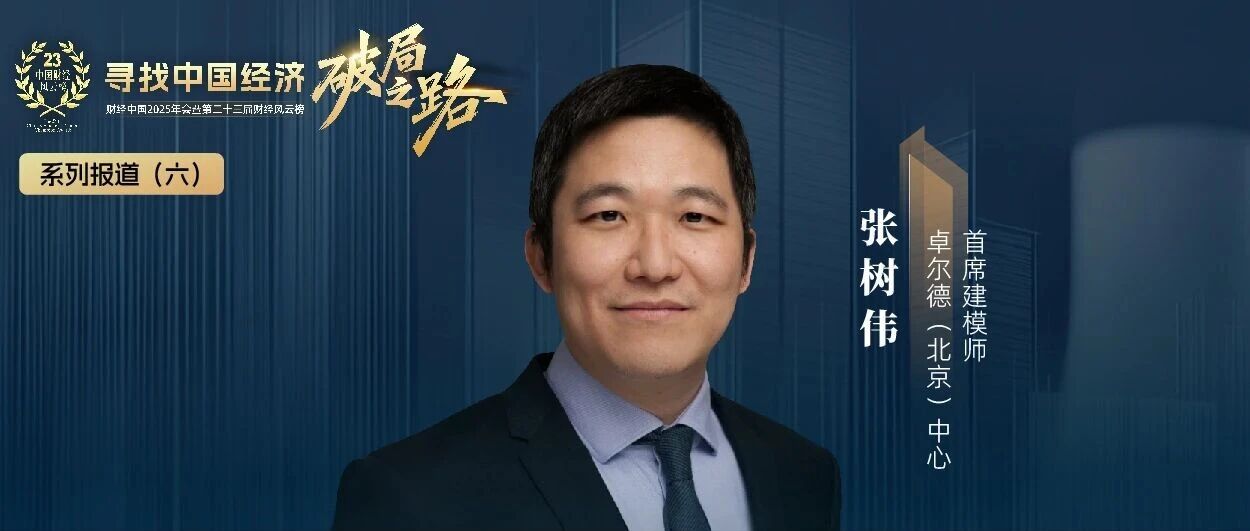
张树伟:煤电“安全兜底”和“低碳转型”,需在运行方式上高度分化
和讯· 2025-11-26 08:56
Core Viewpoint - The article discusses the transition of coal power from being a "basic guarantee power source" to a "supporting adjustment power source" within China's energy strategy, emphasizing the need for a differentiated operational logic for coal power to achieve safety and low-carbon transformation [2][3][10]. Energy Transition and Challenges - The "14th Five-Year Plan" aims to establish a new energy system and a new power system, focusing on accelerating the construction of a new energy framework and promoting energy security [2]. - By September 2025, domestic coal consumption is projected to reach nearly 2.2 billion tons, indicating that coal power will still play a significant role during this transition [2]. - As of September 2025, installed capacity for wind and solar power reached 1.7 billion kilowatts, accounting for 46% of total installed capacity, with wind and solar generation contributing 22.3% to total electricity consumption in the first three quarters of the year [2]. - The increasing scale of renewable energy generation faces challenges in system absorption, with wind abandonment rates at 6.6% and solar abandonment rates at 5.7%, indicating a need for changes in renewable energy development and operational models [2]. Differentiated Operation of Coal Power - To achieve effective safety and low-carbon transformation, over 5,000 coal power units need to operate in a highly differentiated manner, with some units running as baseload, others ensuring grid stability, and some serving as strategic reserves [3][10]. - The current operational model of coal power is criticized for being overly homogenized, which limits efficiency and flexibility in the system [10]. Market and Policy Mechanisms - The article highlights the need for clearer policy objectives and market mechanisms to support the transition to a new energy system, emphasizing that the current market structure is fragmented and lacks transparency [21]. - The concept of "green electricity" is discussed, suggesting that it should be treated as equivalent to "green certificate consumption," which has become less relevant due to the decreasing costs of renewable energy [12][14]. - The article argues for the need to allow renewable energy to replace coal power in a broader context rather than being confined to self-consumption scenarios, which currently limits efficiency [18]. Future Directions - The article suggests that the focus should be on improving the operational transparency of the energy system, allowing for better understanding and efficiency in policy and investment decisions [21]. - It calls for a shift from traditional planning methods to more dynamic models that consider load curves and extreme weather impacts, advocating for the integration of randomness optimization methods to enhance system resilience [22][23].
中国电机工程学会年会在湖南长沙举行
Zhong Guo Jing Ji Wang· 2025-11-26 06:58
Core Insights - The 2025 China Electromechanical Engineering Society Annual Conference was held in Changsha, Hunan, focusing on "Technological Innovation and Mechanism Reform to Build a New Energy System" [1] - The conference attracted 17 academicians and numerous industry elites, emphasizing the "dual carbon" goals and discussing key technologies and major issues in constructing a new power system [1] - The event featured a series of 45 academic activities and aimed to create a high-end communication platform for deep integration of industry, academia, and research [1] Group 1 - The conference adopted a "month of annual meeting activities" format, with Changsha as the main venue and multiple sub-venues across the country, achieving a concentrated and extended outreach effect [1] - Key topics included the "15th Five-Year Plan for Power," "Clean and Efficient Power Generation Technologies," and the cultivation of interdisciplinary talents in artificial intelligence and electrical engineering [1] - An energy technology innovation achievement exhibition was held, showcasing cutting-edge technologies in the energy and power sector, facilitating deep integration of industry, academia, and research [1] Group 2 - Hunan issued an initiative to "build a high-level energy technology innovation system," leveraging four national key laboratories and five national platforms to enhance collaborative innovation mechanisms [2] - Hunan's provincial leaders highlighted the province's progress in constructing a new power system and the establishment of several demonstration projects with significant achievements [2] - The conference was organized by the China Electromechanical Engineering Society, with joint sponsorship from several major companies, including State Grid Hunan Electric Power Co., China Huaneng Clean Energy Technology Research Institute, Huawei Technologies, and CRRC Zhuzhou Electric Locomotive Research Institute [2]
荣信汇科科创板IPO获受理 拟募资9.77亿元
Zheng Quan Shi Bao Wang· 2025-11-26 03:13
Core Insights - Rongxin Huike Electric Co., Ltd. has been accepted for IPO on the Sci-Tech Innovation Board, aiming to raise 977 million yuan [1] - The company specializes in the research, manufacturing, sales, and service of core equipment for new power systems, providing high-end equipment and technical services [4] - Rongxin Huike holds over 25% market share in flexible DC converter valve equipment, ranking among the top in the industry [4] Company Overview - Rongxin Huike is a high-tech enterprise focused on core equipment for new power systems, including flexible transmission equipment and high-power converters [4] - The company's products are widely used in various sectors such as efficient power generation, power transmission and distribution, oil and gas pipelines, national defense, shipbuilding, metallurgy, and energy storage [4] - The flexible DC transmission technology is crucial for constructing new power systems dominated by renewable energy [4] Market Position - The company has participated in four out of five operational high-voltage flexible DC projects in China since 2020, supplying over 30% of the total operational capacity of converter products [4] - Rongxin Huike has successfully entered the overseas market with a contract for a ±500kV flexible DC converter station project in Saudi Arabia, marking a significant breakthrough for its proprietary technology [4] Product Range - The company offers a variety of flexible AC transmission products, including static synchronous compensators and flexible energy storage converters, primarily targeting overseas markets [5] - Its high-power converter products are utilized in critical industries such as aerospace testing, shipbuilding, and natural gas pipeline transportation, showcasing a leading advantage in specific segments [5][6] Financial Performance - The company reported revenues of 233 million yuan, 508 million yuan, and 234 million yuan for the years 2023 to the first half of 2025, with net profits of -56 million yuan, 35 million yuan, and -5 million yuan respectively [6] - The funds raised from the IPO will be allocated to the development and industrialization of offshore wind power transmission equipment, green low-carbon flexible power core equipment, and the establishment of a research and testing center [6] Future Outlook - Successful implementation of the fundraising projects is expected to solidify the company's leading position in the core equipment sector of new power systems, enhancing its market competitiveness and meeting current and potential market demands [6]
一度电的担当!新型电力系统让绿能“超长续航”
Xin Hua She· 2025-11-25 14:01
Core Viewpoint - The development of a new type of power system in China is enhancing the efficiency and sustainability of green energy transmission, enabling long-term energy supply and supporting the country's transition to a low-carbon economy [1][4][5]. Group 1: Green Energy Transmission - Inner Mongolia's green energy is being transmitted to Shandong through a high-voltage direct current (HVDC) system, with an average daily delivery of approximately 160 million kilowatt-hours, sufficient to meet the needs of about 25 million households [1]. - The Ningxia-Hunan ±800 kV HVDC project, which began operation this year, is expected to deliver over 36 billion kilowatt-hours annually, primarily from renewable energy sources [2]. Group 2: Technological Advancements - The development of advanced technologies, such as domestically produced offshore wind turbines and large hydropower stations, is crucial for enhancing the capacity to generate and transmit green electricity [4]. - The State Grid's cross-regional transmission capacity has reached 370 million kilowatts, facilitating the efficient interconnection of energy resources across regions [4]. Group 3: Future Directions - The focus on building a new type of power system is aligned with China's "14th Five-Year Plan," emphasizing high-quality development in the energy sector [4]. - Industry experts advocate for increased interaction on the demand side and the establishment of a unified electricity market to maximize the value of green energy [5].