6G

Search documents
北京市2025年IPv6规模部署和应用主题日活动在海淀举行
Xin Jing Bao· 2025-12-08 12:58
Core Viewpoint - The event emphasizes the importance of IPv6 as a core technology for the next generation of the internet, aiming to drive digital transformation and high-quality development of the digital economy in Beijing [1]. Group 1: Policy and Strategic Initiatives - Beijing will focus on policy guidance, mechanism innovation, ecosystem construction, and resource assurance to promote the large-scale deployment of IPv6 single-stack technology [1]. - The city aims to leverage IPv6 technology advantages in various fields such as artificial intelligence, 6G, autonomous driving, and computing networks to establish a solid foundation for becoming a global benchmark city for the digital economy [1]. Group 2: Technical Insights and Collaborative Efforts - Professor Li Xing from Tsinghua University provided strategic guidance on the deep development of IPv6, highlighting the importance of policy empowerment and multi-party collaboration in achieving full coverage of IPv6 [2]. - The event showcased innovative measures from Haidian District and Economic Development Zone, forming a collaborative work pattern that can be replicated across the city [2]. Group 3: Recognition and Ecosystem Development - An award ceremony recognized outstanding cases of IPv6 deployment and application in key sectors such as government, education, finance, and the internet, with a total of 40 awards distributed [2]. - The establishment of the "Capital Internet Industry IPv6 Innovation Development Alliance" marks a new phase in the collaborative and ecological development of IPv6 in Beijing, with participation from major internet companies [3].
利好来袭!刚刚 集体飙涨!
Zhong Guo Ji Jin Bao· 2025-12-08 06:09
Market Overview - The A-share market saw a collective rise in the three major indices, with the ChiNext Index increasing over 3% and the Growth Enterprise Index rising over 5% [1] - The Shanghai Composite Index closed at 3927.19 points, up 0.62%, while the Shenzhen Component Index rose by 1.55% and the ChiNext Index increased by 3.02% [1] Trading Volume and Stock Performance - The trading volume in the Shanghai and Shenzhen markets reached 1.29 trillion yuan, an increase of 297.1 billion yuan compared to the previous trading day [2] - A total of 3549 stocks rose, with 62 hitting the daily limit, while 1692 stocks declined [2] Sector Performance - The technology sector experienced significant gains, particularly in communication equipment, electronic components, computer hardware, and aerospace military industries, with notable increases in CPO, 6G, storage chips, commercial aerospace, and photolithography stocks [2][3] - Conversely, the coal, oil and chemical, and energy equipment sectors faced declines [2][3] Notable Stock Movements - CPO stocks surged, with companies like Zhongji Xuchuang and Xinyi Sheng rising by 8.1% and 9.4% respectively, reaching market capitalizations of 645 billion yuan and 410.5 billion yuan [6][8] - Tianfu Communication recorded a 20% increase, reaching a historical high with a market cap of 185.4 billion yuan [7][8] Commercial Aerospace Sector - The commercial aerospace sector continued to strengthen, with stocks like Tianjian Technology and Aerospace Power hitting the daily limit, while Guanglian Aviation rose over 13% [9] - Recent developments include the launch of the Zhuque-3 rocket, which completed its mission despite a recovery failure, and advancements in reusable rocket technology by Blue Arrow Aerospace [9] Financial Sector Performance - The financial sector, particularly brokerage stocks, saw a significant rise, with firms like Industrial Securities and Ruida Futures hitting the daily limit [10][11] - The China Securities Regulatory Commission announced plans to optimize regulations for quality institutions, which may benefit mid-sized and foreign brokerages [11] Storage Chip Sector - The storage chip sector showed strong performance, with companies like Chengbang Co. and Demingli hitting the daily limit, driven by rising prices of DDR4 memory and SSDs [12][13]





20cm速递|通信设备板块热度骤升!创业板50ETF华夏(159367)上涨1.54%,同类产品最低费率档
Mei Ri Jing Ji Xin Wen· 2025-12-08 04:37
Group 1: Industry Insights - The communication equipment sector experienced a surge in activity, with the ChiNext 50 ETF (159367) rising by 1.54%, and stocks like Tianfu Communication increasing over 13% [1] - Optical communication companies have made breakthroughs in high-speed products and full-chain capabilities, with Zhongji Xuchuang's 800G optical module gaining recognition from domestic and international data center clients [1] - The industry is expected to see multiple catalytic events by 2026, including the mass production of NVIDIA's next-generation GPUs, leading to increased demand for 800G optical modules and accelerated introduction of 1.6T technology [1] Group 2: Company Performance - New Yi Sheng and Cambridge Technology have completed bulk deliveries of their 800G products, while Yongding Co.'s 1.6T CPO has received certification from NVIDIA [1] - Tianfu Communication's 1.6T silicon photonic engine has a leading yield rate, aligning with global cutting-edge demands [1] - The ChiNext 50 Index selects the top 50 stocks from the ChiNext market based on market capitalization and liquidity, representing high-potential growth companies in sectors like batteries, securities, and communication equipment [1] Group 3: ETF Characteristics - The ChiNext 50 ETF (159367) has two core advantages: a 20% price fluctuation limit, providing greater trading flexibility compared to traditional broad-based indices, and low management fees of 0.15% and custody fees of 0.05%, reducing investment costs [2]

GPT-5.2计划发布,AI算力产业链迎高景气,500质量成长ETF(560500)盘中上涨0.52%
Sou Hu Cai Jing· 2025-12-08 03:33
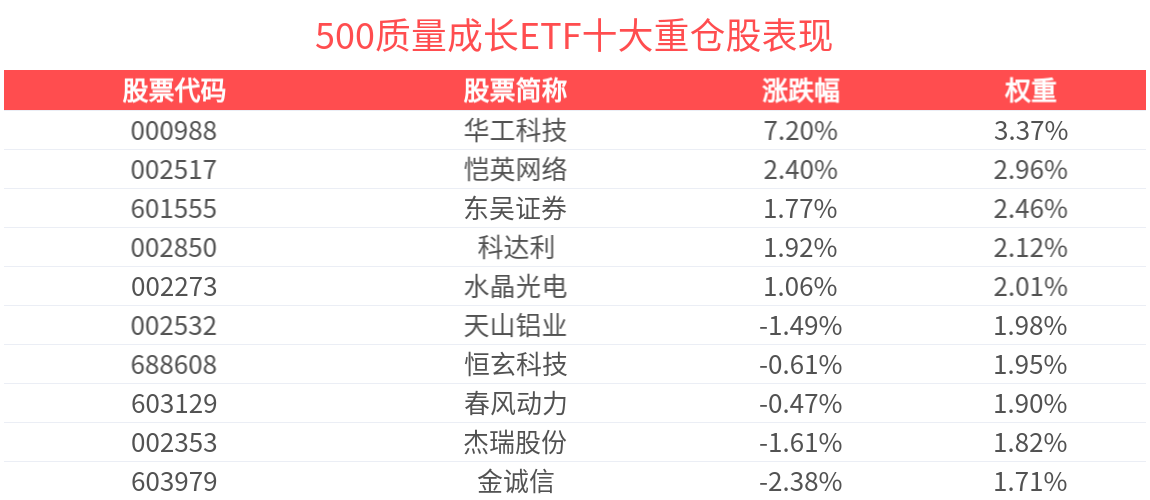
Core Insights - The Zhongzheng 500 Quality Growth Index has seen an increase of 0.48%, with notable stock performances from companies like Huagong Technology (up 7.20%) and Jiejia Weichuang (up 6.77%) [1][2] - OpenAI is set to respond to Google's Gemini 3 with the upcoming release of GPT-5.2, expected on December 9 [1] - The industry is anticipated to experience significant growth due to the mass production of NVIDIA's next-generation GPUs and the increasing demand for optical modules, particularly in the 800G and 1.6T technology transition [1][2] Industry Summary - The computing power industry is currently in a high prosperity cycle, facing explosive growth in demand while the optical module supply chain is experiencing bottlenecks [2] - Guosheng Securities predicts a new round of capacity release in the optical module sector, which will open up growth opportunities for performance [2] - The Zhongzheng 500 Quality Growth ETF closely tracks the Zhongzheng 500 Quality Growth Index, selecting 100 companies with strong profitability and growth potential from the index [2] Company Performance - As of November 28, 2025, the top ten weighted stocks in the Zhongzheng 500 Quality Growth Index accounted for 21.53% of the index, with Huagong Technology leading at 3.37% [2][3] - The performance of individual stocks within the index varies, with notable increases in Huagong Technology and Jiejia Weichuang, while some stocks like Tianshan Aluminum and Jerey Co. experienced declines [3]





“5G工业互联网”迈向深度融合
Jing Ji Ri Bao· 2025-12-08 01:28
Core Insights - The "5G + Industrial Internet" initiative in China has surpassed 20,000 construction projects, entering a new phase of large-scale application [1] - The next steps include implementing "chain-network collaboration" actions in key industrial chains and enhancing research on the integration of 6G with industrial applications [1] Infrastructure Development - China has established over 300 influential industrial internet platforms, with more than 100 million industrial devices connected [2] - The average productivity of leading 5G factories has increased by 25%, product quality by 21%, and operational costs have decreased by 19% [2] - The industrial internet supply chain is nearly complete, with significant upgrades in chips, base stations, core networks, and terminal devices [2] - Over 1,200 5G factories have been built, with an investment exceeding 50 billion yuan, leading to notable improvements in manufacturing quality, operational costs, and efficiency [2] Standardization and Policy - China has taken the lead in formulating the world's first industrial 5G international standards, with over 100 national and industry standards established [3] - The Ministry of Industry and Information Technology aims to optimize the layout of new infrastructure and promote the integrated development of five key systems: network, identification, platform, data, and security [3] AI Integration - Artificial intelligence is reshaping the industrial internet landscape, with companies integrating 5G connectivity with AI capabilities for production optimization and supply chain collaboration [4] - China Telecom has developed a comprehensive intelligent cloud capability system, serving over 20,000 enterprise clients [4] - Various companies are creating industry-specific AI models to enhance operational efficiency across multiple sectors [4] Technological Advancements - The evolution of 5G-A (5G network evolution and enhancement) is expected to significantly support industrial upgrades, enhancing capabilities in visual inspection, motion control, and data connectivity [6] - The Ministry of Industry and Information Technology has initiated commercial trials for satellite IoT services, which will enhance data connectivity across various sectors [6] - The integration of IT, CT, OT, and DT technologies will continue to empower China's industrial system, accelerating the development of new productive forces [7]
【公告全知道】6G+商业航天+低空经济+人工智能+PCB+机器人!公司与客户在6G、低空卫星等通信领域进行相关PCB产品开发
财联社· 2025-12-07 15:50
Group 1 - The article highlights the importance of tracking major announcements in the stock market, including suspensions, shareholding changes, investment wins, acquisitions, performance reports, and unlocks, to help investors identify potential investment hotspots and mitigate risks [1] - The company is involved in the development of PCB products related to 6G, low-altitude satellites, and other communication fields [1] - The company provides infrastructure support for large commercial rockets associated with aerospace industry and is also engaged in humanoid robotics, low-altitude economy, and data centers [1] - The company plans to acquire equity in a commercial encryption enterprise, indicating a focus on computing power and artificial intelligence, particularly in collaboration with Huawei [1]

2025数智科技生态大会 | 高通携手合作伙伴带来多项“智能领航”创新成果
Huan Qiu Wang· 2025-12-07 01:32
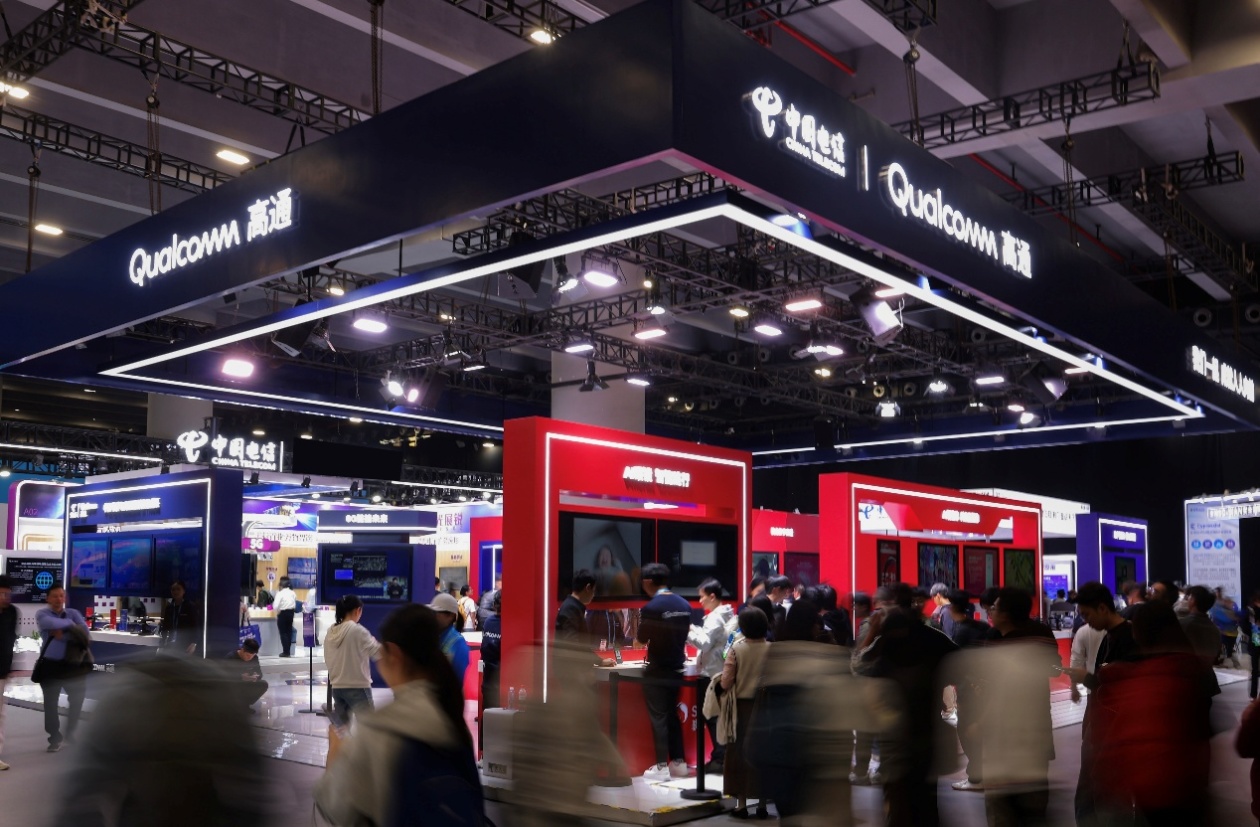
Core Insights - The 2025 Digital Intelligence Technology Ecological Conference hosted by China Telecom focused on the theme "Intelligent Navigation, Intelligent Coexistence," showcasing technological innovations and discussing new opportunities in the digital intelligence ecosystem [1] - Qualcomm, a long-term partner of China Telecom, presented innovations in AI, connectivity, and computing, highlighting collaborative achievements in various fields such as AI smartphones, PCs, XR, Wi-Fi, automotive, robotics, and wearables [3][5] Group 1: AI Integration - Artificial intelligence is becoming a key driver of industrial transformation and economic development, with the Chinese government aiming for over 70% application penetration of new intelligent terminals and agents by 2027, and over 90% by 2030 [5] - The shift in AI architecture from "cloud-centric" to "cloud + edge + terminal" is essential for making AI accessible to the public, emphasizing the advantages of terminal-side AI in terms of privacy, security, performance, and latency [7] - Qualcomm has been a proactive player in AI development for over 15 years, providing advanced hardware and software platforms for billions of edge devices, including the latest Snapdragon 8 Gen 2, which supports personalized AI assistant experiences [7][9] Group 2: Connectivity and 6G - The integration of AI and connectivity is crucial for the large-scale expansion of intelligent agents, with 6G being a pivotal development year for communication technology [10] - 6G will serve as a bridge between cloud and edge, enhancing AI applications and computational capabilities while ensuring low latency [12] - Qualcomm and China Telecom have achieved significant milestones in 5G-A technology, including the first end-to-end verification of 4CC carrier aggregation and innovative applications in smart tourism [12][13] Group 3: Industry Collaboration - The transition from "Internet+" to "AI+" signifies a profound transformation in economic development paradigms, requiring deep integration of underlying technologies and collaborative innovation across industries [14] - Qualcomm continues to deepen cooperation with China Telecom and other partners to accelerate the integration of technological innovations into industry scenarios, creating new value opportunities [14][16] - Various industry applications were showcased at the conference, including advanced robotics and IoT devices, demonstrating the capabilities of Qualcomm's platforms in diverse scenarios [16][18]


宜通世纪:公司目前未涉及6G领域,亦无6G相关产品应用
Mei Ri Jing Ji Xin Wen· 2025-12-05 09:45
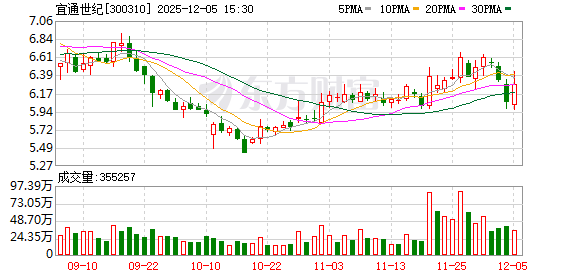
Core Viewpoint - The company is currently not involved in the 6G field and does not have any 6G-related products, as the industry is still in the research and exploration phase for 6G communication technology [1]. Group 1 - The company has stated that the 6G communication technology is still in the experimental stage and will take a long time before commercial and large-scale deployment [1]. - The company is considering investments in related companies from the perspective of strategic positioning and resilience in the industry chain [1]. - There is no current involvement or product application related to 6G technology by the company [1]. Group 2 - An investor inquired about the company's previous statements regarding accelerating 6G technology research and whether there are any stage results or product timelines [3]. - The investor also asked if the company's core products, such as base station antennas and IoT terminals, have any technical plans for adapting to 6G or satellite communication [3]. - The investor sought clarification on the synergy between the company's investment in Ningbo Chip Speed's silicon photonics module business and its 6G layout [3].

交流的平台 共赢的舞台——企业家博鳌论坛举办十年观察
Zhong Guo Jing Ji Wang· 2025-12-05 02:08
Core Viewpoint - The Boao Forum for Entrepreneurs has evolved over its ten years, transforming from a platform for exchanging ideas into a comprehensive "super connector" that integrates discussions, exhibitions, and networking opportunities, reflecting the changing dynamics of the Chinese economy and the global business landscape [2][4][12]. Group 1: Forum Evolution - The forum has transitioned from a single viewpoint exchange to a multi-faceted platform that includes main speeches, public classes, and report releases, creating a diverse entrepreneurial ecosystem [2][4]. - The forum's themes have evolved to align with national strategies and business concerns, reflecting the changing economic landscape and the need for innovation and collaboration [12][13]. Group 2: Innovation and Experience - The forum showcases innovative products and experiences, emphasizing the importance of tangible interactions and the narrative of innovation in driving economic growth [3][14]. - The integration of technology, such as AI and 5G, is highlighted as a key driver of transformation in various industries, particularly in the automotive sector [14][15]. Group 3: Government and Business Collaboration - The forum has shifted from a one-way communication model to a collaborative approach where government and enterprises work together to address industry needs, resulting in significant investment intentions [4][9]. - The focus on "demand lists + solutions" signifies a more dynamic and responsive interaction between the public and private sectors [4]. Group 4: Entrepreneurial Spirit and Values - The forum emphasizes the enduring values of entrepreneurial spirit, such as innovation, social responsibility, and the importance of nurturing future talent [16][18][21]. - Discussions around the balance between profit-making and social contribution reflect a growing trend towards ESG (Environmental, Social, and Governance) strategies in business practices [21][22]. Group 5: Future Directions - The upcoming themes for the forum indicate a continued focus on global connectivity and new opportunities, particularly in the context of China's 14th and 15th Five-Year Plans [9][12]. - The forum aims to serve as a bridge for entrepreneurs to define future directions and foster collaboration across industries [22][24].
【公告全知道】商业航天+可控核聚变+芯片+CPO+数据中心!公司开发太空计算卫星星座相关产品
财联社· 2025-12-04 15:43
Group 1 - The article highlights significant announcements related to stock market activities, including suspensions, investments, acquisitions, performance reports, and stock splits, aimed at helping investors identify potential investment opportunities and risks [1] - A company is involved in developing space computing satellite constellation products and has participated in a major national aerospace project [1] - The same company is also engaged in satellite internet products capable of servicing space stations and manned spacecraft, integrating technologies such as 6G, quantum technology, and artificial intelligence [1] - Another company has secured an order for processing 80,000 tons/year of lithium iron phosphate from a subsidiary of BYD, indicating its involvement in chip, robotics, and solid-state battery sectors [1]