反垄断

Search documents
中国对高通启动反垄断调查;张一鸣公开亮相!字节宣布新的员工补贴政策;滴滴自动驾驶获得D轮20亿元融资
Sou Hu Cai Jing· 2025-10-11 05:15
Group 1: Qualcomm Antitrust Investigation - China has initiated an antitrust investigation against Qualcomm for failing to legally declare its acquisition of Autotalks, potentially violating the Anti-Monopoly Law of the People's Republic of China [4] Group 2: ByteDance Developments - ByteDance founder Zhang Yiming made his first public appearance in years, launching the Shanghai Xuhui Zhichun Innovation Center aimed at nurturing talent in computer science and artificial intelligence [5] - ByteDance announced a new employee subsidy policy providing additional transitional support for formally laid-off employees in mainland China, with a maximum subsidy of 72,000 yuan [6] Group 3: Didi Autonomous Driving Financing - Didi Autonomous Driving secured 2 billion yuan in D-round financing, with funds allocated for increasing AI research and development and advancing L4 autonomous driving applications [8] Group 4: Intel Chip Production - Intel's new factory in Arizona has begun mass production of its most advanced chips, aiming to compete with TSMC and demonstrating the feasibility of manufacturing advanced chips in the U.S. [12] Group 5: OpenAI Data Center Project - OpenAI signed a letter of intent with Sur Energy for a data center project in Argentina, with a potential investment of up to 25 billion dollars, which would be one of the largest tech and energy infrastructure projects in the country [14] Group 6: Global PC Market Growth - The global PC market saw a year-on-year shipment increase of 9.4% in Q3 2025, with Lenovo leading the market share at 25.5%, followed by HP at 19.8%, Dell at 13.3%, Apple at 9%, and Asus at 7.8% [16]





高通为何被反垄断立案调查?
Sou Hu Cai Jing· 2025-10-11 04:32
Core Viewpoint - Qualcomm's acquisition of Autotalks has raised concerns from China's antitrust authority due to the lack of legal notification regarding the merger, which is seen as a potential violation of the Anti-Monopoly Law of the People's Republic of China [3][9][13]. Group 1: Acquisition Details - Qualcomm initiated the acquisition of Autotalks in 2023, previously abandoning it due to global antitrust pressures, but later resumed and completed the deal without notifying the Chinese market regulator [3][6]. - The acquisition was announced on June 5, 2023, with a transaction value estimated between $350 million and $400 million [6][10]. - Autotalks, founded in 2008, specializes in V2X technology, which supports autonomous driving systems through real-time data exchange between vehicles and surrounding infrastructure [3][6]. Group 2: Regulatory Scrutiny - The Chinese State Administration for Market Regulation (SAMR) has launched an investigation into Qualcomm for allegedly failing to report the acquisition, which may violate the Anti-Monopoly Law [3][9]. - The UK's Competition and Markets Authority (CMA) also expressed concerns about the acquisition, leading Qualcomm to terminate the deal in March 2024 due to regulatory pressures [6][7]. - The investigation by SAMR indicates that Qualcomm's acquisition may have implications for market competition, as it did not meet the legal reporting standards but could still be deemed to restrict competition [8][10]. Group 3: Financial Impact - Following the announcement of the investigation, Qualcomm's stock price fell by 7.29% on October 10, 2023, reflecting investor concerns over the regulatory scrutiny [4][6]. - Qualcomm's revenue from China, including Hong Kong, was $17.826 billion for the fiscal year 2024, accounting for 45.75% of its total revenue, highlighting the importance of the Chinese market to the company [14].

被立案调查,高通回应
Zheng Quan Shi Bao Wang· 2025-10-11 01:07
Core Viewpoint - Qualcomm is under investigation by China's State Administration for Market Regulation for allegedly failing to legally declare its acquisition of Autotalks, which may violate the Anti-Monopoly Law of the People's Republic of China [1] Group 1 - On October 10, the investigation was initiated due to Qualcomm's acquisition of Autotalks not being reported as required [1] - Qualcomm responded on October 11, stating that it is actively cooperating with the investigation by the Chinese market regulator [1] - The company emphasizes its commitment to supporting the development and growth of its customers and partners [1]
高通回应涉嫌违反反垄断法:正积极配合有关调查,一直致力于支持客户与合作伙伴的发展与增长
Xin Lang Ke Ji· 2025-10-11 00:28
Core Viewpoint - Qualcomm is under investigation by China's State Administration for Market Regulation for allegedly failing to legally declare its acquisition of Autotalks, which may violate the Anti-Monopoly Law of the People's Republic of China [1] Group 1 - Qualcomm is actively cooperating with the investigation conducted by the State Administration for Market Regulation [1] - The company emphasizes its commitment to supporting the development and growth of its customers and partners [1]
宗馥莉辞职原因曝光!商标使用不合规,将独立经营娃小宗;曹德旺回应做慈善慷慨但对员工苛刻:用的个人的钱;微软新一轮裁员补偿N+4
雷峰网· 2025-10-11 00:27
Group 1 - Cao Dewang responded to criticism about being generous in charity but strict with employees, stating that his charitable donations come from personal funds, not company funds. He emphasized that the average monthly salary for employees is around 10,000 yuan, which is slightly above the industry average, to maintain competitiveness and risk resilience [3][5]. - The resignation of Zong Fuli from Wahaha Group was attributed to trademark usage non-compliance, leading her to independently operate her brand "Wawa Xiaozong" [8][9]. - ByteDance announced a new employee support scheme for those laid off due to organizational adjustments, offering up to 7.2 million yuan in transitional subsidies over six months [9][10]. Group 2 - Qualcomm is under investigation by China's market regulator for allegedly failing to report its acquisition of Autotalks, which may violate antitrust laws [10]. - Longxin Technology has completed its IPO counseling, with a valuation exceeding 140 billion yuan, positioning itself as a leading player in the DRAM market [27]. - BYD's 14 millionth new energy vehicle was rolled off the production line in Brazil, with the Brazilian president becoming the owner of this vehicle [25].



高通收购再涉垄断,V2X市场恐生变局
3 6 Ke· 2025-10-11 00:13
Core Viewpoint - Qualcomm's acquisition of Israeli V2X chip company Autotalks is under investigation by China's market regulator for failing to legally declare the merger, raising concerns about antitrust violations and the implications for the global semiconductor industry and technology standards in the 5G era [1] Group 1: Technology Value - V2X technology is becoming a critical infrastructure in the race for autonomous driving, with Autotalks being a key player due to its dual-mode global V2X solutions that support both DSRC and C-V2X standards [2][4] - Autotalks' third-generation 5G-V2X chipset, SECTON3, enables low-latency communication between vehicles and other entities, which is essential for Qualcomm's Snapdragon Digital Chassis ecosystem [4] - The "security island" design of Autotalks' technology is crucial for meeting the EU's upcoming V2X safety rating requirements, highlighting the strategic importance of this acquisition for Qualcomm [4] Group 2: Business Logic - The acquisition timeline shows a shift from initial support from major automakers to increasing regulatory scrutiny, with the EU and US expressing concerns about market competition [5][6] - Qualcomm's willingness to accept a 74% valuation discount (from $350 million to $90 million) indicates the strategic importance of the acquisition despite regulatory challenges [4] - The acquisition is seen as a way for Qualcomm to gain influence over both C-V2X and DSRC standards, enhancing its competitive position in the automotive sector [4][12] Group 3: Legal Risks - The investigation by China's market regulator stems from the failure to declare the merger, which may involve assessing market definitions and competitive dynamics in the V2X chip market [8][11] - The regulatory landscape is tightening for foreign tech companies in China, particularly in critical technology sectors like automotive and semiconductors, reflecting global concerns about technology sovereignty [12] - The outcome of this investigation could set a precedent for future V2X industry dynamics, with potential implications for Qualcomm's market position and the broader competitive landscape [13]

“抢跑式”并购遭到反垄断调查,高通罚款金额或达17.9亿美元
Xin Lang Cai Jing· 2025-10-10 19:12
Core Viewpoint - Qualcomm is under investigation by China's State Administration for Market Regulation for failing to legally declare its acquisition of Israeli chipmaker Autotalks, which may violate the Anti-Monopoly Law of the People's Republic of China [2][6]. Group 1: Acquisition and Market Impact - Qualcomm's acquisition of Autotalks is a strategic move to enhance its capabilities in the automotive sector, particularly in V2X (Vehicle-to-Everything) communication technology [3][5]. - The investigation could significantly impact Qualcomm's automotive business plans, as the stock price dropped by approximately 3% following the announcement [2][5]. - Autotalks' V2X chips are crucial for real-time communication between vehicles and infrastructure, which aligns with Qualcomm's goal of creating a modular platform for smart vehicles [3][5]. Group 2: Regulatory Compliance and Financial Implications - Qualcomm's failure to submit the necessary documentation for the acquisition, despite exceeding the revenue thresholds set by Chinese law, has triggered the investigation [6][8]. - The potential fine for Qualcomm could reach up to $1.79 billion, calculated as 10% of its previous year's sales in China, which amounted to approximately $17.9 billion [6][9]. - The acquisition's timeline indicates that Qualcomm had previously announced the deal in May 2023 but did not comply with the required legal procedures in China [8].
突发!高通被立案调查!
国芯网· 2025-10-10 13:48
Core Viewpoint - Qualcomm is under investigation by China's State Administration for Market Regulation for allegedly failing to report its acquisition of Autotalks, which may violate the Anti-Monopoly Law of the People's Republic of China [2][4]. Group 1: Acquisition Details - Qualcomm announced its acquisition of Autotalks in May 2023 to enhance its position in the vehicle-to-everything (V2X) technology sector, which is crucial for vehicle communication and safety [4]. - Autotalks, established in 2008, is a fabless semiconductor company that supports major global communication standards, including DSRC and C-V2X, which are essential for vehicle communication [2][4]. - The acquisition faced scrutiny from regulatory bodies in the US, UK, and EU, leading Qualcomm to suspend the deal in March 2024 due to delays in obtaining necessary approvals [4]. - Qualcomm eventually completed the acquisition in 2025, paying between $80 million and $90 million, significantly lower than the initially proposed $350 million [4]. Group 2: Financial Performance - Qualcomm's automotive business reported revenue of $984 million in the third quarter of fiscal year 2025, marking a 21% year-over-year increase [2].
被立案调查,高通跌超3%;美国将调查288万辆特斯拉汽车;谷歌收紧远程办公政策;全球首款1.8纳米工艺芯片晶圆亮相【美股盘前】
Mei Ri Jing Ji Xin Wen· 2025-10-10 11:33
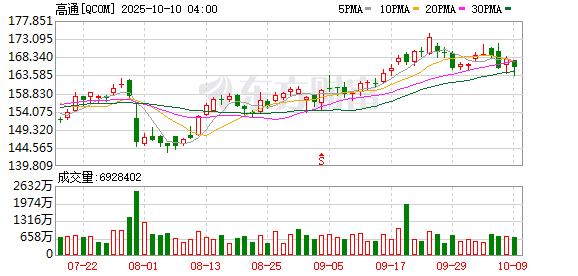
Group 1 - Major U.S. stock index futures are showing slight increases, with Dow futures up 0.14%, S&P 500 futures up 0.13%, and Nasdaq futures up 0.16% [1] - Chinese concept stocks are mixed in pre-market trading, with Alibaba down 2.31%, Pinduoduo down 1.34%, JD.com down 0.32%, Ctrip up 2.80%, Baidu down 2.57%, and Li Auto up 0.47% [1] - Stellantis shares rose 3.4% after reporting a 13% year-on-year increase in global deliveries to 1.3 million units in Q3, with North American deliveries up 35% to 403,000 units [1] Group 2 - Spot silver prices have risen nearly 4% to over $51 per ounce [2] - Google is tightening its remote work policy, which may impact employee work-from-anywhere allowances, leading to a 0.2% increase in its stock price [2] - Intel shares increased by 2.1% following the announcement of its first 1.8nm process chip, which boasts a 50% performance improvement at the same power level compared to its predecessor [2] Group 3 - Qualcomm is under investigation for allegedly violating antitrust laws related to its acquisition of Autotalks, resulting in a drop of over 3% in its stock price [2] - The U.S. is investigating 2.88 million Tesla vehicles equipped with "full self-driving" systems due to safety violation reports, causing Tesla's stock to decline by 0.3% [3] Group 4 - Bernstein has lowered its target price for Ferrari from $554 to $475 [4]




高通在中国遭反垄断调查 因收购车联网芯片设计公司未申报
Nan Fang Du Shi Bao· 2025-10-10 11:10
Core Viewpoint - Qualcomm's acquisition of Autotalks is under investigation by China's market regulatory authority for failing to legally declare the concentration of operators, potentially violating the Anti-Monopoly Law of the People's Republic of China [2][3]. Group 1: Acquisition Details - Qualcomm announced the acquisition of Autotalks on May 8, 2023, but did not disclose the transaction price at that time [2]. - The acquisition raised concerns among multiple countries' antitrust regulatory bodies, leading to a temporary halt due to regulatory delays [2]. - The UK's Competition and Markets Authority (CMA) is investigating whether the acquisition would harm competition in the UK market [2]. Group 2: Regulatory Framework - According to the State Council's regulations on the declaration standards for operator concentration, companies must declare if their combined global revenue exceeds 12 billion RMB, with at least two companies having revenue over 800 million RMB in China [4]. - If the combined revenue in China exceeds 4 billion RMB, with at least two companies having revenue over 800 million RMB, a declaration is also required [4]. Group 3: Potential Implications - The State Council's antitrust enforcement agency can require a declaration even if the concentration does not meet the specified standards if there is evidence of potential anti-competitive effects [5]. - If the concentration is found to have anti-competitive effects, penalties may include a fine of up to 10% of the previous year's sales or less than 5 million RMB if no such effects are found [5]. - Experts suggest that if Qualcomm exclusively acquires Autotalks' V2X technology, it could negatively impact the related technology market and the smart automotive chip market [5].