
新能源转型

Search documents
海外收入增38%!上半年民营油服龙头杰瑞股份营收净利双增
Mei Ri Jing Ji Xin Wen· 2025-08-07 15:17
Core Insights - Jerry Holdings (002353) reported a strong performance in the first half of 2025, with revenue and net profit both increasing, particularly notable was the 38.38% year-on-year growth in overseas revenue [1][2] - Despite the positive financial results, the company faces challenges in its transition to renewable energy, particularly with losses in its lithium battery projects and uncertainties in international market expansion [1][5] Financial Performance - In the first half of 2025, Jerry Holdings achieved operating revenue of 6.901 billion yuan, a 39.21% increase from 4.957 billion yuan in the same period of 2024 [2] - The high-end equipment manufacturing segment generated revenue of 4.224 billion yuan, accounting for 61.22% of total revenue, with a year-on-year growth of 22.42% [2] - The oil and gas engineering and technical services segment saw revenue of 2.069 billion yuan, representing a significant increase of 88.14% year-on-year, becoming a key driver of revenue growth [2] - The company's net profit attributable to shareholders reached 1.241 billion yuan, a 14.04% increase, while the net profit excluding non-recurring items was 1.231 billion yuan, up 33.90% [3] Market Expansion - Jerry Holdings' natural gas-related business achieved a revenue growth of 112.69%, with a gross margin increase of 5.61% and new orders rising by 43.28% [3] - The company successfully expanded into the North African oil service market, contributing to a 38.38% year-on-year increase in overseas revenue, which totaled 3.295 billion yuan [3][4] - The company emphasized the importance of selecting high-quality orders to improve profit margins in overseas markets [3] Renewable Energy Transition - Jerry Holdings is actively pursuing a transition to renewable energy, with the renewable and recycling business segment achieving revenue of 328 million yuan, a 65.74% increase [6] - The company has invested approximately 1.512 billion yuan in a lithium-ion battery anode material integration project, which has incurred losses of 248 million yuan to date [7] - Despite the strategic focus on dual main businesses in oil and gas and renewable energy, the lithium battery project has not yet turned profitable due to intense market competition and fluctuating raw material prices [6][7]

增程车9年销量暴涨8万倍,7大海外车企集体入局,大众回旋镖扎向自己
3 6 Ke· 2025-08-07 11:51
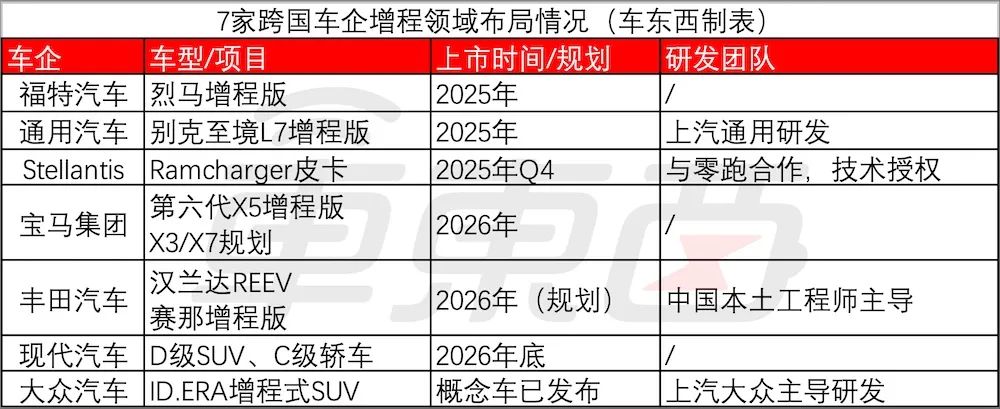
Core Viewpoint - The global automotive industry is increasingly embracing range-extended electric vehicles (REEVs) as a response to the growing demand and market share of this technology, particularly in China, where sales have surged dramatically in recent years [1][11][21]. Group 1: Market Trends - The market share of range-extended vehicles in China's new energy vehicle (NEV) sales rose from 3.6% in 2022 to 9.1% in 2024, indicating a rapid increase in consumer acceptance [2][11]. - Sales of range-extended vehicles in China skyrocketed from 14 units in 2016 to 1.167 million units in 2024, marking an increase of approximately 80,000 times over nine years [3][11]. - Leading models in this segment include Li Auto and Aito, with Li Auto's total sales exceeding 504,500 units in 2024, primarily consisting of range-extended models [3][12]. Group 2: Company Strategies - Seven multinational automakers, including Ford, General Motors, Stellantis, and BMW, have announced plans to launch range-extended models by 2026, reflecting a trend of increased investment in this technology [2][4][10]. - Ford plans to release the Mustang range-extended version in 2025, featuring a 43.7 kWh battery pack with a pure electric range of 220 km and a combined range of up to 1,220 km [4][6]. - General Motors is set to launch the Buick Electra L7 range-extended version, which will include a self-developed range-extending system and is expected to have a combined range exceeding 1,400 km [6][10]. Group 3: Competitive Landscape - The entry of multinational companies into the range-extended vehicle market is expected to intensify competition, particularly against established domestic players like Li Auto and Aito, which have already captured significant market shares [19][21]. - The increasing focus on range-extended technology is partly driven by regulatory pressures in China, where automakers must meet stringent NEV quotas to avoid penalties [13][21]. - Despite the late entry into the range-extended market, multinational companies are leveraging existing technologies and local partnerships to enhance their competitiveness [19][21].


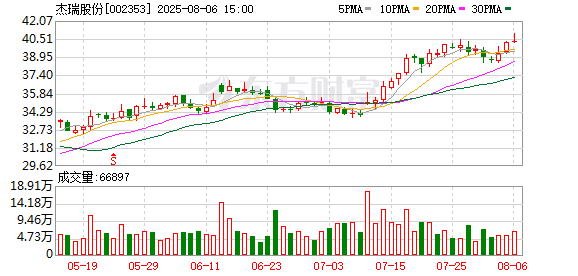
海外收入劲增38% 却藏隐忧!杰瑞股份营收净利双增背后:新能源转型提速但锂电项目仍亏损
Mei Ri Jing Ji Xin Wen· 2025-08-06 15:45
Core Insights - Jerry Holdings (SZ002353) reported a strong performance in the first half of 2025, with revenue and net profit both increasing, particularly driven by a 38.38% year-on-year growth in overseas revenue [2][4][5] - Despite the positive financial results, the company faces challenges in its transition to renewable energy, particularly with losses in its lithium battery projects and uncertainties in international expansion [2][6][8] Financial Performance - The company achieved a revenue of 6.901 billion yuan in the first half of 2025, a 39.21% increase from 4.957 billion yuan in the same period of 2024 [3] - High-end equipment manufacturing generated 4.224 billion yuan, accounting for 61.22% of total revenue, with a year-on-year growth of 22.42% [3] - The oil and gas engineering and technical services segment saw a significant revenue increase of 88.14%, contributing 2.069 billion yuan, driven by rising demand in both domestic and international markets [3][4] Business Segments - The natural gas-related business reported a revenue growth of 112.69%, with a 5.61% increase in gross margin, indicating strong market expansion [4] - Overseas operations generated 3.295 billion yuan, reflecting a 38.38% increase, with new orders up by 24.16%, showcasing robust growth in international markets [4][8] Renewable Energy Transition - The renewable energy and recycling segment achieved a revenue of 328 million yuan, marking a 65.74% year-on-year increase, highlighting its potential as a growth driver [6] - The company is actively pursuing a dual business strategy focusing on both oil and gas and renewable energy, having entered the lithium battery recycling sector in 2023 [6] Challenges in Renewable Energy - The lithium battery project has been a significant source of losses, with cumulative investments reaching 1.512 billion yuan and a reported loss of 248 million yuan as of the reporting period [7] - The company plans to invest approximately 2.5 billion yuan in the lithium-ion battery negative material integration project, but has faced delays due to market conditions [7] International Market Dynamics - The company has successfully expanded its overseas market presence, reducing reliance on the domestic market, but faces challenges from geopolitical tensions and varying regulations across different regions [8] - The complexity of international operations increases management costs and operational risks, which could impact future growth [8]
奕派科技 东风的最后一张牌?
Zhong Guo Jing Ji Wang· 2025-08-06 13:13
Core Viewpoint - The establishment of Dongfeng Yipai Technology represents a strategic move by Dongfeng Motor Group to adapt to the changing automotive landscape after the separation from Changan Automobile, with a focus on accelerating the transition to electric vehicles [1][2][6] Group 1: Company Developments - Changan officially became an independent central enterprise on June 5, marking a significant shift in the automotive central enterprise landscape [2] - Dongfeng Yipai Technology was established on June 26, with a strong emphasis on innovation and transformation in response to the competitive pressures in the electric vehicle market [2][3] - The new company has quickly assembled a core team covering the entire value chain within just six days, indicating a rapid organizational restructuring [2][3] Group 2: Performance Metrics - In the first half of 2023, Yipai Technology delivered 110,703 vehicles, representing a 43.7% year-on-year increase, highlighting its role as a key growth driver for Dongfeng [3][4] - Dongfeng's overall sales declined by approximately 15% in the same period, contrasting with the strong performance of Changan's brands, which achieved a total sales volume of 1.355 million vehicles, a record high in eight years [4][6] Group 3: Strategic Challenges - Dongfeng faces significant challenges due to the decline in its joint venture operations, which have historically been its main revenue sources, with major brands like Dongfeng Nissan and Dongfeng Honda experiencing substantial drops in sales [6][7] - The integration of Yipai, Nanmi, and Fengshen brands is seen as a necessary step for Dongfeng to consolidate resources and scale effectively in a competitive market [5][6] - The leadership change at Yipai Technology, with Wang Junjun taking over from Chen Hao, signals a shift towards a more integrated approach within Dongfeng's operations [3][7]

新能源汽车上半年市场渗透率达44.3%,连续4个月保持50%以上
Jin Rong Jie· 2025-08-06 08:19
中国机械工业联合会发布的数据显示,今年上半年新能源汽车市场渗透率达到44.3%,刷新了同期历史 纪录。这一数据表明,新能源汽车在国内汽车市场中的地位持续巩固。 据统计,今年上半年新能源汽车产量达到687万辆,同比增长36%。与此同时,燃油车同期产量为869万 辆,两者对比反映出新能源汽车增长势头的强劲。新能源汽车零售销量在上半年达到546.2万辆,其中5 月和6月销量均超过100万辆。 新能源汽车出口也呈现良好势头。今年1至3月自主新能源汽车出口增长83%,新能源占自主出口的 35%。虽然对俄罗斯出口出现下降,但自主品牌在俄罗斯市场份额仍保持55%以上的高位。 转自:金融界 汽车消费在社会消费品零售总额中占据重要位置。今年上半年汽车类消费额达到4638亿元,同比增长 5%。社会消费品零售总额累计达24.55万亿元,同比增长5.0%。新能源汽车的强劲表现为整体汽车消费 增长提供了重要支撑。 自主品牌在新能源汽车市场中表现突出。6月份自主品牌新能源车渗透率达到75.4%,豪华车新能源渗 透率为30.3%,主流合资品牌新能源渗透率仅为5.3%。这一差距反映出不同品牌在新能源转型方面的进 展程度。 市场格局正在发生深 ...




港股异动|长城汽车(02333)涨超3% 7月销量稳步提升 机构看好其新能源转型发展加速
Jin Rong Jie· 2025-08-06 07:11
长城汽车(02333)涨超3%,截至发稿,涨3.14%,报13.8港元,成交额2.23亿港元。 本文源自智通财经网 消息面上,长城汽车近日公布,7月份,汽车销量共计104372台,同比增加14.34%,其中新能源销量达 34593辆,同比增加43.27%。长江证券认为,短中期看,公司出海加速叠加国内新能源转向加速及坦克 等高价值车型占比提升有望推动公司销量与业绩成长,长期看,公司四大拓展战略打开销量长期增长空 间,智能化转型开启全产业链盈利空间。国证国际表示,看好长城汽车的新能源转型发展加速,这将推 动销量与业绩成长。 ...

长城汽车涨超3% 7月销量稳步提升 机构看好其新能源转型发展加速
Zhi Tong Cai Jing· 2025-08-06 06:21
长城汽车(601633)(02333)涨超3%,截至发稿,涨3.14%,报13.8港元,成交额2.23亿港元。 消息面上,长城汽车近日公布,7月份,汽车销量共计104372台,同比增加14.34%,其中新能源销量达 34593辆,同比增加43.27%。长江证券认为,短中期看,公司出海加速叠加国内新能源转向加速及坦克 等高价值车型占比提升有望推动公司销量与业绩成长,长期看,公司四大拓展战略打开销量长期增长空 间,智能化转型开启全产业链盈利空间。国证国际表示,看好长城汽车的新能源转型发展加速,这将推 动销量与业绩成长。 ...
港股异动 | 长城汽车(02333)涨超3% 7月销量稳步提升 机构看好其新能源转型发展加速
智通财经网· 2025-08-06 06:19
消息面上,长城汽车近日公布,7月份,汽车销量共计104372台,同比增加14.34%,其中新能源销量达 34593辆,同比增加43.27%。长江证券认为,短中期看,公司出海加速叠加国内新能源转向加速及坦克 等高价值车型占比提升有望推动公司销量与业绩成长,长期看,公司四大拓展战略打开销量长期增长空 间,智能化转型开启全产业链盈利空间。国证国际表示,看好长城汽车的新能源转型发展加速,这将推 动销量与业绩成长。 智通财经APP获悉,长城汽车(02333)涨超3%,截至发稿,涨3.14%,报13.8港元,成交额2.23亿港元。 ...
研报掘金丨长江证券:长城汽车7月销量同比持续增长,维持“买入”评级
Ge Long Hui A P P· 2025-08-05 07:53
长江证券研报指出,长城汽车7月销量达10.4万辆,同比持续增长。累计销量来看,2025年1-7月累计销 量67.4万辆,同比+3.6%,新能源累计销量19.5万辆,同比+24.6%,新能源乘用车销量占比达34.6%,同 比+6.0pct。公司加速全球化布局,坚定新能源转型,积极变革创新,有望持续推动销量业绩双提升。 短中期看,公司出海加速叠加国内新能源转向加速及坦克等高价值车型占比提升有望推动公司销量与业 绩成长,长期看,公司四大拓展战略打开销量长期增长空间,智能化转型开启全产业链盈利空间。维 持"买入"评级。 ...
长城汽车(601633):月销10.4万辆,WEY牌带动总量同比较好增长
Changjiang Securities· 2025-08-05 04:44
Investment Rating - The investment rating for Great Wall Motors is "Buy" and is maintained [8] Core Views - In July 2025, Great Wall Motors achieved sales of 104,372 units, representing a year-on-year increase of 14.3% but a month-on-month decrease of 5.7%. Export sales accounted for 41,088 units, or 39.4% of total sales, while new energy vehicle sales reached 35,000 units, making up 38.2% of total passenger vehicle sales [2][10] - The company is accelerating its global expansion and is committed to transitioning to new energy vehicles. The ongoing new vehicle cycle is expected to drive improvements in both sales and performance. Long-term strategies are set to open up growth opportunities, while the shift towards smart technology is anticipated to enhance profitability across the entire industry chain [2][10] Summary by Sections Sales Performance - In July 2025, total sales were 104,372 units, with domestic sales at 63,000 units (up 19.2% YoY, down 10.4% MoM) and new energy sales at 35,000 units (up 43.3% YoY, down 5.0% MoM). Cumulatively, from January to July 2025, total sales reached 674,000 units, a 3.6% increase YoY, with new energy sales at 195,000 units (up 24.6% YoY) [10][11] - By brand, Haval sold 56,221 units (up 6.2% YoY), Tank sold 20,020 units (up 7.2% YoY), WEY sold 10,045 units (up 263.3% YoY), Ora sold 4,300 units (down 10.0% YoY), and Great Wall Pickup sold 13,772 units (up 14.5% YoY) [10][11] Global Expansion and Strategy - Great Wall Motors is implementing its "ONE GWM" strategy to accelerate overseas expansion, covering over 170 countries and regions with more than 1,400 sales channels. The company has established three complete vehicle production bases in Thailand and Brazil, and several KD factories in Ecuador and Pakistan, which are expected to boost sales growth [10][11] - The company is focusing on smart technology, enhancing its capabilities in data, algorithms, and computing power, which are seen as core competitive advantages in the smart vehicle era [10][11] Financial Projections - The projected net profits for Great Wall Motors from 2025 to 2027 are 141.3 billion, 170.7 billion, and 214.8 billion yuan, respectively. The corresponding A-share price-to-earnings ratios are expected to be 13.1X, 10.9X, and 8.6X, while the Hong Kong stock price-to-earnings ratios are projected to be 7.0X, 5.8X, and 4.6X [10][11]