
乡村振兴

Search documents
东证有爱,善行无疆——传递乡村振兴中的期货关怀
Qi Huo Ri Bao Wang· 2026-02-12 01:29
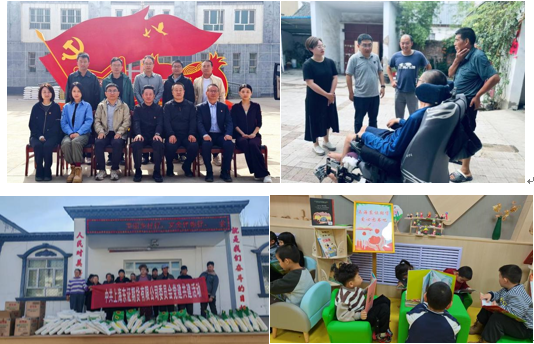
为深入贯彻落实习近平总书记对做好"三农"工作的重要指示精神,积极践行服务实体经济的使命,东证期货2025年持续扎实开展乡村振兴工作,将 行业发展融入服务国家战略,多措并举推进一系列帮扶项目,有效深化产业融合,全面壮大村集体经济,进一步推动乡村发展从"夯实基础"向"全面 振兴"跃升。 一、汇聚东证能量,深化公益帮扶 在过去一年里,东证期货从党建共建、产业振兴、消费帮扶及文化赋能等多方面开展了公益帮扶项目。 (一)强化党建引领,提升帮扶质效 始终坚持党的领导,以党建共建为纽带,与乡村振兴地区党组织深化合作,"用心、用情、用力"实现资源共享、力量融合,深度凝聚发展共识。聚 焦当地党员群众的急难愁盼问题,通过"同上一堂党课"、慰问困难党员群众、支持党建活动室设备更新和搭建爱心图书吧等多种形式,把一件件"关 键小事"办成"暖心实事"。 (四)挖掘红色文化,擦亮公益品牌 2025年度,东证期货携自有品牌"IF公益"继续沿着红军长征足迹,来到胜利会师的终点站——宁夏西吉县,通过深入挖掘西吉县的红色内涵,推动 红色资源在促进村镇产业发展和乡村旅游发展等工作中的创造性转化与创新性发展。 在结对帮扶的兰考县和延长县等地,依托各自 ...

新春走基层|公益慢火车 1元票价背后的乡村振兴与民生温度
Zhong Guo Jing Ying Bao· 2026-02-12 01:04
中经记者 孙丽朝 济南报道 春运启幕,开行超半个世纪的山东唯一公益慢火车7053/4次,以40公里时速往返于淄博、泰山间,184 公里全程票价11.5元、最低票价只要1元。这列慢火车以新场景、新服务、新客群重构"慢生态",既保 障沿线百姓出行,更激活"采摘+旅游+赶集"消费链,见证乡村振兴与民生温度的双向奔赴。 2026年春运,7053次列车创新开行"萌娃研学专线",并于春运首日(2月2日)发车,首批近50名学龄前 儿童及其家长参与,活动反响热烈,已成为春运期间泰山站的特色客运服务新亮点。幼儿园孩子们乘坐 这趟慢火车,从泰安老站房的铁路历史课,到魏家庄的农田采摘、非遗花馍体验,一场沉浸式研学在车 厢与村庄间展开。这不仅为孩子们提供了独特的成长体验,更直接为沿线村庄带来了稳定的亲子客流, 将列车的客流转化为乡村的消费力和教育实践新业态,实现了"教育+文旅+消费"的业态融合。 与此同时,慢火车还串起乡村振兴"致富链"。春运期间,慢火车带来的客流红利为沿线乡村产业注入活 力。淄川区太河镇西桐古站附近的七河生物生产基地,有82座数字化大棚年产香菇400多万斤。近日, 基地"采摘区"的大棚迎来大批乘车而来的旅客,采摘体 ...
东证期货:传递乡村振兴中的期货关怀
Qi Huo Ri Bao Wang· 2026-02-12 00:59
本报讯 为深入贯彻落实习近平总书记对做好"三农"工作的重要指示精神,积极践行服务实体经济的使 命,东证期货2025年持续扎实开展乡村振兴工作,将行业发展融入服务国家战略,多措并举推进一系列 帮扶项目,有效深化产业融合,全面壮大村集体经济,进一步推动乡村发展从"夯实基础"向"全面振 兴"跃升。 汇聚东证能量,深化公益帮扶 在过去一年里,东证期货从党建共建、产业振兴、消费帮扶及文化赋能等多方面开展公益帮扶项目。 强化党建引领,提升帮扶质效。公司始终坚持党的领导,以党建共建为纽带,与乡村振兴地区党组织深 化合作,"用心、用情、用力"实现资源共享、力量融合,深度凝聚发展共识。聚焦当地党员群众的急难 愁盼问题,通过"同上一堂党课"、慰问困难党员群众、支持党建活动室设备更新和搭建爱心图书吧等多 种形式,把一件件"关键小事"办成"暖心实事"。 发挥期货优势,深化专业帮扶 为进一步巩固拓展脱贫攻坚成果,东证期货携风险管理子公司东证润和,运用期货专业优势,深入了解 农户真实风险管理需求,积极参与交易所"保险+期货"项目,覆盖生猪、花生、苹果和天然橡胶等多品 种,切实发挥了农业收入"稳定器"的作用;在乡村振兴地区开展多次"保险+ ...
李璐:精准帮扶持续巩固脱贫攻坚成果
Jing Ji Ri Bao· 2026-02-12 00:43
通过有效实施精准帮扶,我国守牢不发生规模性返贫致贫底线,为常态化帮扶奠定了坚实基 础。"十四五"以来,中央财政累计投入衔接推进乡村振兴补助资金8505亿元,832个脱贫县均培育形成 了2个至3个特色主导产业,总产值超1.7万亿元,脱贫地区产业发展水平持续提高、地区发展差距不断 缩小。脱贫人口务工就业规模连续5年稳定在3000万人以上,稳住了脱贫家庭三分之二以上的收入,脱 贫县农村居民人均可支配收入增速快于全国农民平均水平,稳定脱贫的基础越来越牢固。 习近平总书记指出,"要持续巩固拓展脱贫攻坚成果,把常态化帮扶纳入乡村振兴战略统筹实施, 守牢不发生规模性返贫致贫底线"。"十五五"时期是基本实现社会主义现代化夯实基础、全面发力的关 键时期,也是过渡期结束后转向常态化帮扶的新阶段。要看到,我国农业农村现代化相对滞后,脱贫地 区的底子还比较薄,基础还比较弱,部分群众返贫致贫风险将长期存在。这就需要持续抓好常态化精准 帮扶,持续巩固拓展脱贫攻坚成果。 一是依托多部门共建共享常态化监测平台,进行精准监测和动态帮扶。发挥低收入人口动态监测信 息平台作用,构筑统一规范、精准识别、动态调整的常态化监测体系。依托全国一体化政务服 ...
陕西省实施《中华人民共和国农民专业合作社法》办法
Shan Xi Ri Bao· 2026-02-12 00:13
Core Points - The document outlines regulations for the establishment and operation of farmers' professional cooperatives, aiming to promote high-quality development and protect the rights of members [2][3] - It emphasizes the importance of democratic management and equal status among members, with a focus on serving the collective interests of farmers [3][4] - The government is tasked with providing support and guidance to these cooperatives through various measures, including financial assistance and policy coordination [9][26] Chapter Summaries Chapter 1: General Principles - The purpose of the regulations is to standardize the organization and behavior of farmers' cooperatives and to support their development [2] - The cooperatives are defined as mutual economic organizations formed voluntarily by agricultural producers or service providers [2] Chapter 2: Establishment and Operation - Membership in cooperatives must consist of at least 80% farmers, with specific rules regarding the inclusion of enterprises [8][9] - Cooperatives must establish a charter and hold a founding assembly to ensure democratic governance [11][12] - Financial management systems must be established, and cooperatives are required to maintain transparency in their operations [14][23] Chapter 3: Promotion and Development - Cooperatives can independently apply for agricultural projects and are encouraged to engage in various agricultural services [26][27] - Financial institutions are urged to innovate agricultural financing products to support cooperatives and their members [27][28] - The government is responsible for facilitating training, technical support, and market access for cooperatives [26][40] Chapter 4: Regulation and Management - A quality safety supervision system for agricultural products is mandated, along with the promotion of standardized production practices [30][31] - Cooperatives must report their annual activities and financial status to ensure accountability [31] Chapter 5: Legal Responsibilities - Specific legal responsibilities are outlined for government officials and cooperative leaders to prevent misconduct and protect the rights of cooperatives and their members [32][33] Chapter 6: Supplementary Provisions - The regulations apply to state-owned farms and similar entities engaged in agricultural production [35] - The regulations came into effect on March 1, 2021 [36]
五位新长沙人的幸福小年
Chang Sha Wan Bao· 2026-02-12 00:10
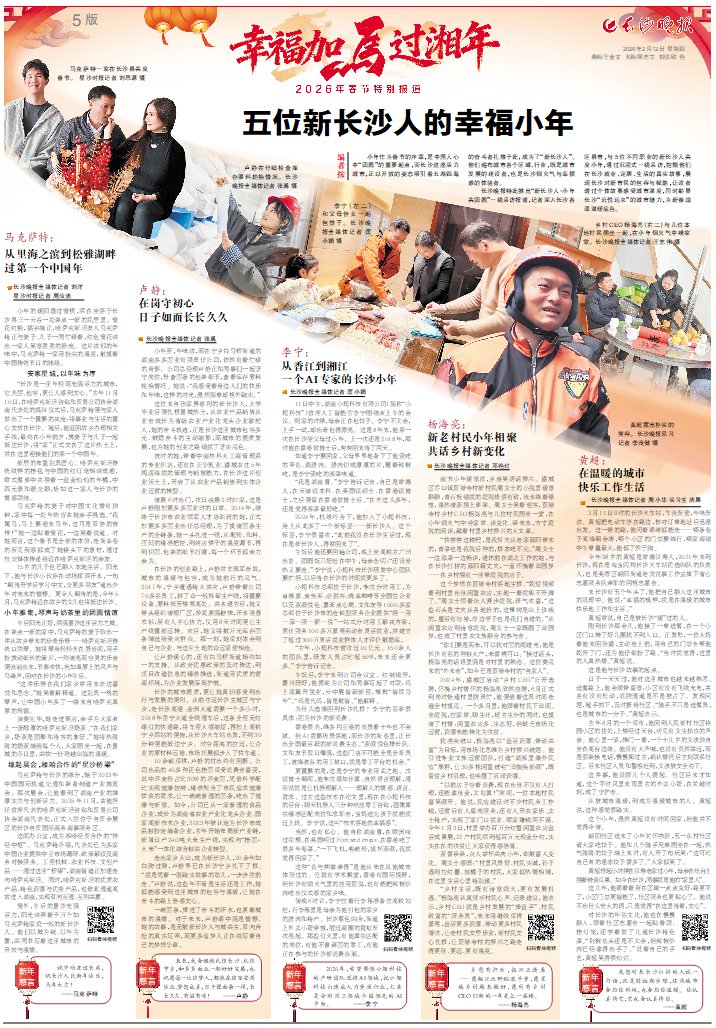
Group 1 - The article highlights the vibrant and inclusive atmosphere of Changsha, attracting new residents from various backgrounds, referred to as "New Changsha People" [4][6][9] - The stories of five individuals from different professions illustrate their experiences of settling and thriving in Changsha, showcasing the city's warmth and opportunities [4][12][22] - The article emphasizes the cultural integration of newcomers, such as the blending of Kazakh and Chinese traditions in the household of a Kazakh family celebrating their first Chinese New Year [6][7][8] Group 2 - The success of local businesses, like the Hunan Duoduo Noodle Company, is highlighted, showcasing the entrepreneurial spirit and resilience of individuals like Lu Jing, who transformed the company into a leading agricultural enterprise [12][14][15] - The article discusses the role of technology in the local economy, with companies like Xiaochi Technology providing innovative solutions for flexible employment, reflecting the growth of the new consumption ecosystem in Changsha [17][20][18] - The narrative includes the impact of community initiatives and local governance in supporting businesses and enhancing the living environment, contributing to the overall development of Changsha [13][14][31]
产业兴旺生态美 日子富足幸福长(新春走基层)
Ren Min Ri Bao· 2026-02-11 23:27
Group 1: Mushroom Industry in Hebei - The mushroom industry in Hebei's Handan City has seen significant improvements due to the "company + base + farmer" model, which unifies seed supply, technology, standards, and purchasing [1][2] - Farmers like Yin Yonghui have reported increased incomes, with some earning around 200,000 yuan annually from their mushroom production [3] - The establishment of a new production line in 2026 is expected to double the daily processing capacity, further enhancing profitability for local farmers [3] Group 2: Wood Ear Mushroom and Tourism in Shanxi - The village of Gongyang has successfully developed a wood ear mushroom industry, with farmers like Liang Xiaoping investing significantly and benefiting from government subsidies [5][6] - The tourism sector has also flourished, with local businesses like agritourism generating substantial daily incomes during peak seasons [7] - The combination of mushroom farming and tourism has contributed to an increase in average annual income for villagers, exceeding 20,000 yuan [8] Group 3: Agricultural Development in Liaoning - The agricultural landscape in Zhangwu County has transformed, with a focus on high-yield crops like millet and rice, leading to record grain production [9] - The implementation of advanced agricultural techniques has resulted in increased crop yields, with some farmers reporting over 2,000 jin per mu [9] - The county's efforts in soil improvement and sustainable farming practices have significantly enhanced the quality of agricultural output [9] Group 4: Integrity in Local Markets - The "integrity vegetable stall" in Guangdong has maintained a 23-year record of zero disputes and theft, showcasing a model of trust in local commerce [10][11] - The village has actively promoted moral values and community engagement, leading to a thriving local economy and increased collective income [11] Group 5: Winter Melon Cultivation in Hainan - The black-skinned winter melon has become a key crop in Daan Village, with farmers expecting substantial profits from their cultivation [12][14] - The village has transitioned from traditional crops to winter melon, with over 90% of households participating in its cultivation [14] - Collaboration with agricultural research institutions has improved soil quality and crop resilience, ensuring sustainable growth for the future [14] Group 6: Tourism Development in Xinjiang - The village of Saluwulang has begun to develop its tourism sector, leveraging its unique border protection stories to attract visitors [15][16] - The village expects to receive over 30,000 tourists annually by 2025, generating significant income for local residents [15] - Community initiatives to maintain cleanliness and enhance the visitor experience have contributed to the village's growing reputation as a tourist destination [16]
昔日闲置土地 今朝“网红农场”
Xin Lang Cai Jing· 2026-02-11 22:53
祁山村党支部书记、村委会主任韦富海介绍,祁山村共有5个村民组、232户827人,过去村里以种植水 稻、玉米等传统作物为主,村民辛苦一年也只能勉强收回成本。为了改变这一现状,村"两委"通过"走 出去、请进来"动脑筋、想思路,多次对接区、乡两级相关部门,结合村里的良好生态环境,于2024年 引进了知行农场项目,并通过举行坝坝会,向村民详细介绍发展乡村农文旅产业的好处,打消村民的顾 虑。 "城里亲子家庭缺少接触自然、了解农耕的机会,而村里的不少田地却闲置着,祁山村有优良的乡村生 态环境,离市区也不远,这让我萌生了创业的想法。"知行农场负责人黄开发介绍,2024年下半年,在 村集体大力支持下,自己流转祁山村祁山组65亩闲置土地,盘活废弃的村小学校舍,打造了知行农场。 农场采用与村集体合作的模式,除了支付土地流转租金,每年还会将利润分红给村集体合作社,并返聘 村民在家门口务工,既盘活了闲置资源,又带动了村民增收。 "知行农场目前的业态涵盖农事体验、亲子研学、休闲团建、夏季亲水等多元服务,更注重体验感和文 化感,想打造一个'让孩子懂农业、让家庭享自然'的亲子农场。2025年初正式运营以来,已接待团队游 客、散客4000余 ...
精准帮扶持续巩固脱贫攻坚成果
Jing Ji Ri Bao· 2026-02-11 22:51
Core Viewpoint - The article emphasizes the importance of "precise poverty alleviation" as a significant innovation in China's poverty reduction theory and practice, focusing on targeted support measures to ensure sustainable outcomes in poverty alleviation efforts [1]. Group 1: Key Strategies in Poverty Alleviation - The strategy involves precise identification of at-risk populations to prevent them from falling back into poverty, with over 700 million monitoring subjects identified by 2025 to stabilize vulnerable groups [2]. - Coordination of resources is highlighted, showcasing the collaboration of various sectors, including government, enterprises, and social organizations, to effectively support underdeveloped areas [3]. - The article discusses the optimization of support methods tailored to local conditions and individual needs, implementing specific strategies for different households to ensure effective assistance [4]. Group 2: Financial and Economic Impact - Since the beginning of the "14th Five-Year Plan," the central government has invested 850.5 billion yuan in rural revitalization, with significant growth in the output value of key industries in poverty-stricken areas, exceeding 1.7 trillion yuan [5]. - The employment scale of the poverty alleviation population has remained stable at over 30 million for five consecutive years, contributing to the income stability of more than two-thirds of the poverty-stricken families [5]. Group 3: Future Directions and Monitoring - The establishment of a multi-departmental monitoring platform is crucial for ongoing precise monitoring and dynamic support, ensuring no individuals are overlooked in the assistance process [6]. - The article stresses the need for continuous investment in human capital and the equalization of basic public services to enhance the development capabilities of underdeveloped regions [6].
569名“文化村长”在乡村“种文化”
Xin Lang Cai Jing· 2026-02-11 21:51
Core Viewpoint - The "Cultural Village Chief" initiative in Inner Mongolia's Xing'an League has significantly enhanced cultural life in rural areas, fostering community engagement and revitalizing local culture through various artistic activities and programs [2][3][5]. Group 1: Cultural Activities and Community Engagement - The initiative has led to the organization of over 10,000 cultural events, including the creation of 117 village songs and 678 village dances, which have actively involved villagers in cultural expressions [5]. - Villagers have expressed satisfaction with the increased cultural activities, stating that they now enjoy a more fulfilling and vibrant community life [1][4]. - The "Cultural Village Chief" program has resulted in the establishment of 786 village-level artistic teams, contributing to the sustainable development of local culture [3]. Group 2: Economic and Cultural Development - The program has effectively transformed cultural values into economic benefits, providing new income channels for villagers through cultural tourism and local product branding [3]. - By integrating local history and culture into tourism, villages like Ping'an have enhanced their appeal as tourist destinations, showcasing their unique cultural heritage [2]. - The initiative has also focused on training local talents, with 6,657 grassroots artistic leaders cultivated to ensure the continuity of cultural activities [3]. Group 3: Social Impact and Community Transformation - The "Cultural Village Chief" initiative has played a crucial role in improving the moral and cultural standards within communities, leading to a notable enhancement in social civility and a reduction in negative behaviors [5]. - The program emphasizes a shift from merely delivering cultural activities to fostering a deeper cultural engagement and resource utilization within the community [5]. - Villagers have transitioned from being passive spectators to active participants in cultural performances, reflecting a significant change in community dynamics and self-identity [4].