
碳达峰碳中和

Search documents
节能降碳中央预算内投资专项管理办法印发
Ren Min Ri Bao· 2025-10-14 22:12
Core Viewpoint - The National Development and Reform Commission (NDRC) has issued a management approach for central budget investment in energy conservation and carbon reduction projects, emphasizing support for regions and projects that excel in carbon peak and carbon neutrality efforts, energy savings, and circular economy development [1] Group 1: Investment Focus - The management approach prioritizes support for energy conservation and carbon reduction projects in key industries, clean coal consumption replacement projects, circular economy initiatives, low-carbon and zero-carbon demonstration projects, and foundational capacity building for carbon peak and carbon neutrality [1] - Specific measures include supporting energy conservation and carbon reduction transformations implemented on a large scale in industrial parks and clusters, as well as low-carbon transformations of coal-fired power units and coal chemical projects [1] Group 2: Regional Support - The NDRC will allocate resources based on the nature of projects, regional economic and social development levels, and the completion status of local energy conservation and carbon reduction targets, with a focus on areas that perform well in these aspects [1] - There is a particular emphasis on supporting regions designated as national ecological civilization pilot areas [1] Group 3: Infrastructure Development - The approach includes support for the construction of standardized recycling stations and green sorting centers to facilitate large-scale recycling efforts [1]
“十四五”以来我国自然资源标准化工作取得显著成效
Zhong Guo Xin Wen Wang· 2025-10-14 11:17
"十四五"以来我国自然资源标准化工作取得显著成效 来源:中国新闻网 编辑:王永乐 广告等商务合作,请点击这里 在具体措施上,自然资源部聚焦"两统一"职责履行,强化引领支撑。一是加强国土空间规划标准引领, 发布《国土空间规划"一张图"实施监督信息系统技术规范》等标准。二是提升自然资源保护利用水平, 构建统一的自然资源调查监测、评价评估和资产管理体系。三是推动生态整体保护和系统修复,发布相 关标准,促进生态系统的可持续发展。四是加强碳达峰碳中和标准支撑,引导矿业领域绿色发展新模 式。 中新网北京10月14日电 (汪俐辰)10月14日是第56届世界标准日,今年世界标准日的国际主题是"美好世 界的共同愿景:增强伙伴关系,共促可持续发展"。当日,自然资源部举办2025年世界标准日自然资源 主题宣传活动。 此外,自然资源部还加强了标准宣贯实施与复审评估,通过自然资源标准化信息服务平台,推动2067项 现行标准全文免费公开,加强重要标准培训和解读宣贯,有效推动自然资源系统知标准、用标准。(完) 据了解,"十四五"以来我国自然资源标准化工作取得显著成效。在"十四五"期间,自然资源部累计部署 开展1000余项标准研制,累计发布 ...
这个领域,A股上市银行平均每家投8000亿
和讯· 2025-10-14 09:25
Core Insights - The report highlights the continuous growth of green finance in China, with green loans reaching a total of 29.22 trillion yuan across 37 listed banks, indicating a robust upward trend in green financing [1][2] - The green bond market showed significant recovery in September, with 104 new bonds issued, totaling approximately 102.77 billion yuan, reflecting increased institutional financing demand [3][4] - The carbon market experienced heightened trading activity, with total transaction volume reaching 32.7 million tons and total transaction value at 2.004 billion yuan, although prices showed a downward trend [5][6] Group 1: Green Loan Expansion - As of the end of Q2 2025, the balance of green loans in China reached 42.39 trillion yuan, showing significant year-on-year and month-on-month growth [2] - The six major state-owned banks accounted for over 70% of the total green loan balance, with Industrial and Commercial Bank of China leading at over 6 trillion yuan [2][30] - The average green loan balance per listed bank was approximately 800 billion yuan, indicating a strong commitment to green financing across the sector [2] Group 2: Green Bond Market Activity - In September, the green bond market saw a total of 104 new issuances, with a total scale of approximately 102.77 billion yuan, marking a 112.24% increase in the number of bonds and a 190.72% increase in total issuance compared to August [3][33] - The average issuance size of new green bonds in September was 9.88 million yuan, up from 7.21 million yuan in August, indicating larger project sizes and stronger financing needs [3][33] - The proportion of bank green financial bonds increased from 35.36% in August to 42.91% in September, while asset-backed securities (ABS) also saw a significant rise in issuance [4][33] Group 3: Carbon Market Dynamics - The carbon market in September exhibited a "volume increase + price decline" characteristic, with total transaction volume reaching 32.7 million tons and total transaction value at 2.004 billion yuan, both showing substantial growth from August [5][39] - The average closing price for carbon emissions allowances (CEA) in September was 62.94 yuan per ton, down 11.5% from August, indicating a downward price trend [5][36] - Predictions suggest that carbon prices may continue to decline, with expected buy and sell prices for October at 55.39 yuan and 60.63 yuan per ton, respectively [5][41] Group 4: Policy and Market Developments - September saw multiple significant policy implementations aimed at enhancing green finance, including guidelines for sustainable corporate disclosures and new energy market regulations [11][12] - Local governments and enterprises are actively innovating in green finance, with notable projects such as the issuance of offshore green bonds and the introduction of biodiversity-linked loans [6][44] - The establishment of various green finance tools and frameworks is facilitating the transition from traditional financing methods to more diversified and innovative approaches [6][44]







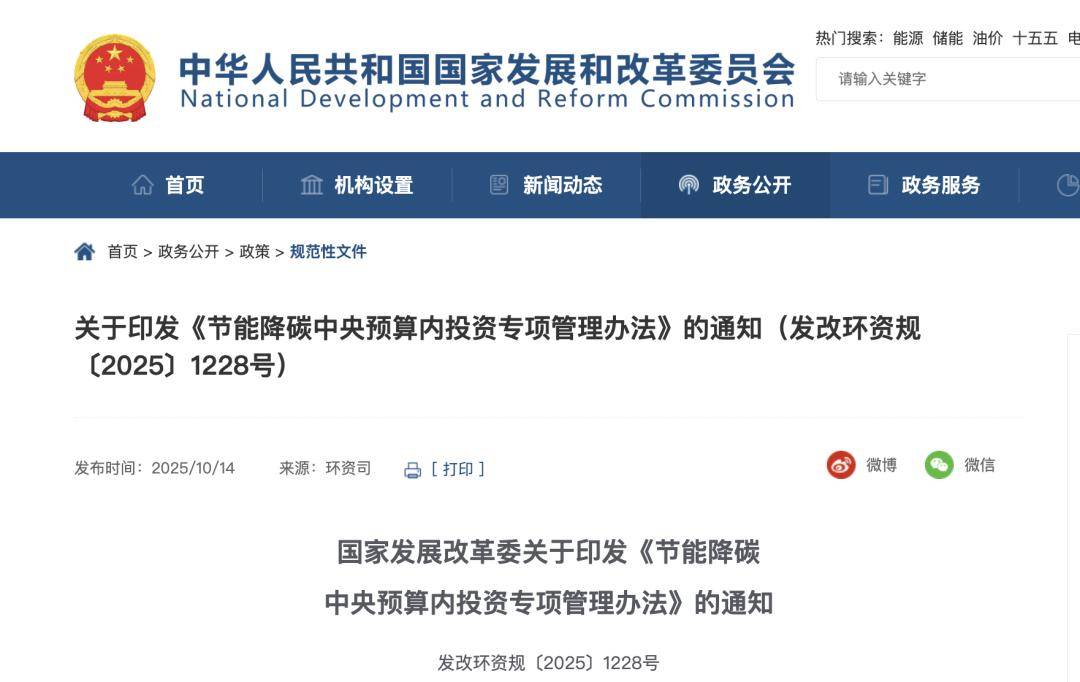
国家发改委关于印发《节能降碳中央预算内投资专项管理办法》的通知(发改环资规〔2025〕1228号)
Sou Hu Cai Jing· 2025-10-14 08:16
Core Points - The article outlines the management measures for central budget investments aimed at energy conservation and carbon reduction, emphasizing the importance of these projects in achieving carbon peak and carbon neutrality goals [3][4][30] - The National Development and Reform Commission (NDRC) will prioritize projects that align with national strategies and have significant potential for energy savings and carbon reduction [4][7] Investment Management - The NDRC will organize annual investment plans based on national priorities and the 14th Five-Year Plan, focusing on projects that contribute to carbon neutrality and energy conservation [3][4] - The investment will support both "hard investments" and "soft construction," aiming to establish long-term mechanisms for green and low-carbon development [4][5] Support Scope and Standards - The investment will target key industries such as electricity, steel, non-ferrous metals, building materials, petrochemicals, and machinery for energy-saving transformations [6][7] - Specific projects include clean replacement of coal consumption, circular economy initiatives, low-carbon demonstration projects, and foundational capacity building for carbon peak and neutrality [5][6][7] Application and Approval Process - Provincial development and reform departments are responsible for project application and must ensure that projects meet the specified criteria and are included in the national major construction project database [8][9] - Applications must include detailed project information, including economic indicators, expected benefits, and compliance with national standards [10][11] Performance Monitoring and Evaluation - The NDRC will conduct performance evaluations of funded projects, focusing on energy-saving and carbon reduction outcomes, and will adjust funding based on project performance [16][19][23] - Projects must adhere to strict management regulations, including independent accounting and dedicated use of funds [20][22] Compliance and Accountability - There are strict penalties for projects that fail to meet performance targets or engage in fraudulent activities, including potential suspension of funding and legal consequences [24][25][28] - Regular audits and oversight will be conducted to ensure compliance with investment regulations and project execution standards [27][29]
国家发展改革委关于向社会公开征求《可再生能源消费最低比重目标和可再生能源电力消纳责任权重制度实施办法(征求意见稿)》意见的公告
国家能源局· 2025-10-14 03:25
Core Points - The article discusses the public consultation for the draft implementation measures of the minimum proportion target for renewable energy consumption and the responsibility weight system for renewable energy power consumption [2][3] - The initiative aims to promote high-quality development of renewable energy and support the achievement of carbon peak and carbon neutrality goals [2] Group 1 - The National Development and Reform Commission (NDRC) is seeking public opinions on the draft measures [2] - The consultation is part of the implementation of the Energy Law of the People's Republic of China [2] - The deadline for feedback is set for November 12, 2025 [3]

国家发改委发布通知!
中国能源报· 2025-10-14 03:08
Core Viewpoint - The article discusses the implementation of the "Central Budget Investment Management Measures for Energy Conservation and Carbon Reduction," which aims to support key industries in energy conservation and carbon reduction projects, focusing on sectors such as electricity, steel, non-ferrous metals, building materials, petrochemicals, chemicals, and machinery [1][3][4]. Group 1: Investment Focus Areas - The measures support energy conservation and carbon reduction projects in key industries, including electricity, steel, non-ferrous metals, building materials, petrochemicals, chemicals, and machinery [10][11]. - Projects for clean replacement of coal consumption are supported, including low-carbon transformation of coal power units and coal chemical projects, as well as clean energy alternatives for coal-fired boilers in various industries [10][11]. - The initiative promotes circular economy projects, including the construction and transformation of resource recycling bases and the utilization of agricultural and forestry waste [11][12]. Group 2: Support Standards and Funding - The support ratio for energy conservation and carbon reduction projects in key industries, clean coal consumption replacement projects, and circular economy projects is set at 20% of the approved total investment [12]. - For local government investment projects focused on carbon peak and carbon neutrality capacity building, the support ratios vary by region, with eastern, central, western, and northeastern regions receiving 60%, 70%, 80%, and 80% respectively [12]. Group 3: Project Application and Management - Provincial development and reform departments are responsible for project application and must establish a dynamic project reserve mechanism to ensure quality and compliance with national standards [14][15]. - The application for investment funds must include detailed project information, including basic conditions, construction scale, total investment, and expected economic and social benefits [16][17]. - Projects must adhere to strict management and reporting requirements, including performance evaluation and compliance with national laws and regulations [18][19].

吉林省加速构建碳足迹管理体系
Zhong Guo Huan Jing Bao· 2025-10-14 01:44
Group 1 - The Jilin Province has launched a carbon footprint management system to support ecological civilization reform and achieve carbon peak and neutrality goals [1] - The carbon footprint is a key metric for measuring greenhouse gas emissions throughout a product's lifecycle, and the management system aims to enhance industrial competitiveness and promote green consumption [1] - The implementation plan includes a timeline: by 2027, a preliminary carbon footprint labeling and certification system will be established, and by 2030, a comprehensive management system will be in place [1] Group 2 - FAW-Volkswagen has set a target to reduce product lifecycle carbon emissions by 29% by 2030, showcasing its commitment to green development [2] - The company has achieved a level 1 carbon footprint certification for its Audi A5L model, highlighting its leadership in low-carbon transformation [2] - Jilin Province aims to strengthen mechanisms, enhance data infrastructure, and promote collaborative efforts among government, industry, and society for effective carbon footprint management [2]
【省生态环境厅】陕西统筹推进高质量发展和生态环境保护
Shan Xi Ri Bao· 2025-10-14 00:13
Group 1 - The core viewpoint emphasizes the integration of ecological protection and high-quality development in Shaanxi Province, focusing on sustainable practices and environmental improvements [1][2] - Shaanxi aims for the ecological quality index in the Qinling Mountains to reach the highest category by 2024, with over 99% of the ecological environment quality rated as good [1] - The province has achieved significant improvements in air quality, with a comprehensive index improvement of 8.3% and a PM2.5 average concentration reduction of 9.8% year-on-year [1] Group 2 - Shaanxi has established a "1+N" policy system for carbon peak and carbon neutrality, guiding enterprises to participate in carbon trading markets [2] - The province has implemented a green channel for environmental impact assessments (EIA) for 138 projects, reducing provincial approval times by 65% compared to legal requirements [2] - The ecological environment department has introduced a 2025 implementation plan to enhance the business environment, focusing on one-on-one support for key projects [2] Group 3 - The Deputy Director of the Provincial Ecological Environment Department stated the commitment to continuously optimize the business environment in the ecological sector to meet public expectations for a better living environment [3]
陕西筑牢生态屏障 推动绿色低碳转型发展
Zhong Guo Xin Wen Wang· 2025-10-13 07:28
Core Viewpoint - Shaanxi Province aims to enhance ecological quality and promote green low-carbon transformation, targeting a top ecological quality index by 2024, with over 99% of the area maintaining good ecological quality [1][2]. Group 1: Ecological Protection and Governance - The province is implementing integrated protection and systematic governance of natural resources, focusing on pollution prevention and ecological restoration in key areas such as the Yellow River basin and Qinling region [1][2]. - Shaanxi has organized law enforcement checks and remediation of pollution issues, ensuring that the Yellow River's main stream in the province has met Class II water quality standards for three consecutive years [2]. Group 2: Green Low-Carbon Development - The province is committed to green low-carbon development as a fundamental strategy to address ecological issues, with initiatives like the "Carbon Benefit Sanqin" platform facilitating carbon asset management [2][4]. - As of September 2023, Shaanxi has participated in national carbon market transactions amounting to 2.703 billion yuan [2]. Group 3: Policy Framework and Future Plans - Shaanxi has established a "1+N" policy framework for carbon peak and carbon neutrality, including the implementation of a collaborative reduction plan for pollution and carbon emissions [4]. - The province is set to optimize the business environment in the ecological sector to meet public expectations for a better living environment, supporting economic and social development through high-quality ecological conditions [4].
何维率队来粤开展循环经济促进法执法检查
Nan Fang Ri Bao Wang Luo Ban· 2025-10-13 01:26
Core Points - The National People's Congress (NPC) Standing Committee is conducting an enforcement inspection of the Circular Economy Promotion Law in Guangdong Province, emphasizing the importance of implementing this law for green and low-carbon development [1][2][3] Group 1: Implementation and Effectiveness - The NPC Standing Committee has acknowledged the achievements of Guangdong Province in implementing the Circular Economy Promotion Law and promoting green low-carbon circular development [2] - There is a call for deeper understanding of Xi Jinping's ecological civilization thoughts and the need for legal publicity to enhance the high-quality development of the circular economy [2] - The enforcement inspection aims to ensure the effective implementation of the law, urging government departments to fulfill their legal responsibilities and improve the producer responsibility extension system [2][3] Group 2: Legal and Policy Framework - The NPC emphasizes the need to establish a comprehensive policy system and incentive mechanisms to promote the development of the circular economy, including the formulation of supporting regulations and standards [2] - There is a focus on addressing the mismatch between legal provisions and developmental reforms, aiming to enhance the operability of laws and improve resource utilization efficiency [2][3] - The enforcement inspection process is also seen as an opportunity for legal education, aiming to raise public awareness about resource conservation and environmental protection [3]