
国家粮食安全

Search documents
国家粮食安全得到有效保障
Ren Min Ri Bao· 2025-10-15 00:17
Core Insights - The article emphasizes the effective guarantee of national food security through stable grain production and improved storage capacity during the "14th Five-Year Plan" period [2][3]. Group 1: Grain Production and Supply - Grain production in China has remained stable at over 1.3 trillion jin annually, with projections to exceed 1.4 trillion jin in 2024, marking a 25 kg increase in per capita grain availability compared to the end of the "13th Five-Year Plan," reaching 500 kg, which is above the internationally recognized safety line of 400 kg [3]. - The average annual grain purchase volume has surpassed 400 million tons, indicating a robust supply and stable market operation [3]. Group 2: Storage and Management Improvements - The national grain storage capacity has significantly increased, with the total capacity of standard grain warehouses exceeding 730 million tons, an increase of 58 million tons since the end of the "13th Five-Year Plan" [3]. - The capacity for low-temperature and quasi-low-temperature storage has reached 220 million tons, up by 70 million tons from the previous period [3]. Group 3: Emergency Response and Quality Assurance - The grain emergency response system has been enhanced, with the number of emergency processing enterprises increasing from 5,448 to 6,872, a growth of 26%, and daily processing capacity rising from 1.2 million tons to 1.78 million tons, a 48% increase [6]. - Over 100 national standards and 50 industry standards have been revised or established since 2021, focusing on quality, nutrition, and health to ensure consumer safety [8]. Group 4: Financial Support and Investment - Since 2021, the Ministry of Finance and the National Food and Strategic Reserves Administration have allocated 46.2 billion yuan in fiscal funds, attracting over 84 billion yuan in social investment for more than 8,400 projects aimed at enhancing the quality of the grain industry [8].
全省秋粮收购工作视频会议召开
Xin Hua Ri Bao· 2025-10-14 23:31
Core Points - The provincial government emphasizes the importance of ensuring food security and adapting to the new conditions and characteristics of this year's autumn grain procurement [1][2] - The meeting highlights the need for effective measures to stabilize grain prices and enhance market vitality while ensuring farmers achieve good income from their harvests [2] Group 1 - The meeting calls for strict implementation of the dual responsibility for food security, focusing on the autumn grain procurement work [2] - There is a forecast of continuous rainy weather that may negatively impact the harvest and procurement of autumn grain, necessitating prompt action to ensure timely collection [2] - The government stresses the importance of utilizing machinery and manpower effectively, particularly in deploying harvesting and drying equipment to secure the harvest [2] Group 2 - The meeting outlines the need for comprehensive measures to maintain market order and combat illegal activities that harm farmers [2] - It emphasizes the importance of providing convenience for farmers, including ensuring adequate storage and funding, and disseminating information on procurement progress and prices [2] - The government aims to facilitate both online and offline procurement processes to ensure farmers can sell their grain comfortably [2]
国家粮食安全得到有效保障(权威发布·高质量完成“十四五”规划)
Ren Min Ri Bao· 2025-10-14 22:12
Core Insights - The article discusses the achievements and future plans regarding grain circulation reform and development during the "14th Five-Year Plan" period in China, emphasizing the importance of food security for high-quality economic and social development [2][3]. Group 1: Grain Production and Supply - During the "14th Five-Year Plan" period, China's annual grain production remained stable at over 1.3 trillion jin, with a projected increase to 1.4 trillion jin in 2024, resulting in a per capita grain availability of 500 kg, surpassing the international safety line of 400 kg [3]. - The average annual grain purchase volume exceeded 400 million tons, supported by improved services for farmers and enterprises [3]. Group 2: Grain Storage and Management - The grain storage capacity has significantly improved, with the total capacity of standard grain warehouses exceeding 730 million tons, an increase of 58 million tons compared to the end of the "13th Five-Year Plan" [3]. - The grain storage management is transitioning towards high-quality development, focusing on green storage and quality preservation, with advanced storage technologies being widely adopted [5]. Group 3: Emergency Response and Supply Chain - A comprehensive grain emergency response system has been established, with the number of emergency processing enterprises increasing from 5,448 to 6,872, a growth of 26% [6]. - The daily processing capacity for emergency grain oil has risen from 1.2 million tons to 1.78 million tons, an increase of 48%, ensuring sufficient supply for urban markets [6]. Group 4: Quality Standards and Consumer Health - Over 100 national standards and 50 industry standards related to grain quality have been revised since 2021, focusing on green, high-quality, and nutritious food [7]. - The government has invested 46.2 billion yuan in quality grain projects, leading to over 84 billion yuan in social investment and the implementation of more than 8,400 projects [7].

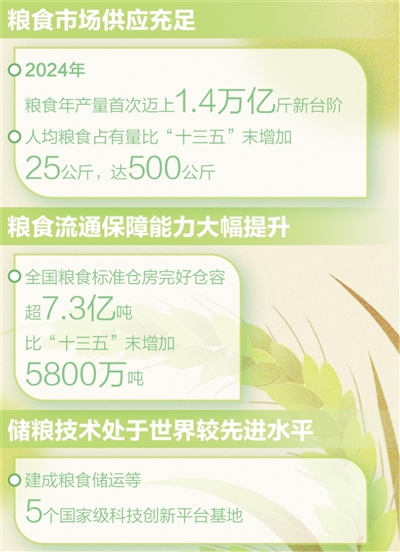
粮食年产量稳定在1.3万亿斤以上,高标准粮仓仓容逐年增加 国家粮食安全得到有效保障(权威发布·高质量完成“十四五”规划)
Ren Min Ri Bao· 2025-10-14 22:04
Core Viewpoint - The "14th Five-Year Plan" period has seen significant progress in China's grain circulation reform and development, ensuring national food security and supporting high-quality economic and social development [1][2]. Grain Production and Supply - During the "14th Five-Year Plan" period, China's annual grain production remained stable at over 1.3 trillion jin, with a projected increase to 1.4 trillion jin in 2024, resulting in a per capita grain availability of 500 kg, surpassing the international safety line of 400 kg [2]. - The average annual grain purchase volume exceeded 400 million tons, with measures taken to optimize services for farmers and enterprises [2]. Grain Storage and Management - The grain storage capacity has significantly improved, with the total capacity of standard grain warehouses exceeding 730 million tons, an increase of 58 million tons compared to the end of the "13th Five-Year Plan" [2]. - The implementation of advanced storage technologies has led to a shift towards high-quality development in grain storage management [4]. Emergency Response and Supply Chain - A comprehensive grain emergency response system has been established at national and local levels, with the number of emergency processing enterprises increasing by 26% to 6,872 [5]. - Daily processing capacity for emergency grain oil has risen by 48% to 1.78 million tons, ensuring sufficient supply for urban markets [5]. Quality Standards and Consumer Safety - Over 100 national standards and 50 industry standards related to grain quality have been revised since 2021, emphasizing green, high-quality, and nutritious food [6]. - The quality inspection system has been strengthened, ensuring the overall safety of stored grain and oil [6]. Industry Development and Investment - Since 2021, the Ministry of Finance and the National Grain and Reserves Administration have invested 46.2 billion yuan, attracting over 84 billion yuan in social investment for more than 8,400 projects aimed at enhancing the grain industry [7]. - The promotion of healthy consumption of grain and oil is being emphasized, with initiatives to increase public awareness of whole grains and healthy dietary practices [7].
1.4万亿斤!粮食市场供应充足 中国饭碗端得更牢
2 1 Shi Ji Jing Ji Bao Dao· 2025-10-14 15:25
Core Insights - The article highlights the achievements in grain circulation reform and development during the "14th Five-Year Plan" period, emphasizing the stability and growth in grain production and the effectiveness of grain security measures [1][2][3]. Grain Production and Supply - Grain production in China has remained stable at over 1.3 trillion jin annually, with a projected increase to 1.4 trillion jin in 2024, and per capita grain availability reaching 500 kg, surpassing the international safety line of 400 kg [1][3]. - The average annual grain procurement has exceeded 400 million tons, ensuring ample grain stocks and market stability [1][3]. Grain Circulation and Logistics - The capacity for grain circulation has significantly improved, with the total capacity of standard grain storage exceeding 730 million tons, an increase of 58 million tons from the end of the "13th Five-Year Plan" [6]. - The construction of grain logistics hubs and key nodes has accelerated, enhancing the efficiency of grain circulation [6]. Quality and Safety Management - The quality and safety management systems for grain procurement and storage have been continuously improved, with enhanced standards and inspection systems [1][6]. Emergency Response and Resilience - The grain emergency response system has been strengthened, with a four-tier emergency plan established at national, provincial, municipal, and county levels [6][7]. - The number of emergency grain processing enterprises has increased from 5,448 to 6,872, a growth of 26%, and daily processing capacity has risen from 1.2 million tons to 1.78 million tons, an increase of 48% [7]. Loss Reduction and Resource Utilization - The annual average loss of grain during storage, processing, and transportation is approximately 2% of the annual production, with significant reductions in loss rates across various stages [8]. - The loss rate for household storage has decreased to 3%, and the loss rate in grain warehouses is maintained below 1% [8]. Future Outlook - The National Grain and Material Reserve Bureau plans to continue advancing grain circulation reforms and enhance the national grain security system in the "15th Five-Year Plan" [8].
粮食年产量首次超1.4万亿斤,中国饭碗端得更牢
21世纪经济报道· 2025-10-14 14:34
Core Viewpoint - The article highlights the significant achievements in China's grain circulation reform and development during the "14th Five-Year Plan" period, emphasizing the stability of grain production, improvements in storage and logistics, and the establishment of a robust emergency response system for grain supply [1][2][4]. Grain Production and Supply - China's annual grain production has remained stable at over 1.3 trillion jin, with a projected increase to 1.4 trillion jin in 2024, and a per capita grain availability of 500 kg, surpassing the international safety line of 400 kg [1][4]. - The average annual grain purchase volume exceeds 400 million tons, ensuring sufficient grain stocks and market stability [1][4]. Grain Circulation and Logistics - The capacity for grain circulation has significantly improved, with the total storage capacity of standard grain warehouses exceeding 730 million tons, an increase of 5.8 million tons compared to the end of the "13th Five-Year Plan" [8]. - The construction of key logistics hubs and nodes has accelerated, enhancing the efficiency of grain circulation [8]. Quality and Safety Management - The quality and safety management systems for grain purchasing and storage have been continuously improved, with a more robust standard and inspection system in place [2][4]. Emergency Response and Supply Chain - The grain emergency response system has been strengthened, with a four-level emergency plan established across national, provincial, municipal, and county levels [8][9]. - The number of emergency grain processing enterprises has increased from 5,448 to 6,872, a growth of 26%, and the daily processing capacity for grain oil emergencies has risen from 1.2 million tons to 1.78 million tons, an increase of 48% [9]. Reduction of Grain Loss - The average annual grain loss during storage, processing, and transportation is approximately 2% of the annual grain production, with significant reductions in loss rates across various stages [10]. - The storage loss rate for farmers has decreased by 5 percentage points compared to a decade ago, now standing at 3% [10].
1.4万亿斤!粮食市场供应充足,中国饭碗端得更牢
2 1 Shi Ji Jing Ji Bao Dao· 2025-10-14 13:17
Core Insights - The article discusses the achievements in grain circulation reform and development during the "14th Five-Year Plan" period in China, highlighting the stability and growth in grain production, storage, and logistics capabilities [1][2][5]. Grain Production and Supply - Grain production in China has remained stable at over 1.3 trillion jin annually, with a target of reaching 1.4 trillion jin in 2024, ensuring a per capita grain availability of 500 kg, surpassing the international safety line of 400 kg [1][2]. - The average annual grain purchase volume has exceeded 400 million tons, indicating sufficient grain reserves and a stable market [1][2]. Grain Circulation and Logistics - The capacity for grain circulation has significantly improved, with the total capacity of standard grain storage exceeding 730 million tons, an increase of 58 million tons compared to the end of the "13th Five-Year Plan" [5]. - The construction of key logistics hubs and nodes has accelerated, enhancing the efficiency of grain circulation [5]. Quality and Safety Management - The quality and safety management systems for grain purchasing and storage have been continuously improved, with a strengthened quality inspection system [2][5]. - The grain loss rate during storage, processing, and transportation has been reduced to approximately 2% of annual grain production [7]. Emergency Response and Support Systems - The grain emergency response system has been established at multiple levels, ensuring that major cities maintain a supply of finished grain and oil for over 15 days [6]. - The number of emergency processing enterprises has increased from 5,448 to 6,872, a growth of 26%, enhancing the emergency supply capacity [6]. Future Outlook - The National Grain and Material Reserve Bureau plans to further advance grain circulation reforms and improve the national grain security system during the "15th Five-Year Plan" [7].
“十四五”时期国家粮食安全得到有效保障
Zhong Yang Ji Wei Guo Jia Jian Wei Wang Zhan· 2025-10-14 10:12
Core Insights - During the "14th Five-Year Plan" period, China's annual grain production is expected to stabilize above 1.3 trillion jin, reaching 1.4 trillion jin in 2024, with per capita grain availability increasing by 25 kg to 500 kg, surpassing the international safety line of 400 kg [1] - The National Development and Reform Commission reported that grain circulation reforms have progressed as expected, effectively ensuring national food security and supporting high-quality economic development [1] Group 1: Grain Production and Supply - Grain storage capacity has increased, with standard grain warehouses exceeding 730 million tons, up by 58 million tons from the end of the "13th Five-Year Plan" [2] - The total industrial output value of national grain enterprises is projected to exceed 4 trillion yuan in 2024, with accelerated technological innovation in the grain industry [2] Group 2: Regulatory and Legal Framework - The implementation of the Food Security Law marks a new phase in comprehensive legal governance and information-based regulation of grain circulation [3] - A digital regulatory system for grain reserves has been established, achieving full coverage of government reserve monitoring [3] Group 3: Grain Purchase and Market Dynamics - The average annual grain purchase volume is over 400 million tons, with market-oriented purchases accounting for over 90% of total purchases [4] - Key measures for the autumn grain purchase include enhancing market-oriented purchasing, organizing policy-based storage, and optimizing services for farmers [5]
新华社权威速览·非凡“十四五”|保障国家粮食安全,他们这样干!
Xin Hua She· 2025-10-14 05:33
Group 1 - The core viewpoint emphasizes the importance of food security during the "14th Five-Year Plan" period, highlighting the effective implementation of the national food security strategy and its support for high-quality economic and social development [1][3]. - The management system for grain purchasing, sales, and reserves has made significant progress, with improved institutional guarantees and clearer responsibilities for grain reserve enterprises [3][7]. - The capacity for grain circulation has been significantly enhanced, with national grain standard storage capacity exceeding 730 million tons and low-temperature storage capacity reaching 220 million tons [5]. Group 2 - The transformation in grain management and storage methods has entered a new phase characterized by comprehensive legal governance and information-based supervision, with the implementation of the Food Security Guarantee Law [7]. - A robust emergency grain supply system has been established, comprising emergency storage, processing enterprises, and distribution centers, with the total industrial output value of national grain enterprises expected to exceed 4 trillion yuan in 2024 [5].
“十四五”时期中国年均粮食收购量在4亿吨以上
Zhong Guo Xin Wen Wang· 2025-10-14 05:22
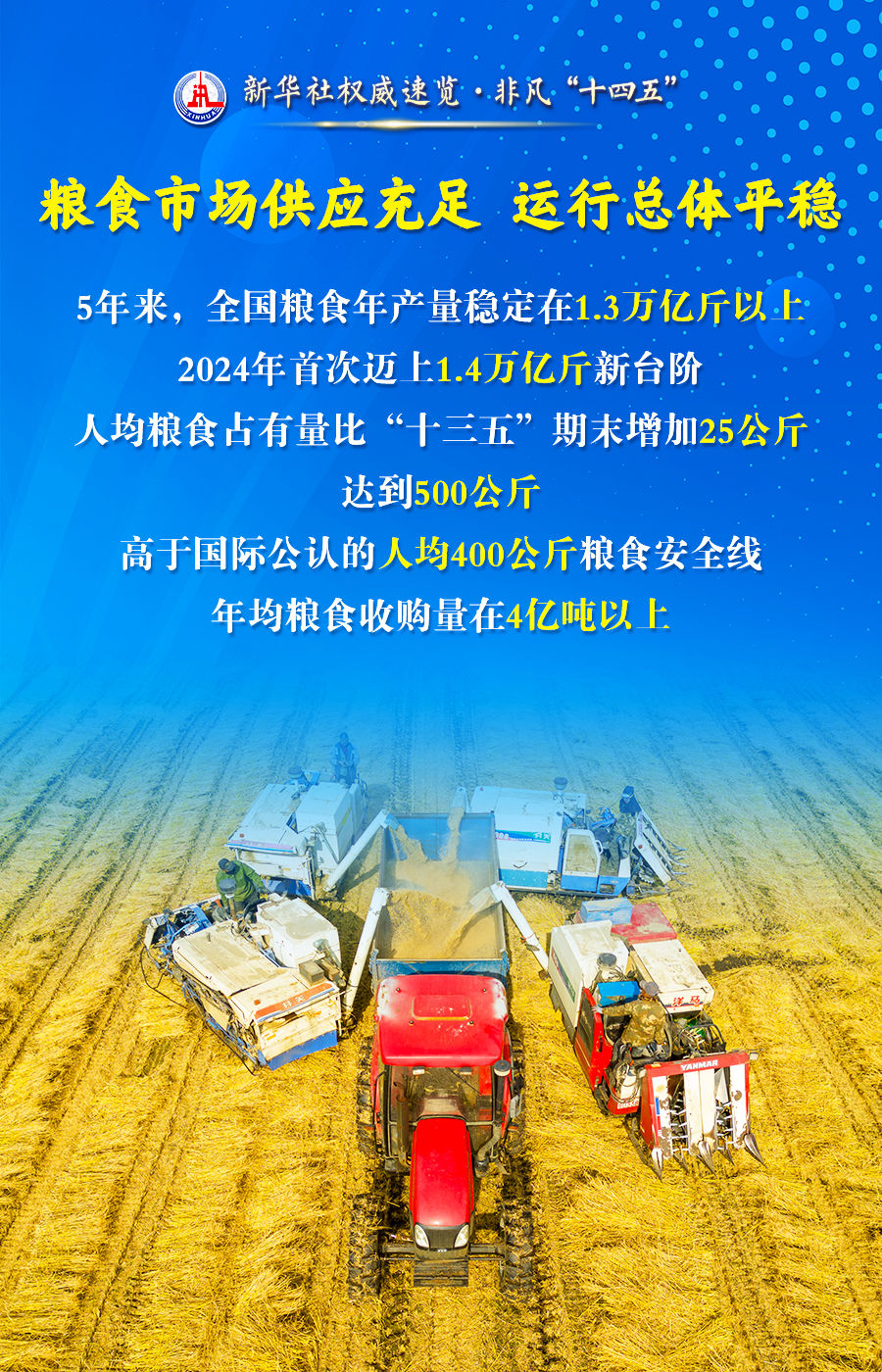
Core Points - During the "14th Five-Year Plan" period (2021-2025), China's average annual grain purchase volume is expected to exceed 400 million tons [1] - The national grain security has been effectively guaranteed, with stable market supply and overall smooth operation [1] - China's annual grain production has remained stable at over 1.3 trillion jin (approximately 650 million tons), with a projected increase to 1.4 trillion jin (approximately 700 million tons) in 2024 [1] - Per capita grain availability has increased by 25 kg compared to the end of the "13th Five-Year Plan," reaching 500 kg, surpassing the internationally recognized safety line of 400 kg [1] - The country has prioritized grain purchases, optimizing channels for farmers to sell grain and ensuring a stable market [1] Grain Purchase and Market Dynamics - Market-oriented purchases now account for over 90% of total grain purchases, enhancing circulation and market vitality [2] - The grain reserve system has been further improved, with enhanced management of grain purchasing and storage, significantly boosting grain circulation capabilities [2] - The management of grain storage has undergone major transformations, entering a new phase of comprehensive legal governance and information-based supervision [2] Global Contribution - China, with only 9% of the world's arable land and 6% of freshwater resources, supports nearly one-fifth of the global population, contributing significantly to global food security [2] - The country is deepening international cooperation in the agricultural sector, playing an important role in promoting global food development and maintaining food security [2]