楼市调控

Search documents
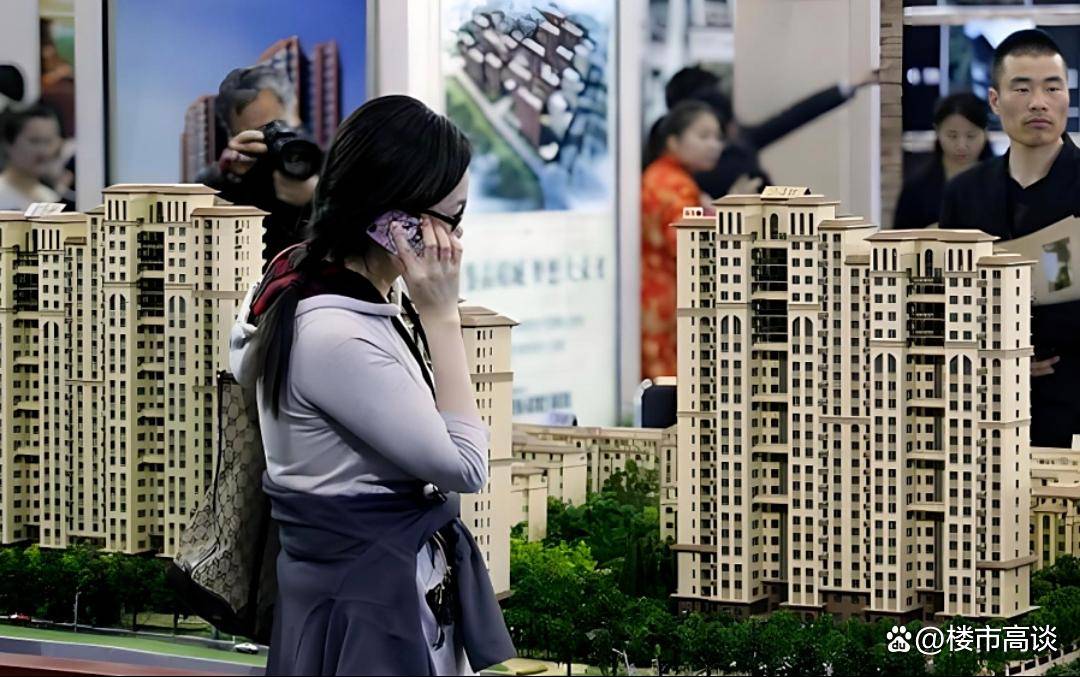
深圳楼市新政实施首个周末:“当晚就接到很多咨询电话”
Zheng Quan Shi Bao· 2025-09-07 18:28
Core Viewpoint - Shenzhen has introduced significant real estate policies aimed at optimizing housing purchase restrictions, corporate purchasing policies, and personal housing credit policies, reflecting a combination of urban governance and public welfare [1][6]. Policy Changes - The new policies allow eligible residents, including local and certain non-local families, to purchase an unlimited number of homes in specific districts such as Luohu and Baoan, while non-local families without proof of continuous social insurance or tax payments can buy up to two homes [2][3]. - The relaxation of purchase restrictions is expected to stimulate market activity, particularly in areas with high rental yields and quality school districts [3][5]. Market Response - Following the announcement of the new policies, there was a noticeable increase in inquiries and property viewings, with some real estate agents reporting a significant rise in client consultations and property showings [2][3]. - The number of consultations for second-hand homes reached the highest level in nearly 90 days, with a 15% increase in viewing numbers compared to the previous eight weeks, particularly in Luohu where viewings surged by 38% [3][4]. Future Expectations - The release of new demand may be more evident during the upcoming National Day holiday, with experts suggesting that the market will not experience drastic fluctuations even with the lifting of restrictions [5][6]. - The policies are expected to enhance market confidence and stabilize expectations, particularly during the traditional peak sales period of "Golden September and Silver October" [6][7]. Broader Implications - The relaxation of corporate purchasing restrictions is anticipated to activate demand in industrial areas, benefiting regions with a high concentration of enterprises [5][6]. - The overall strategy reflects a proactive approach to real estate governance, aiming for targeted and effective policy implementation rather than broad, indiscriminate measures [6][7].
深圳楼市新政实施首个周末: “当晚就接到很多咨询电话”
Zheng Quan Shi Bao· 2025-09-07 18:27
Core Viewpoint - Shenzhen has introduced significant real estate policy changes aimed at optimizing housing purchase restrictions, corporate purchasing policies, and personal housing credit policies, reflecting a combination of urban governance and public welfare [1][6] Group 1: Policy Changes - The new policy allows eligible residents, including both local and non-local families who have paid social insurance or income tax in Shenzhen for over a year, to purchase an unlimited number of homes in specific districts [2][3] - Non-local families without the required proof can still buy up to two homes in the same districts, which include Luohu, Baoan, Longgang, Longhua, Pingshan, and Guangming [2][3] Group 2: Market Reactions - Following the announcement of the new policy, there was a noticeable increase in property viewings and consultations, with some real estate agents reporting a significant rise in client inquiries [2][3] - The number of consultations for second-hand homes reached the highest level in nearly 90 days, with a 15% increase in viewing volume compared to the previous eight weeks, particularly in Luohu where the viewing volume surged by 38% [3][4] Group 3: Future Expectations - The release of new demand may be more evident during the upcoming National Day holiday, with expectations that the policy will stimulate market activity without causing drastic fluctuations [5][6] - The policy is expected to enhance market confidence and stabilize expectations, particularly during the "Golden September and Silver October" period, which is traditionally a peak season for real estate transactions [6]
房价失守!深圳楼市,终于坐不住了!
Sou Hu Cai Jing· 2025-09-07 00:18
Core Viewpoint - Shenzhen's real estate market is responding to regulatory changes, with new policies introduced to stimulate housing demand and adjust market dynamics [1][11]. Policy Changes - Shenzhen's new housing policy categorizes the city into three zones: core areas (Nanshan, Futian, and Bao'an New An), peripheral areas (Luohu, Bao'an excluding New An, Longhua, Longgang, Guangming, and Pingshan), and suburban areas (Yantian, Dapeng, and Deep-Shan) [4][5][6]. - The policy allows for unlimited purchases for local residents and non-residents with one year of social security in peripheral areas, while suburban areas have no purchase restrictions for outsiders [6][8]. - Single individuals now have equal purchasing rights as families, allowing them to buy two properties in core areas if they have paid social security for one year [8]. Financial Implications - The distinction between first and second homes has been removed, aligning down payment ratios and loan rates for both categories, effectively lowering costs for second-home buyers [9][10]. - Current mortgage rates for both first and second homes are set at 3.05%, down from 3.45% for second homes, which could save buyers significant interest over time [9][10]. Market Performance - Shenzhen's housing prices have fallen below 60,000 yuan per square meter, with recent data showing a drop to 59,300 yuan in July, marking the second time since last year that prices have dipped below this threshold [16][18][21]. - The overall trend indicates a significant decline in property prices across major cities, with Shenzhen experiencing a 39.6% drop since 2016 [21]. Market Dynamics - The current market environment reflects a broader adjustment phase, with many potential buyers hesitant due to economic uncertainties and previous high prices creating a "demand gap" [37][40]. - The population decline in China, with a reduction of 208,000 in 2023, is expected to further impact the real estate market, as population growth is a key driver of housing demand [46][49]. Long-term Outlook - The recent policy changes are anticipated to have a short-term stimulating effect, but the long-term impact remains uncertain, as the market continues to adjust to economic realities and changing buyer sentiments [33][52].

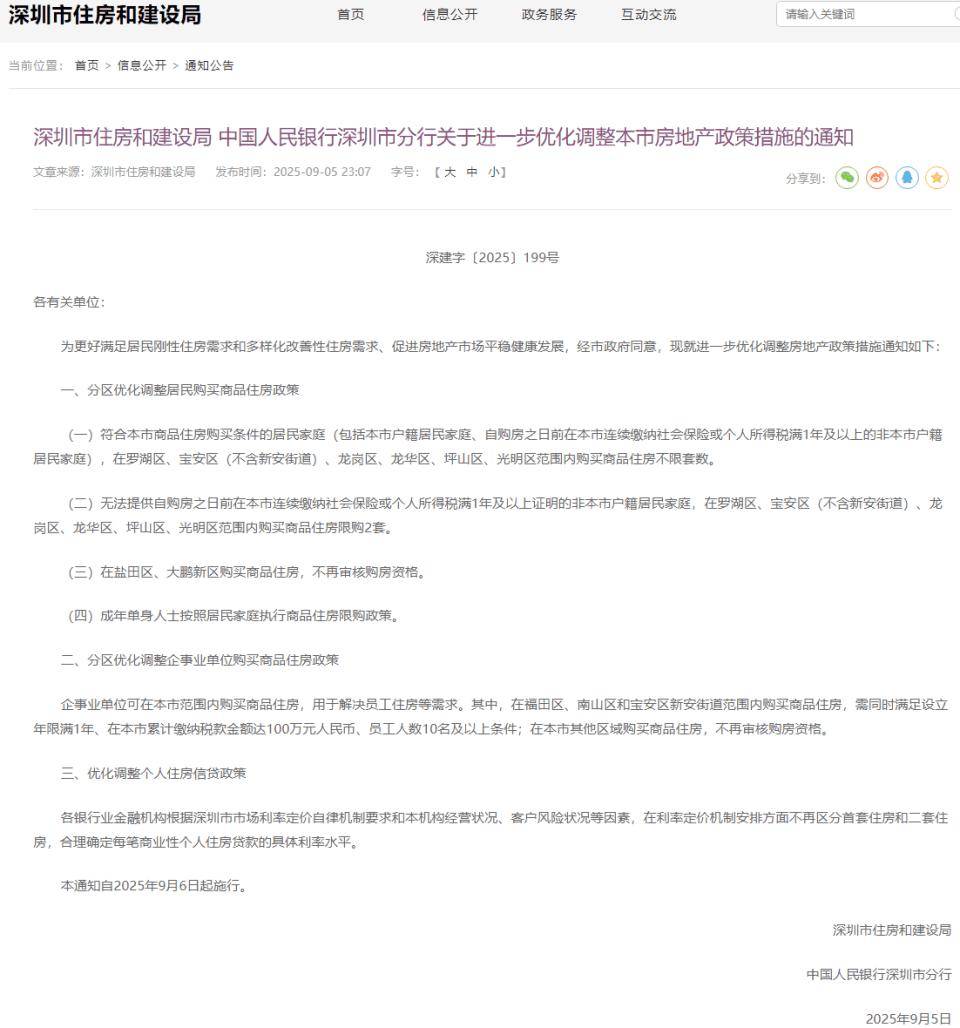
深圳楼市“大礼包”落地:观望的客户开始入场
Di Yi Cai Jing Zi Xun· 2025-09-06 23:26
Core Insights - Shenzhen has implemented significant policy changes regarding housing purchase restrictions, narrowing the limited purchase areas to specific districts, which exceeded market expectations [1][5][6] - The new policy has led to an immediate increase in market activity, with a notable rise in both new and second-hand property inquiries and transactions [2][3][4] Policy Changes - The limited purchase areas have been significantly reduced, with only Futian, Nanshan, and Bao'an's Xin'an Street remaining under restrictions, while other districts have been fully opened for purchases [6][7] - Local residents can purchase an unlimited number of properties, while non-residents can buy up to two properties after meeting certain criteria [6] Market Response - Following the announcement, there was a reported increase of over 10% in visitor numbers to property sites, indicating a boost in buyer confidence [1][2] - Some projects experienced a doubling of inquiries compared to previous weeks, with immediate sales reported shortly after the policy announcement [2][3] Future Outlook - Analysts predict that the new policies will stimulate market activity, particularly in the upcoming "Golden September and Silver October" period, with expectations of a significant increase in transaction volumes, potentially exceeding 50% [8] - The easing of mortgage rates for second homes is expected to further enhance demand, particularly for improved housing products [8]
深圳楼市“大礼包”落地首日,访量增加超10%,有人直接签约
第一财经· 2025-09-06 15:33
Core Viewpoint - Shenzhen's recent policy adjustments, particularly the relaxation of purchase restrictions, have exceeded market expectations and are expected to significantly boost market confidence and transaction volumes [1][7][9]. Policy Changes - The new policy has narrowed the purchase restriction areas, with only Futian, Nanshan, and Bao'an's Xin'an Street remaining under restrictions, while areas like Luohu and Bao'an's Xixiang Street are no longer restricted [7][8]. - In other districts, local residents can purchase unlimited properties, while non-residents can buy up to two properties, and certain areas have completely lifted purchase qualification reviews [8]. Market Response - Following the announcement, there was an immediate increase in buyer inquiries and visits to properties, with some projects reporting visitor numbers doubling compared to previous weeks [3][4]. - Specific projects noted a significant uptick in sales, with some reporting multiple transactions within a single morning after the policy announcement [3][4]. Market Sentiment - Industry experts believe that the new policy will enhance market sentiment, encouraging developers to increase supply and buyers to enter the market, thus stimulating demand [9][10]. - The upcoming "Golden September and Silver October" period is anticipated to further amplify market activity, with expectations of a transaction volume increase of over 50% in September [11]. Long-term Implications - The policy is seen as a strategic move to attract buyers from surrounding regions and to stabilize prices in non-core areas, while still maintaining some restrictions in core districts to prevent speculation [9][10]. - The reduction in mortgage rates for second homes is also expected to support demand, particularly from buyers looking for improved living conditions [10].
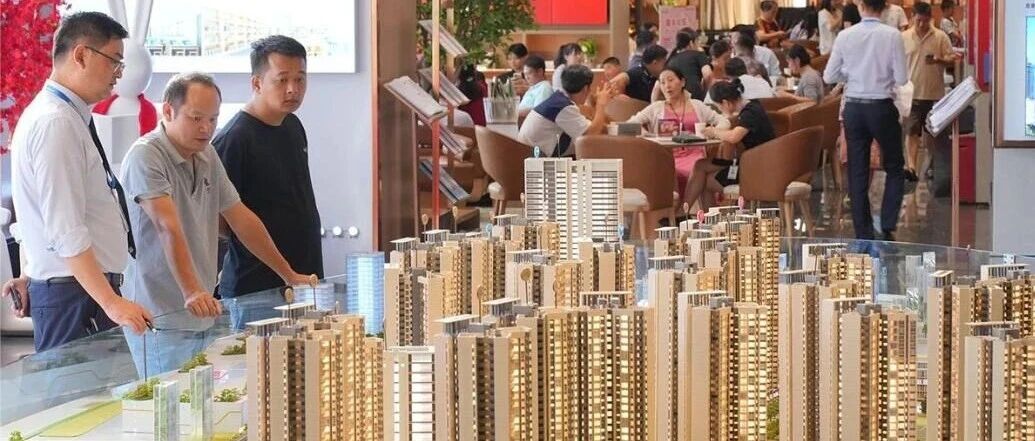
重磅落下!深圳楼市大松绑,800万二套房贷利息可省51万
Nan Fang Du Shi Bao· 2025-09-06 04:16
Core Viewpoint - Shenzhen's new real estate policy, released on September 5, aims to stimulate the sluggish housing market through significant adjustments in purchase restrictions, corporate buying policies, and mortgage interest rates, surpassing expectations compared to recent policies in Beijing and Shanghai [1][2][8]. Purchase Restriction Policy Optimization - The purchase restriction policy has been optimized with four key changes: 1. The restricted areas for local residents have been reduced to include only Futian, Nanshan, and Bao'an New An Street [1]. 2. Non-local residents can purchase two homes in non-restricted areas without needing proof of tax or social security contributions [1]. 3. In Yantian District and Dapeng New District, there will be no qualification checks for purchasing residential properties, effectively lifting restrictions [2]. 4. Single individuals can now purchase an additional property, equating their purchasing capacity to that of families [2]. Corporate Buying Policy Relaxation - The new policy allows companies to purchase properties more freely, requiring only a one-year establishment period, a total tax payment of 1 million RMB, and a minimum of 10 employees to qualify for purchases in restricted areas, with no limits on the number of properties [3][5]. - This is expected to encourage investment in Shenzhen and stimulate demand in the housing market, particularly in areas with a high concentration of businesses [3]. Mortgage Rate Mechanism Adjustment - The mortgage interest rate mechanism has been adjusted, eliminating the distinction between first and second home loans. Both types will now have a rate of LPR - 45 basis points (3.05%) [5][6]. - This change is projected to save approximately 510,000 RMB in interest for a second home loan of 8 million RMB over 30 years, significantly benefiting buyers looking to upgrade their homes [6]. Expected Policy Effects - The new policy is anticipated to drive market activity, particularly in non-core areas, with expectations of a transaction volume increase of over 40% and at least 30% of demand coming from new buyers [8][9]. - The timing of the policy coincides with the traditional peak sales period ("Golden September and Silver October"), which is likely to enhance market confidence and stimulate transactions [8][9]. - The relaxation of restrictions may attract buyers from surrounding regions, potentially leading to a "siphoning effect" on the housing market in the Greater Shenzhen area [9].
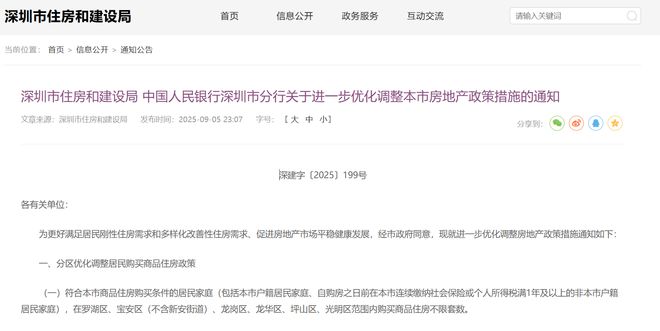
深圳楼市新政!分区松绑限购,非深户可买两套-财经-金融界
Jin Rong Jie· 2025-09-06 00:01
Group 1 - The Shenzhen Municipal Housing and Construction Bureau and the People's Bank of China Shenzhen Branch issued a notification to further optimize and adjust real estate policies in Shenzhen to better meet residents' housing needs and promote stable market development [1] - Residents eligible to purchase commercial housing in specified districts can buy an unlimited number of properties, while non-local residents without proof of tax or social insurance contributions are limited to two properties [1][2] - Single adults will be subject to the same housing purchase restrictions as resident families [1] Group 2 - Enterprises and institutions can purchase commercial housing within the city to address employee housing needs, with specific conditions for purchases in certain districts [2] - In designated areas, enterprises must meet criteria such as a minimum establishment period, tax contributions, and employee count to qualify for purchasing commercial housing [2] - In other areas, there will be no qualification review for purchasing commercial housing [2] Group 3 - Financial institutions will no longer differentiate between first and second home loans in terms of interest rate pricing, allowing for a more flexible approach based on market conditions and client risk profiles [3] - The new policies will take effect from September 6, 2025 [4]
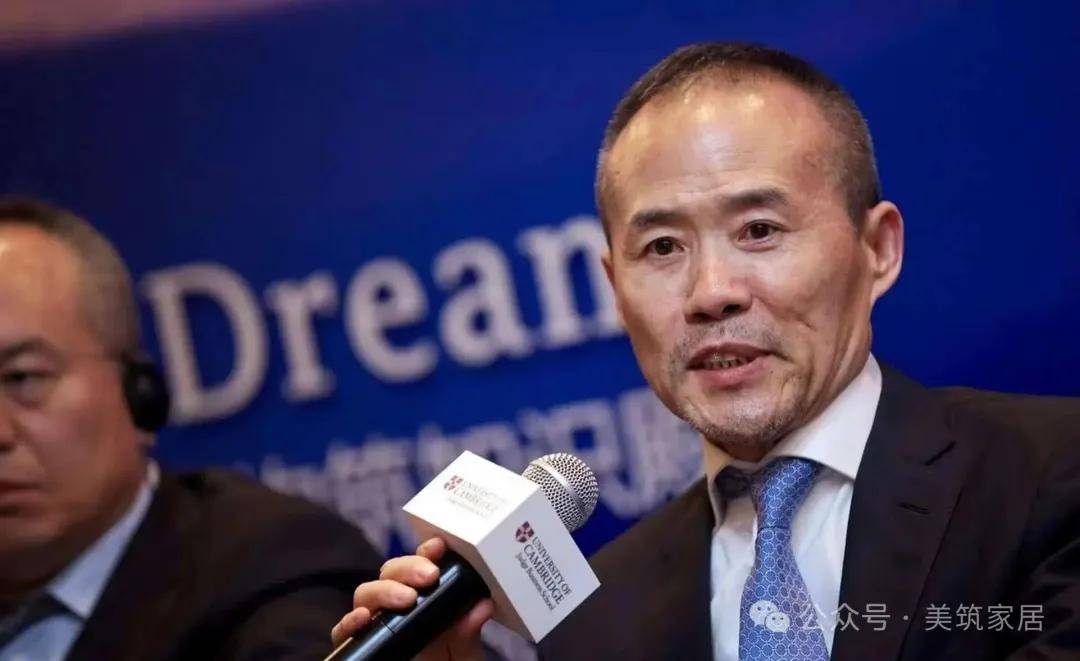
王石预言再次成真?不出意外的话,2025年下半年,房地产将迎来“重大转变”
Sou Hu Cai Jing· 2025-09-05 17:03
Core Viewpoint - The real estate market has undergone a fundamental shift, marking the end of its golden era, as the driving forces of urbanization, population growth, and economic expansion have changed significantly [5][9][10]. Group 1: Historical Context - In 2007, the real estate market was booming, but Vanke's chairman Wang Shi warned of an impending turning point, which proved accurate as the financial crisis led to a sharp decline in housing prices [2]. - By 2018, Wang emphasized the need to "survive" amidst a hot market, which many viewed skeptically, yet his cautious approach allowed Vanke to weather subsequent market downturns [4][5]. Group 2: Current Market Dynamics - The previous growth drivers included rapid urbanization, a clear demographic dividend, high economic growth, and loose monetary policies, all contributing to rising housing prices [7]. - Current policies emphasize "housing for living, not speculation," aiming to curb speculative buying and return housing to its fundamental purpose [8]. Group 3: Future Outlook - The adjustment phase in the real estate market is ongoing, with expectations of stabilization by 2025, avoiding the extreme volatility of the past [15]. - Future policies will focus on stabilizing the market rather than stimulating it, with measures like interest rate cuts and relaxed purchase restrictions aimed at preventing market collapse [16][17]. - A clear market differentiation is anticipated, where prime locations in first-tier and strong second-tier cities will maintain value, while third and fourth-tier cities face significant challenges due to lack of demand and high inventory [19]. - The era of valuing product quality in real estate is emerging, requiring developers to focus on creating safe, comfortable, and sustainable housing [19]. Group 4: Implications for Buyers - Buyers should abandon the notion of becoming wealthy through real estate speculation, as future appreciation will be slow or even negative [21]. - It is advised to avoid high leverage in purchasing decisions, considering personal financial capacity and avoiding excessive debt [21]. - Emphasis should be placed on selecting properties based on location, quality, and amenities, particularly avoiding low-quality developments in less desirable areas [23].
苏州楼市,全脱了!
商业洞察· 2025-09-01 09:23
Core Viewpoint - The article discusses the recent policy changes in Suzhou's real estate market, highlighting the complete removal of restrictions on new housing sales, which reflects the urgency of the local housing market situation [4][6][9]. Group 1: Policy Changes - Suzhou has lifted the two-year restriction on the transfer of new housing, allowing for immediate sales [4][6]. - This policy change follows the previous removal of purchase restrictions, indicating a significant shift in the regulatory landscape for the housing market [6][9]. - The aim of these changes is to meet the improvement housing needs of residents and stimulate the declining transaction volumes in the market [11][14]. Group 2: Market Conditions - The real estate market in Suzhou has seen a drastic decline in transaction volumes, with new housing sales dropping significantly from 2020 to 2023, with a 22.3% decrease in sales area [36][37]. - The average price of new housing has also decreased from 18,500 yuan per square meter in 2021 to 16,700 yuan per square meter in 2023, a drop of 9.9% [37]. - Predictions for 2024 indicate a further decline in both new and second-hand housing transaction volumes, with new housing sales expected to decrease by approximately 26% [40]. Group 3: Financial Products and Incentives - Suzhou has introduced a set of financial products aimed at reducing the barriers to homeownership, including low down payments (15%), low interest rates (minimum 3%), and a unique low monthly payment structure [15][16][18]. - For example, a buyer purchasing a 2 million yuan home can benefit from a significantly reduced first-month payment due to these incentives, effectively halving their initial financial burden [19][28]. - This approach aims to alleviate the financial pressure on buyers while not increasing the overall cost of homeownership [30][31]. Group 4: Economic Context - Suzhou's economy remains robust, with a GDP of 2.67 trillion yuan, ranking sixth nationally, and a population of approximately 12.99 million [49][50]. - The city is recognized as the second-largest industrial hub in China, with significant industrial output surpassing that of Shanghai [54][56]. - Despite these strengths, the article suggests that the decline in housing prices is a broader reflection of market adjustments across various cities, indicating a necessary correction in the real estate sector [60][62].

2025年后,楼市将出现四个变化,买不买房心里有数了
Sou Hu Cai Jing· 2025-08-31 01:01
Group 1: Market Dynamics - The debate over housing prices is intensifying, with contrasting opinions on whether the market is about to rebound or if prices will continue to decline [1] - The real estate market is undergoing significant changes post-2025, with four key transformations becoming evident [1] Group 2: Policy Changes - Policies are shifting from a "one-size-fits-all" approach to a more localized strategy, with different regulations for areas inside and outside the city center [2] - For instance, Beijing has introduced relaxed policies for home purchases outside the Fifth Ring Road, while maintaining strict regulations within it, reflecting the need to address high inventory levels [2] - Nationwide, cities like Suzhou and Hainan are implementing tailored measures to stimulate the market, indicating a departure from uniform policies [2] Group 3: Market Stabilization - The primary goal of current policies is to stabilize the market and prevent further declines, rather than to stimulate price increases [3][5] - Recent statistics show a downward trend in key real estate metrics, with many cities still experiencing price drops, albeit at a slower pace [5] Group 4: Changing Consumer Preferences - The focus of homebuyers is shifting from merely acquiring a property to seeking quality living conditions, as the average urban housing space has surpassed 40 square meters [6][7] - New regulations emphasize the importance of safety, comfort, and sustainability in residential projects, moving away from simply increasing housing stock [8] Group 5: Investment Risks - The greatest risk in the current market is not price fluctuations but rather the potential of purchasing the wrong property, which can lead to significant financial losses [10] - Certain property types, such as older high-rise buildings, suburban off-plan homes, and commercial properties, are particularly vulnerable to depreciation and should be avoided [10] Group 6: Market Outlook - The real estate market is transitioning from an investment-driven model to one focused on consumer needs, similar to the automotive industry [11] - For genuine homebuyers with stable financial conditions, the timing of purchase is less critical, while speculative investments carry higher risks in the current environment [11]