楼市分化

Search documents
不出意外,2026年楼市大概会出现4大趋势,置业指南收好
Sou Hu Cai Jing· 2026-02-22 05:25
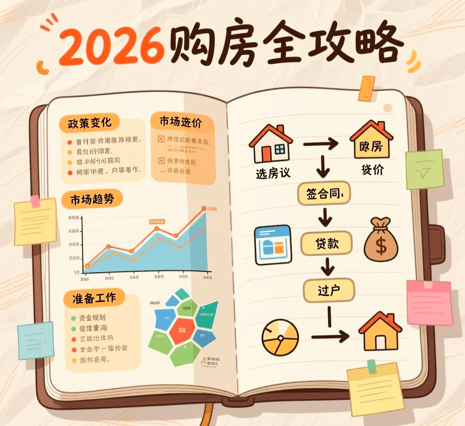
Core Viewpoint - The real estate market in 2026 is characterized by an L-shaped bottoming process, moving away from a "one-size-fits-all" trend to a differentiated market where value reconstruction occurs across cities, districts, and products [1][4][14] Overall Market Trends - The market is expected to continue a slow decline, with a 8.7% drop in sales area and a 12.6% drop in sales revenue in 2025, indicating a rational return to stable development [2] - The overall housing price is projected to have slight downward movement, but the pace of decline will slow, marking the end of the "sharp drop" phase [2][3] Policy Environment - Policies are focused on stabilizing the market without stimulating it, with measures such as low public housing loan rates at 2.6% and commercial mortgage rates entering the "2 era" [3] - The Ministry of Housing and Urban-Rural Development emphasizes "controlling increments, reducing inventory, and optimizing supply" for 2026, which aims to alleviate supply-demand imbalances [2][3] Market Differentiation - Differentiation is becoming the norm, extending beyond first-tier and third- and fourth-tier cities to include internal districts and product types, leading to a three-tier value structure [4][6] - First-tier and strong second-tier cities are becoming "safe havens" for real estate, while third- and fourth-tier cities face ongoing challenges with high inventory and liquidity issues [4][10] Product and Service Focus - The focus is shifting from scale competition to product and service quality, with a significant decline in new construction areas and investment indicating the end of blind expansion [10][11] - Property services are emerging as a new competitive arena, enhancing living experiences and property value [10] Consumer Behavior Changes - The purchasing logic of buyers is evolving from "just having a house" to "choosing quality homes," with a focus on long-term living needs rather than short-term speculation [7][8] - The demand for improved housing is becoming a core support for the new home market, with buyers increasingly opting to upgrade to quality properties in core areas [8][14]

别等吃亏才后悔!2026房价若下跌,三大连锁反应直接影响生活
Sou Hu Cai Jing· 2026-02-13 05:42
Core Viewpoint - The era of rising national housing prices has ended, leading to a new normal characterized by market differentiation, deep adjustments, and slow recovery [1] Group 1: Impact on Household Finances - Falling housing prices have led to significant shrinkage in household assets, particularly affecting families with high leverage [3] - Many families are experiencing a decline in net assets as property values drop while mortgage obligations remain unchanged, leading to financial distress [3] - The average price drop in new and second-hand homes across various cities has reached 20% to 30%, with some smaller cities seeing declines over 40% [3] Group 2: Land Finance and Urban Development - The reliance on land finance for local governments is under pressure, impacting urban development and public services [6] - Land transfer income has decreased significantly, dropping by approximately 4.6 trillion yuan over four years, a decline of over 50% compared to peak levels in 2021 [6] - Cities heavily dependent on land finance may face worsening fiscal imbalances, leading to delays in infrastructure projects and public service improvements [6] Group 3: Market Differentiation - The housing market is experiencing a stark divide, with prime locations in first-tier cities remaining resilient while third and fourth-tier cities struggle with high inventory and declining prices [8][10] - The liquidity of properties has diminished, with many homes remaining unsold for extended periods despite price reductions [8] - Buyers are advised to prioritize self-use needs and consider factors such as commuting, school districts, and living amenities when purchasing property [9] Group 4: Investment Strategy - Investors should focus on cash flow and stability, avoiding properties in areas with weak economic fundamentals [7] - The traditional belief that real estate is a liquid asset has been challenged, emphasizing the need for careful selection based on urban dynamics and infrastructure [8] - The era of blindly purchasing properties with the expectation of appreciation is over; strategic selection akin to stock investment is now essential [9]
2026年买房会成赢家?先看这两个群体的现实对比
Sou Hu Cai Jing· 2026-02-07 14:05
Core Insights - The Chinese real estate market in 2025 is experiencing a complex situation, with some believing that the market is recovering while others view it as a temporary response to policy stimuli [1] Group 1: Policy Changes and Market Reactions - In the first half of 2025, national housing prices continued to adjust, with second-hand housing prices declining and new housing slowing down, while inventory in third and fourth-tier cities remained high [3] - Starting in August, first-tier cities began to subtly implement policy changes, such as Beijing lifting restrictions on the number of properties purchased outside the Fifth Ring Road and reducing the down payment for second homes to 30% [3] - Following these policy changes, the transaction volume of second-hand homes in first-tier cities began to rise, with Shanghai selling 244,000 second-hand homes in 2025, significantly higher than the previous year [3] Group 2: Market Dynamics and Consumer Behavior - Despite a slight increase in new home prices in December, the overall trend indicates that developers are offering discounts, and buyers are being more cautious in their purchasing decisions [5] - There is a divide in consumer sentiment, with some opting to buy homes for stability while others choose to wait for potentially lower prices, leading to a "hidden war" between buying and renting [6] - Buyers who purchase homes feel a sense of stability in their lives, while those who wait may find themselves missing out on opportunities as desirable properties become scarce [6][8] Group 3: Market Segmentation and Future Outlook - The market is showing signs of division, with first-tier cities experiencing a recovery due to population inflow, while third and fourth-tier cities continue to struggle with oversupply and outmigration [9] - The real estate market is shifting back to its fundamental purpose of providing housing, with valuable properties being those that offer access to resources like jobs, schools, and healthcare [9] - Predictions for 2026 suggest that the market will not see a uniform rise or fall in prices, but rather an increase in segmentation, with home purchases driven by personal needs rather than speculative investment [10]
杭州约8成小区价格下跌!下沙这些小区涨跌情况出炉!你家是涨是跌?
Sou Hu Cai Jing· 2026-01-26 08:40
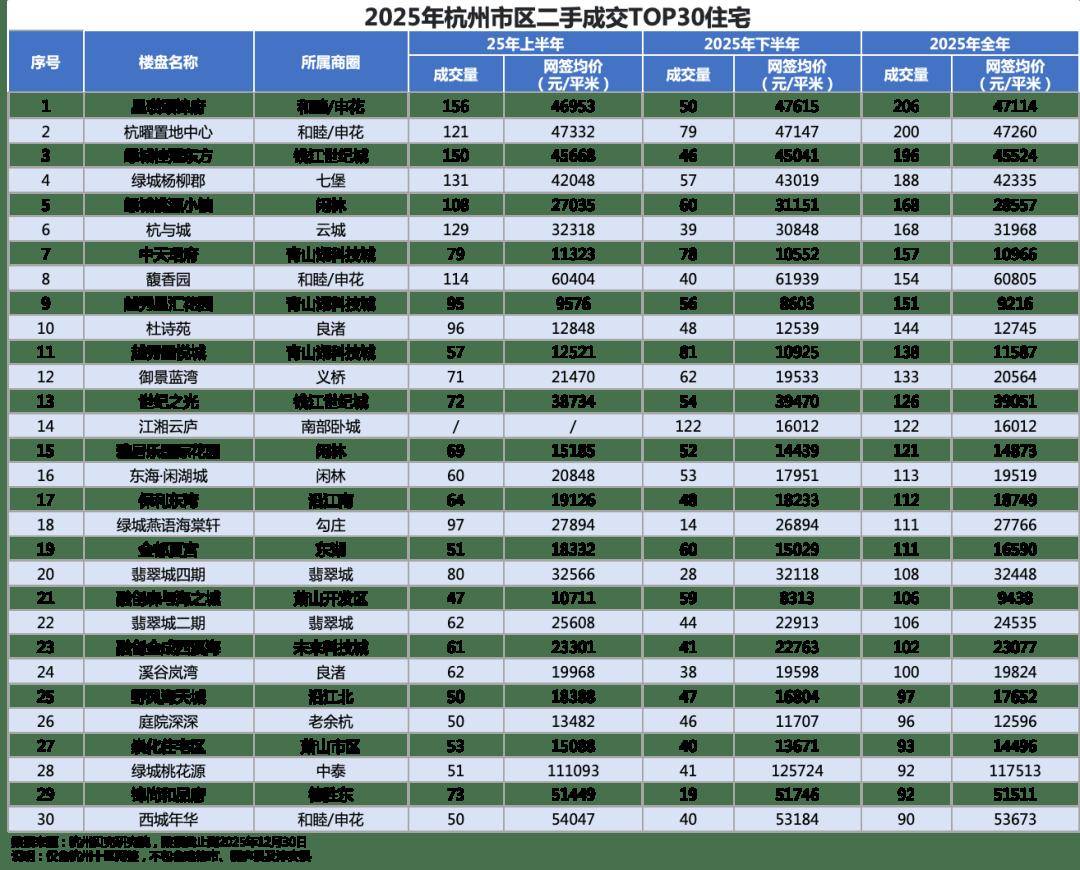
Core Insights - In 2025, Hangzhou recorded a total of 88,500 second-hand housing transactions, marking the second-highest volume in the past five years, despite a decrease from 2024 [1] - The average transaction price for residential properties in December 2025 was 25,161 yuan per square meter, down 12.2% from 28,658 yuan per square meter in December 2024 [1] - A total of 24 residential communities had transaction volumes exceeding 100 units in 2025, with 9 communities surpassing 150 units and 2 communities exceeding 200 units [1] Market Performance - The top 30 residential properties in Hangzhou for 2025 showed varied performance in transaction volumes and average prices, with some properties experiencing significant price fluctuations [2] - The market exhibited a divergence in price trends, with newer properties in core areas and school districts maintaining relatively stable prices, while older properties saw declines exceeding 20% in some cases [2] Price Trends - In December 2025, several properties in the Qiantang District showed mixed price changes, with some properties like Longhu Port Lan Mountain increasing by 7.01% compared to December 2024, while others like Green City Spring Wind Sand dropped by 10.81% [3][4] - The average price for properties in the Xihu District varied significantly, with the West Lake Golf Villa priced at 163,780 yuan per square meter, while other properties experienced declines [18][19] Regional Insights - In the Xiaoshan District, the average price for properties like Rongchuang Times Aocheng increased by 8.53% year-on-year, indicating a positive trend in this area [21] - The Yuhang District saw properties like Green City Peach Blossom Source priced at 134,930 yuan per square meter, reflecting a strong market presence [26]
普通人做好准备!不出意外的话,从2026年起,楼市或将出现3大转变!
Sou Hu Cai Jing· 2026-01-25 07:34
Core Insights - The real estate market is undergoing significant structural adjustments, with a projected 12.6% decline in national commodity housing sales to 8.4 trillion yuan in 2025 compared to 2024 [1] - The market is shifting from an expansion model to an optimization model, focusing on utilizing existing properties rather than building new ones [2] - Three major transformations are expected in the housing market starting in 2026, which will have significant implications for potential buyers [1] Group 1: Market Transformation - The development logic of the market is shifting from incremental expansion to stock optimization, emphasizing the importance of existing housing [2] - The average per capita housing area in urban areas is around 30 square meters, indicating a stable demand for new housing between 600 million to 800 million square meters annually [4] - New housing starts in 2025 are projected to decline by 20.4%, with residential starts down by 19.8%, reflecting a significant reduction in construction activity [4] Group 2: Market Differentiation - The market is showing signs of increasing differentiation, with first-tier cities experiencing the smallest decline in new residential sales, while second-hand housing transactions have reached a five-year high [5] - The trend of "price for volume" is evident, where declining prices are leading to increased transaction volumes, particularly in core cities like Shanghai, Beijing, and Shenzhen [5][7] - The pressure on third and fourth-tier cities is growing due to high new housing inventory and population outflow, leading to price adjustments [5][8] Group 3: Developer Strategies - Real estate companies are concentrating their resources in first and second-tier cities, particularly in prime locations, which reinforces the differentiation between urban areas [8] - Developers are transitioning from survival mode to a focus on quality, emphasizing product quality, design, and community services [9] - The competition among developers is shifting from scale to quality, leading to higher overall standards for new housing [9] Group 4: Market Opportunities - The current market conditions present a favorable opportunity for buyers with improvement needs, as housing prices have adjusted significantly [11] - The active second-hand housing market indicates genuine demand, with transactions occurring at reasonable prices [11] - Lower down payment ratios and mortgage rates are making home purchases more accessible for first-time buyers [11] Group 5: Land Market Dynamics - The residential land transaction area in 300 cities is expected to decline by 12.3% in 2025, indicating strict control over new supply by local governments [12] - Major cities like Beijing, Shanghai, and Hangzhou continue to attract the most investment, with the top 20 cities accounting for 52% of national residential land transfer fees [12] Group 6: Strategic Recommendations - Buyers should clarify their needs and consider entering the market now, as current conditions are favorable [13] - Selecting cities with strong population inflows and industrial development is crucial for long-term investment safety [13] - The quality and location of properties will become increasingly important, as the era of guaranteed appreciation is ending [13]
2026年该买房还是卖房?大佬给出忠告,值得每一个普通人重视
Sou Hu Cai Jing· 2026-01-21 15:40
Core Insights - The real estate market is at a critical turning point in 2026, with many individuals uncertain about selling or buying properties due to fears of declining values [1] - Influential figures like Jack Ma and Cao Dewang emphasize that real estate should not be viewed as an investment asset, but rather for residential purposes, warning against blind holding of properties [1][3] - The market is experiencing a significant divergence, with over 8.5 million second-hand homes listed and prices in third and fourth-tier cities continuing to decline, while core areas in first-tier cities see a slight price increase of 2% [1] Group 1 - Cao Dewang advises ordinary people not to hoard properties, especially non-quality assets, and to sell them quickly to avoid losses [3] - He reiterates that properties are for living, not speculation, particularly in less desirable areas that may become negative assets [3] - Jack Ma suggests that the market will return to rationality, with quality properties retaining value, but warns against incurring massive debts for home purchases [3] Group 2 - 2026 is seen as a policy-friendly window for first-time buyers, with expanded pilot programs for current home sales and reduced down payments and mortgage rates in some cities [5] - Buyers are encouraged to prioritize purchasing quality properties in mature core areas with established amenities, rather than waiting for the lowest prices [5][7] - The advice is to avoid the mindset of waiting for a market bottom, as the window for selling non-quality properties is narrowing, and policy benefits for first-time buyers may change [7]

有人预测:2026上半年,中国楼市将出现3大“变化”,早做准备
Sou Hu Cai Jing· 2026-01-16 12:17
Core Insights - The real estate market in China is expected to experience significant changes by 2026, with a focus on differentiation in property values based on city and property quality [3][5]. Group 1: Market Trends - The overall real estate market is likely to continue "bottoming out" in 2025, with potential for slight recovery in 2026, particularly in first-tier and strong second-tier cities [3][8]. - Property prices are expected to diverge, with "good cities + good properties" being more resilient to price declines, while weaker cities and assets will face greater challenges [7][10]. Group 2: Sales Dynamics - There is a shift towards the sale of completed properties, as trust in pre-sale properties has diminished due to issues like project delays and quality concerns [14][18]. - The government is emphasizing the importance of "good properties" in its policies, which will lead to increased competition based on quality, community amenities, and service standards [10][18]. Group 3: Policy and Financial Environment - The policy direction aims to stabilize the real estate market rather than incite another price surge, with measures including easing purchase restrictions and maintaining a loose monetary environment [22][28]. - Financial support is expected to continue, with low mortgage rates and down payment ratios, but the focus will be on stabilizing prices rather than driving them up [24][30]. Group 4: Recommendations for Buyers - Buyers are advised to focus on first-tier and strong second-tier cities, avoiding impulsive purchases in weaker markets [12][33]. - When considering properties, buyers should prioritize completed homes or newer second-hand properties, and assess the reputation and financial stability of developers [20][37]. - Financial prudence is emphasized, with recommendations to keep monthly mortgage payments within a manageable percentage of household income [40].
楼市究竟有没有见底?其实已经不重要了
Sou Hu Cai Jing· 2026-01-06 01:04
Core Viewpoint - The real estate market has been declining for four consecutive years, leading to uncertainty and frustration among potential buyers and sellers [2][3]. Market Dynamics - The previous market dynamics of rising and falling prices have changed, with a new phase of significant differentiation emerging in the real estate sector [4][5]. - The market is no longer uniform; properties are categorized into three types based on location, quality, and other factors, leading to varied performance [6][12]. Property Classification - Properties are divided into three categories: 1. Quality assets that provide both living comfort and investment value [6][7]. 2. Non-core assets that primarily serve as residences with little to no appreciation potential [9]. 3. "Junk" assets that are undesirable due to significant shortcomings, leading to a lack of demand [10][11]. Market Outlook - Regardless of market fluctuations, quality assets are expected to appreciate, while non-core assets will stagnate or decline slowly, and junk assets will continue to depreciate [12][19]. - The real estate market is influenced by broader demographic trends, such as population decline and delayed marriage and childbearing among younger generations, leading to an oversupply of undesirable properties [16][17]. Investment Strategy - The focus should shift from trying to time the market to making informed decisions based on personal needs and preferences, as waiting for the lowest price may lead to missed opportunities [20][24]. - The era of profiting from real estate investments has passed for ordinary individuals, emphasizing the importance of purchasing a home for personal enjoyment rather than speculation [27][28].

同一套房子,花450万买下和花100万租30年,你会怎么选?
Sou Hu Cai Jing· 2026-01-05 16:32
Core Viewpoint - The article discusses the financial implications of renting versus buying a home in Guangzhou, highlighting the changing perceptions of housing as a necessity for security versus a flexible living arrangement [7][15]. Group 1: Renting vs. Buying - The monthly rent for a self-built house in a city village in Guangzhou is 2,800 yuan, which is significantly lower than the estimated 4,500 to 5,000 yuan for similar conditions in other cities like Zhengzhou [4]. - The average price for a comparable property in the area is over 20,000 yuan per square meter, leading to a total purchase cost of approximately 4.5 million yuan, while renting for 30 years would only cost around 1 million yuan [4][7]. - The rental yield is becoming more favorable, with rental prices stabilizing at 2%-3% of property values, indicating that the potential for property appreciation in non-core areas is questionable [7][15]. Group 2: Hidden Costs of Homeownership - Purchasing a 4.5 million yuan property requires a down payment of 135,000 yuan, with total repayment (including interest) amounting to approximately 6.17 million yuan over 30 years [8][9]. - This financial burden can restrict personal freedom, affecting job mobility and lifestyle choices due to the fear of mortgage default [9]. Group 3: Opportunity Costs of Renting - The opportunity cost of the down payment could yield significant returns if invested, potentially covering most of the rental expenses over 30 years [11]. - Renting provides flexibility and security, especially with new regulations enhancing tenant rights, making long-term rentals more stable [12]. Group 4: Societal Psychological Changes - The perception of homeownership as a source of security is shifting, with a growing emphasis on rental housing as a viable long-term option [13][14]. - A survey indicates that 75.11% of recent graduates prefer renting for better commuting and living quality rather than focusing on property ownership [14]. Group 5: Conclusion on Housing Choices - The decision to rent or buy should align with individual lifestyle needs rather than societal pressures, especially in non-core areas where property values may not justify the investment [15]. - The article suggests that in the current market context, prioritizing quality of life over the pursuit of homeownership may be a more rational choice [15].

2026年买房逻辑巨变!以后别再问涨跌,关键是避开这些“坑”
Sou Hu Cai Jing· 2026-01-05 13:21
Core Insights - The real estate market in 2026 is expected to experience a significant differentiation, moving away from the previous era of uniform price increases to a scenario where "good properties" and "poor properties" will perform very differently [1][4] Policy Direction - The policy focus has shifted from "stopping the decline" to "stabilizing the market," indicating a strong commitment to support the market and reduce the risk of significant declines [3] - The new strategy includes a combination of "controlling new supply, reducing inventory, and optimizing supply," with an emphasis on improving the quality of housing [3] - Reforms in housing fund policies aim to ease the purchasing pressure on citizens, including potential increases in loan limits and new options for using housing funds for down payments [3] Market Conditions - The overall market is stabilizing, but significant disparities exist between cities, with inventory levels being a key factor in this differentiation [4] - First-tier cities have a relatively short inventory digestion period of about 17 months, while second-tier cities face a 22-month period, and third- and fourth-tier cities struggle with a staggering 40-month period [5][6] Actionable Guidelines - For homebuyers, focusing on core cities with population inflows and healthy inventory levels is crucial, prioritizing reputable developers and high-quality properties [6][7] - Investors are advised to be extremely cautious, avoiding weaker cities with declining populations and poor economic prospects, as these areas may present significant risks [8]