
财富管理转型

Search documents
突然启动!东方财富爆量夺魁,顶流券商ETF(512000)飙涨逾4%,主力145亿巨资涌入
Xin Lang Cai Jing· 2026-01-06 11:22
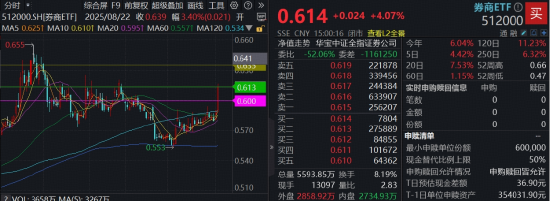
Core Viewpoint - The stock market is experiencing a strong upward trend, with the Shanghai Composite Index rising 1.5% and achieving a remarkable 13 consecutive days of gains, breaking through the previous high from November 14, 2025, and reaching the highest level in over 10 years since July 2015 [1][9]. Market Performance - The total trading volume in the Shanghai and Shenzhen markets reached 2.83 trillion yuan, marking the sixth consecutive trading day exceeding 2 trillion yuan, indicating increased market activity [1][9]. - The brokerage sector has seen a significant surge, with stocks like Huayin Securities and Huashan Securities hitting the daily limit, while others like Changjiang Securities and Guotai Junan rose over 6% [1][9]. - Dongfang Caifu's stock surged by 5.73%, achieving a trading volume of 22.367 billion yuan, making it the top stock in A-shares [1][9]. - The leading brokerage ETF (512000) saw a price increase of 4.07%, the largest single-day gain since October 2025, with a trading volume of 3.393 billion yuan, reflecting a 146% increase in volume [1][9]. Capital Inflow - The brokerage sector attracted a net inflow of 14.549 billion yuan from major funds, leading all secondary industries in the Shenwan classification [3][11]. - Key stocks such as Dongfang Caifu, Guotai Junan, Huashan Securities, and CITIC Securities each received over 1 billion yuan in inflows [3][11]. Sector Analysis - The rise in brokerage stocks is attributed to a deep adjustment in valuations since September 2025, coupled with new capital entering the market, industry mergers, and a slight easing of regulatory measures [3][12]. - The overall performance of the brokerage sector in 2025 was lackluster, with the brokerage ETF tracking the CSI All Share Securities Companies Index only increasing by 2.54%, significantly lagging behind the broader market [3][12]. - The price-to-book ratio (PB) for the index was 1.52, placing it in the lower 42.86% percentile historically, indicating a significant divergence from high growth performance [3][12]. Future Outlook - Looking ahead to 2026, the brokerage sector is expected to benefit from trends such as the migration of household deposits, active market trading, and regulatory support for mergers and acquisitions among leading firms [5][14]. - Analysts from Fangzheng Securities and Galaxy Securities predict that the market will maintain high activity levels, with the capital market showing a "healthy bull" trend, driven by wealth management transformation, international business expansion, and financial technology [5][14]. - The brokerage sector's valuations are currently at historical lows, suggesting potential for defensive rebounds [5][14]. Investment Tools - The brokerage ETF (512000) and its linked funds are designed to track the CSI All Share Securities Companies Index, providing an efficient investment tool that encompasses 49 listed brokerage stocks [6][14]. - The brokerage ETF has an average daily trading volume exceeding 1 billion yuan this year, positioning it as a leading liquidity provider in the A-share market [6][14].


财富管理系列报告之五:财富管理起源欧洲、发展于美国,未来在亚洲(公司篇)
Soochow Securities· 2026-01-06 10:13
Investment Rating - The report maintains a rating of "Buy" for the non-bank financial industry [1]. Core Insights - The report emphasizes that the wealth management industry is evolving from a seller-driven sales model to a buyer-driven advisory model, with significant growth potential in Asia as national wealth increases and household savings shift towards financial assets [2]. - It highlights the importance of learning from overseas wealth management experiences, particularly from Europe and the United States, to enhance the development of wealth management in China [2]. Summary by Sections UBS Group - European Banking System - UBS is the only international bank that has made wealth management its core strategic focus, with a total investment asset scale reaching $6.8 trillion by Q3 2025, of which the wealth management department accounts for $4.7 trillion, or 70% [2][11]. - The wealth management strategy is centered around a "One-firm" model, integrating investment banking, asset management, and commercial banking to provide comprehensive solutions [22]. - UBS targets high-net-worth and ultra-high-net-worth clients, with specific asset thresholds for different regions, ensuring a focus on affluent clientele [24][27]. Morgan Stanley - American Banking System - Morgan Stanley has a long history and is recognized as a leading financial services company, with a total asset management scale of $3 trillion, ranking 6th globally in wealth management [38]. - The company has shifted its focus towards wealth management, which has shown stable growth over the years, particularly after the 2008 financial crisis [39]. - Morgan Stanley employs a strategy of cost control, business synergy, and compensation incentives to enhance productivity and client service [41]. Charles Schwab - American Discount Brokerage - Charles Schwab has transitioned from a discount brokerage to a leading wealth management institution, offering a full suite of financial services [2]. - The company targets retail clients with a low-cost model, rapidly increasing its asset management scale through client retention and product innovation [2]. - Schwab's revenue is primarily driven by assets under management (AUM), having moved away from reliance on trading commissions [2]. BlackRock - American Fund Management - BlackRock is the largest asset management company globally, with an asset scale of $11.6 trillion by the end of 2024, focusing on passive investment strategies [2]. - The company has diversified its product offerings from fixed income to equity investments, with a significant emphasis on its iShares ETF as a growth driver [2]. - BlackRock's revenue model is based on AUM management fees, supplemented by performance fees and consulting services [2].


ETF盘中资讯|沪指突破十年新高!“旗手”迅速启动,两股涨停,顶流券商ETF(512000)放量涨逾3%!
Jin Rong Jie· 2026-01-06 03:19
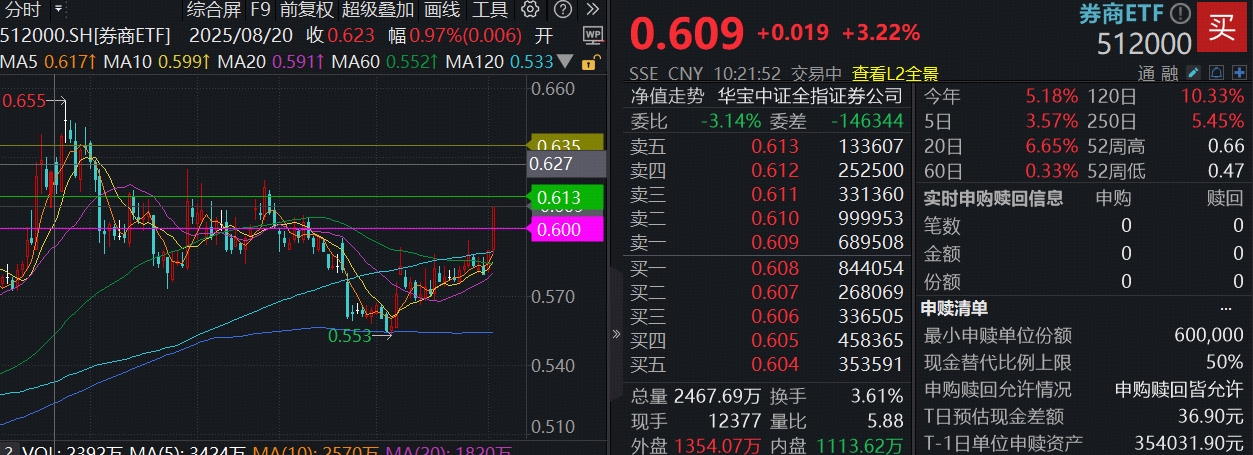
Group 1 - The Shanghai Composite Index has broken through the high point of November 14, 2025, marking a new high since late July 2015, achieving a historic 13 consecutive days of gains [1] - The brokerage sector, long dormant, has finally started to rally, with stocks like Huayin Securities and Huashan Securities hitting the daily limit, and Dongfang Caifu showing significant gains [1] - The top brokerage ETF (512000) saw a price increase of over 3% with nearly 1.5 billion yuan in trading volume within half a day, indicating strong trading sentiment in the sector [1] Group 2 - According to Galaxy Securities, the government's policies aimed at "stabilizing growth and the stock market" will continue to guide the future direction of the brokerage sector, supported by a moderately loose liquidity environment and improved capital market conditions [2] - The current environment is characterized by an accelerated entry of medium to long-term funds into the market, maintaining high market activity, and showcasing a "healthy bull" market [3] - The brokerage sector's valuation is at a historical low, with the ETF tracking the CSI All Share Securities Companies Index having a price-to-book ratio (PB) of 1.52, which is at the 42.86 percentile of the past decade, indicating a significant divergence from high growth performance [3] Group 3 - The brokerage ETF (512000) and its linked funds are efficient investment tools that passively track the CSI All Share Securities Companies Index, encompassing 49 listed brokerage stocks [5] - The brokerage ETF has an average daily trading volume exceeding 1 billion yuan this year, making it one of the top liquidity ETFs in the A-share market [5]
券商ETF(159842)飙升近3%,华林证券涨停!指数创新高,市场情绪持续活跃
Jin Rong Jie· 2026-01-06 02:17
Group 1 - The core viewpoint of the news is that the Chinese securities market is experiencing a bullish trend, with the Shanghai Composite Index reaching new highs not seen since July 2015, driven by a strong performance in the brokerage sector [1] - The China Securities Association has revised the "Quality Evaluation Method for Investment Banking Business of Securities Companies," focusing on improving evaluation indicators related to underwriting quality and introducing new metrics for IPO valuation [1] - China Galaxy Securities believes that the government's policies aimed at stabilizing growth and boosting the stock market will continue to influence the brokerage sector positively, with factors such as a moderately loose liquidity environment and improved investor confidence contributing to the sector's upward trend [1] Group 2 - The brokerage ETF (159842) closely tracks the CSI All Share Securities Company Index, with top holdings including leading brokerages like CITIC Securities and East Money, and it features one of the lowest management fees in the industry at 0.15% [2] - The ETF's low fee structure effectively reduces the holding costs for investors, making it an attractive option in the market [2]

行情一到,证券就躁!“牛市旗手”证券ETF(159841)跟踪指数大涨近3%,沪指冲击13连阳,盘中再创阶段新高!
Sou Hu Cai Jing· 2026-01-06 02:10
Core Viewpoint - The A-share market is experiencing a strong upward trend, with the Shanghai Composite Index reaching a new high not seen since July 2015, indicating a potential structural market phase in 2026 [1][2]. Market Performance - As of January 6, 2026, the Securities ETF (159841) saw a turnover of 2.58% and a transaction volume of 274 million yuan, while the tracked CSI All Share Securities Index (399975) rose by 2.76% [1]. - The Shanghai Composite Index achieved a 12-day consecutive rise, marking the longest streak since March 1992, with significant historical context provided [2]. Institutional Insights - Zhongyou Securities predicts that the A-share market will transition to a phase dominated by structural trends, with average daily stock fund transaction volumes expected to range between 2.2 trillion to 3.2 trillion yuan, reflecting a moderate increase from 2025 [3]. - Shenwan Hongyuan Securities notes that the current valuation of the brokerage sector is at a historical low, with expectations for public funds to increase allocations due to the sector's stable growth and high index weight [3]. Sector Highlights - The brokerage sector is anticipated to benefit from improved performance metrics and increased merger and acquisition activities, which will enhance industry leverage and resource allocation efficiency [3]. - The transition towards wealth management and internationalization is expected to accelerate, providing strong upward momentum for the brokerage sector in 2026 [3].




七年两度挂牌,国联民生决意退出中海基金
Sou Hu Cai Jing· 2026-01-04 10:02
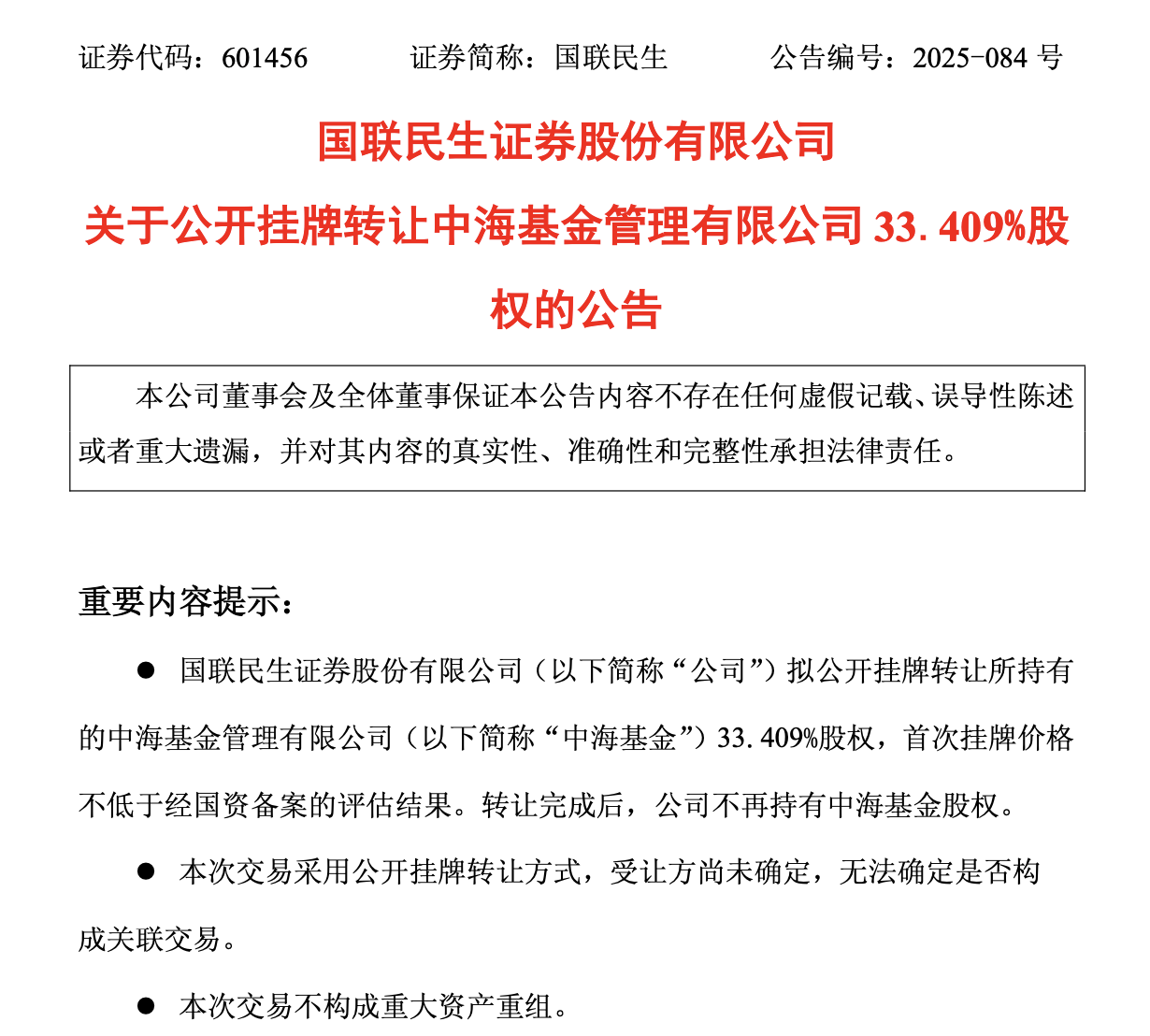
2025年12月30日,国联民生(601456)发布公告,拟公开挂牌转让所持中海基金33.409%股权,首次挂牌价格不低于经国资备案的评估结果,按中联资产评 估集团的市场法评估,这部分股权价值约1.53亿元。 而国联证券作为中海基金的创始股东,其持股比例从最初的49%降至33.41%,经历了从控股到参股的角色转变。 七年前,国联证券曾试图彻底退出中海基金,2018年2月,国联证券曾挂牌转让中海基金33.41%股权,挂牌底价2.14亿元。公开资料显示,2014-2017年上半 年,国联证券从中海基金获得的分红相当可观;并且当时正处于券商资管向主动管理转型的大背景下,国联证券选择退出的举动令人费解。时代周报报道, 据中海基金内部人员表示,国联证券在公司的存在感较低,与之对应的是大股东中海信托对于公司的发展给予了较多支持,公司的文化也与大股东颇为接 近,而国联证券作为第二大股东某种意义上更类似于财务投资者的角色。但最终这起转让并没有成功。 两年后,国联证券态度突变,又计划从法国洛希尔银行收购25%股权,意图重获控制权。根据2020年9月的计划,收购价格为1.15亿元,若交易完成,国联 证券将持股58.41%,成为控 ...

中国财富管理新纪元:从“卖”到“配置”的深度变革|财富与资管
清华金融评论· 2026-01-04 09:35
Core Viewpoint - The essence of wealth management is to help clients achieve long-term preservation and appreciation of wealth. In the context of increasing global macroeconomic and political uncertainties and declining asset yields, wealth management institutions are undergoing a profound shift from scale-oriented to client allocation-oriented strategies. The future competitiveness of wealth management institutions will depend on three core capabilities: the breadth of fund evaluation dimensions, the depth of allocation service expertise, and the length of client companionship [2][17]. Industry Transformation - The understanding of the wealth management industry has evolved from merely being a sales channel for financial products to a more comprehensive service model. Key events such as the continuous decline in the yield of ten-year government bonds and the reduction of life insurance policy interest rates indicate a systemic downward trend in the risk-free return rate. The era of relying on traditional fixed-income assets for stable appreciation is nearing its end, shifting the focus from obtaining "absolute returns" to managing "relative risks" through scientific allocation [3][4]. Wealth Management Quality - Good wealth management encompasses two levels: asset-liability management and understanding client life cycles. The role of wealth management has transitioned from simply selling products to becoming a critical bridge connecting client needs with asset management. This requires a deep understanding of clients' financial situations, risk preferences, and life stages to create tailored asset allocation strategies that balance safety, returns, and liquidity [4]. Core Challenges - Wealth management institutions face three core challenges: homogenized competition, the urgent need for enhanced professional capabilities, and the conflict between short-term orientation and long-term value. These challenges necessitate profound industry transformation [5]. Regulatory Changes - By 2025, regulatory policies will demand more precise requirements for fund management, sales, and advisory services, marking the beginning of a deep reform phase centered on "investor interests." The wealth management market is undergoing significant structural changes, with the essence of "asset scarcity" being a mismatch between risk and return rather than a reduction in total social wealth [7]. Professional Competence - The professional nature of wealth management extends beyond sales. As investors move away from "guaranteed returns" to a "allocation era," practitioners must possess three core competencies: understanding investments, comprehending product creation and management, and mastering asset allocation across cycles and categories [8]. Fund Evaluation Dimensions - A scientific fund evaluation system is fundamental for wealth management institutions to provide allocation services. This system should encompass four core dimensions: 1. Performance stability, focusing on long-term risk-adjusted returns and consistency across different market conditions [9]. 2. Transparency of investment processes, ensuring objective decision-making and risk control [9]. 3. Stability of management teams, assessing the alignment of incentive mechanisms with long-term performance [9]. 4. Reasonableness of fees, evaluating the match between management fees and actual value creation [9]. Client-Centric Advisory Model - The essence of the buy-side advisory model is to align with client interests through systematic service processes while also addressing human factors. Wealth management institutions should establish systematic business processes to ensure service quality and continuity, avoiding emotional decision-making risks [11]. Client Companionship - Long-term companionship with clients is crucial for mitigating behavioral biases in investment decisions. Research indicates that over 70% of the variance in investor returns is due to behavioral biases rather than product selection. Effective companionship involves timely interventions during market volatility, product value declines, and significant life changes [14]. Future Outlook - The wealth management industry is expected to expand its service scope from mere fund allocation to comprehensive family governance services, leveraging external expert networks for specialized support. Additionally, technological empowerment and global asset allocation will become focal points, alongside integrating social responsibility into wealth management decisions [15][16].
新浪财经资讯AI速递:昨夜今晨财经热点一览 丨2026年1月2日
Sou Hu Cai Jing· 2026-01-01 23:21
Group 1: Berkshire Hathaway and Warren Buffett - Warren Buffett officially handed over the CEO position of Berkshire Hathaway to Greg Abel after 60 years of leadership, achieving a 19.9% annualized compound return from 1964 to 2024, with a total return exceeding 5.5 million percent, significantly outperforming the market [1] - The company emphasizes that its core culture of long-term investment will continue despite the change in leadership, although the unique public influence and decision-making style of Buffett may change [1] Group 2: Chinese Credit Repair Policy - A new credit repair policy from the People's Bank of China allows individuals with overdue loans of no more than 10,000 yuan from 2020 to 2025 to have their overdue records cleared if repaid by March 31, 2026, aimed at helping those with damaged credit rebuild it efficiently [1] Group 3: Domestic GPU Companies - Shanghai Suiruan Technology has completed its IPO counseling, becoming the last of the "four domestic GPU dragons" to initiate the listing process, focusing on cloud AI chips with its latest products showing outstanding performance [2][6] - The company is collaborating with leading internet firms to advance the construction of AI training clusters, potentially reaching scales of tens of thousands of cards [2] Group 4: U.S. Stock Market and Interest Rate Expectations - The U.S. stock market was closed on New Year's Day, with a significant drop in the market prior due to cooling interest rate cut expectations from the Federal Reserve, which has lowered the probability of a rate cut in January [3] - Market participants are closely monitoring the "January effect" and overall market trends, with differing views on the prospects of a tech-led bull market [3] Group 5: Gold Prices and Market Trends - Gold prices have reached historical highs over 50 times in a year, driven by global economic uncertainty, increased geopolitical risks, and ongoing central bank purchases of gold, as investors seek gold as a key asset for value preservation [4] Group 6: U.S. Dollar Index and Federal Reserve Leadership - The U.S. dollar index ended 2025 with its largest annual decline in eight years, down approximately 8%, with expectations that a dovish successor to Powell could lead to further dollar weakness [5] - The selection of the new Federal Reserve chair will be crucial in determining the dollar's trajectory in 2026, with potential candidates like Hassett and Waller being closely watched [5] Group 7: Commercial Aerospace IPOs - New regulations from the Shanghai Stock Exchange allow commercial aerospace companies with zero revenue and negative profits to apply for IPOs if they meet certain criteria, accelerating the listing process for unicorns in the sector [7] - This move is expected to open up financing channels for the commercial aerospace industry, benefiting major stakeholders like Goldwind Technology and Zhangjiang Hi-Tech [7] Group 8: Fat Donglai Group's Sales Performance - Fat Donglai Group reported sales exceeding 23.5 billion yuan in 2025, significantly surpassing the founder's target of 20 billion yuan, with the supermarket segment contributing over 12.6 billion yuan [8] Group 9: Moutai's Marketing Strategy - The iMoutai platform launched a regular offering of the 1,499 yuan Flying Moutai, marking a shift towards a fully market-oriented marketing system aimed at stabilizing prices and reducing speculation [9] - This strategy includes a product matrix that promotes a diverse range of offerings beyond the flagship Flying Moutai, transitioning the marketing focus from product-driven to consumer-driven [9] Group 10: Nuclear Power Developments - The Zhangzhou Nuclear Power Unit 2 has officially commenced commercial operation, marking the completion of the first phase of the project utilizing China's self-developed third-generation nuclear technology, "Hualong One" [10] - The unit is expected to generate an annual output of 10 billion kilowatt-hours, contributing to energy structure optimization and supporting carbon neutrality goals [10]
广发证券以“专业进阶”共赴奔跑与财富新程
Zheng Quan Ri Bao Wang· 2025-12-29 10:46
在赛前互动环节,广发证券专业投顾团队驻场开展防非宣传,用通俗方式传递理性投资理念,跑者通 过"摸高挑战""趣投福包"等互动游戏可赢取专属文创。在赛中陪伴环节,沿线的"广发元素"全程为跑者 赋能——16公里专属补给站提供能量胶、马蹄爽等物资,"盘中可以震荡,信念不能动摇""理财加跑 步,健康加财富"等创意文案,巧妙串联跑步与投资的共通。在赛后关怀环节,全马与半马终点的广发 服务站,提供奖牌刻字、号码布过塑、专业拉伸等服务。 广发证券表示,已将马拉松"长期稳健、科学配速"的精神融入财富管理实践,通过"买方投顾化、资产 配置化、解决方案化"三大策略,实现从"卖产品"到"管资产"的深度转型。正如跑者需要根据状态调整 配速,投资者也需根据风险偏好、生命周期制定资产配置方案。广发证券既是"赛事中的补给站",也 是"财富路上的专业顾问",为投资者的长期财富增值保驾护航。 本报讯 (记者昌校宇) 12月28日,"2025广州黄埔马拉松赛"(以下简称"黄马")在绿轴广场激情开跑。作为赛事连续五年的金 牌合作伙伴,广发证券(000776)以"专业进阶,勇往向前"为主题,不仅以专业服务陪伴2万名跑者奔 赴终点,更积极践行财富管理" ...

金证FS2.5新一代账户管理系统在某头部券商完成信创单轨上线
Zhong Jin Zai Xian· 2025-12-29 09:11
Core Insights - The new FS2.5 account management system has been successfully launched by a leading brokerage firm, replacing a legacy system that served for over 20 years, marking a significant upgrade in financial infrastructure and the implementation of the national strategy for independent and controllable information technology [1][3] - The system supports comprehensive account services across brokerage, asset management, and proprietary trading, reflecting the industry's shift towards wealth management transformation and the need for unified account management [1][2] Group 1 - The FS2.5 system is designed based on an independent and controllable architecture, creating a unified account system that covers all business lines and channels, enabling unified customer identity authentication and dynamic management throughout the customer lifecycle [2] - The system integrates customer data across multiple business lines, allowing for a single customer ID to access a panoramic view of their information, supported by big data analysis and visualization technologies [2] - The new account management system innovatively integrates brokerage and non-brokerage services, establishing a multi-level unified account management system that supports five major business lines [2] Group 2 - The upgrade of account services is crucial for the brokerage industry, providing a replicable model for core system transformation in the sector [3] - The brokerage firm aims to leverage the FS2.5 system as a foundation for future infrastructure, focusing on wealth management transformation and enhancing digital service capabilities [3] - The collaboration with Jinzheng Co. is expected to drive the development of advanced technologies and products, promoting the construction of a new generation of system infrastructure in the securities industry [3]
