OTA升级

Search documents
阿维塔重庆车展晒销量:累计卖了15万辆,平均售价超27万
Nan Fang Du Shi Bao· 2025-06-09 06:13
Group 1 - The core viewpoint is that Avita has achieved significant sales milestones and plans to expand its product offerings and market presence in the coming years [2][3] - Avita has sold over 150,000 vehicles with an average selling price exceeding 270,000 yuan, and aims to launch 17 new products within five years [2] - The company is backed by major stakeholders, including Changan Automobile and CATL, with Huawei providing smart driving technology [2] Group 2 - Avita has completed 36 OTA upgrades since the end of 2022, with a major upcoming upgrade focusing on user experience and introducing new features [2] - The brand has established over 700 sales channels covering 212 cities, achieving an 82% coverage rate in prefecture-level cities [2] - Avita plans to enter over 50 countries and regions this year, with a goal of establishing more than 160 sales channels [3]

汽车行业周刊:北京新增小客车指标10万个,比亚迪回应经销商“暴雷”
Chan Ye Xin Xi Wang· 2025-06-03 02:40
Policy Focus - The Ministry of Commerce of China responded to the EU's anti-dumping investigation on Chinese tires, emphasizing the need to protect the legitimate rights of Chinese enterprises and urging dialogue to resolve concerns [4] - Sichuan Province released a plan for the construction of regional centers for the recycling and utilization of new energy vehicle batteries, aiming to establish a comprehensive recycling system [5] - Beijing announced an increase of 100,000 new small car indicators this year, with a focus on increasing the proportion of indicators allocated to "car-free families" [6] - Fujian Province is supporting local automotive consumption activities and promoting purchase incentives [8] - Quanzhou City has allocated over 190 million yuan in subsidies for its vehicle replacement policy [9][10] Industry Highlights - The China Automotive Engineering Society emphasized the importance of OTA upgrade management and the need for clear safety responsibilities for enterprises [13] - Changan Automobile's chairman predicted that the industry competition will return to a healthier environment within two years [14] - In April, sales of Chinese brand passenger cars increased by 81.4% year-on-year [15] - From May 1-25, retail sales of passenger cars in China reached 1.358 million units, a 16% year-on-year increase [15] - The automotive industry revenue for January-April was 32,552 billion yuan, a 7% year-on-year increase [16] Company Dynamics - BYD responded to rumors of a "funding chain break" among its dealers, attributing the issue to the dealers' aggressive leverage operations [25] - Huawei transferred the "Shangjie" trademark application to SAIC, which has been approved [26] - Xiaomi's latest model, the SU7 Ultra, has received over 23,000 orders [27] - Li Auto reported a first-quarter adjusted net profit of 1.02 billion yuan, a 20% year-on-year decline [29] - Geely's battery subsidiary plans to achieve a battery production capacity of 70GWh by 2027 [31] Key Events - Xiaoma Zhixing announced a strategic partnership with the Dubai Roads and Transport Authority to launch a Robotaxi fleet [18] - Hyundai and LG Energy Solution plan to build a battery factory in the U.S. with a capacity of 30GWh [19] - Ford's CEO stated that Chinese companies are leading in electric vehicle and battery technology compared to U.S. automakers [20] - Tata Motors will build an electric vehicle battery factory in the UK, creating 9,000 jobs [22] - Tesla's new car registrations in Europe fell by 52.6% year-on-year in April [23] Product Launches - Tesla's Model Y autonomous driving model is set to be delivered in June [33] - The Dongfeng Nano 06, an electric SUV, has been launched with a starting price of 79,900 yuan [34] - The Haval Menglong fuel version has been launched with a limited-time price starting at 136,900 yuan [35] - Geely's electric hybrid pickup trucks, the Radar King Kong and Horizon, have been launched [36] - XPeng's MONA MO3 Max has been launched with a starting price of 129,800 yuan [37] Industry Collaborations - Stellantis invested in the U.S. startup Lyten to develop lithium-sulfur batteries [39] - Samsung SDI and LGES will set up a lithium iron phosphate battery production line in the U.S. [40] - The UK successfully conducted its first flying taxi flight [41] - Fengmao Technology plans to build an automotive parts production base in Jiaxing with an investment of up to 1.5 billion yuan [42][43] - Comau provided an automated assembly solution for Li Auto's next-generation range extender [44]




VIN码随机匹配如同抽奖?长安启源遭车主质疑OTA升级延迟
Bei Ke Cai Jing· 2025-05-19 10:12
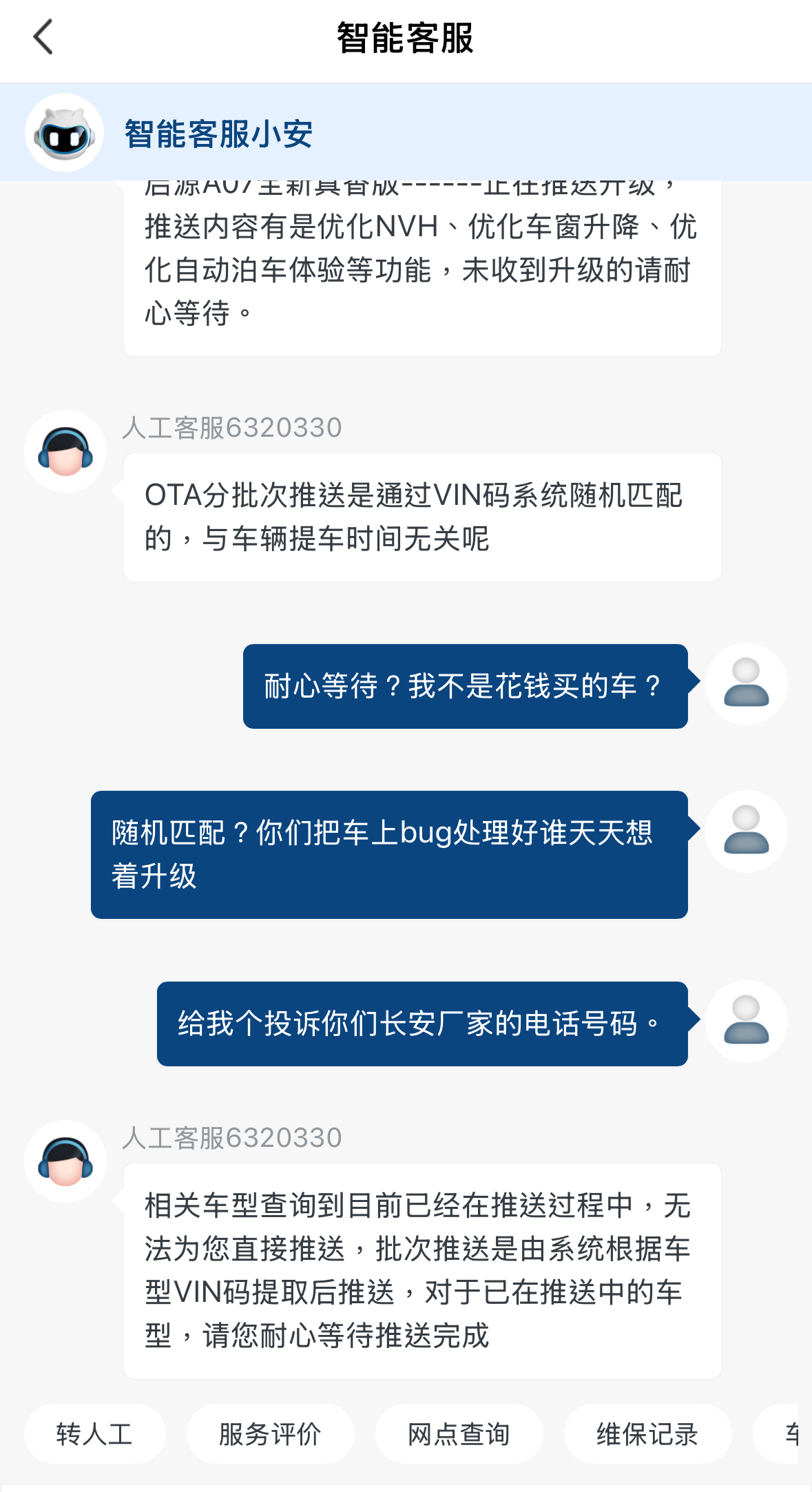
Core Points - The core issue revolves around the delayed OTA (Over-The-Air) updates for the Changan Qiyuan A07 model, which has led to customer dissatisfaction and unresolved vehicle issues [1][4][8] Group 1: Customer Feedback - A customer, Mr. Jiang, reported that he has not received OTA updates for his Changan Qiyuan A07 since an initial update in early 2024, despite experiencing multiple small issues with the vehicle [3][8] - The customer was informed by the official customer service that OTA updates are pushed in batches based on the VIN code system, making it impossible to provide a specific timeline for updates [1][6] Group 2: Company Response - A representative from Changan Qiyuan stated that the last OTA updates for the A07 base and "Zhenxiang" versions were in January and March 2024, respectively, and that there have been no new updates since then [2][9] - The company emphasized the need for the vehicle's VIN to better investigate the reasons for the delay in OTA updates and committed to addressing user feedback [9] Group 3: Legal and Consumer Rights - Legal experts highlighted that consumers have the right to know the specific plans, timelines, and reasons for delays in OTA updates, and that delays could be seen as a breach of contract if OTA updates are part of the purchase agreement [9][10] - Consumers are advised to retain communication evidence and may escalate their complaints through consumer protection platforms if necessary [10]
智能驾驶遭监管重锤:车企营销话术还能“飞”多久?
Xi Niu Cai Jing· 2025-04-29 07:59
Core Viewpoint - The recent tragic incident involving the Xiaomi SU7 has exposed the misleading marketing practices in the smart driving sector, prompting regulatory actions to ensure safety and accountability in the industry [3][4]. Industry Overview - The penetration rate of L2-level autonomous driving in passenger vehicles reached 55.7% in 2024, with predictions suggesting it could approach 65% by 2025 [4]. - Smart technology has become the third most critical factor in car purchasing decisions, following quality and performance, surpassing brand and price considerations [4]. - A significant 76% of users consider "highway NOA" essential, while 64% view "urban NOA" as indispensable, and 77% deem "automatic parking" necessary [4]. Marketing Practices - Car manufacturers have been using aggressive marketing tactics, creating terms like "full-scene intelligent driving" and "zero takeover," which blur the lines between L2-level assistance and full autonomy [4][5]. - A survey indicated that 62% of young car owners mistakenly equate "intelligent auxiliary driving systems" with "autonomous driving," highlighting a significant gap in consumer understanding [5]. Regulatory Changes - The Ministry of Industry and Information Technology (MIIT) has introduced new guidelines to regulate the marketing and testing of smart driving technologies, emphasizing the need for clear communication of system capabilities and safety measures [3][6]. - The new regulations prohibit the use of public testing for users, requiring manufacturers to conduct rigorous simulations and validations before releasing products [6][7]. - Over-the-air (OTA) software updates will now require approval and must undergo thorough verification, impacting the rapid iteration strategies previously employed by some manufacturers [7][8]. Marketing and Communication Standards - The new guidelines mandate the use of standardized terminology in marketing, discouraging misleading phrases like "autonomous driving" and "hands-free" [8][9]. - Manufacturers are required to clearly communicate the limitations of their systems, such as inability to recognize stationary obstacles or performance issues in adverse weather conditions [9]. Future Implications - The introduction of these regulations aims to reshape the industry towards safety, authenticity, and sustainability, moving away from exaggerated marketing claims [10]. - As the industry adjusts to these changes, consumer perceptions are expected to shift from blindly chasing technological advancements to a more rational evaluation of functional value [10].
中汽股份(301215) - 301215中汽股份投资者关系管理信息20250427
2025-04-27 14:30
Group 1: Business Operations and Revenue - The Long Triangle (Yancheng) Intelligent Connected Vehicle Test Field is a company fundraising project, with expected output value contingent on macroeconomic conditions and market demand [3] - The first major client for 2024 is the China Automotive Center, with an overall business volume exceeding 70 million [3] - The company’s revenue growth in Q1 2025 is attributed to increased industry demand and successful client acquisition, particularly in the intelligent connected vehicle sector [6] Group 2: Industry Standards and Regulations - In February 2024, the Ministry of Industry and Information Technology and the State Administration for Market Regulation issued a notice to strengthen the management of intelligent connected vehicle product access and recalls, raising compliance requirements for the industry [4] - The company has participated in drafting multiple national standards, with 7 national standards and 12 group standards published to date [7] Group 3: Testing and Service Capabilities - The company operates over 100 kilometers of test roads and offers more than 100 types of characteristic road surfaces, meeting diverse testing needs for various vehicle types [6] - Although service prices may be slightly above the industry average, the company’s higher testing efficiency helps clients reduce overall R&D costs [6] Group 4: Future Prospects and Challenges - The transition to mandatory testing for intelligent connected vehicles is expected to boost the company’s business, increasing testing volume and client R&D investments [4] - Current L3 autonomous driving technology in China is still in the testing and demonstration phase, with commercial trials limited to specific areas and scenarios [4]
零跑(纪要):2025 年销量目标 50-60 万台
海豚投研· 2025-03-11 14:00
Financial Overview - The company reported a revenue of 14.4 billion in Q2 2023, with a year-on-year decrease of 28% [1] - Gross profit was -1.1 billion, with a gross margin of -7.8% [1] - The net profit for Q4 2024 was -11.3 billion, reflecting a year-on-year decline of 78.5% [1] Delivery and Sales Performance - In 2024, the total delivery volume reached 293,724 units, a year-on-year increase of 163.8% [2] - The C series accounted for 76.6% of total sales, with cumulative deliveries of 225,071 units, up 112.9% from 2023 [2] - In January and February 2025, cumulative sales reached 50,457 units, a growth of 167.8% compared to the same period in 2024 [2] Product and Technology Innovations - The company launched new models C10 and C16 based on a new platform in 2024, achieving significant safety certifications and design awards [3] - The LEAP3.0 central control technology was successfully applied, leading to strong market performance with monthly sales exceeding 30,000 units in Q4 2024 [3] Future Product Plans - The company plans to launch three new models on the B platform in 2025, with the B10 model starting pre-sales on March 10, 2025 [10] - The C platform will see updated versions of C10 and C16 in the first half of 2025 [10] Global Expansion Strategy - A joint venture with Stellantis was established in May 2024 to enhance overseas market presence, with over 400 sales and service points globally by the end of 2024 [8] - The company aims for overseas sales of 50,000 to 60,000 units in 2025 [9] Strategic Collaborations - A strategic cooperation memorandum was signed with China FAW Group on March 3, 2025, focusing on joint development of new energy vehicles and component collaboration [9] R&D and Investment in Smart Driving - The smart driving team is set to expand from 500 to over 600 members in 2025, with an investment of over 800 million in smart driving technologies [12] - The company aims to achieve full integration of urban NOA by the end of 2025 [5]