
B01

Search documents
零跑汽车:25 年报点评-毛利率创新高,A+D 新品周期将至
ZHONGTAI SECURITIES· 2026-03-19 10:25
Investment Rating - The report maintains a "Buy" rating for the company, expecting a relative performance increase of over 15% compared to the benchmark index within the next 6 to 12 months [12]. Core Insights - The company achieved a revenue of 64.73 billion yuan in 2025, representing a year-on-year growth of 101.3%. The gross margin reached a record high of 14.5%, up by 6.1 percentage points year-on-year, with a quarterly gross margin of 15% in Q4 2025 [5][6]. - The company turned profitable in 2025 with a net profit of 540 million yuan, marking a significant turnaround from previous losses [5][6]. - The company is set to launch new models in 2026, including the A series and D series, which are expected to fill gaps in its current product lineup and contribute to increased sales [8]. Financial Performance Summary - Revenue projections for the company are as follows: 32.16 billion yuan in 2024, 64.73 billion yuan in 2025, 100.81 billion yuan in 2026, 138.68 billion yuan in 2027, and 163.5 billion yuan in 2028, with growth rates of 92%, 101%, 56%, 38%, and 18% respectively [4]. - The net profit forecast shows a recovery trajectory with estimates of -2.82 billion yuan in 2024, 538 million yuan in 2025, 4.82 billion yuan in 2026, 7.35 billion yuan in 2027, and 9.25 billion yuan in 2028, indicating a year-on-year growth of 33%, 119%, 796%, 52%, and 26% respectively [4]. - The company’s gross margin is projected to improve slightly to 15.1% in 2026 and further to 15.3% by 2028 [10]. Market Position and Expansion - The company ranked first among new energy vehicle manufacturers in terms of export volume, with 67,000 units exported in 2025 and over 100,000 units cumulatively by February 2026 [7]. - The company is actively expanding into the South American market, having launched models in Brazil and established a significant presence in Europe with over 800 outlets [7]. - The upcoming production of the B10 model in Spain is expected to enhance the company's local manufacturing capabilities and support its international growth strategy [8].

零跑汽车(09863):25年报点评:毛利率创新高,A+D新品周期将至
ZHONGTAI SECURITIES· 2026-03-19 09:22
Investment Rating - The report maintains a "Buy" rating for the company, indicating an expected relative performance increase of over 15% against the benchmark index within the next 6 to 12 months [12] Core Insights - The company achieved a revenue of 64.73 billion yuan in 2025, representing a year-on-year growth of 101.3%. The gross margin reached a record high of 14.5%, up by 6.1 percentage points year-on-year, with a quarterly gross margin of 15% in Q4 2025 [5][6] - The company turned profitable in 2025 with a net profit of 540 million yuan, marking a significant turnaround from previous losses [5][6] - The company is set to launch new models in 2026, including the A series and D series, which are expected to fill gaps in the current product lineup and contribute to increased sales [8] Financial Performance Summary - Revenue projections for the company are as follows: 32.16 billion yuan in 2024, 64.73 billion yuan in 2025, 100.81 billion yuan in 2026, 138.68 billion yuan in 2027, and 163.5 billion yuan in 2028, with growth rates of 92%, 101%, 56%, 38%, and 18% respectively [4] - The company’s net profit is projected to reach 4.82 billion yuan in 2026, 7.35 billion yuan in 2027, and 9.25 billion yuan in 2028, with year-on-year growth rates of 796%, 52%, and 26% respectively [4] - The earnings per share (EPS) is expected to be 0.38 yuan in 2025, 3.39 yuan in 2026, 5.17 yuan in 2027, and 6.51 yuan in 2028 [4] Market Position and Expansion - The company ranked first among new energy vehicle manufacturers in terms of export volume, with 67,000 vehicles exported in 2025 and over 100,000 cumulative exports by February 2026 [7] - The company is actively expanding into the South American market, with new models launched in Brazil and plans for further growth in this region [7] Future Outlook - The introduction of the A and D series models is anticipated to drive domestic sales upward, while the new factory in Spain is expected to commence production of the B10 model in October 2026 [8] - Despite adjustments in profit forecasts due to industry challenges, the company is expected to maintain strong growth driven by new vehicle cycles and international expansion [8]
零跑汽车:2025年业绩点评:业绩符合预期,期待后续新车周期及海外放量-20260317
SINOLINK SECURITIES· 2026-03-17 06:24
Investment Rating - The report maintains a "Buy" rating for the company, anticipating a price increase of over 15% in the next 6-12 months [6]. Core Insights - The company achieved a revenue of 64.73 billion yuan in 2025, marking a year-on-year growth of 101.3%, and a net profit attributable to shareholders of 540 million yuan, indicating a turnaround from losses [2]. - The launch of the B series new cars significantly boosted sales and revenue, with Q4 2025 automotive business revenue reaching 202 million yuan, a year-on-year increase of 53.7% [3]. - The company is expanding its global footprint, with a focus on localizing operations in key markets such as Europe and South America, having established around 900 sales service outlets in approximately 40 international markets by the end of 2025 [4]. - The company is in a strong new product cycle, with four major product series set to launch in 2026, which is expected to drive sales growth and help achieve an annual sales target of one million units [5]. Financial Summary - The company is projected to achieve net profits of 4.65 billion yuan, 6.75 billion yuan, and 7.22 billion yuan for the years 2026, 2027, and 2028, respectively [6]. - The report indicates a significant improvement in gross margin, with Q4 2025 gross margin at 15.0%, up 1.8 percentage points year-on-year [3]. - The company’s revenue growth rate is expected to stabilize at 53.52% in 2026, following the substantial growth of 101.25% in 2025 [11].
新势力 | 1月:车市表现平淡 新势力同比表现好于行业【国联民生汽车 崔琰团队】
汽车琰究· 2026-02-05 03:45
Core Viewpoint - The January 2026 performance of the new energy vehicle market was relatively flat, but new forces in the industry showed better year-on-year performance compared to the overall market [3]. Group 1: January Delivery Data - Leap Motor delivered 32,059 vehicles in January, a year-on-year increase of 27.4% but a month-on-month decrease of 31.9% [2]. - Li Auto delivered 27,668 vehicles, down 7.5% year-on-year and down 37.5% month-on-month [7]. - NIO delivered 27,182 vehicles, marking a significant year-on-year increase of 96.1% but a month-on-month decrease of 14.2% [6]. - Zeekr delivered 23,852 vehicles, with a year-on-year increase of 99.7% and a month-on-month decrease of 9.3% [8]. - Xpeng delivered 20,011 vehicles, down 34.1% year-on-year and down 38.0% month-on-month [5]. - Xiaomi delivered over 39,000 vehicles in January [8]. Group 2: Market Performance Analysis - The total retail market for narrow passenger cars in January was approximately 1.8 million units, a month-on-month decrease of 20.4% but a slight year-on-year increase [3]. - The new energy vehicle retail market is expected to reach 800,000 units, with a penetration rate of 44.4% [3]. - The five sample new force car companies (excluding Xiaomi and Aion) delivered a total of 130,772 vehicles, a year-on-year increase of 17.5% but a month-on-month decrease of 28.0% [3]. Group 3: Company-Specific Insights - Leap Motor's growth is attributed to strong product offerings like the C10 and B01, with plans to launch new models in 2026 [4]. - Xpeng's delivery decline is noted, but the company plans to launch multiple new models in 2026 [5]. - NIO's delivery increase is supported by strong sales of the ES8 and new software updates enhancing user experience [6]. - Li Auto's stable sales are backed by the L series, with ongoing expansion in the charging infrastructure [7]. - Zeekr's growth is driven by the success of the 7X model and plans for new model launches [8]. Group 4: Industry Trends - The smart driving technology is accelerating, with companies like Xpeng and Huawei leading the charge in promoting intelligent driving features [9]. - The industry is expected to see a shift towards more affordable smart driving solutions, enhancing competitiveness against joint venture brands [9]. - The rise of intelligent capabilities is becoming a critical factor in competition among automakers, with a focus on autonomous driving and user acceptance [10].





新势力系列点评二十六:1月车市表现平淡,新势力同比表现好于行业
Guolian Minsheng Securities· 2026-02-05 00:25
Investment Rating - The report maintains a positive investment rating for the new energy vehicle sector, indicating a favorable outlook for the industry [7]. Core Insights - The performance of the new energy vehicle market in January 2026 was relatively flat, with a total retail market size of approximately 1.8 million vehicles, a month-on-month decrease of 20.4%, but a slight year-on-year increase. The penetration rate for new energy vehicles reached 44.4% [4]. - Five key new energy vehicle companies (excluding Xiaomi and Aion) delivered a total of 130,772 vehicles in January, representing a year-on-year increase of 17.5% but a month-on-month decrease of 28.0%, outperforming the industry average [4]. - The report anticipates a stabilization and recovery in automotive demand post-Chinese New Year, driven by the rollout of local government subsidies and the introduction of new models [4]. Summary by Relevant Sections Delivery Performance - Leap Motor delivered 32,059 vehicles in January, a year-on-year increase of 27.4% but a month-on-month decrease of 31.9%. The strong performance is attributed to the competitive pricing of models C10 and B01 [5]. - Ideal Auto reported 27,668 vehicles delivered, a year-on-year decrease of 7.5% and a month-on-month decrease of 37.5%. The company is focusing on enhancing user experience through software updates and expanding its service network [9]. - NIO delivered 27,182 vehicles, marking a significant year-on-year increase of 96.1% but a month-on-month decrease of 14.2%. The ES8 model was the top performer [6]. - Zeekr delivered 23,852 vehicles, with a year-on-year increase of 99.7% and a month-on-month decrease of 9.3% [10]. - Xpeng delivered 20,011 vehicles, reflecting a year-on-year decrease of 34.1% and a month-on-month decrease of 38.0% [6]. Market Trends - The report highlights the ongoing trend of intelligent driving technology adoption, with companies like Xpeng and Huawei leading the charge. The expectation is that advancements in intelligent driving will lower hardware costs and expand market access [12]. - The report suggests that the intelligent driving capabilities will become a key competitive factor for automakers, with a focus on companies that are leading in this area [12]. Investment Recommendations - The report recommends focusing on companies with strong intelligent driving capabilities and those that are well-positioned in the new energy vehicle supply chain. Specific companies highlighted include Geely, Xpeng, and BYD [12].


国海证券晨会纪要-20260109
Guohai Securities· 2026-01-09 01:31
Group 1: Fixed Income Analysis - The report analyzes the recent increase in borrowing of local government bonds and provides insights into the reasons behind this trend and future market outlook [3][4] - As of January 6, the net borrowing volume of local government bonds has increased, with the top five being Henan, Jiangxi, Shandong, Hunan, and Hebei, all with a 30-year maturity [5] - Institutions are primarily borrowing local bonds to take long positions on the spread between local government bonds and national bonds, with the spread reaching a relative low of 14.8 basis points on December 29, 2025 [5][6] Group 2: Great Wall Motors Analysis - Great Wall Motors reported a total sales volume of 1.324 million vehicles in 2025, marking a year-on-year increase of 7.3%, achieving a record high for the company [7][8] - The WEY brand saw significant growth, with a year-on-year increase of 86.3%, while the Haval brand maintained a steady performance with a 7.4% increase [8][9] - The company aims to continue its high-end upgrade strategy with the launch of new models and expects to maintain strong sales momentum in 2026 [9][10] Group 3: Leap Motor Analysis - Leap Motor achieved a total delivery of 597,000 vehicles in 2025, a year-on-year increase of 103.1%, and aims for a target of 1 million vehicles in 2026 [11][12] - The B and C series products have been well-received, contributing to the company's upward structural upgrade, with new models expected to enhance the product lineup [12] - The company has expanded its overseas presence, achieving over 60,000 deliveries in international markets, and plans to accelerate local production in 2026 [12][13] Group 4: Leshushih Analysis - Leshushih has established itself as a leading player in the African hygiene products market, focusing on local manufacturing and a strong distribution network [14][15] - The African market for baby diapers and sanitary products is projected to grow from $3.8 billion in 2024 to $5.6 billion by 2029, driven by increasing penetration and a young population [15][16] - The company has built a robust local supply chain and brand recognition, holding significant market shares in key product categories [16][17] Group 5: AI and Manufacturing Policy - The report discusses the recent policy initiative aimed at integrating AI into manufacturing, with goals to develop industrial intelligence and enhance software capabilities by 2027 [18][19] - The initiative aims to create 1,000 industrial intelligent entities and promote the application of AI across various manufacturing processes, potentially increasing efficiency and reducing costs [19][20] - The industrial software market in China is expected to exceed 500 billion yuan by 2029, driven by the ongoing digital transformation and policy support [21][22]

一周一刻钟,大事快评(W139):补贴政策受益分析,小鹏、零跑、长城销量解读
Shenwan Hongyuan Securities· 2026-01-07 09:13
Investment Rating - The industry investment rating is "Overweight" indicating that the industry is expected to outperform the overall market [12]. Core Insights - The 2026 new energy vehicle purchase tax subsidy policy has shifted from a "one-size-fits-all" model to a tiered proportional subsidy, resulting in a slight decrease in per-vehicle subsidy amounts. Companies with a higher proportion of low-end models, such as Geely and BYD, will experience a more significant subsidy reduction, while high-end brands are largely unaffected [2][3]. - The adjustment in subsidy policy is expected to significantly reshape the sales structure of new energy vehicles in 2026, with demand for low-end models likely to decline, benefiting mid-to-high-end models and companies with higher average selling prices (ASP) [3]. Summary by Sections Subsidy Policy Analysis - The 2026 subsidy policy will lead to a reduction in subsidies for companies with a higher share of low-end models, with Geely facing a 19% reduction and BYD a 14% reduction. In contrast, companies like Xiaopeng, Great Wall, and Leap Motor will see a reduction of around 10% due to their higher proportion of mid-to-high-end models [3][4]. Sales Analysis of Key Companies - **Xiaopeng Motors**: Projected delivery volume for 2025 is approximately 430,000 units, a 126% increase year-on-year. December deliveries were 37,500 units, showing a decline due to subsidy reductions. The ASP is expected to drop from nearly 190,000 yuan in 2024 to 160,000 yuan in the first half of 2025. Xiaopeng plans to launch seven dual-power models in 2026, which are expected to benefit from the policy changes [4][5]. - **Leap Motor**: Expected to deliver 597,000 units in 2025, doubling from 290,000 units in 2024. The growth is driven by new models and overseas market expansion. Despite the introduction of lower-priced models, Leap Motor has maintained its gross margin due to effective cost control. The 2026 sales target is set at 1 million units [5][6]. - **Great Wall Motors**: Anticipated sales for 2025 are 1.32 million units, a 7% increase. The company has optimized its internal structure, with new models compensating for declines in older models. The sales target for 2026 is set at 1.8 million units, reflecting a 40% year-on-year growth expectation [6]. Investment Recommendations - The report suggests focusing on new energy vehicle companies that have advantages in AI and robotics, such as Xiaopeng, NIO, and Li Auto, as well as key Tier 1 suppliers. It also recommends second-hand car companies and component manufacturers with low valuations and growth potential, such as Yinchuan, Fuda, and others [2][6].
37.4亿!央企首次入股新势力!10岁的零跑稳了?
电动车公社· 2026-01-02 16:00
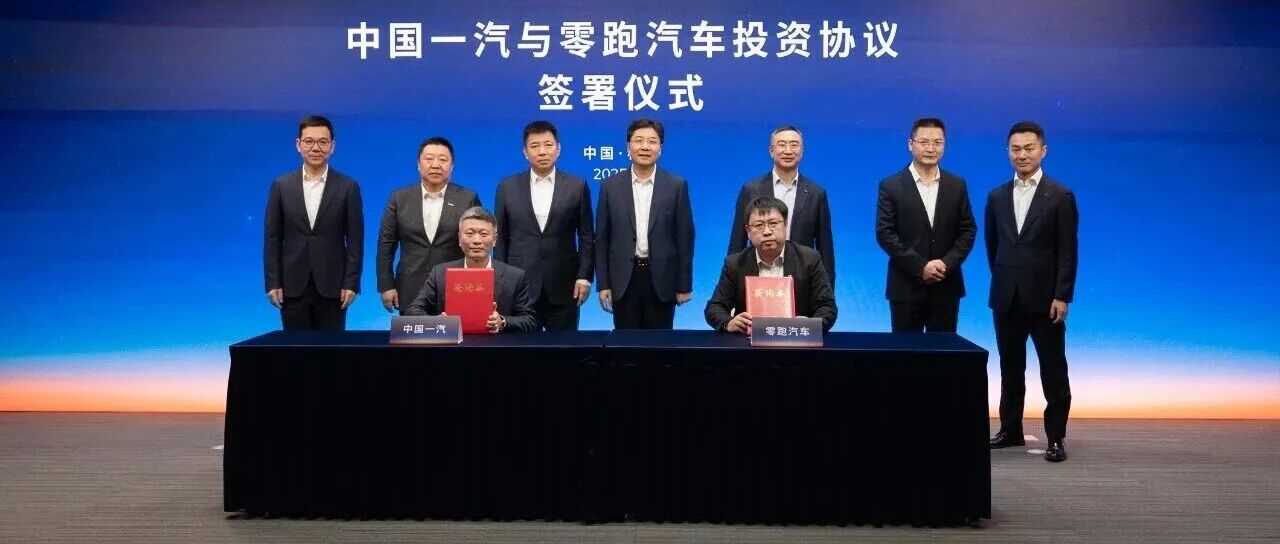
Core Viewpoint - Leap Motor has achieved significant milestones in 2023, including surpassing its annual sales target of 500,000 units and expanding its product line with the new A and D series, targeting price ranges from 60,000 to 300,000 yuan [1][4][7]. Group 1: Strategic Partnerships and Investments - Leap Motor has entered a strategic partnership with FAW Group, which will invest 3.744 billion yuan to acquire a 5% stake in the company, marking the first investment by a state-owned enterprise in a new energy vehicle startup [4][6]. - The collaboration will involve joint research and development of hybrid and extended-range powertrains, enhancing Leap Motor's technological capabilities and resource sharing [4][6]. Group 2: Growth and Future Goals - Leap Motor aims to double its sales to 1 million units by 2026 and establish itself as a world-class smart electric vehicle manufacturer, aspiring to rank among the top 10 globally [7][8]. - The company has set ambitious sales targets, with expectations of significant contributions from its new A series and continued success from its B and C series models [62][70]. Group 3: Historical Context and Development - Leap Motor's journey began in 2015, with founder Zhu Jiangming leveraging his experience from the security industry to enter the automotive sector, driven by the belief that China could achieve breakthroughs in electric vehicles [15][18]. - The company faced early challenges, including low sales of its first model, the S01, which sold only 1,086 units in 2019, and a critical cash shortage in 2020 [22][24]. Group 4: Technological Advancements and Competitive Edge - Leap Motor has focused on developing its own technologies, such as the CTC battery integration and advanced driving assistance systems, which have become key competitive advantages [37][44]. - The company has established a robust in-house manufacturing system, producing 65% of its vehicle components internally, with plans to increase this to 80% [44][46]. Group 5: Market Position and Global Expansion - In 2023, Leap Motor delivered over 500,000 vehicles in China, with expectations for its new A series to drive further growth [62][63]. - The company has partnered with Stellantis, which holds an 18.99% stake, to facilitate its entry into international markets, with plans for local production in Malaysia and Europe [67][70].
新势力年终收官:零跑、小鹏全年销量同比增超100% 理想“失速”、蔚来下半年“反弹”
Xin Lang Cai Jing· 2026-01-01 11:41
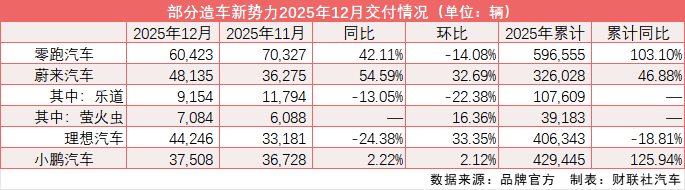
Core Viewpoint - The new energy vehicle market in 2025 did not experience a significant year-end surge, but several companies achieved substantial annual growth in deliveries, with Leap Motor and Xpeng Motors doubling their delivery volumes, while NIO saw a 46.88% year-on-year increase. Li Auto, however, struggled to regain its peak performance due to unmet expectations in its pure electric strategy [1]. Group 1: Company Performance - Leap Motor delivered 60,423 vehicles in December 2025, marking a year-on-year increase of 42.11%, and achieved a total of 596,555 deliveries for the year, a 103.1% increase, setting a new record for new energy vehicle sales [2][3]. - NIO's December deliveries reached 48,135 vehicles, a historical monthly high with a year-on-year growth of 54.59%. The total deliveries for 2025 amounted to 326,028 vehicles, reflecting a 46.88% increase [5]. - Li Auto delivered 44,246 vehicles in December, with a total of 406,343 for the year, representing an 18.81% decline. However, it became the first new energy brand to surpass 1.54 million cumulative deliveries [7]. - Xpeng Motors achieved 429,445 deliveries in 2025, a significant year-on-year increase of 125.94%, although December deliveries were 37,508, falling short of its quarterly guidance [9]. Group 2: Market Trends and Future Outlook - The absence of a year-end surge in the 2025 car market was confirmed by industry analysts, with government policies expected to stabilize the market in 2026 [11]. - Leap Motor aims to reach a delivery target of one million vehicles in 2026, with new models from the A and D series set to launch [3]. - NIO's ES8 model has become a key contributor to sales, with a significant number of orders expected to mitigate performance dips in early 2026 [5]. - Li Auto is focusing on expanding its overseas market presence to alleviate domestic competition pressures [7]. - Xpeng Motors plans to introduce seven new models with advanced configurations in 2026, aiming to significantly expand its market reach [9].


零跑汽车(09863):零跑汽车点评:一汽入股落地,优势互补合作共赢
Changjiang Securities· 2025-12-30 23:30
Investment Rating - The investment rating for the company is "Buy" and is maintained [5]. Core Views - Leap Motor plans to issue 74.832 million domestic shares to FAW at a price of HKD 50.03 per share, totaling HKD 3.744 billion. Approximately 50% of the funds will be allocated for R&D, 25% for operational capital, and 25% for expanding sales and service networks [2][4][6]. - The company is expected to benefit from a strong domestic new car cycle, driving continuous sales growth, while its partnership with Stellantis will facilitate a light-asset overseas expansion, enhancing global sales potential [4][6]. - The projected net profits for Leap Motor from 2025 to 2027 are estimated at CNY 6.3 billion, CNY 5.0 billion, and CNY 8.37 billion, with corresponding P/E ratios of 102.5X, 13.0X, and 7.7X [4]. Summary by Relevant Sections Domestic Market - The company leverages its technological foundation to create a strong price-performance ratio, which is expected to enhance sales during the ongoing new car cycle. Scale effects and product structure optimization are anticipated to improve profitability [4][6]. Overseas Market - The collaboration with Stellantis, the fourth-largest automotive group globally, allows Leap Motor to utilize Stellantis's extensive sales and after-sales network and production capacity for a rapid and flexible overseas expansion. This partnership is expected to yield significant profit contributions from high single-vehicle profitability [4][6]. Product Development and Sales Network - Leap Motor plans to launch 2-3 new products globally each year over the next three years, with several models already introduced in 2025. The company has established a robust domestic sales network with 866 sales outlets across 292 cities and has expanded its international presence with over 700 sales and service points in approximately 30 international markets [6].