全国统一大市场建设

Search documents
加快新型城镇化建设 推动城市发展能级跃升——访省发展改革委党组书记、主任马健
He Nan Ri Bao· 2025-10-17 23:16
Core Insights - The province has achieved a significant increase in urbanization rate, rising from 55.43% in 2020 to 59.22% in 2024, with an addition of 2.87 million urban residents and 38 new cities since the start of the 14th Five-Year Plan [1] Group 1: Urbanization Strategy - The province is implementing a people-centered new urbanization strategy, prioritizing high-quality urban development in urbanization construction [1] - Various plans have been introduced, including new urbanization construction and Zhengzhou metropolitan area development, to ensure the successful achievement of urbanization rate targets set in the 14th Five-Year Plan [1] Group 2: Metropolitan Area Development - The focus is on enhancing the comprehensive strength, core competitiveness, and regional influence of the Zhengzhou metropolitan area, promoting coordinated development with surrounding cities [2] - The province aims to strengthen urban integration and collaboration among cities within the metropolitan area, facilitating cross-regional administrative processes [2] Group 3: Town Development Potential - The province has cultivated 20 new-type urbanization pilot counties and identified 84 potential counties, with nearly 70% showing urbanization rate growth above the provincial average [2] - Future efforts will include supporting infrastructure development, industrial transfer, and collaborative projects to accelerate industrial upgrades and population concentration in potential areas [2] Group 4: Urban Development Projects - The province plans to initiate more key urban renewal projects, including the renovation of underground pipelines and old urban communities, while seeking additional funding support [2] - There will be a focus on investing in human capital, particularly in education, healthcare, and elderly care, to enhance urban livability and overall capacity [2]

刘宁在省委城市工作会议上强调 全面推动城市高质量发展 加快建设现代化人民城市 王凯主持 孔昌生出席
He Nan Ri Bao· 2025-10-17 11:14
Core Points - The meeting emphasized the importance of high-quality urban development as a key component of modernization and enhancing people's quality of life [1][2] - The provincial government aims to establish a modern urban system that integrates large, medium, and small cities, with Zhengzhou as the central city and other cities like Luoyang and Nanyang as sub-centers [2][3] - The focus will be on optimizing urban layout, promoting new urbanization, and ensuring coordinated development between urban and rural areas [2][3] Group 1 - The meeting highlighted the need to implement Xi Jinping's important discussions on urban work and the spirit of the Central Urban Work Conference [1] - The provincial government will adopt a "one main, two sub, one circle, two belts, four regions, and multiple points" development pattern to enhance urban capabilities [2] - Key principles include optimizing urban structures, transforming energy sources, improving quality, and ensuring green transitions [1][3] Group 2 - The government will focus on innovation, reform, and openness to drive urban vitality and enhance living conditions [3] - Emphasis will be placed on environmental governance, energy conservation, and promoting a healthy lifestyle to create a green and beautiful city [3] - The meeting called for strengthening leadership, improving systems and mechanisms, and building a strong professional team to support urban modernization [3]
“十五五”研究系列(一):“十五五”规划前瞻:从政策方向寻找产业线索
Ping An Securities· 2025-10-17 09:07
Group 1 - The "14th Five-Year Plan" has achieved high-quality completion of most policy goals, including economic growth, labor productivity, and R&D investment, with significant progress in urbanization and life expectancy indicators [9][10][11] - The "15th Five-Year Plan" is positioned as a critical period for achieving Chinese-style modernization, focusing on solidifying the foundation for modernization and comprehensive development [7][8] Group 2 - Four industrial clues are identified for the "15th Five-Year Plan": fostering new productive forces, expanding domestic demand, advancing the construction of a unified national market, and enhancing resource utilization and protection [4][12][16] - The macroeconomic environment shows new momentum in domestic growth, with a need to address insufficient effective demand, emphasizing the importance of technology innovation and expanding domestic consumption [13][14] Group 3 - The focus on new productive forces includes the development of emerging industries, traditional industry upgrades, and the stimulation of digital economy innovation [4][12][18] - Expanding domestic demand involves promoting consumption through initiatives like "old-for-new" exchanges and investing in human capital, alongside infrastructure investment to support urban renewal [4][12][16] Group 4 - The construction of a unified national market aims to reduce internal competition and enhance efficiency in sectors like new energy, traditional cycles, and consumer goods [4][12][16] - Resource utilization and protection strategies emphasize the development of the marine economy and the safeguarding of strategic mineral resources [4][12][16] Group 5 - The market outlook suggests that technology innovation sectors such as TMT, new energy, and biomedicine will continue to be key investment themes, supported by policy and industry growth [4][12][16] - Historical analysis indicates that A-share market trends around the announcements of previous five-year plans show a pattern of initial growth followed by sector rotation and differentiation [4][12][16]
9月PPI同比降幅继续收窄
Zhong Guo Hua Gong Bao· 2025-10-17 03:37
Group 1 - In September, China's Producer Price Index (PPI) remained flat month-on-month and decreased by 2.3% year-on-year, with the decline narrowing by 0.6 percentage points compared to the previous month [1] - The PPI's month-on-month performance showed two main characteristics: first, improvements in supply and demand structures led to price stabilization in certain industries, notably a 3.8% increase in coal processing prices and a 2.5% increase in coal mining and washing prices, both rising for two consecutive months [1] - Second, domestic oil-related industry prices fell due to external factors, with a 2.7% decrease in oil extraction prices, a 1.5% decrease in refined petroleum product manufacturing prices, a 0.6% decrease in organic chemical raw material manufacturing prices, and a 0.2% decrease in chemical fiber manufacturing prices [1] Group 2 - Year-on-year, the effects of macroeconomic policies have become evident, with some industry prices showing positive changes, particularly in coal processing, coal mining and washing, photovoltaic equipment and components manufacturing, and battery manufacturing, where price declines narrowed by 8.3, 3, 2.4, and 0.5 percentage points respectively [2] - The upgrading of industrial structures and the release of consumer potential have contributed to price increases in related industries, such as a 1.2% rise in electronic specialty materials manufacturing prices [2]
数说十四五︱“十四五”期间全国法院累计受理案件18974.5万件 司法机关以高质量办案服务高质量发展
Yang Guang Wang· 2025-10-17 01:00
Group 1 - During the "14th Five-Year Plan" period, courts across the country accepted a total of 189.745 million cases, providing strong support for high-quality development and long-term social stability [1] - A landmark case regarding plant variety infringement resulted in the highest compensation of over 50 million yuan, highlighting the effectiveness of punitive damages in deterring infringement [1] - A total of 2.34 million intellectual property cases were concluded during the "14th Five-Year Plan," fostering a favorable legal environment for innovation and high-quality development [1] Group 2 - The implementation of the Private Economy Promotion Law in May 2025 will hold administrative agencies accountable for failing to fulfill promises that harm the legitimate rights of private enterprises [2] - The scope of public interest litigation in ecological and environmental protection has expanded, with 348,000 cases handled, 90% of which are administrative public interest lawsuits [2] Group 3 - Courts concluded 23.466 million cases related to education, employment, elderly care, and healthcare during the "14th Five-Year Plan" [3] - In 2024, the number of cases received by courts is projected to reach 46.02 million, a 41.5% increase from 2020, with a cumulative adjudication rate of 98.03% [3]
开放的河南豫加出彩
Zheng Zhou Ri Bao· 2025-10-17 00:59
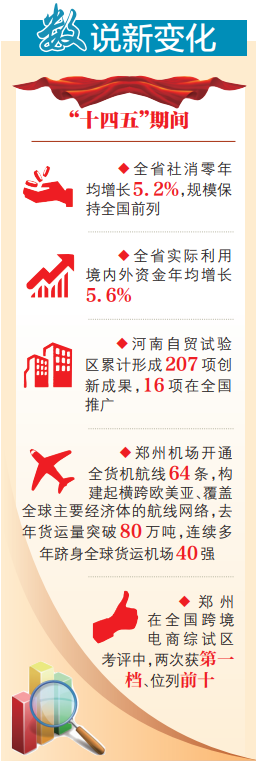
Core Insights - The report highlights the achievements of Henan Province in promoting high-quality business development during the "14th Five-Year Plan" period, focusing on expanding consumption, stabilizing foreign trade and investment, and enhancing overall openness [2] Consumption Growth - Henan Province has implemented multiple measures to expand the consumption market, achieving an average annual growth of 5.2% in total retail sales of consumer goods over the past four years, maintaining a leading position nationally [3] - The government has introduced various policies to boost consumption, including special action plans and subsidies for key products, resulting in over 40 billion yuan in consumer vouchers that stimulated consumption by more than 500 billion yuan [4] - New consumption trends have emerged, such as "IP + consumption," digital consumption, and live e-commerce, with online participation in the 2025 Henan online New Year goods festival exceeding 200 million [4] Foreign Trade Enhancement - Henan Province has focused on expanding and improving the quality of foreign trade, maintaining a trade volume exceeding 800 billion yuan over the past four years, ranking among the top ten in the country [5] - The proportion of general trade has increased from 32.9% in 2020 to 40.4% in 2024, with exports of mobile phones exceeding 200 billion yuan annually and a significant growth in automobile exports [5] - The number of import and export enterprises has increased by 3,600 since 2020, with private enterprises' share of total exports rising from 31.2% to 70.5% by 2024 [5] Investment Expansion - The province has combined high-quality "inward" and high-level "outward" investment strategies, achieving an average annual growth of 5.6% in actual utilization of domestic and foreign funds over the past four years [6] - Key projects have been attracted, such as the Singapore Yihai Kerry investment of nearly 7 billion yuan and the establishment of a new energy vehicle production base by BYD [6] - Over 300 Henan enterprises have invested in more than 50 countries, with total investments reaching 47 billion yuan, enhancing international competitiveness [6] Open Economy Development - Henan has deepened its free trade zone strategy, expanding institutional openness and enhancing trade connectivity through various initiatives [7] - The province has achieved 207 innovative results in its free trade zone, with 16 being promoted nationwide, and has established a leading air transport safety control model for cross-border e-commerce [7] - The Zhengzhou Airport has opened 64 all-cargo routes, significantly increasing its cargo volume and establishing itself as a key trade corridor connecting Europe and ASEAN [8]



系统性补上信用机制短板
Jing Ji Ri Bao· 2025-10-16 22:14
Core Viewpoint - The draft of the "Management Measures for the Serious Violation and Dishonesty List" aims to enhance the credit mechanism and promote the construction of a unified national market, addressing the shortcomings in the current credit system [1][2]. Group 1: Credit System Development - Since the 18th National Congress, China has made significant progress in building a social credit system, transitioning from a non-existent framework to a comprehensive one, with a unified social credit code system fully implemented [2]. - The national credit information sharing platform has integrated credit information from 1.8 billion business entities, totaling over 80.7 billion records, facilitating a joint reward and punishment mechanism across various sectors [2]. Group 2: Challenges and Improvements - Despite advancements, the social credit system is still in a critical transition phase, facing institutional shortcomings that hinder its overall effectiveness [3]. - There is a need for legal construction of the credit system to unify standards for identifying dishonest behavior, ensuring consistent application across different regions [3]. Group 3: Data and Governance - Strengthening the data foundation of the social credit system is essential, as credit information is the basis for its applications [4]. - The governance of credit punitive measures should be improved to prevent the misuse of credit evaluations that create market entry barriers and local protectionism [4].
何立峰会见清华大学经济管理学院顾问委员会委员代表
Xin Hua She· 2025-10-16 10:04
Core Viewpoint - China is advancing the construction of a unified national market and is committed to expanding high-level opening-up, aiming for stable economic growth and deepening mutually beneficial cooperation with countries worldwide [1] Group 1: Economic Development - The Chinese government is focused on achieving stable economic growth through the promotion of a unified national market [1] - There is an emphasis on high-level opening-up to enhance international cooperation and share opportunities for high-quality development [1] Group 2: International Cooperation - Tim Cook, the chairman of the advisory committee, expressed confidence in China's development prospects and a commitment to deepening investment and cooperation in the Chinese market [1] - The advisory committee members are encouraged to act as a bridge to support China's economic development and international exchanges [1]
《油气管网设施公平开放监管办法》院士解读︱强化自然垄断环节监管 助力全国统一大市场建设
国家能源局· 2025-10-16 08:06
Core Viewpoint - The article emphasizes the importance of regulating natural monopoly segments in the oil and gas pipeline network to support the construction of a unified national market, enhancing energy security and optimizing resource allocation [2][3]. Group 1: Breaking Down Monopoly Barriers - The new regulatory measures focus on dismantling monopoly barriers in the oil and gas pipeline facilities, promoting a fair and just competitive environment for various market entities, which will significantly enhance resource allocation efficiency [4]. - This initiative is a crucial support for the construction of a unified national market, aiming for free flow of factors, unified rules, and fair competition [4]. Group 2: Strengthening Natural Monopoly Regulation - The new regulatory framework clarifies the scope and operational rules for fair access to natural monopoly segments, facilitating the optimization of energy resource allocation and contributing to the modern energy market system [5]. - The previous regulatory measures laid a foundation for stable pipeline services, which are essential for energy supply security and fostering a competitive market environment [5]. Group 3: Improving Fair Access Mechanisms - The new regulations enhance the framework for fair access to oil and gas pipeline facilities, aiming to improve service levels and ensure comprehensive planning to avoid resource waste and market imbalance [6]. - This approach considers various factors such as resource distribution and market demand, aligning with the current development stage of the oil and gas industry in China [6]. Group 4: Introducing Penalties for Fair Access - The new regulations represent a significant legal advancement by introducing penalty clauses that align with the Energy Law, creating a comprehensive legal responsibility system [7]. - This innovation aims to regulate the behavior of pipeline facility operators and ensure orderly market participation, thereby preventing resource misuse and unhealthy competition [7].

中资离岸债每日总结(10.15) | 中国水务(00855.HK)、成都中法生态园投发行
Sou Hu Cai Jing· 2025-10-16 02:59
Group 1 - Federal Reserve Chairman Powell indicated a potential 25 basis points rate cut this month, despite the impact of the government shutdown on economic assessments [2] - Market expectations for a rate cut in October remain high, with nearly 100% probability according to federal funds futures data [2] - The Fed's September rate cut was the first since December of the previous year, following a significant slowdown in job growth over the summer [2] Group 2 - The unemployment rate remains relatively low, rising to 4.3% in August [2] - The U.S. Labor Department has delayed the release of the September non-farm payroll report due to the ongoing government shutdown, but is preparing to release the consumer price index data later this month [2] - The Fed is scheduled to meet again on October 28-29, with policymakers' median forecasts indicating two more 25 basis points cuts this year [2] Group 3 - In the primary market, two companies issued bonds today: China Water Affairs Group Limited (5NC3) and Chengdu Sino-French Eco-Park Investment Development Co., Ltd. (3-year term) [4] - Seven companies had their ratings updated by institutions today, including Sunac China Holdings Limited, which reported a successful debt restructuring plan with approximately 98.5% of creditors voting in favor [4] - The announcement from Shougang Group regarding the transfer of shares in Shougang Securities to Jingtou Company aims to optimize shareholder structure and enhance business support [4] Group 4 - As of October 14, the yield on China's 2-year government bonds was 1.49%, while the 10-year yield was 1.84% [6] - The U.S. 2-year government bond yield decreased by 1 basis point to 3.48%, and the 10-year yield also fell by 1 basis point to 4.03% [6] Group 5 - The consumer price index (CPI) in China rose by 0.1% month-on-month in September, with a year-on-year decline of 0.3% [11] - The core CPI, excluding food and energy, increased by 1.0% year-on-year, marking the fifth consecutive month of growth [11] - The People's Bank of China conducted a reverse repurchase operation of 43.5 billion yuan at a fixed rate of 1.40% on October 15, with no reverse repos maturing that day [11]