银发经济

Search documents
八部门出招:鼓励养老服务机器人、外骨骼机器人等发展
2 1 Shi Ji Jing Ji Bao Dao· 2026-01-13 06:20
民政部等八部门出台《关于培育养老服务经营主体促进银发经济发展的若干措施》。其中提出,鼓励养 老服务机器人产业发展;积极探索脑机接口、外骨骼机器人、肌肉外甲等技术,为身体功能退化的老年 人提供科技支撑。数据显示,截至2024年底,我国60岁及以上老年人口达3.1亿。中国老龄科学研究中 心的报告显示,2024年我国养老护理员缺口达550万。 (文章来源:21世纪经济报道) ...

民政部:加快完善养老服务、适老化产品等领域相关标准
Zhong Guo Xin Wen Wang· 2026-01-13 05:50
Core Viewpoint - The Ministry of Civil Affairs of China is promoting the development of the silver economy through a series of measures aimed at enhancing elderly services and improving the quality of life for senior citizens [1][2]. Group 1: Policy Support and Guidance - The Ministry is actively integrating the development of the silver economy into relevant special plans and is collaborating with other departments to formulate supportive measures for high-quality development [1]. - Key focus areas include elderly services, rehabilitation aids, and age-friendly products, with targeted support measures proposed to optimize industrial layout and guide social capital and technology investments [1]. Group 2: Optimizing Industrial Development Environment - The Ministry is working with market regulation departments to improve standards in elderly services, rehabilitation aids, and age-friendly products, encouraging industry associations and enterprises to establish group standards [2]. - There will be monitoring and evaluation of the implementation of standards for silver products and services, along with the establishment of certification systems to ensure safety and rights for elderly consumers [2]. Group 3: Strengthening Industrial Development Support - Financial support policies tailored to the characteristics of the elderly industry are being developed, promoting innovative credit products and service models to attract social capital [2]. - A statistical monitoring system for the elderly industry and silver economy will be established to provide data support for industrial development [2]. - Collaboration with educational and human resources departments is aimed at enhancing the training of professionals in rehabilitation, elderly care, and product design, thereby expanding the talent pool for the industry [2].
民政部:将推动养老服务设施与消费场景深度融合
Zhong Guo Xin Wen Wang· 2026-01-13 05:25
Core Viewpoint - The Ministry of Civil Affairs aims to promote the integration of elderly care service facilities with consumption scenarios to stimulate the silver economy and enhance the quality of life for the elderly [1][2]. Group 1: Expanding Consumption Scenarios - The Ministry will facilitate the deep integration of elderly care service facilities with consumption scenarios, making age-friendly products and services more accessible [1]. - Various facilities such as county-level comprehensive elderly service management platforms, community service stations, and senior activity centers will be utilized to create display and rental sales scenarios for elderly products [1]. - Regions with suitable conditions will be encouraged to revitalize idle resources and plan the construction of specialized shopping streets and rental points for age-friendly products [1]. Group 2: Unlocking Silver Consumption Potential - Multiple measures will be implemented to stimulate new consumption momentum, including integrating home adaptation for the elderly into the old-for-new consumption policy [2]. - Seasonal activities like "Elderly Service Consumption Season" will be organized, offering subsidies and coupons to encourage consumption among the elderly [2]. - A variety of cultural, sports, and fitness events will be held to meet not only the basic needs of the elderly but also their aspirations for a better life and self-fulfillment [2]. Group 3: Creating an Elderly-Friendly Consumption Environment - Collaborative actions will be taken to promote digital literacy among the elderly, including initiatives like "Digital Warmth" and "Smart Assistance" [2]. - The construction of an elderly-friendly society will be advanced, focusing on upgrading public facilities and encouraging diverse payment methods to enhance the convenience and safety of elderly consumption [2].
事关银发经济 八部门联合发布
Shang Hai Zheng Quan Bao· 2026-01-13 05:08
Core Viewpoint - The Ministry of Civil Affairs introduced measures to cultivate the elderly care service sector and promote the silver economy through systematic policy support aimed at enhancing the operational vitality of service providers and advancing structural reforms in supply-side elderly care [1][3]. Group 1: Key Measures - The measures include 14 specific initiatives across five areas, focusing on brand development, market supply-demand matching, technological empowerment, environmental optimization, and increased support for resources [3][4]. - Encouragement for elderly care service providers to enhance brand recognition and protection, providing clear policy pathways for developing well-known brands and leading enterprises in the sector [3]. - Promotion of market-oriented supply-demand matching by optimizing elderly care services and products, facilitating community-based home care through chain operations, and enhancing online and offline service accessibility [3]. Group 2: Technological Empowerment - Strong support for integrating technology into elderly care services, including the use of big data, artificial intelligence, and robotics to improve health monitoring and personalized services for the elderly [3][6]. - Focus on the development and application of humanoid robots and health monitoring devices in various settings such as homes and care institutions, transitioning from mechanical care to precise service delivery [6][7]. Group 3: Environmental Optimization - Creation of a fair competitive environment and establishment of a standard certification system to monitor and evaluate the implementation of standards for silver products and services, while combating illegal activities against the elderly [3][4]. - Improvement of administrative services to attract social investment in elderly care, including the implementation of a unified online service for licenses across regions to reduce operational costs for service providers [4]. Group 4: Market Development - The Ministry of Commerce aims to enhance the supply of quality elderly care services by developing home care services, creating platforms for supply-demand matching, and promoting new consumption scenarios for the elderly [7]. - Plans to accelerate the development of new business models and pilot programs for consumption, while encouraging e-commerce platforms to enrich the supply of elderly-friendly products and services [7].
增加优质养老服务供给 商务部将重点开展这五方面工作
Xin Lang Cai Jing· 2026-01-13 04:20
商务部将结合便民生活圈建设,有力服务"一老一小"群体。商务部牵头开展一刻钟便民生活圈建设,将 养老服务作为其中必备业态。截至2025年7月,全国210个试点地区累计建设6255个便民生活圈,涉及养 老、家政等商业网点150.3万个,覆盖人群范围1.29亿。商务部将继续加力推动城市一刻钟便民生活圈扩 容升级,聚焦群众急难愁盼,突出满足"一老一小"照护需求,进一步优化社区服务供给。 王波表示,从"三个打造"看。商务部将持续打造养老供需对接平台。去年,第八届进博会设立健康养老 专区,共有7家境外企业参展,第137届、138届广交会专设银发经济专区,2025年服贸会围绕智慧养 老、适老化改造、养老金融等热点集中展示了一批优秀产品和服务,第五届消博会在大健康展区集中展 示适老化产品。下一步,商务部将继续利用重要展会平台,引入更多优质老年用品和服务,鼓励企业组 织适老化产品参展,展示更多养老服务领域的新技术、新业态、新成果。 中新网1月13日电 民政部于13日举行专题新闻发布会,介绍《关于培育养老服务经营主体 促进银发经济 发展的若干措施》有关情况。商务部服贸司副司长王波在会上表示,为进一步培育发展养老服务经营主 体,增 ...
民政部:鼓励电商平台优化“长辈模式”,设立银发消费专属频道
Xin Lang Cai Jing· 2026-01-13 04:19
Core Viewpoint - The Ministry of Civil Affairs has introduced measures to stimulate the silver economy by enhancing elderly consumer services and promoting consumption among the elderly population [1][2]. Group 1: Expanding Consumption Scenarios - The initiative aims to integrate elderly service facilities with consumption scenarios, making age-friendly products and services more accessible [1]. - It encourages the development of elderly product display, rental, and sales areas in various service facilities, including community centers and activity centers [1]. - The plan supports the revitalization of idle resources to create specialized shopping districts and rental points for age-friendly products [1]. Group 2: Unlocking Consumption Potential - The government will implement policies to stimulate consumption, including expanding subsidies for home modifications to make them age-friendly [2]. - Special events like "Elderly Service Consumption Season" will be organized around significant holidays to promote silver consumption through subsidies and themed shopping festivals [2]. - A variety of cultural, sports, and fitness activities will be introduced to enhance the quality of life for the elderly, addressing their desires for self-fulfillment [2]. Group 3: Creating an Elderly-Friendly Consumption Environment - Collaborative actions will be taken to enhance digital literacy among the elderly, including initiatives like "Digital Warmth" and "Smart Assistance" [2]. - The initiative promotes the renovation of public facilities to be more age-friendly and encourages diverse payment methods to improve the shopping experience for the elderly [2]. - The goal is to create a welcoming and attractive consumption environment for the elderly, enhancing their sense of security and satisfaction [2].
截至2025年底,我国养老机构共4.17万家,从业人员72.2万人
Sou Hu Cai Jing· 2026-01-13 03:53
Core Viewpoint - The Ministry of Civil Affairs emphasizes the importance of developing the elderly care service environment and has introduced various supportive policies to promote the growth of private sector participation in elderly care services [1]. Group 1: Current State of Elderly Care Services - As of the end of 2025, there will be 41,700 elderly care institutions in China, employing 722,000 people, representing a year-on-year growth of 12.2% [1]. - Private elderly care institutions account for 52.2% of the total, with a cumulative total of 30,000 private and publicly built private institutions, making up 71.9% [1]. - Most home-based elderly care services are provided by private institutions, indicating that social forces are becoming the mainstay of diversified elderly care service supply [1]. Group 2: Measures to Promote Fair Competition - The government aims to create a fair competitive environment by ensuring equal rights, opportunities, and rules for all types of operators in the elderly care sector [2]. - Local governments are encouraged to reform elderly care institutions and optimize support policies, allowing more space for social forces to participate in elderly care services [2]. - Restrictions that harm fair competition in government procurement for elderly care projects are prohibited, ensuring that all operators can compete fairly [2]. Group 3: Enhancing Government Services - The government will improve service precision and convenience, providing comprehensive guidance for operators throughout the entire service chain [2]. - Local civil affairs departments are required to regularly publish information on elderly population status, service facility distribution, and current support policies to help operators assess market demand [2]. - A mechanism for industry incubation is being established to support qualified operators in developing specialized and competitive services [2]. Group 4: Optimizing Licensing and Administrative Processes - Efforts are being made to eliminate departmental and regional barriers to improve service efficiency in the elderly care sector [3]. - A shared information mechanism for elderly care institutions will be established to reduce the burden of repeated submissions and improve administrative efficiency [3]. - The government is exploring cross-regional online processing of licenses for elderly care operators to enhance service efficiency [3]. Group 5: Support for Stable Operations - Support will be provided in terms of land, duration, and funding to stabilize operations in the elderly care sector [3]. - Land supply for elderly care facilities will be prioritized based on the aging population, addressing location challenges for operators [3]. - Financial support policies will be optimized to alleviate funding pressures on operators, ensuring that subsidies are effectively implemented [3]. Group 6: Policy Support for Equipment and Services - The recent policy from the National Development and Reform Commission and the Ministry of Finance includes support for equipment updates in elderly care institutions and subsidies for smart home products [4]. - This policy aims to further promote the development of elderly care service operators and enhance the quality of services provided [4].
刚刚,上海宣布大利好
中国基金报· 2026-01-13 03:52
Core Viewpoint - Shanghai's government has released 28 measures to enhance the quality and efficiency of the service industry and stimulate consumption, focusing on optimizing supply and expanding demand to achieve mutual empowerment and progress [5][12]. Group 1: Background and Considerations - The measures are in response to the 20th National Congress's call to expand domestic demand and the Central Economic Work Conference's emphasis on boosting consumption and service industry capacity [5]. - In the first three quarters of 2025, the service industry's added value grew by 5.9%, and retail sales of consumer goods increased by 5%, both surpassing national averages [5]. - The measures aim to create new growth points in service supply and consumption demand, promoting high-quality development in the service sector [6]. Group 2: Key Measures - The focus is on six key sectors: finance, information services, transportation, cultural and entertainment services, life services, and inspection and certification, which together account for about 60% of the city's service industry value [7]. - Financial services will be enhanced to support diverse consumer needs, including the development of new financial products tailored to various consumption scenarios [7][13]. - E-commerce platforms will be encouraged to shift from price competition to quality competition, driving offline consumption and enhancing consumer experience [7][16]. Group 3: Transportation and Cultural Services - Transportation services will be improved to connect various consumption scenarios, enhancing the overall consumer experience and reducing travel costs [8][17]. - Cultural and entertainment offerings will be expanded, including support for high-quality exhibitions and events that drive significant economic impact [9][19]. - The gaming and esports industry will be developed further, with initiatives to support high-level competitions and foster a robust ecosystem [9][20]. Group 4: Life Services and Quality Improvement - Life services will be enhanced to improve quality and convenience, including initiatives for home care, elderly care, and healthcare services [10][22]. - The government will support the transformation of home service companies into employee-based models, enhancing service quality and providing insurance for service personnel [22][23]. - Medical services will be diversified, promoting high-end healthcare and encouraging the development of specialized insurance products [23][24]. Group 5: Brand and Standards Enhancement - The measures will strengthen brand certification and establish a robust standard system to enhance consumer trust and service quality [11][24]. - The inspection and certification industry will be supported to improve service capabilities, focusing on high-demand sectors such as food and cosmetics [11][25]. - A consumer credit system will be developed to promote transparency and trust in the marketplace [11][26]. Group 6: Support and Talent Development - The government will enhance financial support for service providers, ensuring effective use of fiscal resources to stimulate growth [27][28]. - Talent attraction initiatives will be implemented to draw skilled professionals to the service and consumption sectors, fostering innovation and development [28][29]. - Statistical monitoring will be improved to assess the effectiveness of policies and optimize measures for service industry growth [28].


截至2025年底我国养老机构共4.17万家 从业人员72.2万人
Zhong Guo Xin Wen Wang· 2026-01-13 03:39
Core Viewpoint - The Ministry of Civil Affairs emphasizes the importance of developing the elderly care service environment, with a focus on promoting private sector participation and enhancing policy support for the elderly care industry [1][2]. Group 1: Industry Growth and Structure - By the end of 2025, there will be a total of 41,700 elderly care institutions in China, employing 722,000 people, representing a year-on-year growth of 12.2% [1]. - Private elderly care institutions account for 52.2% of the total, with a combined total of 30,000 private and publicly built private institutions, making up 71.9% of the sector [1]. Group 2: Policy Measures for Development - The measures aim to create a fair competitive environment by ensuring equal rights and opportunities for all types of operators, while also promoting the participation of social forces in elderly care services [2]. - The government will enhance the precision and convenience of administrative services, providing comprehensive guidance to operators through various channels [2]. Group 3: Administrative Efficiency and Support - Efforts will be made to eliminate departmental and regional barriers in the licensing process, improving service efficiency and reducing the administrative burden on operators [3]. - Support for stable operations will be provided through land, duration, and financial assistance, ensuring that elderly care facilities have the necessary resources for development [3]. Group 4: Equipment and Technology Support - The recent policy from the National Development and Reform Commission and the Ministry of Finance includes support for updating equipment in elderly care institutions and subsidies for purchasing smart home products [4].
八部门出台措施促进银发经济向“新”向“优”发展 托起老年人“稳稳”的幸福
Yang Shi Wang· 2026-01-13 03:22
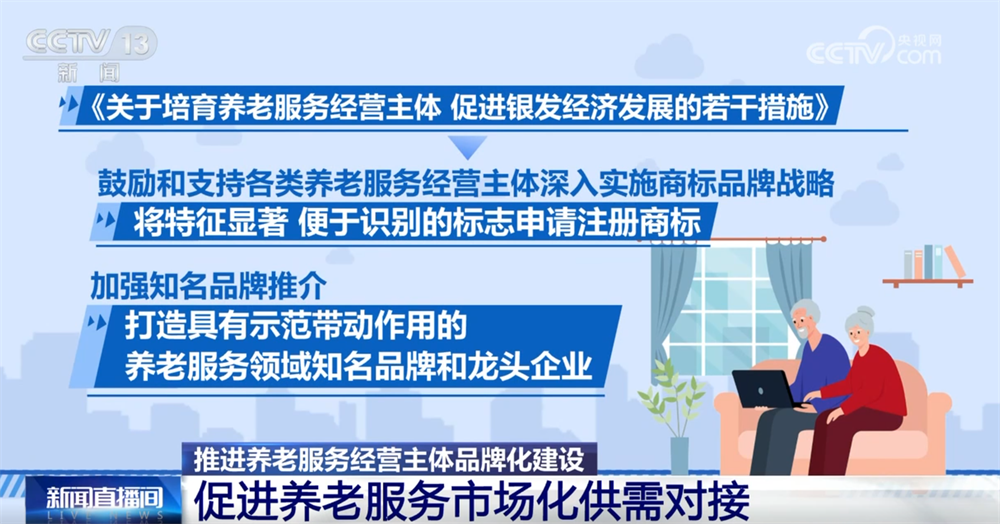
Group 1 - The core viewpoint of the news is the introduction of measures by the Ministry of Civil Affairs and eight other departments to foster the development of the elderly care service industry and promote the silver economy through brand building and supply-demand matching platforms [1][10]. Group 2 - The measures encourage various elderly care service providers to implement trademark brand strategies and register distinctive logos, aiming to strengthen brand promotion and create leading enterprises in the elderly care sector [1][10]. - There is a focus on optimizing the supply of elderly care services and age-friendly products, promoting the expansion of the "15-minute convenient living circle," and encouraging community-based service integration through chain operations [3][5]. Group 3 - Support is provided for the cultivation of specialized medical escort services and mobile bathing services, as well as the development of age-appropriate cosmetics, food, and clothing [5]. - The initiative emphasizes the importance of technology in enhancing elderly care services, encouraging the development of elderly care robots and smart home technologies [7]. Group 4 - There is a push for the rapid establishment of national standards for elderly products and services, along with the implementation of a certification system for silver products and services [9][10]. - Local civil affairs departments are tasked with regularly publishing information on the elderly population, distribution of care facilities, and existing support policies, while also promoting cross-regional service integration through digital platforms [12].