强化学习

Search documents
当无人机遇到AI智能体:多领域自主空中智能和无人机智能体综述
具身智能之心· 2025-06-30 12:17
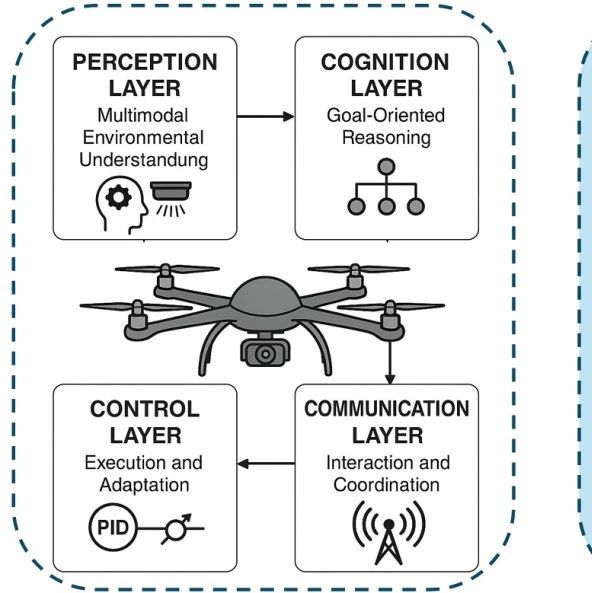
Core Insights - The article discusses the evolution of Unmanned Aerial Vehicles (UAVs) into Agentic UAVs, which are characterized by autonomous reasoning, multimodal perception, and reflective control, marking a significant shift from traditional automation platforms [5][6][11]. Research Background - The motivation for this research stems from the rapid development of UAVs from remote-controlled platforms to complex autonomous agents, driven by advancements in artificial intelligence (AI) [6][7]. - The increasing demand for autonomy, adaptability, and interpretability in UAV operations across various sectors such as agriculture, logistics, environmental monitoring, and public safety is highlighted [6][7]. Definition and Architecture of Agentic UAVs - Agentic UAVs are defined as a new class of autonomous aerial systems with cognitive capabilities, situational adaptability, and goal-directed behavior, contrasting with traditional UAVs that operate based on predefined instructions [11][12]. - The architecture of Agentic UAVs consists of four core layers: perception, cognition, control, and communication, enabling autonomous sensing, reasoning, action, and interaction [12][13]. Enabling Technologies - Key technologies enabling the development of Agentic UAVs include: - **Perception Layer**: Utilizes a suite of sensors (RGB cameras, LiDAR, thermal sensors) for real-time semantic understanding of the environment [13][14]. - **Cognition Layer**: Acts as the decision-making core, employing techniques like reinforcement learning and probabilistic modeling for adaptive control strategies [13][14]. - **Control Layer**: Converts planned actions into specific flight trajectories and commands [13][14]. - **Communication Layer**: Facilitates data exchange and task coordination among UAVs and other systems [13][14]. Applications of Agentic UAVs - **Precision Agriculture**: Agentic UAVs are transforming precision agriculture by autonomously identifying crop health issues and optimizing pesticide application through real-time data analysis [17][18]. - **Disaster Response and Search and Rescue**: These UAVs excel in dynamic environments, providing real-time adaptability and autonomous task reconfiguration during disaster scenarios [20][21]. - **Environmental Monitoring**: Agentic UAVs serve as intelligent, mobile environmental sentinels, capable of monitoring rapidly changing ecosystems with high spatial and temporal resolution [22][23]. - **Urban Infrastructure Inspection**: They offer a transformative approach to infrastructure inspections, enabling real-time damage detection and adaptive task planning [24]. - **Logistics and Smart Delivery**: Agentic UAVs are emerging as intelligent aerial couriers, capable of executing complex delivery tasks with minimal supervision [25][26]. Challenges and Limitations - Despite the transformative potential of Agentic UAVs, their widespread application faces challenges related to technical constraints, regulatory hurdles, and cognitive dimensions [43].

具身智能领域,全球Top50国/华人图谱(含具身智能赛道“师徒关系图”)
Robot猎场备忘录· 2025-06-30 08:09
Core Viewpoint - The development of embodied intelligence technology is a leading trend in the AI and robotics sector, involving advanced techniques such as large language models (LLM), visual multimodal models (VLM), reinforcement learning, deep reinforcement learning, and imitation learning [1]. Group 1: Embodied Intelligence Technology - Embodied intelligence technology encompasses various cutting-edge techniques, including LLM, VLM, reinforcement learning, deep reinforcement learning, and imitation learning [1]. - The evolution of humanoid robots has progressed from model-based control algorithms to dynamic model control and optimal control algorithms, and currently to simulation combined with reinforcement learning [1]. - The most frequently mentioned concepts in humanoid robotics companies are imitation learning and reinforcement learning, primarily researched by academic and leading tech company teams [1]. Group 2: Academic Contributions - UC Berkeley and Stanford University are leading institutions in the AI and robotics research field, with notable alumni contributing to the embodied intelligence sector [2]. - Four prominent figures from UC Berkeley, known as the "Four Returnees," have transitioned from Tsinghua University to UC Berkeley and then to entrepreneurial ventures in embodied intelligence [2]. Group 3: Notable Individuals in the Field - Wang He and Lu Ce Wu are key representatives of individuals who graduated from Stanford University and are now involved in the embodied intelligence startup scene in China [3]. - Wang He, a 2021 PhD graduate from Stanford, is now an assistant professor at Peking University and the founder of a leading humanoid robotics startup [3]. - Lu Ce Wu, a postdoctoral researcher at Stanford, is a co-founder and chief scientist of a unicorn collaborative robotics company and a founder of an embodied intelligence startup [3]. Group 4: Global Talent Pool - The majority of the top 50 Chinese individuals in the embodied intelligence field have educational backgrounds from prestigious institutions such as UC Berkeley, Stanford, MIT, and CMU, often under the mentorship of industry leaders [4]. - A detailed mapping of the top 50 Chinese talents in the field includes their educational history, research directions, and current positions in leading tech companies or startups [5].

人形机器人「通用临界点」:当灵巧手握住万亿市场
3 6 Ke· 2025-06-30 06:21
Core Insights - The article emphasizes that dexterous hands are becoming a crucial component in the evolution of embodied AI, transitioning from laboratory concepts to practical applications in various industries [2][4] - The report aims to provide insights into the development of dexterous hands, focusing on industry definitions, application scenarios, and competitive landscapes [2][4] Industry Definition and Technological Evolution - Dexterous hands are positioned as the end revolution of embodied AI, moving beyond mere grasping to mimicking human hand movements and adapting to complex environments [4][5] - The development of dexterous hands is supported by advancements in structural engineering, control algorithms, and sensor integration, expanding their industry boundaries [7][9] - The market perception of dexterous hands is shifting from a hardware component to a platform capability, particularly in humanoid robots and service robots [10] Application Scenarios and Business Trends - In industrial applications, dexterous hands address the challenges of handling irregular shapes and performing multi-task automation, enhancing productivity in logistics and manufacturing [21] - In service and medical fields, dexterous hands are seen as essential for home robots, rehabilitation prosthetics, and remote medical operations, with a focus on cost control and reliability [22][23] - The technology exhibits strong cross-scenario adaptability, with current focus on B2B applications while future potential lies in B2C markets [24] Competitive Landscape and Capital Judgments - The global competition in the dexterous hand sector features a mix of overseas technological advancements and domestic innovations, with companies like Shadow Robot and Linker Hand leading the charge [26][27] - Investment trends indicate a growing interest in dexterous hand technologies, with significant funding rounds reported for various startups focusing on high degrees of freedom and integrated control systems [32][35] - The investment logic emphasizes the importance of technological breakthroughs, application validation, and system integration capabilities for companies in this space [38][41]


具身智能入门必备的技术栈:从零基础到强化学习与Sim2Real
具身智能之心· 2025-06-30 03:47
Core Insights - The article emphasizes that the field of AI is at a transformative juncture, particularly with the rise of embodied intelligence, which allows machines to understand and interact with the physical world [1][2]. Group 1: Embodied Intelligence - Embodied intelligence is defined as AI systems that not only possess a "brain" but also have a "body" capable of perceiving and altering the physical environment [1]. - Major tech companies like Tesla, Boston Dynamics, OpenAI, and Google are actively developing technologies in this revolutionary field [1]. - The potential impact of embodied intelligence spans across various industries, including manufacturing, healthcare, and space exploration [1]. Group 2: Technical Challenges - Achieving true embodied intelligence presents unprecedented technical challenges, requiring advanced algorithms and a deep understanding of physical simulation, robot control, and perception fusion [2][4]. - MuJoCo (Multi-Joint dynamics with Contact) is highlighted as a critical technology in this domain, serving as a high-fidelity simulation engine that bridges the virtual and real worlds [4][6]. Group 3: MuJoCo's Role - MuJoCo allows researchers to create realistic virtual robots and environments, enabling millions of trials and learning experiences without risking expensive hardware [6]. - The simulation speed of MuJoCo can be hundreds of times faster than real-time, significantly accelerating the learning process [6]. - MuJoCo has become a standard tool in both academia and industry, with major companies utilizing it for robot research [7]. Group 4: Practical Training - A comprehensive MuJoCo development course has been developed, focusing on practical applications and theoretical foundations in embodied intelligence [8][9]. - The course is structured into six modules, each with specific learning objectives and practical projects, ensuring a solid grasp of the technology [10][12]. - Projects range from basic robotic arm control to complex multi-agent systems, providing hands-on experience in real-world applications [14][21]. Group 5: Target Audience and Outcomes - The course is designed for individuals with programming or algorithm backgrounds looking to enter the field of embodied robotics, as well as students and professionals seeking to enhance their practical skills [27][28]. - Upon completion, participants will have a complete skill set in embodied intelligence, including proficiency in MuJoCo, reinforcement learning, and real-world application of simulation techniques [27][28].

CVPR2025 WAD纯视觉端到端 | 冠军方案技术报告~
自动驾驶之心· 2025-06-29 11:33
Core Viewpoint - The article discusses the advancements in end-to-end autonomous driving technology, highlighting the performance of the top competitor, Poutine, in a recent visual-based driving competition, emphasizing its robust training methodology and superior results [1][13]. Group 1: Technical Overview - The leading solution, Poutine, utilizes a 3B parameter Vision-Language Model (VLM) to address long-tail scenarios in visual end-to-end autonomous driving [1]. - The training process consists of two phases: - Phase one involves self-supervised pre-training using a combination of vision, language, and trajectory data, with a total of 83 hours of CoVLA data and 11 hours of Waymo long-tail dataset [2]. - Phase two focuses on fine-tuning through reinforcement learning (RL) using 500 segments of manually annotated data from the Waymo validation set to enhance robustness [2][8]. - The Poutine model achieved a Rater-Feedback Score (RFS) of 7.99 on the Waymo test set, leading the competition [2][13]. Group 2: Data and Methodology - The datasets used include CoVLA, which contains 10,000 front-view images and 30 seconds of driving video, and WOD-E2E, which provides 4,021 long-tail driving scenarios with trajectory information [11]. - The evaluation metric, RFS, is calculated based on the proximity of predicted trajectories to expert-rated trajectories, with a scoring range of 0 to 10 [11]. - The training details include a batch size of 64 and a learning rate of 1e-5 for the CoVLA dataset, while the WOD-E2E dataset used a batch size of 16 with similar training parameters [11]. Group 3: Results and Analysis - Poutine's performance significantly outperformed other models, with a notable score of 7.99, while the second-best model scored 7.91, indicating a substantial lead [13]. - The article notes that while the addition of RL did not drastically improve scores, it effectively addressed challenging scenarios [13]. - The results suggest that the combination of VLM and RL training enhances the model's ability to handle complex driving environments [18]. Group 4: Future Considerations - The article raises questions about the mainstream applicability of VLM and LLM in trajectory prediction, particularly regarding their understanding of the physical world and 3D trajectory information [19]. - It suggests that for conventional evaluation datasets, the advantages of such models may not be as pronounced, indicating a need for further exploration [19]. - The potential integration of action models with VLM for trajectory prediction is proposed as a more comprehensive approach [19].

中科院自动化所最新综述!VLA模型后训练与类人运动学习的共性
具身智能之心· 2025-06-29 09:51
Core Viewpoint - The article discusses the post-training strategies of Vision-Language-Action (VLA) models from the perspective of human motor skill learning, emphasizing the need for robots to undergo a post-training phase to adapt to specific tasks and environments, similar to how humans learn skills through practice and experience [4][5][9]. Summary by Sections 1. Introduction to VLA Models - VLA models integrate visual perception, language understanding, and action generation, enabling robots to interact with their environment effectively. However, their out-of-the-box performance is often insufficient for complex real-world applications, necessitating a post-training phase to refine their capabilities [8][9]. 2. Post-Training Strategies - The article categorizes VLA model post-training strategies into three dimensions: environment perception, embodiment (body awareness), and task understanding. This classification mirrors the key components of human motor learning, facilitating targeted improvements in specific model capabilities [10][12]. 3. Environmental Perception Enhancement - Strategies include enhancing the model's ability to perceive and adapt to various operational environments, utilizing cues from the surroundings to inform actions, and optimizing visual encoding for task-specific scenarios [12][13]. 4. Body Awareness and Control - The post-training strategies focus on developing internal models that predict body state changes, improving the model's ability to control robotic movements through feedback mechanisms inspired by human motor control [14]. 5. Task Understanding and Planning - The article highlights the importance of breaking down complex tasks into manageable steps, akin to human learning processes, to enhance the model's understanding of task objectives and improve operational planning [14]. 6. Multi-Component Integration - Effective skill acquisition in humans involves synchronizing multiple learning components. Similarly, VLA models benefit from integrating various strategies to optimize performance across different dimensions [14]. 7. Challenges and Future Trends - Despite advancements, challenges remain in enabling robots to learn and adapt like humans. Key areas for future research include improving kinematic models, optimizing action output structures, and enhancing human-robot interaction through expert knowledge integration [16][17][18]. 8. Continuous Learning and Generalization - The need for continuous learning capabilities is emphasized, as current VLA models often struggle with retaining previously learned skills. Future research should focus on developing algorithms that allow for lifelong learning and better generalization in open environments [22]. 9. Safety and Explainability - The article underscores the importance of safety and explainability in robotic decision-making, advocating for research into interpretable AI and safety mechanisms to ensure reliable operation in diverse scenarios [22].

从后训练回到预训练,LLM+RL 的潜力兑现有有机会走更远吗?
机器之心· 2025-06-28 05:22
Core Insights - The article discusses the potential of combining Reinforcement Learning (RL) with Large Language Models (LLMs), particularly focusing on the transition from post-training to pre-training phases, highlighting the challenges and opportunities in this area [2][3]. Group 1: Transition from Post-training to Pre-training - The integration of RL with LLMs is seen as a significant technological advancement, extending applications from post-training to pre-training phases [2]. - LLMs traditionally rely on supervised learning, which requires extensive and accurate human-provided data, making RL a viable alternative to address these limitations [3]. - RL's ability to generate data through model-environment interaction reduces the dependency on high-quality labeled data, thus lowering the requirements for supervision [3][4]. Group 2: Applications and Innovations in RL - Initial applications of RL in LLMs were focused on post-training, with techniques like Reinforcement Learning from Human Feedback (RLHF) being prominent [4]. - Recent advancements, such as Reinforcement Pre-Training (RPT) by researchers from Microsoft and Tsinghua University, have expanded RL's application to the pre-training phase, showing improved performance on certain benchmarks [4][5]. - RPT redefines the next token prediction (NTP) task as a verifiable reasoning task, potentially unlocking RL's capabilities while reducing reliance on labeled data [5]. Group 3: Challenges and Limitations - Despite the promising developments, the known limitations of RL in LLMs are still being uncovered, indicating that while the path appears bright, significant challenges remain [4][6]. - The training data and settings for RPT have yet to be validated across broader text and foundational models, and the computational resource demands for RL training continue to pose challenges [5].

OpenAI 4 名王牌研究员“叛变”,Meta 上亿美元的签约奖金终于花出去了
AI前线· 2025-06-28 05:13
Group 1 - Meta has recruited four former OpenAI researchers to join its newly established superintelligence lab, including Trapit Bansal, who played a key role in launching OpenAI's reinforcement learning project [1] - The other three researchers, Lucas Beyer, Alexander Kolesnikov, and Xiaohua Zhai, previously assisted in establishing OpenAI's Zurich office and worked at DeepMind [1] - The formation of the superintelligence lab comes after Meta's internal large language model, Llama 4 Behemoth, faced performance issues, leading to a delay in its release [1] Group 2 - OpenAI revealed that Meta attempted to lure its employees with signing bonuses of up to $100 million, although many researchers declined the offers [2] - Meta's recruitment efforts extend beyond OpenAI, having recently hired Alexandr Wang, CEO of AI training dataset provider ScaleAI, and invested $14.3 billion for a 49% stake in the company [2] - Meta is also in advanced negotiations to acquire PlayAI, a voice AI developer, which has previously raised approximately $21 million in funding [2] Group 3 - Meta is seeking to hire tech investors Daniel Gross and former GitHub CEO Nat Friedman, who co-founded Safe Superintelligence, aiming to develop multi-task AI models that surpass human capabilities [3] - To support its AI initiatives, Meta plans to invest up to $65 billion in data center infrastructure, including the construction of a new data center equipped with over 1.3 million NVIDIA GPUs [3]


肖仰华教授:具身智能距离“涌现”还有多远?
3 6 Ke· 2025-06-27 11:30
Group 1 - The development of artificial intelligence (AI) has two clear trajectories: one represented by AIGC (Artificial Intelligence Generated Content) and the other by embodied intelligence [3][6] - AIGC is considered a technological revolution due to its foundational nature, its ability to significantly enhance productivity, and its profound impact on societal structures [10][11] - Embodied intelligence aims to replicate human sensory and action capabilities, but its impact on productivity is seen as limited compared to cognitive intelligence [11][13] Group 2 - The current stage of AI development emphasizes the quality of data and training strategies over sheer data volume and computational power [3][15] - The scaling law, which highlights the importance of large datasets and computational resources, is crucial for both AIGC and embodied intelligence [14][15] - The industry faces challenges in gathering sufficient high-quality data for embodied intelligence, which is currently lacking compared to language models [20][21] Group 3 - The future of embodied intelligence relies on its ability to understand and interact with human emotions, making emotional intelligence a core requirement for consumer applications [5][28] - The development of embodied AI is hindered by the complexity of accurately modeling human experiences and environmental interactions [30][32] - There is a need for innovative data acquisition strategies, such as combining real, synthetic, and simulated data, to overcome current limitations in embodied intelligence training [22][23]
OpenAI连丢4位大将!Ilya合作者/o1核心贡献者加入Meta,苏黎世三人组回应跳槽:集体做出的选择
量子位· 2025-06-27 08:09
Core Insights - Meta has successfully recruited key talent from OpenAI, including Trapit Bansal, who will focus on advanced reasoning models in a newly established superintelligence department [1][2][10] - The recent hiring spree includes a group of three researchers from Zurich, indicating a strategic move by Meta to strengthen its AI capabilities [10][11] Group 1: Talent Acquisition - Trapit Bansal, a core contributor to OpenAI's large model reinforcement learning research, has joined Meta after a year at OpenAI [1][6] - The Zurich trio, consisting of Lucas Beyer, Alexander Kolesnikov, and Zhai Xiaohua, confirmed their transition to Meta, emphasizing their collective decision to move [10][11][21] - Bansal has over 2800 citations on Google Scholar, showcasing his significant impact in the field [7] Group 2: Research Focus - Bansal's research at Meta will continue to explore reasoning models, building on his previous work in multi-agent reinforcement learning [4][6] - The Zurich trio is known for developing the ViT architecture, which has been widely cited, indicating their strong background in AI research [14][15] Group 3: Strategic Moves - Meta is not only focusing on talent acquisition but is also in talks to acquire PlayAI, a voice AI startup, to enhance its capabilities in voice technology [23][24] - This acquisition strategy aligns with Meta's goal to integrate more voice functionalities into its AR glasses [27]