
贸易保护主义

Search documents
财经观察:美“小额包裹免税”取消,商家民众影响几何?
Huan Qiu Shi Bao· 2025-09-17 22:36
Core Points - The cancellation of the small package tax exemption policy by the U.S. government has led to unexpected tariff bills for American consumers, causing widespread dissatisfaction [1][2][3] - The policy change primarily targets Chinese cross-border e-commerce, but its repercussions are felt across the U.S. economy due to deep economic interdependence [1][4] Consumer Impact - Many American consumers are receiving unexpected tariff bills after online purchases, leading to confusion and frustration [2][3] - A specific case highlighted a consumer receiving a $42.35 bill for a $77 shirt, which was unexpectedly subject to tariffs due to the new policy [2] - The National Bureau of Economic Research estimates that the termination of the small package exemption could result in an additional annual expenditure of at least $10.9 billion for U.S. consumers, equating to $136 per household [9] Business Impact - The new tariff policy has created significant challenges for businesses, forcing them to decide whether to absorb the costs or pass them on to consumers, which could deter potential sales [4][8] - Many foreign merchants have suspended shipments to the U.S., resulting in an 80% decrease in mail flow into the country [4] - U.S. small businesses, particularly those relying on platforms like Etsy and eBay, are expressing concerns about the financial burden imposed by the policy change [8][9] Cross-Border E-commerce Adjustments - Chinese cross-border e-commerce businesses are adapting by shifting from direct shipping to the U.S. to using overseas warehouses, thereby mitigating the impact of the new tariffs [10][12] - The transition to overseas warehouse models allows for quicker delivery to U.S. consumers while avoiding the complications of the small package exemption policy [10][11] - Companies are increasingly focusing on enhancing product value to withstand tariff impacts, indicating a shift away from low-cost competition [11][12]


王毅同韩国外长赵显会谈:中方对韩政策保持稳定性和连续性,希望双方以诚相待,实现共赢,同时妥处敏感问题
Bei Jing Qing Nian Bao· 2025-09-17 14:38
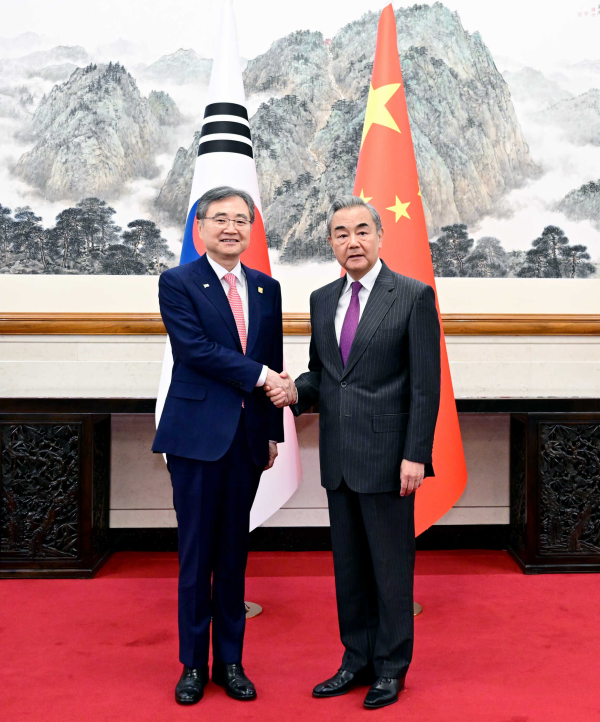
Group 1 - Wang Yi welcomed South Korean Foreign Minister Park Jin's first visit to China, emphasizing the importance of enhancing the China-South Korea strategic partnership and achieving mutual benefits [3] - Both sides agreed to maintain stable and continuous policies towards each other, focusing on cooperation and mutual trust while addressing sensitive issues [3] - The two countries are committed to opposing trade protectionism and maintaining the international free trade system amidst rising unilateralism [3] Group 2 - Wang Yi highlighted the significance of the 80th anniversary of the victory in the Chinese People's Anti-Japanese War and the World Anti-Fascist War, proposing a global governance initiative to enhance international order [4] - South Korean Foreign Minister Park Jin acknowledged China's major contributions to World War II and expressed a desire to strengthen bilateral relations, including economic and cultural exchanges [6] - Both parties agreed to coordinate and support the upcoming APEC Leaders' Informal Meeting in the next two years [6]
刚刚!降息25基点
Zhong Guo Ji Jin Bao· 2025-09-17 14:35
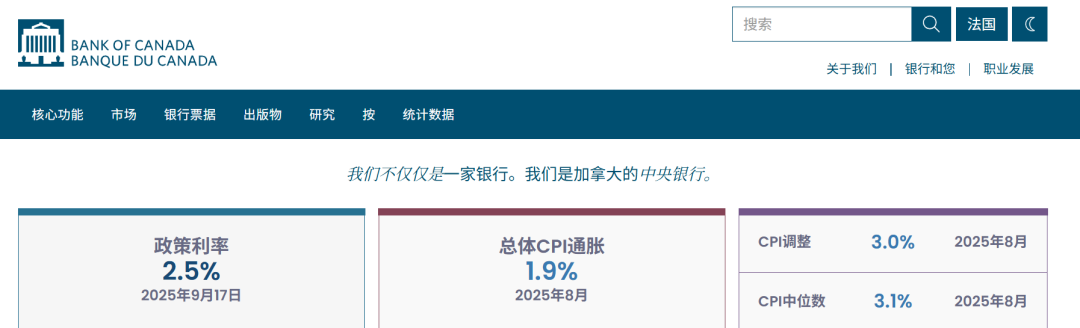
Core Viewpoint - The Bank of Canada has lowered its policy interest rate by 25 basis points to 2.5% in response to economic pressures from U.S. tariffs and a weakening labor market, marking the first rate cut since March [1][4][8] Economic Conditions - The Canadian economy contracted by an annualized rate of 1.6% in the second quarter, primarily due to declines in export activity and business investment [6][8] - Employment has decreased by over 106,000 jobs in July and August, mainly in trade-sensitive sectors, with the unemployment rate rising to 7.1% [6][9] - Consumer and housing activities are growing at a healthy pace, but slowing population growth and a weakening labor market may suppress household spending [6][8] Inflation and Monetary Policy - The core inflation rate is currently around 3%, but the Bank of Canada believes broader underlying inflation pressures are closer to 2.5% [6][9] - The decision to cut rates was made with a consensus among committee members, aiming to better balance risks in a weakening economy with reduced inflationary pressures [4][9] - The central bank has removed previous forward guidance suggesting further rate cuts may be necessary, indicating a cautious approach moving forward [4][5] Trade and Tariff Impact - U.S. tariffs have had a profound impact on key industries such as automotive, steel, and aluminum, contributing to economic strain [6][8] - The recent decision by the Canadian government to eliminate most retaliatory tariffs on U.S. imports is expected to alleviate some upward price pressures on related goods [9]
刚刚!加拿大降息25基点
Zhong Guo Ji Jin Bao· 2025-09-17 14:31
【导读】加拿大降息25个基点 大家好,今晚,降息之夜,加拿大也降息了,一起关注一下。 9月17日晚间,鉴于美国关税对经济和劳动力市场造成冲击,加拿大央行宣布降息,但对未来宽松路径保持缄默。降息幅度为25个基点,利率降至2.5%, 这是自3月份以来首次下调政策利率,符合市场和大多数经济学家的预期。 | 0 IIIIII BANK OF CANADA | | | | 搜索 | O 法国 | | --- | --- | --- | --- | --- | --- | | & BANQUE DU CANADA | | 关于我们 | | | 银行和您 职业发展 | | 核心功能 银行票据 | 市场 | 研究 按 统计数据 | 出版物 | | | | | | 我们不仅仅是一家银行。我们是加拿大的中央银行。 | | | | | 政策利率 | 总体CPI通胀 | CPI调整 | 3.0% | 2025年8月 | | --- | --- | --- | --- | --- | | 2.5% | 1.9% | | | | | 2025年9月17日 | 2025年8月 | CPI中位数 | 3.1% | 2025年8月 | 相反, ...
刚刚!降息25基点
中国基金报· 2025-09-17 14:27
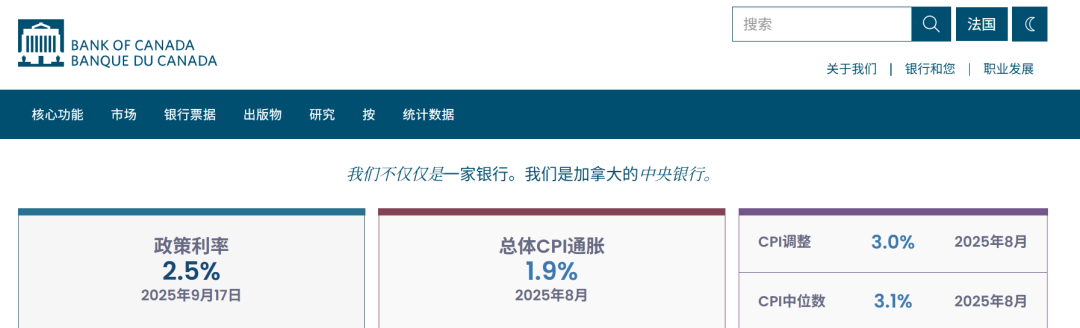
Core Viewpoint - The Bank of Canada has lowered its policy interest rate by 25 basis points to 2.5% due to economic pressures and the impact of U.S. tariffs on the economy and labor market, marking the first rate cut since March [2][5][13]. Economic Conditions - The Canadian economy contracted by an annualized rate of 1.6% in the second quarter, primarily due to declines in export activity and business investment, which aligns with the central bank's expectations [9][14]. - Employment has decreased by over 106,000 jobs in July and August, mainly in trade-sensitive sectors, with the unemployment rate rising to 7.1% [9][14]. - Despite a healthy growth pace in consumption and housing, the central bank warns that slowing population growth and a weakening labor market may suppress household spending [10][14]. Inflation and Monetary Policy - The overall CPI inflation rate is at 1.9%, with core inflation indicators around 3%, but the upward momentum for broader inflation pressures is considered to have weakened [4][11][14]. - The central bank has removed previous forward guidance regarding the need for further rate cuts, indicating a cautious approach moving forward [8][15]. - The decision to cut rates is seen as a means to better balance risks in a weakening economy with reduced inflationary pressures [5][15]. Trade and Tariff Impacts - The U.S. tariffs have had a profound impact on key industries such as automotive, steel, and aluminum, contributing to economic strain [11][12]. - The recent decision by the Canadian government to eliminate some retaliatory tariffs on U.S. imports is expected to alleviate upward price pressures on related goods [14].

为何日本硬刚美国,拒绝对华加税?对中国依赖高,无法承受加关税
Sou Hu Cai Jing· 2025-09-17 10:38
根据中国海关发布的数据显示,2025年前8个月,中日双边贸易总额高达2064亿美元,其中中国自日进口1034亿美元,对日出口1030亿美元。中国现为日本 第五大贸易伙伴、第五大进口来源国及第四大出口市场,两国经济已形成深度绑定格局。 美国近期在对外经贸策略上展现出典型的"两面派"作风。 一方面,派出财政部长贝森特率团赴西班牙与中国就经贸问题展开谈判;另一方面,却在G7线上会议上鼓动盟友对购买俄罗斯石油的中国、印度征收100% 惩罚性关税。 然而,这种试图孤立中印的"小算盘"并未得到广泛响应,至今未有任何盟友听命于美国,均选择沉默应对,其中日本更以罕见强硬姿态直接回绝。 日本财务大臣加藤胜信于9月16日明确表态,称"将关税提高至50%以上对日本而言不可行,是难以做到的",这番直指美国施压的回应引发关注。 深究日本此次"硬气"背后的逻辑,实则是基于现实经济利益的理性抉择。作为外贸依赖型经济体,日本与各主要贸易伙伴维持良好关系是其经济命脉所在。 要求盟友冲锋在前,自身却置身事外,这种"小弟当炮灰"的策略彻底暴露了美国的自私本质。日本政客虽对华态度复杂,但在经济利益面前选择"装傻"而 非"犯傻"——毕竟牺牲本国企业利 ...

加拿大为“忠诚”付惨痛代价!中方反击刀刀见血,盟友却坐视不理
Sou Hu Cai Jing· 2025-09-16 19:31
Group 1 - Canada's recent trade barriers against Chinese goods have not resulted in the expected support from allies, instead plunging the country into an unprecedented economic storm [2] - The Canadian government's sudden shift in trade policy is driven by external political pressures rather than economic considerations, risking decades of established trade cooperation [2][5] - The imposition of a 25% additional tariff on Chinese steel and a 100% tariff on electric vehicles has not yielded any substantial trade concessions from other countries [2][5] Group 2 - China's countermeasures, particularly in the agricultural sector, have had immediate effects, such as a 100% tariff on Canadian canola seeds, leading to skyrocketing import costs and nearly freezing access to the Chinese market [3][4] - Canada previously relied on China as its largest buyer of canola seeds, accounting for two-thirds of its total exports, but trade volumes have drastically declined due to these retaliatory measures [4][6] - The agricultural sector is facing severe repercussions, with canola futures dropping over 6% in a single day and farmers' income expectations decreasing by nearly 20% [4][5] Group 3 - The trade policies have triggered a chain reaction affecting other key industries in Canada, revealing vulnerabilities in its supply chains [5] - The imposition of tariffs has led to production line shutdowns in the chemical sector, particularly affecting the supply of halogenated butyl rubber, a core material for tire manufacturing [5] - Domestic dissatisfaction with the government's trade policies has led to widespread protests from farmers and pressure from provincial leaders to negotiate with China [5][8] Group 4 - Canada has struggled to find alternative markets, with competitors like Russia and Ethiopia offering lower prices, further complicating its trade situation [10] - The high tariffs on Chinese electric vehicles, which hold less than 5% market share in Canada, appear to be more of a political gesture than a strategic economic move [10] - The Canadian government is at a crossroads, facing the choice between continuing its hardline stance or seeking dialogue to resolve trade disputes, which will significantly impact its economic future [15]
中国订单归零,美国豆农:中国不要,只能搅碎
Sou Hu Cai Jing· 2025-09-16 06:01
Core Viewpoint - The U.S. soybean farmers are facing unprecedented despair due to the complete halt of orders from China, which has historically been their largest buyer, leading to a significant decline in soybean prices and threatening their livelihoods [1][3][5]. Group 1: Impact of Trade War - The trade war initiated by the U.S. government has resulted in high tariffs on Chinese goods, prompting China to impose reciprocal tariffs on U.S. soybeans, drastically reducing the price competitiveness of U.S. soybeans in the Chinese market [1][3]. - As a consequence of the tariffs, Chinese buyers have shifted their focus to other soybean suppliers, particularly Brazil and Argentina, which have become the biggest beneficiaries of this shift due to their lower prices and stable supply [3][5]. Group 2: Current Market Situation - The U.S. Soybean Association has reported a complete lack of new orders from China during a critical purchasing period, indicating a severe crisis for U.S. agriculture [3][5]. - U.S. soybean prices have plummeted by 40% compared to three years ago, while production costs continue to rise, putting immense financial pressure on farmers [3][5]. Group 3: Government Response and Future Outlook - The U.S. government, recognizing the severity of the situation, has made unrealistic demands for China to increase soybean orders significantly, but these requests have not resonated with the Chinese market [5][7]. - The absence of Chinese orders could result in a loss of 14 to 16 million tons of soybean orders for the U.S., which is more than half of its soybean exports to China [5][7]. - The event has highlighted the dangers of trade protectionism, emphasizing the need for the U.S. government to take effective measures to improve trade relations with China to avoid further economic damage to U.S. farmers [7].

美国提议征收25%外包税,印度IT行业感到巨大焦虑和压力
Sou Hu Cai Jing· 2025-09-16 00:18
Core Points - A U.S. senator has proposed a 25% tax on American companies that use overseas outsourcing services, significantly impacting India's IT industry [1][3] - The Indian IT industry is valued at $283 billion, accounting for over 7% of India's GDP, with major U.S. companies as key clients [3][4] - The proposed tax could lead to a total tax burden of up to 60% on outsourcing expenditures, making it financially burdensome for U.S. companies [4] - The U.S. government aims to protect domestic jobs by discouraging outsourcing, with tax revenues intended for workforce development [4][6] - The rise of protectionism poses challenges to the globalized IT service model, affecting both companies and individuals [6] - The likelihood of the bill passing is low due to opposition from U.S. companies that rely heavily on outsourcing [8] - The situation serves as a warning for the Indian IT industry to reduce its dependence on the U.S. market [8]
墨西哥欲对中国等国加税 出于什么目的
Di Yi Cai Jing· 2025-09-15 14:12
Group 1 - Mexico's President submitted a legislative proposal to impose tariffs of up to 50% on imports from countries without a free trade agreement with Mexico, primarily targeting China [1][2] - The proposed tariffs will affect approximately 1,400 product categories, including automobiles, toys, steel, textiles, and plastic products [2] - Mexico has become China's largest automotive export market, with 2025 figures showing 4.18 million vehicles exported, and Mexico's automotive industry is expected to be significantly impacted by the new tariffs [3] Group 2 - The new tariffs are seen as a strategy to strengthen domestic production and increase fiscal revenue while also appeasing the U.S. [4] - The Mexican government aims to maintain good relations with China despite the tariff proposal, emphasizing that the measures are not specifically targeting any country [5] - The automotive sector in Mexico may face rising vehicle prices and reduced consumer choices due to the new tariffs, potentially affecting local dealerships and employment [3][4] Group 3 - The relationship between Mexico and the U.S. remains complex, with Mexico heavily reliant on the U.S. market while also seeking to diversify its trade partnerships [6][7] - The U.S. has previously threatened to impose significant tariffs on Mexican imports, which adds pressure on Mexico's trade negotiations [6][7] - Mexico is preparing for potential outcomes regarding the USMCA agreement, indicating a long-term strategy in trade relations [7]