
产业数字化转型

Search documents
工业和信息化部:到2027年建成200个左右高标准数字园区
Xin Hua Wang· 2025-11-19 13:00
Core Insights - The Ministry of Industry and Information Technology has issued a guideline for the construction of high-standard digital parks, aiming to establish around 200 such parks by 2027, achieving full coverage of digital transformation for industrial enterprises above designated size [1] Group 1: Digital Park Development - The construction of high-standard digital parks is a key measure to promote high-quality development in industrial parks and is crucial for the digital transformation of the manufacturing sector [1] - The guideline aims to accelerate the establishment of high-standard digital parks, leading various parks to expedite their digital transformation efforts, thereby supporting the advancement of new industrialization and the construction of a modern industrial system [1] Group 2: Implementation Measures - The guideline outlines 13 initiatives focused on promoting industrial digital transformation, enhancing digital services in parks, improving digital management, and strengthening digital support capabilities [1] - Key initiatives include exploring applications of "Artificial Intelligence + Manufacturing," promoting large-scale deployment of intelligent manufacturing equipment like industrial robots, and advancing the construction and upgrade of network infrastructure such as 5G-A and 10G optical networks [1] Group 3: Standards for Digital Parks - The guideline specifies standards for high-standard digital parks, including comprehensive coverage of industrial internet applications across all industries within the park [1] - It aims for 100% coverage of digital production service applications for industrial enterprises above designated size, and the establishment of a digital operation management system covering asset management, economic operation monitoring, green low-carbon development, and safety emergency management [1] - Additionally, it sets a target for 100% coverage of dual-gigabit network availability within the parks [1]
工信部:加强园区数字化建设要素保障和政策支持 引导社会资本参与高标准数字园区建设
智通财经网· 2025-11-18 11:16
Core Viewpoint - The Ministry of Industry and Information Technology (MIIT) has released the "Guidelines for the Construction of High-Standard Digital Parks," emphasizing the importance of digital transformation in manufacturing and the establishment of high-standard digital parks to enhance industrial quality and efficiency [1][4]. Group 1: Overall Requirements - The guidelines aim to integrate digital technology with park development, focusing on the digital transformation of industries and enhancing the quality of park services and management [5]. - By 2027, the goal is to establish around 200 high-standard digital parks, achieving full coverage of digital transformation for industrial enterprises and significantly improving management and service digitalization levels [5]. Group 2: Construction Standards - High-standard digital parks must achieve high levels of industrial digitalization, with 100% coverage of digital transformation for regulated industrial enterprises [7]. - The parks should provide high-quality digital public services and improve operational management efficiency through comprehensive digital systems [7][8]. Group 3: Construction Tasks - The guidelines outline tasks such as creating benchmarks for enterprise digital transformation, supporting supply chain digital upgrades, and enhancing services for small and medium-sized enterprises [9][10]. - There is a focus on expanding digital services in production, living, and government sectors to create a smart living environment and improve administrative efficiency [10]. Group 4: Digital Management - The guidelines emphasize the need for digital management of park assets, economic operations, and environmental sustainability, including real-time monitoring and data analysis for better decision-making [11]. - Safety and emergency management systems should be enhanced through digital technologies to improve response efficiency [11]. Group 5: Support Capabilities - The guidelines call for the improvement of digital infrastructure, including the upgrade of network capabilities and the establishment of data utilization platforms [12][13]. - There is a strong emphasis on enhancing cybersecurity measures to protect data and network integrity within the parks [13]. Group 6: Implementation Organization - The MIIT will guide the construction of high-standard digital parks and evaluate their compliance with the established standards [14]. - Policy support will be strengthened to facilitate the digital transformation of industries and attract social capital for park development [15]. - An evaluation system will be established to assess the effectiveness of the digital parks and promote successful models [16].
投资促进局俞子荣副局长率团赴沙特开展数字产业“走出去”投资促进活动
Shang Wu Bu Wang Zhan· 2025-11-17 11:41
Group 1 - The delegation led by the Deputy Director of the Investment Promotion Bureau, Yu Zirong, visited Saudi Arabia to promote investment in key areas such as artificial intelligence, industrial digitalization, and smart cities [1] - The delegation engaged in in-depth discussions with various Saudi government departments, including the Ministry of Investment, Ministry of Housing, and Ministry of Education, focusing on topics like industrial digital transformation, digital talent cultivation, and educational technology cooperation [1] - The Saudi side expressed high recognition of Chinese enterprises' strengths in digital technology and established a regular communication mechanism for future cooperation with relevant Chinese companies [1] Group 2 - The delegation conducted exchanges with the Saudi Chamber of Commerce and the Saudi Public Investment Fund, discussing opportunities for supply chain collaboration and promoting Chinese enterprises' participation in major digital transformation projects in Saudi Arabia [1] - The delegation visited King Saud University to explore feasible paths for establishing joint laboratories, conducting research cooperation, and facilitating talent exchange, reaching a consensus on specific future collaborations [1] - Participating companies reported that the visit to Saudi Arabia was efficient and pragmatic, laying a solid foundation for Chinese enterprises to further explore the Saudi market and achieve localized development [2]
上海钢联(300226) - 上海钢联投资者关系活动记录表20251113
2025-11-13 09:32
Group 1: Business Operations and Strategy - The company has not yet engaged in stablecoin business but will comply with regulations if it does in the future [2] - The company is considering a name change to better reflect its diverse business operations [2] - The company’s production and operations are normal despite the controlling shareholder's share pledge [2] Group 2: Financial Performance and Challenges - The decline in industrial data service revenue is attributed to industry challenges such as "production resilience, weak consumption, and low profits" [3] - The overall gross margin is expected to improve through enhanced data quality, service fee increases, and trade model upgrades [3] - The company acknowledges that net profit growth is primarily driven by interest from idle funds and government subsidies [3] Group 3: Future Growth and Development - The company aims to enhance its core competitiveness through technological innovation, digital transformation, and overseas market expansion [3] - The focus remains on internal growth while actively seeking acquisition opportunities [4] - The company is committed to becoming a leading integrated service provider in steel circulation by optimizing supply chain services [4]

2025年中国通用商业大数据服务行业产业链、市场规模、各业务形态代表企业及行业发展趋势研判:应用场景不断拓展,市场规模将将增长至199亿元[图]
Chan Ye Xin Xi Wang· 2025-11-12 01:30
Core Insights - The general commercial big data service industry in China is experiencing rapid growth, driven by the integration of data and industry, as well as the ongoing digital transformation across various sectors [1][4] - The market size for general commercial big data services is projected to reach 17.4 billion yuan in 2024, an increase of 2.5 billion yuan from 2023, and is expected to grow to 19.9 billion yuan in 2025, with a potential of reaching 28.7 billion yuan by 2028 [1][4] Industry Definition and Classification - General commercial big data services are defined as standardized products and services based on enterprise-related data processed through big data technologies, applicable across various business scenarios [3][4] - The services can be categorized into general and specialized commercial big data services, depending on the reusability and applicability of the products or services [2][3] Current Development Status - The rapid development of big data has led to an explosive growth in data volume, providing abundant resources for the general commercial big data service industry [4][6] - The total data production in China is expected to reach 41.06 zettabytes in 2024, a 25% increase from 2023, with new data storage capacity growing by 20.81% to 2.09 zettabytes [6] Industry Chain - The industry chain consists of upstream hardware suppliers (network, computer, and storage devices), midstream service platforms, and downstream applications across various sectors such as government, finance, telecommunications, healthcare, and logistics [4][5] Competitive Landscape - Major players in the general commercial big data service industry include Qichacha, Tonghuashun, and various other companies specializing in different data service types [7][8] - Qichacha, for instance, has over 150 million registered users and reported revenues of 5.18 billion yuan in 2022, with a projected compound annual growth rate of 16.89% through 2024 [7] - Tonghuashun, a pioneer in securities analysis software, reported total revenue of 1.529 billion yuan in 2024, an increase of 416 million yuan from the previous year [8] Development Trends - The future growth of the general commercial big data service industry is expected to be driven by advancements in artificial intelligence, big data mining, and visual analysis technologies, with an expanding range of application scenarios [8][9]



多元化布局成效显著,汽车之家Q3财报揭示O2O与AI如何重塑增长引擎
Ge Long Hui· 2025-11-07 02:48
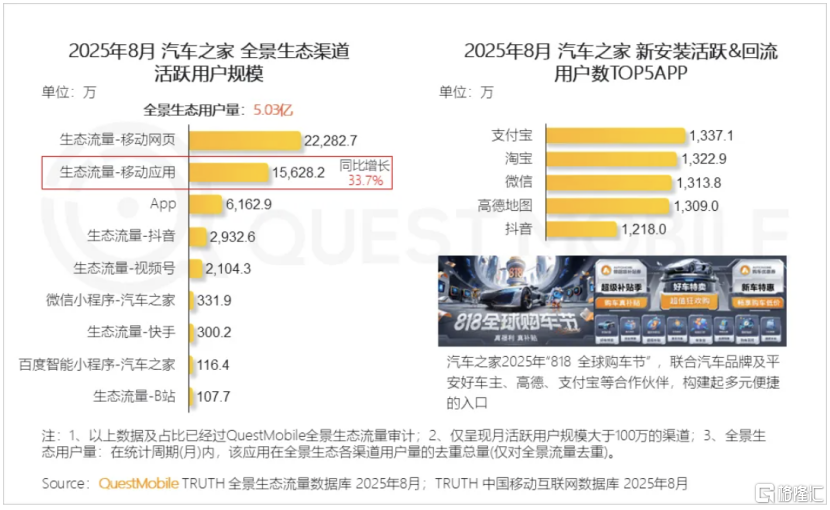
Core Insights - The company reported a total revenue of 1.778 billion RMB for Q3 2025, with an adjusted net profit of 407 million RMB, indicating a strong performance in the expanding new energy vehicle market [2] - Online marketing and other business revenues grew by 32.1% year-on-year, highlighting the success of the company's diversified business strategy [2] - The company has established a robust content ecosystem and AI capabilities, which serve as competitive barriers and enhance user engagement [3][6] Revenue and Profitability - Total revenue for Q3 2025 was 1.778 billion RMB, with an adjusted net profit of 407 million RMB [2] - The growth in online marketing and other business revenues by 32.1% year-on-year signifies a shift towards diversified revenue streams [2] User Engagement and Content Strategy - As of September 2025, the average daily user count on the mobile platform reached 76.56 million, a 5.1% increase year-on-year, maintaining a leading position in the industry [3] - The company has expanded its content offerings by launching "Zhi Jia Media MCN," which includes over 200 high-quality creators across various verticals, enhancing both depth and breadth of content [5] AI Integration and Technological Advancements - The company has upgraded its AI capabilities, introducing features like "AI Car Selection Assistant" and "AI Fault Diagnosis," which improve user decision-making and overall experience [6] - The self-developed "Cangjie" model scored 72.96 points in a recent evaluation, indicating its leading position in the automotive vertical AI space [9] Market Position and Strategic Initiatives - The company is focusing on the integration of online and offline services, launching the "Auto Home Mall" which attracted 15 brands and has processed over 3,000 orders, showcasing the effectiveness of its new retail strategy [8] - The company aims to transform into an "industry intelligence hub," leveraging AI and O2O models to enhance service capabilities and meet complex user demands [9][14] Industry Trends and Future Outlook - The company is well-positioned to capitalize on the growth in low-tier market consumption and the new energy used car market, leveraging its technological and brand advantages [12] - The shift towards service-oriented value creation in the automotive industry aligns with the company's strategy of using AI to enhance service offerings and digital transformation [12][14]
破局产业数字化转型 坪地举办“鸿蒙+智能制造”沙龙
Nan Fang Du Shi Bao· 2025-11-06 11:44
Group 1 - The event "Hongmeng + Intelligent Manufacturing" was held in Longgang District, Shenzhen, aiming to create a platform for government-enterprise collaboration, technical exchange, and resource connection, fostering consensus on industrial upgrading [1][2] - Leading companies in the Hongmeng ecosystem, such as Deep Open Hong and Hualong Xunda, shared cutting-edge technology practices, outlining a clear blueprint for the integration of the Hongmeng ecosystem with intelligent manufacturing [1] - A total of 16 key manufacturing enterprises participated, with young professionals from the computer field engaging in the discussions, injecting innovative energy into the exchanges [1] Group 2 - The salon is a concrete action responding to the district's strategy, serving as a key measure to connect "policy supply - technical support - enterprise demand" [2] - The street has laid a solid foundation for the construction of the Hongmeng ecosystem by visiting potential companies and identifying software and hardware needs [2] - Future actions include optimizing the Hongmeng industry scenario list, accelerating the creation of demonstration projects, and building a virtuous ecosystem that benefits the government, enterprises, and the public [2]



十五五”规划的产业体系建设之“变
Zheng Quan Shi Bao Wang· 2025-11-06 07:02
Core Viewpoint - The "15th Five-Year Plan" marks a strategic shift in China's industrial development, emphasizing the construction of a modern industrial system as a primary task, reflecting a transition from focusing on localized breakthroughs to establishing a resilient and open industrial ecosystem [1][2]. Strategic Positioning Changes - The "15th Five-Year Plan" elevates the construction of a modern industrial system to the top of its 12 strategic tasks, indicating a significant shift in national strategic focus [2]. - The plan aims to transition from being a participant in the global value chain to becoming a leader driving global industrial transformation [2]. Structural Design Changes - The plan establishes a modern industrial system centered on advanced manufacturing, moving beyond the previous principle-oriented approach to a more systematic framework [3]. - It emphasizes a gradient development mechanism that includes traditional, emerging, and future industries, ensuring a balanced industrial upgrade [3]. Dynamic Mechanism Changes - The economic development model shifts to "demand-led, consumption-driven, and endogenous growth," focusing on the interaction between supply and demand [4]. - The plan sets quantitative goals such as significantly increasing the resident consumption rate and aims to eliminate barriers to a unified national market [4]. Open Dimension Changes - The "15th Five-Year Plan" upgrades its approach to openness from merely aligning with international standards to actively leading institutional openness [6]. - It emphasizes the importance of participating in global governance and setting international standards in emerging fields like artificial intelligence and quantum technology [6]. Future Outlook - The plan aims to drive China's industrial transformation towards becoming a "strong manufacturing" and "strong creation" nation, focusing on intelligent, green, and integrated development [7].
补短板高质量共建“一带一路”
Jing Ji Ri Bao· 2025-11-04 22:20
Core Viewpoint - The article emphasizes the evolution of the "Belt and Road Initiative" (BRI) towards high-quality development, aligning with global sustainable development trends and showcasing China's commitment to building a community with a shared future for mankind [1] Group 1: Infrastructure and Standards - In the past five years, there has been significant progress in both hard connectivity (infrastructure) and soft connectivity (rules and standards), with over 100,000 China-Europe freight trains operated and 113 standardized cooperation documents signed with 69 countries and organizations [1] - The establishment of industrial parks has led to a more complete platform industrial ecosystem, demonstrating effective collaboration in industrial ecological construction [1] Group 2: Policy Innovation - High-quality BRI development relies on policy innovation, as seen in the 2022 guidelines promoting green development, encouraging enterprises to exceed host country environmental standards [1] - The 2024 guidelines on digital trade aim to facilitate cross-border data flow, driving digital transformation in partner countries [1] Group 3: Structural Challenges - Despite advancements, the BRI faces structural shortcomings, including fragmented standards among countries, slow progress in green certification, and limited local support in partner countries [2] - Challenges such as the cost of green transformation, financing difficulties, and mismatches between local needs and projects continue to pose risks to high-quality BRI development [2] Group 4: Industry Focus - The focus should be on key areas like digital economy and green development, with a push for unified standards and enhanced coordination among countries [2] - Multilateral financial institutions are encouraged to increase funding support for cooperative parks, promoting emerging industries like photovoltaics and artificial intelligence [2] Group 5: Corporate Engagement - Companies should transition from "going out" to "integrating in," actively participating in international standard-setting and leveraging mechanisms like "Silk Road e-commerce" to expand markets [3] - Encouraging a new model of "Luban Workshop + Enterprise" can help meet the demand for skilled labor in the localization process [3] Group 6: Consumer Engagement - Digital consumption should be a focus for soft connectivity, integrating digital payments with the internationalization of the renminbi [3] - Policies should incentivize consumers to purchase green products, promoting the entry of partner countries' unique products into the Chinese market through e-commerce [3]
第五届潮汕服博会将于明年举行 参展企业超1200家
Zhong Guo Xin Wen Wang· 2025-11-02 03:06
Core Viewpoint - The fifth Chaozhou-Shantou International Textile and Apparel Expo will take place on March 18, 2026, at the Shantou International Convention and Exhibition Center, focusing on showcasing new technologies, products, and models in the textile and apparel industry [1][2] Group 1: Event Overview - The expo will cover an exhibition area of over 150,000 square meters and will feature more than 1,200 participating companies from over 19 intimate apparel industry clusters across the country [1] - The event will include over 50 activities, such as the opening ceremony, brand fashion shows, and various forums and award ceremonies, marking a new high in both scale and content [1] Group 2: Industry Development - The textile and apparel industry is a traditional specialty of Shantou, with initiatives like the global textile procurement center and textile industrial parks being fully operational [1] - New projects, including a new fabric manufacturing base and an international textile digital trade base, are set to enhance Shantou's position as a global textile and apparel industry hub [1] Group 3: Strategic Initiatives - The expo aims to promote high-quality development in the textile and apparel sector, exploring innovation and digital transformation while tapping into market potential in the new consumption era [2] - A strategic cooperation agreement was signed between the Shantou Textile and Apparel Industry Association and foreign intimate apparel brands to deepen international collaboration and facilitate resource flow [2] - The launch of the "Sailing Plan" signifies a strategic upgrade for the Chaozhou-Shantou intimate apparel industry, moving from single exhibitions to collective international outreach, providing comprehensive support for small and medium enterprises [2]