
投资组合多元化

Search documents
RLI(RLI) - 2025 Q3 - Earnings Call Transcript
2025-10-21 16:00
Financial Data and Key Metrics Changes - The company reported third quarter operating earnings of $0.83 per share, supported by solid underwriting performance and a 12% increase in investment income [8] - The total combined ratio improved to 85.1, down from 89.6 last year, largely due to a benign hurricane season [9] - Book value per share has grown 26% year to date, resulting in a 20%+ return on equity [4][12] Business Line Data and Key Metrics Changes - The property segment experienced an 11% decline in gross premiums, influenced by rate and exposure declines in ENS property, while Hawaii homeowners grew 33% in the quarter [9][13] - The casualty segment saw gross premiums advance 8%, with a combined ratio of 98 for Q3, benefiting from favorable prior year's reserve development [10][19] - The surety segment posted an 85% combined ratio, with premiums down modestly for the quarter [16][18] Market Data and Key Metrics Changes - The commercial property catastrophe market has softened significantly, presenting headwinds to current growth [4][5] - Increased competition and rate pressure have been noted in the property segment, particularly for catastrophe-exposed business [10][15] - The overall market environment is characterized by increased volatility, political uncertainty, and the entry of alternative capital providers [5][6] Company Strategy and Development Direction - The company emphasizes maintaining underwriting discipline and adaptability in a rapidly evolving market landscape [5][6] - Investments in technology and information for underwriters and claims specialists are prioritized to enhance decision-making and performance [6][24] - The company aims to achieve its 30th consecutive year of underwriting profits by focusing on long-term profitable growth [25] Management's Comments on Operating Environment and Future Outlook - Management expressed confidence in navigating economic headwinds and maintaining a well-priced book with sustainable terms [16][18] - The company is focused on leveraging its unique culture and expertise to respond to market changes and opportunities [25][60] - Management acknowledged the potential for increased competition but remains committed to disciplined underwriting practices [36][50] Other Important Information - The company has doubled its premium in the last five years while significantly increasing its capabilities [23] - New product offerings are being introduced gradually to ensure adequate coverage at appropriate rates [24] - The company is exploring generative AI to enhance operational efficiency and decision-making [24] Q&A Session Summary Question: Impact of higher attachment points in personal umbrella book - Management noted that moving to a higher attachment point has improved loss trends and is expected to help with frequency [27][28] Question: Rate increase in personal umbrella - The substantial rate increase was influenced by state-specific filings, particularly in Florida [29] Question: Current state of the property market - The property market remains competitive with some softening, but the company is focused on maintaining adequate rates and terms [33][36] Question: Surety expense ratio outlook - The expense ratio is expected to remain elevated due to ongoing investments in technology and personnel [32] Question: Competitive environment in surety business - The company maintains its competitive advantage through strong relationships and service quality [47][50]

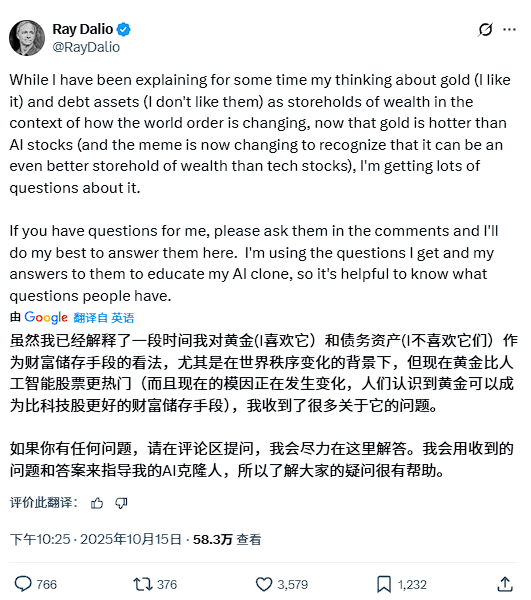
“黄金旗手”达里欧“加大火力”:黄金是唯一“不靠他人”的“永恒、普世”货币
美股IPO· 2025-10-19 03:24
Core Viewpoint - Dalio reinforces his bullish stance on gold, viewing it as the only asset that does not rely on counterparty credit, and as the most fundamental form of currency, while fiat currency is essentially debt [1][3][7] Group 1: Gold as a Core Asset - Gold is increasingly replacing U.S. Treasuries in investment portfolios, becoming a risk-free asset for investors [3][10] - Dalio suggests that investors should allocate up to 15% of their portfolios to gold, highlighting its effectiveness as a diversification tool [3][19] - The strategic value of gold is becoming more pronounced in the current financial environment [3][10] Group 2: Understanding Gold's Value - Dalio emphasizes the need to shift the mindset regarding gold, asserting that it should be viewed as money rather than merely a metal [6][7] - He argues that gold's value is intrinsic and does not depend on any counterparty's payment promise, unlike fiat currencies which are based on debt [7][13] - Historical trends show that debt-based currencies are losing value compared to gold, especially during financial crises [9][12] Group 3: Gold vs. Other Assets - Compared to other precious metals like silver and platinum, gold has a unique historical and cultural acceptance that makes it a superior store of value [15] - Inflation-protected securities (TIPS) are still government debt and may not provide the same safety as gold during significant debt crises [17] - While stocks, particularly in high-growth sectors like AI, offer high return potential, they also carry bubble risks, making gold a prudent diversification choice [17][18] Group 4: Tactical Allocation Strategy - Dalio advises a strategic asset allocation approach rather than tactical betting on gold prices, suggesting a 15% allocation for optimal risk-return balance [19][20] - He notes that the rise of gold ETFs has improved market liquidity but does not represent the primary driver of the current gold price increase [20] - If various investors allocate a suitable proportion of their assets to gold, the limited supply could lead to significantly higher gold prices [20]

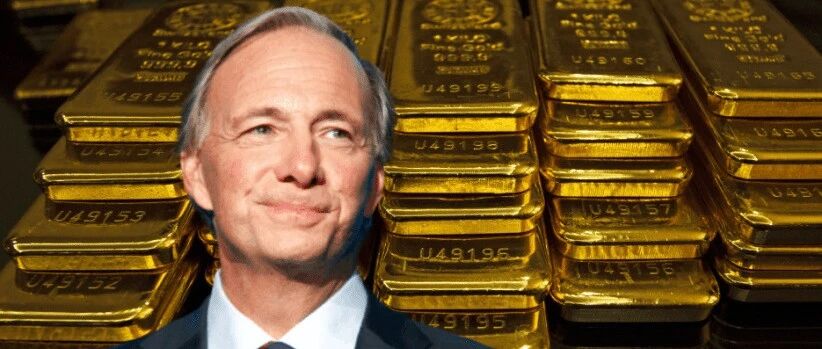
战略配置15%!达利欧:黄金是唯一“不靠他人”的“永恒、普世”货币
Hua Er Jie Jian Wen· 2025-10-18 10:51
Core Viewpoint - Ray Dalio, founder of Bridgewater Associates, has reinforced his bullish stance on gold, viewing it as a "timeless and universal" form of currency that is increasingly valuable in the current financial environment [3][10]. Group 1: Gold as a Core Asset - Dalio suggests that gold is replacing a portion of U.S. Treasury bonds in investment portfolios, particularly among central banks and large institutional investors [9]. - He advocates for a strategic allocation of up to 15% of investment portfolios to gold, emphasizing its role as an excellent diversification tool during market downturns [16][17]. - Dalio argues that gold's value does not depend on any counterparty's creditworthiness, making it a unique asset compared to traditional debt instruments [10]. Group 2: Historical Context and Value of Gold - Dalio highlights the historical cycles of "debt-gold-currency," where gold's value becomes prominent when debt cannot be repaid and fiat currencies are printed excessively [6]. - He notes that approximately 80% of global currencies have disappeared since 1750, with the remaining 20% experiencing significant devaluation, underscoring the risks associated with debt assets like U.S. Treasuries [9]. Group 3: Comparison with Other Assets - Dalio explains that while other precious metals like silver and platinum have inflation-hedging properties, they lack the historical and cultural acceptance that gold enjoys [12]. - He acknowledges that inflation-protected securities (TIPS) are undervalued but are still fundamentally government debt, making them vulnerable during debt crises [13][14]. - Although stocks, particularly in high-growth sectors like AI, offer high return potential, they also carry significant bubble risks, necessitating prudent diversification [15]. Group 4: Strategic Recommendations - Dalio recommends a strategic asset allocation approach rather than tactical bets, suggesting that investors should hold around 15% in gold for optimal risk-return balance [16][17]. - He proposes leveraging strategies or overlaying investments to maintain gold positions without sacrificing expected returns [18]. - The rise of gold ETFs has improved market liquidity, but their scale is still smaller than physical gold investments, which are not the primary driver of the current gold price increase [19].

战略配置15%!达利欧:黄金是唯一“不靠他人”的“永恒、普世”货币
华尔街见闻· 2025-10-18 10:47
Core Viewpoint - Ray Dalio, founder of Bridgewater Associates, emphasizes a bullish stance on gold, viewing it as a "universal currency" that is increasingly replacing U.S. Treasuries as a core asset in investment portfolios [3][11]. Group 1: Gold as a Core Asset - Dalio suggests that investors should allocate up to 15% of their portfolios to gold, highlighting its role as an excellent diversification tool during downturns in traditional assets [3][25]. - He argues that gold's value is intrinsic and does not rely on counterparty credit, making it a safer asset compared to debt instruments like U.S. Treasuries [14][12]. - Historical data indicates that approximately 80% of currencies have disappeared since 1750, underscoring the risks associated with debt assets [12][13]. Group 2: Comparison with Other Assets - Dalio explains that while silver and platinum have inflation-hedging properties, they lack the historical acceptance and stability of gold [17]. - He acknowledges that inflation-protected securities (TIPS) are government debt and thus tied to the issuing government's creditworthiness, which can be problematic during debt crises [18][19]. - Although stocks, particularly in high-growth sectors like AI, offer high return potential, they also carry significant bubble risks, necessitating careful diversification [21][22]. Group 3: Strategic Allocation Recommendations - Dalio recommends a strategic asset allocation approach, suggesting that a 15% gold position can optimize the risk-return profile of an investment portfolio [25][26]. - He notes that while gold may have lower long-term expected returns, it performs exceptionally well during market downturns [26]. - The rise of gold ETFs has improved market liquidity, but they are not the primary driver of the current gold price increase, which is more influenced by physical gold investments and central bank holdings [28].
“黄金旗手”达里欧“加大火力”:黄金是唯一“不靠他人”的“永恒、普世”货币
Hua Er Jie Jian Wen· 2025-10-18 04:01
Core Viewpoint - Ray Dalio, founder of Bridgewater Associates, reinforces his bullish stance on gold, viewing it as a "timeless and universal" form of currency that does not rely on counterparty credit, highlighting its strategic value in the current financial environment [1] Group 1: Gold as a Core Asset - Dalio suggests that gold is beginning to replace a portion of U.S. Treasuries in investment portfolios as a risk-free asset due to rising gold prices [1] - He recommends that investors allocate up to 15% of their portfolios to gold, emphasizing its effectiveness as a diversification tool during downturns in traditional investments [1][13] - Dalio's analysis indicates that gold's role in portfolios is becoming increasingly significant, especially among central banks and large institutional investors [7] Group 2: Understanding Gold's Value - Dalio argues that gold should be viewed as a fundamental form of currency rather than merely a metal, contrasting it with fiat currencies, which he sees as essentially debt [4] - He explains that throughout history, countries have experienced cycles of "debt-gold-currency," where gold's value becomes prominent when debt cannot be repaid [5] - Gold functions similarly to cash, allowing for direct settlement of transactions and debt repayment without creating new debt [6] Group 3: Gold vs. Other Assets - Dalio asserts that gold is becoming the second-largest currency, effectively replacing U.S. Treasuries in many investment portfolios [7] - He highlights that gold is less risky than sovereign debt, which can be subject to default or devaluation through inflation [8][9] - Compared to other precious metals like silver and platinum, gold holds a unique position due to its historical and cultural acceptance among global investors and central banks [10] Group 4: Tactical Allocation Strategy - Dalio emphasizes the importance of strategic asset allocation over tactical bets, suggesting that investors should hold approximately 15% in gold to optimize the risk-return profile of their portfolios [13] - He notes that while gold may have a lower expected long-term return, it performs exceptionally well during critical times [13] - The rise of gold ETFs has improved market liquidity, but the overall market size remains smaller than physical gold investments, which are not the primary driver of the current gold price increase [14]
Buy, Sell, or Hold Chiptole Stock?
Forbes· 2025-10-15 11:30
Core Insights - Chipotle Mexican Grill is a solid company with strong margins and a robust balance sheet, but its stock appears expensive despite a 32% decline this year [2] - The company's growth has decelerated, with revenue growth dropping from approximately 12.5% annually over the last three years to 8.6% in the past twelve months, and just a 3% year-over-year increase in the latest quarter [3][4] - Chipotle's valuation remains high at around 37 times earnings and 4.7 times sales, which is not justified given the moderating growth and traffic trends [2][5] Financial Performance - Chipotle's operating margin is approximately 17% and net margin is near 13%, indicating effective cost management [5] - The company generates around $2 billion in operating cash flow annually and has minimal debt of $4.8 billion against a market cap of $55 billion, along with over $1.5 billion in cash [5][6] - This financial strength allows management to invest during downturns or finance international expansion [6] Growth and Valuation Concerns - The main concern is the disparity between Chipotle's high valuation and its moderate operational performance, with growth decelerating and persistent inflation affecting same-store sales [7] - If upcoming earnings reports indicate further margin compression or declining foot traffic, it could lead to another downturn for the stock [8] Long-Term Outlook - Chipotle has a history of quick recovery from downturns, as seen during the pandemic when the stock dropped over 50% but recovered swiftly [9] - However, this volatility suggests that timing is crucial for investors, as early purchases may lead to painful short-term losses [9][10] Investment Strategy - While Chipotle remains a leading player in fast-casual dining with solid fundamentals, the current valuation appears stretched for its moderate growth trajectory [11] - It is recommended to hold off on purchasing the stock for now, despite its strong financial standing [11]


1 No-Brainer International Index Fund to Buy Right Now for Less Than $100
Yahoo Finance· 2025-10-14 10:55
Group 1 - The United States is recognized as the world's most innovative and best-performing economy, with a stock market valued at approximately $62 trillion, significantly larger than that of any other country [1] - The ongoing artificial intelligence boom has led to substantial investments in the U.S. stock market, particularly in the "Magnificent Seven" stocks, which have shown impressive returns since early 2023 [1] Group 2 - Investment strategies should consider diversification, especially as U.S. stocks have outperformed international stocks for over 14 years, a trend that may soon reverse [4][7] - The Vanguard Total International Stock ETF (NASDAQ: VXUS) is highlighted as a strong investment option, providing exposure to over 8,600 international stocks, low fees, and effective diversification [6][8] Group 3 - Concerns are raised about the current valuation of the U.S. stock market, with some experts suggesting that the AI stock boom may resemble a market bubble, indicating a potential need for investors to explore international stock options [5]
Why gold prices are rising now, how long they could keep rising, and should you invest or is it too late? Here’s the 2025 gold price forecast
The Economic Times· 2025-10-08 17:22
Core Insights - Gold prices have reached a historic high of $4,007 per ounce, marking the first time it has crossed the $4,000 threshold, with a surge of over 4% this week indicating strong market interest in safe-haven assets [1][2][7] Economic Factors - The rise in gold prices is attributed to multiple global and domestic pressures, including the ongoing U.S. government shutdown, which has increased market uncertainty, and expectations of Federal Reserve interest rate cuts that make yield-bearing assets less attractive [2][10] - Currency fluctuations, particularly a weaker U.S. dollar, have made gold cheaper for foreign buyers, further driving demand [5][21] Geopolitical Influences - Global tensions, such as political unrest in France and Japan and the ongoing Russia-Ukraine conflict, have heightened demand for secure investments like gold [3][11] - Central banks, notably China's People's Bank of China (PBOC), are actively increasing their gold reserves, which supports rising prices [3][12] Central Bank Activities - The PBOC has been on a gold buying streak for 11 consecutive months, adding approximately 1.24 tonnes in September 2025, bringing its total reserves to about 2,303.5 tonnes [12][13] - India's Reserve Bank of India (RBI) has also been incrementally adding to its gold reserves, which stand at around 770 tonnes as of mid-2025, focusing on diversification and inflation-hedging strategies [14][24] Market Dynamics - Analysts caution that while gold may experience short-term volatility, long-term fundamentals remain strong, with economic instability and geopolitical risks likely to keep prices elevated through 2025 [4][9] - Increased trading volumes in both physical and paper gold markets indicate heightened activity, which could influence short-term price movements [7][17] Investment Considerations - For investors, this moment is critical, with Exchange-Traded Funds (ETFs) like SPDR Gold Shares (GLD) and iShares Gold Trust (IAU) providing exposure to gold without the need for physical ownership [8][16] - Experts recommend a moderate allocation of around 5-15% of a portfolio to gold, balancing risk and reward while considering the potential for price corrections [21][24] Strategic Outlook - The outlook for gold remains cautiously bullish for the next 12-18 months, with opportunities for gains but also risks of price corrections, necessitating close monitoring of monetary policy, inflation trends, and geopolitical developments [15][24] - Prominent investors advocate for significant gold allocations in portfolios, with suggestions ranging from 15% to 25% due to ongoing economic uncertainties and inflationary pressures [19][22]

Gold on fire: What's fueling the rally and will it last?
Youtube· 2025-10-08 00:09
Group 1 - Gold has reached a record price of over $4,000 per troy ounce, with predictions from Goldman Sachs suggesting it could hit $5,000 by the end of 2026 [1][2] - Ken Griffin from Citadel indicates that the rise in gold prices may signal a decline in the dollar's status as a safe haven, suggesting investors may prefer gold for safety [2][4] - Central banks are increasing their gold purchases as a safe haven asset, indicating a shift in investment strategies away from traditional fiat currencies [3][9] Group 2 - The geopolitical landscape, particularly following Russia's invasion of Ukraine and the subsequent seizure of Russian assets, has prompted countries to reconsider their holdings in US assets, leading to increased interest in gold and cryptocurrencies [5][6] - The uncertainty surrounding global events, including tensions in Taiwan and actions by North Korea, is driving a trend towards diversification away from fiat currencies [7][9] - The discussion of geopolitical alliances and their implications for global markets highlights the interconnectedness of economic and political factors influencing investment decisions [8]
Banks will kick off earnings season strong, says Wealth Advancement Group's Nicole Webb
Youtube· 2025-10-07 20:49
Core Viewpoint - The upcoming earnings season, particularly from banks, is expected to be strong and could serve as a catalyst for market growth, while gold is increasingly viewed as a store of value amid economic uncertainties [2][3]. Group 1: Market Trends - The banks are anticipated to kick off the earnings season with robust reports, which is expected to drive market momentum higher [2]. - Investors are seeking alternatives to traditional asset classes, with a notable shift towards gold as a preferred store of value due to five years of significant income and asset growth [3][5]. Group 2: Gold Demand - The demand for gold is not speculative but is driven by a backdrop of lower Treasury yields and currency uncertainties, leading global banks to reduce their exposure to the US dollar [3][4]. - Goldman Sachs has raised its price target for gold, indicating continued bullish sentiment in the gold market [4]. Group 3: Investment Diversification - Investors are diversifying away from public equities and debt markets into private markets, seeking to manage concentration risks associated with public market supply and demand [7][8]. - Diversification strategies are evolving, focusing on how investments are managed rather than merely shifting between asset classes, with an emphasis on illiquid investment vehicles like private equity and private debt [8].