
汇率干预

Search documents
日本财长再发汇率警告,当局干预预期升温
Sou Hu Cai Jing· 2025-11-04 06:41
Core Viewpoint - Japan's Finance Minister, Shunichi Suzuki, has issued a strong verbal warning regarding the volatility of the yen, emphasizing a heightened alertness to market fluctuations and the potential for government intervention [1] Group 1: Market Dynamics - The yen has depreciated to its lowest level against the dollar since February, nearing 154.5 [1] - Following Suzuki's comments, the yen temporarily rebounded to 153.71, indicating market sensitivity to government statements [1] Group 2: Government Intervention - There is an increasing market expectation of potential intervention by Japanese authorities, although most analysts believe actual intervention is unlikely in the short term [1] - The last time Japan intervened in the currency market was in July of the previous year, when the yen was approximately 160 to 1 dollar [1]
日本财长再发汇率警告 当局干预预期升温
Xin Hua Cai Jing· 2025-11-04 06:11
Core Viewpoint - Japan's Finance Minister, Shunichi Suzuki, has issued a strong verbal warning regarding the volatility of the yen, emphasizing the government's heightened vigilance towards market fluctuations [1]. Group 1: Market Dynamics - The yen has depreciated to its lowest level against the dollar since February, nearing 154.5 [1]. - Following Suzuki's remarks, the yen temporarily rebounded to 153.71, indicating market reactions to potential government intervention [1]. Group 2: Government Intervention Expectations - There is an increasing market expectation for possible government intervention in the foreign exchange market, although most analysts believe actual intervention is unlikely in the short term [1]. - The last time Japan intervened in the currency market was in July of the previous year, when the yen was approximately 160 to 1 dollar [1].
全球避险资金涌入 瑞郎连涨逼近干预区间
智通财经网· 2025-10-24 11:37
Core Viewpoint - The Swiss Franc has significantly appreciated recently, driven by safe-haven demand, leading to speculation that the Swiss National Bank (SNB) may have intervened to curb its strength [1][2]. Group 1: Swiss Franc Performance - The Swiss Franc has experienced its ninth consecutive weekly increase, marking its best performance in two years [1]. - The exchange rate of the Swiss Franc against the Euro surged to a near ten-year high, approaching the critical level of 0.92 [1]. - Despite the Swiss policy rate remaining at zero, the Swiss Franc has seen the highest appreciation against the US Dollar among major developed currencies over the past month [1]. Group 2: Market Sentiment and Investor Behavior - Risk-averse investors are increasingly seeking alternatives to the US Dollar and Japanese Yen, with the Swiss Franc being a primary choice due to its stable economy and good governance [2]. - Analysts from Societe Generale noted that the risk of intervention by the Swiss National Bank is at its highest level [2]. - UBS analysts believe that the SNB may have already begun market intervention to lower the Swiss Franc's exchange rate [2]. Group 3: Swiss National Bank's Position - The Swiss National Bank does not comment on whether it intervenes in the currency market, and data proving intervention will be released later [3]. - The recent US-Swiss agreement not to manipulate exchange rates allows the SNB to focus on price stability while potentially using intervention to address deflationary pressures [3]. - The options market indicates that the SNB's unilateral actions may slow the appreciation of the Swiss Franc rather than reverse its upward trend [3]. Group 4: Inflation and Economic Outlook - The SNB's meeting minutes suggest that deflation is not a threat, with inflation expected to rise moderately in the coming months [4]. - Despite the Swiss Franc's strength against the US Dollar, it remains relatively stable against the Euro, with geopolitical shocks potentially driving funds into the Franc [4]. - Analysts expect the SNB to continue intervening in the 0.90-0.92 range to manage the Swiss Franc's strength [4].
比索继续遭抛售,“阿根廷人相信,美国来救也没用”
Sou Hu Cai Jing· 2025-10-17 04:08
Core Viewpoint - The Argentine peso is expected to face further devaluation despite U.S. financial support, as market confidence in the government's ability to stabilize the currency diminishes [1][3][5] Group 1: U.S. Intervention and Market Reaction - On October 16, U.S. Treasury Secretary Becerra announced intervention in the Argentine foreign exchange market, selling dollars and buying pesos to provide support, with potential aid increasing to $40 billion [1] - The intervention temporarily stabilized the exchange rate, preventing the peso from falling below 1,400 pesos per dollar [1] - However, market sentiment has shifted, with investors increasingly skeptical about the government's ability to maintain the exchange rate, leading to a surge in dollar purchases for hedging [3][5] Group 2: Political Uncertainty and Economic Pressure - Political uncertainty surrounding the upcoming elections on October 26 has heightened concerns about the government's reform agenda and potential policy reversals [5][6] - The Argentine government has raised short-term interest rates to an astonishing 157% in an attempt to absorb peso liquidity, which is putting additional strain on the already fragile economy [3][5] - Since the lifting of currency purchase restrictions in April, unofficial net dollar purchases have reached $18 billion, averaging about $400 per person [5][6] Group 3: Historical Context and Economic Indicators - Analysts draw parallels between the current situation in Argentina and historical events, such as the 1992 British pound crisis, where limited reserves and market speculation led to significant currency devaluation [7][9] - The peso is perceived as overvalued, with inflation rising by 12% since April, further questioning the sustainability of government interventions [9] - The Argentine government's measures to curb capital flight have resulted in tighter credit conditions, with local financing costs significantly increasing and bond yields surpassing 100% [9]

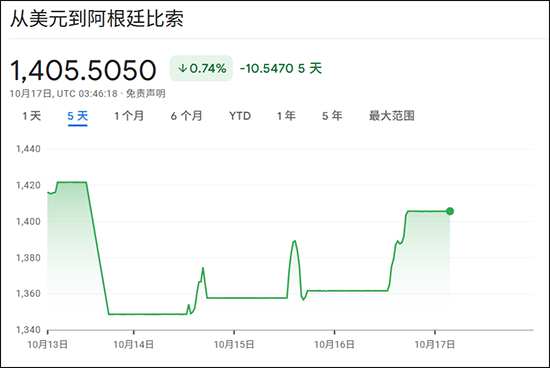
10月前十天韩国对美国出口额暴跌超40%,美国已下滑为韩国第三大出口市场!韩国官方时隔一年半再次口头干预汇率
Sou Hu Cai Jing· 2025-10-14 07:15
Core Viewpoint - South Korea's exports to the United States have sharply decreased by over 40% in the first ten days of October, marking a significant decline in trade relations due to the implementation of U.S. tariff policies [1] Group 1: Export Trends - The United States has fallen from being South Korea's second-largest export market to the third-largest since July [1] - The recent statistics indicate a notable drop in South Korea's exports to the U.S., which has been a long-standing trading partner [1] Group 2: Currency Fluctuations - The South Korean won has experienced significant volatility, prompting the Ministry of Economy and Finance and the Bank of Korea to issue a joint statement expressing concern over the currency's fluctuations [1] - This marks the first verbal intervention regarding the exchange rate by South Korean authorities in one year and six months, highlighting the seriousness of the situation [1]

日元走进“高市交易”,在主要7种货币中最弱
日经中文网· 2025-10-10 03:27
Core Viewpoint - The Japanese yen is experiencing significant depreciation, with predictions that it will be the weakest week since September 2024, primarily due to market reactions to political changes and monetary policy expectations in Japan [1][5]. Exchange Rate Trends - As of October 9, the yen's exchange rate fluctuated around 153 yen per dollar, marking a depreciation of approximately 4% compared to the rate before the ruling party's presidential election on October 3 [3][5]. - The yen's depreciation is more pronounced than that of other major currencies, such as the euro and New Zealand dollar, which have also seen declines of 1.6% and 1.5% respectively [5]. Market Sentiment and Speculation - UBS has indicated that speculative positions in the yen are leading to further selling pressure, with a potential temporary drop to 155 yen [5]. - Market participants are testing the bottom of the yen's exchange rate, with Forex.com suggesting it may be a good opportunity to reduce yen holdings [5]. Political and Economic Factors - The political landscape in Japan remains uncertain, with discussions about coalition governance and the selection of a new finance minister potentially influencing market dynamics [6]. - A report from Bank of America highlights that individual investors' foreign exchange asset investments and ongoing corporate overseas direct investments are contributing to increased selling pressure on the yen [6].
日元大跌引日本财务大臣担忧,跌穿155关口或引发干预?
Hua Er Jie Jian Wen· 2025-08-01 08:47
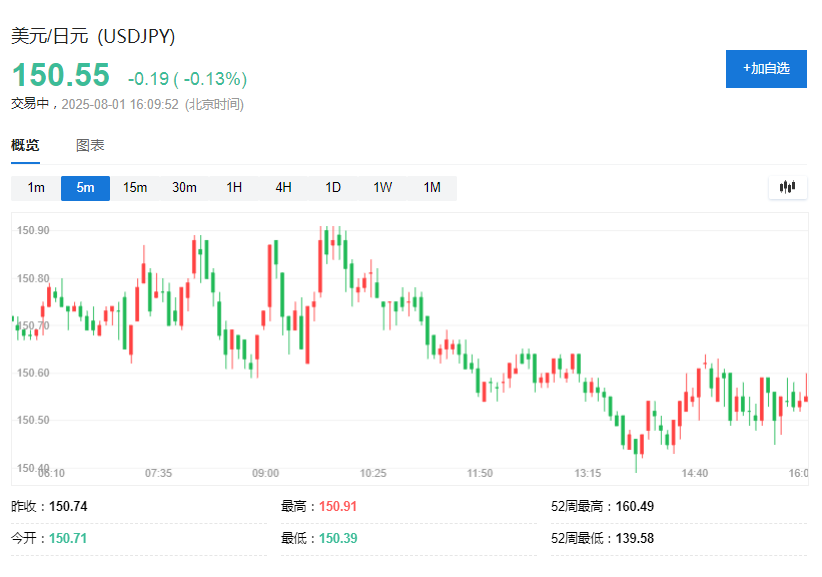
Group 1 - The Bank of Japan (BOJ) decided to maintain its interest rate at 0.5%, leading to a significant depreciation of the yen, which fell below the 150 mark, reaching its weakest level since March [1][4] - Japanese Finance Minister Shunichi Suzuki expressed concerns over the yen's decline, emphasizing the importance of maintaining exchange rate stability that reflects economic fundamentals [1] - The market is now focusing on the 155 level as a potential intervention point, with analysts suggesting that if the yen continues to weaken, the Japanese authorities may need to take action [4][5] Group 2 - Analysts believe that if the BOJ does not raise interest rates, the yen could potentially drop to 155, making intervention the only option [5] - Market expectations are that if the yen breaks the 152 level, the next target will be 155, driven by strong US data and a strengthening dollar [6]
日本央行放鸽压垮日元,财务大臣发声,干预风险抬头!
Jin Shi Shu Ju· 2025-08-01 04:26
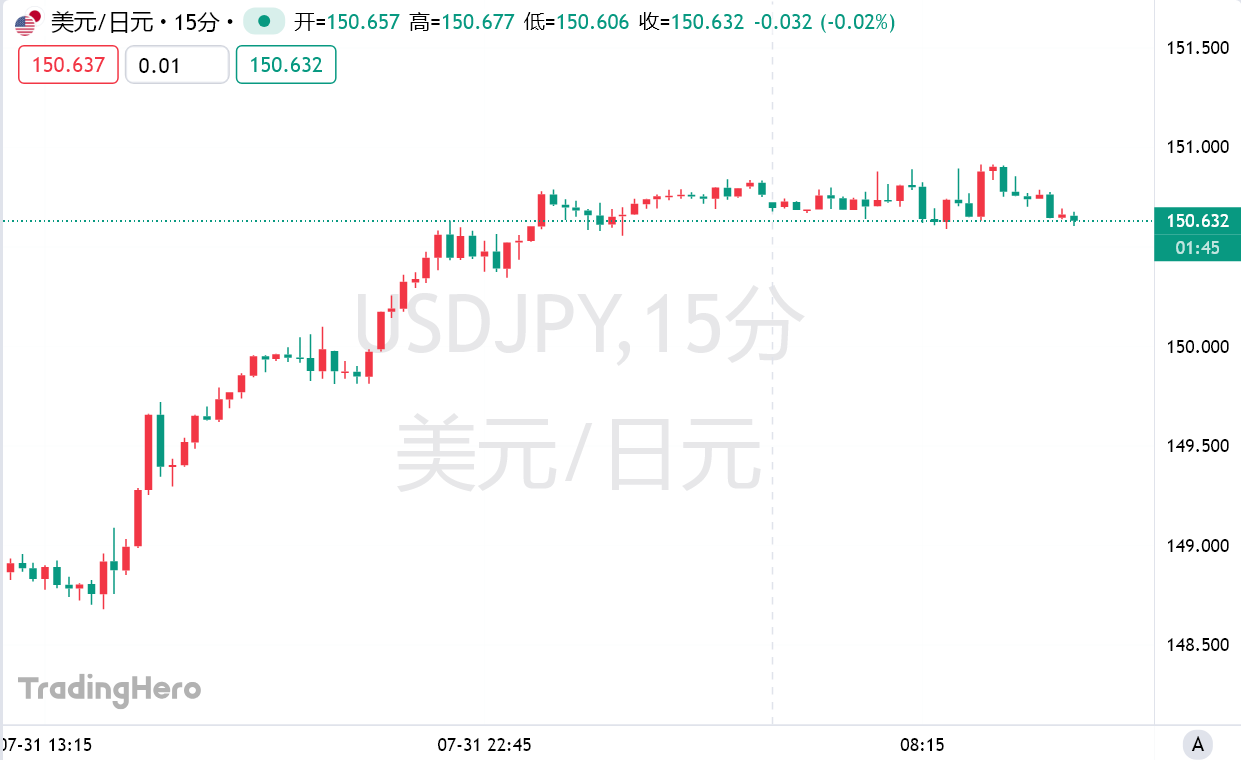
Group 1 - The Japanese Finance Minister expresses concern over the depreciation of the yen, which has fallen to its lowest level since March after the Bank of Japan signaled a dovish stance [1] - The yen has breached the 150 mark against the dollar, prompting discussions about potential market intervention to support the currency [2] - In July, the yen depreciated by approximately 4.5%, contrary to seasonal trends, influenced by domestic political uncertainty and tariff factors [3] Group 2 - Analysts warn that if the Bank of Japan does not raise interest rates, the yen could fall to 155, which may trigger intervention from authorities [2] - The Finance Minister acknowledges the need to monitor the impact of new tariffs set at 15% on Japan, which are expected to take effect on August 7 [4] - The government plans to take necessary measures to mitigate the impact of these tariffs on Japanese industries and employment [4]
欧洲央行行长拉加德:我们不干预任何汇率。
news flash· 2025-07-24 13:05
Core Viewpoint - The President of the European Central Bank, Christine Lagarde, stated that the ECB does not intervene in any exchange rates [1] Group 1 - The ECB maintains a neutral stance regarding currency fluctuations, emphasizing its non-intervention policy [1]
日本财务省:从5月25日到6月26日,日本的汇率干预规模为0日元。
news flash· 2025-06-30 10:08
Core Viewpoint - The Japanese Ministry of Finance reported that from May 25 to June 26, the scale of Japan's currency intervention was 0 yen [1] Group 1 - The Japanese government did not engage in any currency intervention during the specified period [1]