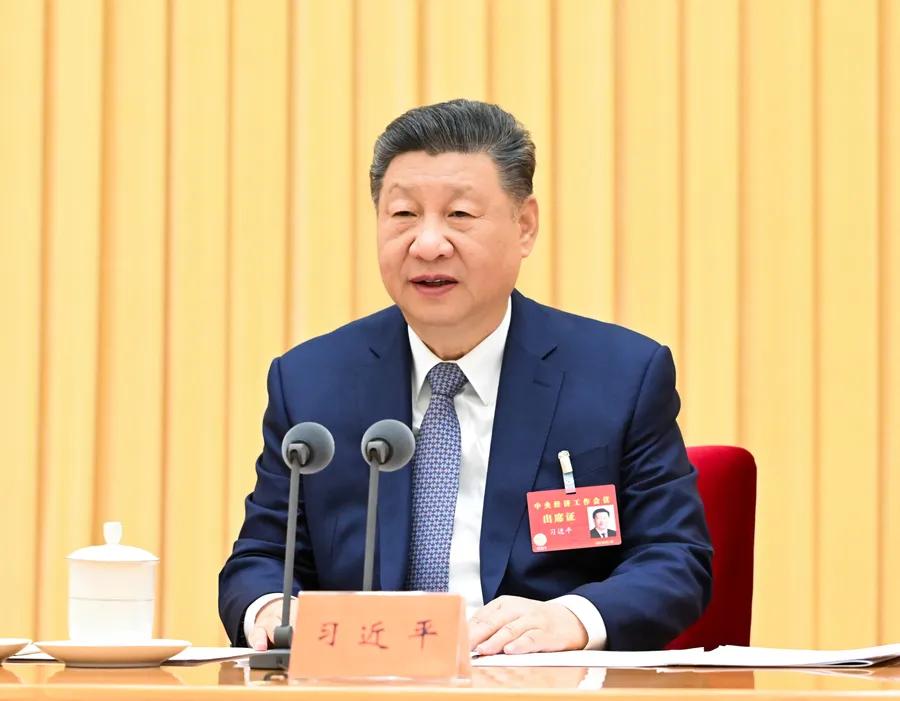
全国统一大市场

Search documents
立路牌清路障筑牢制度基石
Sou Hu Cai Jing· 2025-12-13 02:09
Core Viewpoint - The construction of a unified national market in China requires substantial institutional reforms and cannot rely solely on spontaneous order to achieve a truly unified market [1][2]. Group 1: Institutional Challenges - The current market in China has not yet formed a genuine "national unified market," which is essential for maximizing the potential of the country's vast market [2]. - The complexity of economic and social relationships necessitates a robust legal framework to regulate various interests, as seen in international examples like the EU and Japan [3]. - Since the issuance of the "Opinions on Accelerating the Construction of a National Unified Market" in 2022, significant progress has been made, including the introduction of various regulations aimed at promoting fair competition and addressing long-standing issues [4]. Group 2: Market Fragmentation and Local Protectionism - Despite progress, local protectionism and market fragmentation remain significant challenges, driven by local government performance evaluation systems that prioritize local economic metrics [6][7]. - The existing fiscal and statistical systems do not fully align with the requirements of a unified national market, leading to resource retention within local jurisdictions [7]. - Regulatory gaps in emerging sectors, such as the low-altitude economy, hinder market vitality and increase operational costs for businesses [8]. Group 3: Standardization Issues - The coexistence of national, industry, and local standards creates barriers to market entry and complicates compliance for businesses [9]. - Efforts to unify standards are ongoing, but discrepancies between international and domestic standards continue to impose additional costs on businesses [9]. Group 4: Policy Implementation and Effectiveness - The challenge lies in balancing effective market operations with government oversight, requiring a clear legal framework to regulate local government actions [10]. - There is a need for a systematic approach to reform local government performance evaluation systems to align with the goals of a unified national market [11]. - Ensuring the effective implementation of policies and regulations is crucial, with a focus on avoiding superficial compliance and ensuring that local interpretations of laws are consistent [12].
中国经济长期向好具有三大核心驱动力
Xin Lang Cai Jing· 2025-12-13 01:22
Core Insights - The Central Economic Work Conference held on December 10-11, 2025, highlighted the core contradiction of "strong supply and weak demand" and emphasized future policies will focus on boosting demand and optimizing supply [1][4] Group 1: Economic Potential and Policy Directions - The conference stressed the need to fully tap into economic potential, combining policy support with reform innovation, ensuring both flexibility and effective management, and integrating investments in both physical and human capital [5] - The five key imperatives outlined reflect three core drivers of long-term economic growth: the development of new productive forces, a vibrant unified national market, and macro policies that address both short-term issues and long-term space [5] Group 2: Focus on New Growth Drivers - The conference emphasized the importance of innovation-driven growth and the cultivation of new momentum, with specific measures addressing education and talent, international technology innovation centers, intellectual property protection, service industry enhancement, and high-quality development of key industrial chains [2][5] - The shift towards "new momentum" encompasses not only technology itself but also the institutional, industrial, social governance, financial, and service upgrades driven by technology, ultimately forming a positive cycle [2][5] Group 3: Support for Industries - Three key directions for supporting strategic emerging industries and upgrading traditional industries were identified: promoting a dual approach of private investment and fiscal support, encouraging government procurement of major technological equipment and new materials, and driving industry upgrades through demand-side initiatives [3][6] - Financial mechanisms are to be enhanced to support technological innovation and industrial upgrades, with improvements in multi-tiered capital markets like the Sci-Tech Innovation Board and the Beijing Stock Exchange, aimed at providing comprehensive financing for "hard tech" companies [6]

【“打通全国统一大市场堵点卡点”热点问题探析⑤】立路牌清路障筑牢制度基石
Jing Ji Ri Bao· 2025-12-13 00:48
Core Viewpoint - The construction of a unified national market in China requires substantial institutional reforms and cannot rely solely on spontaneous order. It is essential to address fundamental issues and strengthen regulatory frameworks to promote the development of a unified market [1][2]. Group 1: Institutional Challenges - The unified national market is fundamentally a battle for institutional construction, emphasizing the need for a comprehensive legal framework to eliminate trade barriers and conflicts [3][5]. - Since the issuance of the "Opinions on Accelerating the Construction of a Unified National Market" in 2022, significant progress has been made, including the implementation of the "Fair Competition Review Regulations" in 2024 and the introduction of guidelines for market construction [4][5]. Group 2: Market Fragmentation and Local Protectionism - Despite progress, local protectionism and market fragmentation remain significant challenges, with some regions still competing for "policy lowlands," distorting market mechanisms and disrupting fair competition [6][8]. - The current performance evaluation system for local governments emphasizes local economic indicators, which incentivizes them to retain resources within their administrative boundaries, contributing to market segmentation [8][9]. Group 3: Regulatory Gaps and Standardization Issues - There are regulatory gaps in emerging sectors, such as the low-altitude economy, where existing laws do not adequately address new developments, limiting market vitality and increasing operational costs for businesses [9][10]. - The coexistence of national, industry, and local standards creates barriers to market entry, complicating compliance for businesses and hindering the establishment of a unified market [10]. Group 4: Economic Order and Governance - Achieving a balance between an effective market and proactive government intervention is crucial for establishing a well-functioning economic order. This requires a robust legal framework to regulate local government actions and clarify administrative boundaries [11][12]. - The focus should be on both establishing new regulations and reforming existing ones to ensure they align with the goals of a unified national market, while also addressing local barriers to resource flow [12][13].
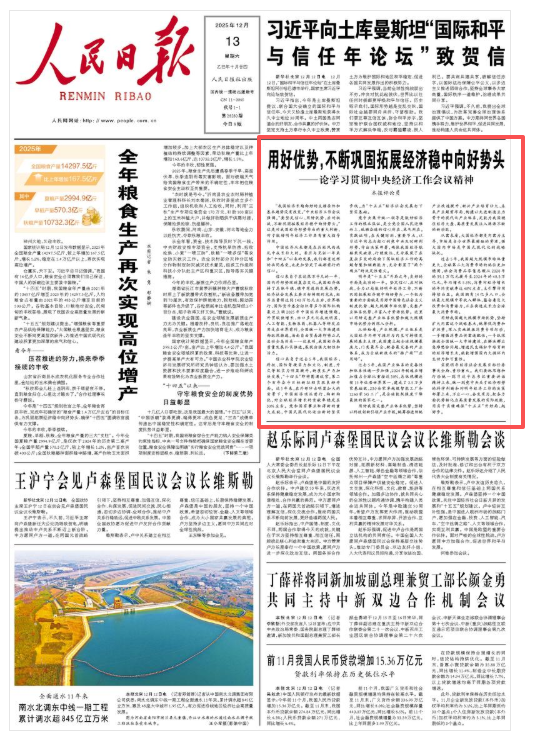
用好优势,不断巩固拓展经济稳中向好势头
Ren Min Ri Bao· 2025-12-13 00:15
Core Viewpoint - The central economic work conference emphasizes the importance of confidence, leveraging advantages, and addressing challenges to maintain a stable and improving economic momentum in China [1]. Economic Performance - China's economy is projected to reach approximately 140 trillion yuan, with international organizations raising their growth forecasts for 2025 [1]. - The contribution rate of China's economy to global growth has remained stable at around 30% over the past five years, despite external pressures [2]. Industrial Strength - China has established the world's largest and most comprehensive industrial system, with manufacturing value added expected to account for nearly 30% of the global total by 2024 [3]. - The country has built over 35,000 basic-level intelligent factories and 1,260 5G factories, showcasing its rapid advancements in technology and energy efficiency [3]. Market Potential - The total retail sales of consumer goods are projected to increase from 39.1 trillion yuan in 2020 to 48.3 trillion yuan in 2024, with an average annual growth rate of 5.5% [4]. - China's domestic market, supported by a population of over 1.4 billion and the largest middle-income group globally, is rapidly evolving into the largest consumer market [4]. Strategic Focus - The emphasis is on utilizing China's complete industrial system and large-scale market advantages to drive economic stability and high-quality development [2][3][4]. - The government aims to enhance domestic demand and consumer spending while addressing public concerns to foster new economic growth points [4].
论学习贯彻中央经济工作会议精神:用好优势,不断巩固拓展经济稳中向好势头
Xin Lang Cai Jing· 2025-12-12 23:17
专题:中央经济工作会议在北京举行 业内解读 用好优势,不断巩固拓展经济稳中向好势头 ——论学习贯彻中央经济工作会议精神 本报评论员《人民日报》(2025年12月13日 第 01 版) "我国经济长期向好的支撑条件和基本趋势没有改变。"中央经济工作会议强调,"要坚定信心、用好优 势、应对挑战,不断巩固拓展经济稳中向好势头。"这是对我国经济形势作出的重大判断,对于做好明 年经济工作具有重大指导作用。 中国经济从来都是在历经风雨洗礼中成长壮大的。亲历与见证一年来和"十四五"以来的发展,我们都有 这样的共同感受,也更加坚定了砥砺前行的信心。 信心来自于在这很不平凡的一年,国内外形势深刻复杂变化,我国经济保持了总体平稳、稳中有进的发 展态势。经济社会发展主要目标将顺利完成,经济总量将达到140万亿元左右,世界银行、国际货币基 金组织等多个国际机构最近上调2025年中国经济增速预期。外贸较快增长、出口多元化成效明显,人工 智能、生物医药、机器人等研发应用走在世界前列,全国统一大市场建设向纵深推进,海南自由贸易港 即将正式启动全岛封关……这表明,我国经济高质量发展扎实推进,展现出强大韧性和活力。 信心来自于过去5年,我国经 ...

奋力实现明年经济社会发展目标任务(谈体会 话落实) ——与会同志谈贯彻落实中央经济工作会议精神
Ren Min Ri Bao· 2025-12-12 22:05
经济顶压前行、向新向优发展,现代化产业体系建设持续推进,改革开放迈出新步伐,重点领域风险化 解取得积极进展,民生保障更加有力……走过很不平凡的2025年,中国经济站上一个新台阶。 持续扩大内需、优化供给,做优增量、盘活存量,因地制宜发展新质生产力,纵深推进全国统一大市场 建设,持续防范化解重点领域风险,着力稳就业、稳企业、稳市场、稳预期……迈向"十五五"开局之 年,中央经济工作会议明确了明年经济工作的总体要求、政策取向和重点任务。 会议期间,部分与会同志接受本报记者采访时表示,要深入学习领会习近平总书记在会上发表的重要讲 话,把思想和行动统一到党中央关于经济形势的科学判断和对明年经济工作的决策部署上来,准确把握 在全国发展大局中的定位,结合实际、因地制宜,推动高质量、可持续的发展。 今年,东部沿海省份山东的地区生产总值将突破10万亿元。山东省委书记林武表示,山东将继续坚定扛 牢经济大省挑大梁的责任担当,深入实施工业经济"头号工程",立足基础条件和优势,优化提升冶金、 化工等传统产业,培育壮大集成电路、新能源汽车等新兴产业,前瞻布局深海空天、量子科技等未来产 业,以科技创新引领新质生产力发展,努力成为北方地区经 ...
用好优势,不断巩固拓展经济稳中向好势头 ——论学习贯彻中央经济工作会议精神
Ren Min Ri Bao· 2025-12-12 22:04
Core Viewpoint - The central economic work conference emphasizes the importance of confidence, leveraging advantages, and addressing challenges to maintain and expand the positive momentum of China's economy, which is expected to reach approximately 140 trillion yuan in total economic output by next year [1][2]. Group 1: Economic Performance and Projections - China's economy has shown resilience and steady progress despite complex domestic and international challenges, with a stable contribution rate of around 30% to global economic growth over the past five years [2]. - International organizations have recently raised their forecasts for China's economic growth in 2025, indicating a positive outlook for the country's economic trajectory [1]. - The retail sales of consumer goods are projected to increase from 39.1 trillion yuan in 2020 to 48.3 trillion yuan in 2024, reflecting an average annual growth rate of 5.5% [4]. Group 2: Industrial and Market Advantages - China has established the world's largest and most comprehensive industrial system, with manufacturing value added expected to account for nearly 30% of the global total by 2024 [3]. - The country has built over 35,000 basic-level and more than 230 excellent-level smart factories, along with 1,260 5G factories, showcasing its leadership in technology application and energy efficiency [3]. - The domestic market, supported by a population of over 1.4 billion and the largest middle-income group globally, is rapidly evolving into the world's largest consumer market, which is crucial for China's modernization strategy [4]. Group 3: Strategic Focus for Future Development - The focus for the upcoming year includes leveraging China's complete industrial system and large-scale market advantages to drive economic stability and high-quality development [2][3]. - The government aims to enhance domestic demand as a strategic foundation, promoting consumption and investment while addressing public needs to foster new economic growth points [4]. - The successful execution of economic goals for the coming year is deemed critical for the overall economic landscape, necessitating unified efforts to translate various advantages into tangible outcomes [5].
东方证券研究所所长黄燕铭:中国经济长期向好具有三大核心驱动力
Zheng Quan Ri Bao· 2025-12-12 16:25
Core Insights - The Central Economic Work Conference held on December 10-11, 2025, highlighted the core contradiction of "strong supply but weak demand," indicating a future focus on policies that stimulate demand and optimize supply [1] Group 1: Economic Potential and Policy Focus - The conference emphasized the need to fully tap into economic potential, combining policy support with reform and innovation, ensuring both flexibility and effective management [1] - Five essential strategies were outlined to support long-term economic growth, including the development of new productive forces, a vibrant unified national market, and macro policies that address both short-term issues and long-term space [1] Group 2: Innovation and New Momentum - The conference underscored the importance of innovation-driven growth and the cultivation of new momentum, with specific measures targeting education, international technology innovation centers, intellectual property protection, and the enhancement of service industries [2] - The definition of "new momentum" has broadened to encompass not only technology but also the institutional, industrial, social governance, financial, and service sector upgrades driven by technology [2] Group 3: Support for Industries - Three key directions were identified for supporting strategic emerging industries and upgrading traditional industries: 1. Promoting a dual approach of private investment and fiscal support, leveraging tools like special government bonds and encouraging private sector involvement [3] 2. Driving industrial upgrades through demand-side initiatives, including government procurement of major technological equipment and encouraging innovation in smart and green products [3] 3. Enhancing financial support for technological innovation and industrial upgrades, with reforms in capital markets to better serve "hard tech" companies and provide comprehensive financing support [3]

从新会出发,贯通全国!中国陈皮贸易中心运营启动
Nan Fang Nong Cun Bao· 2025-12-12 16:01
Core Viewpoint - The launch of the China Chenpi Trade Center and the China Supply and Marketing (Jiangmen) Xinhui Chenpi Industrial Park marks a significant milestone in the development of the Chenpi industry, transitioning from a regional specialty to a national commodity system, and aims to support rural revitalization and agricultural modernization [3][9][10]. Group 1: Overview of the Trade Center - The China Chenpi Trade Center aims to create a comprehensive service platform covering the entire industrial chain, including information, standards, and branding, focusing on the trading of Chenpi as a bulk commodity [7][8]. - The operation of the trade center is supported by various national-level associations, state-owned enterprises, and industry leaders, emphasizing collaboration to address key issues in standardization, branding, and marketization within the Chenpi industry [23][25][26]. Group 2: Recognition and Certification - The Xinhui Chenpi industry is recognized through eight national-level certifications, establishing its authority and foundational status in the market, including titles such as "Hometown of Chinese Chenpi" and "Demonstration Base of Chinese Medicine Culture" [11][12][18]. - These recognitions span multiple fields, providing comprehensive support for the development of the Chenpi industry and enhancing the credibility of the China Chenpi Trade Center [16][18]. Group 3: Collaborative Development - The trade center is designed to link national Chenpi production areas and build a collaborative development ecosystem, integrating resources from various regions to promote standardization and brand building [40][43][46]. - Initial partnerships include enterprises from Guangdong, Guangxi, Chongqing, Zhejiang, and Hunan, covering areas such as Chenpi cultivation, processing, and related products [42][43]. Group 4: Technological Integration - The China Chenpi Trade Center will utilize modern digital trading systems in collaboration with the Guangzhou Commodity Exchange, enhancing transaction efficiency and transparency in the industry [32][50][54]. - The center aims to create a closed-loop industrial chain supported by digital platforms, facilitating effective supply-demand matching and resource allocation [51][52]. Group 5: Strategic Importance - The launch of the trade center is seen as a benchmark project for high-quality development in rural areas and a practical exploration of new agricultural productivity [55][56]. - It signifies Xinhui's leadership in the Chenpi industry and aligns with national strategies to build a unified national market, contributing to the revitalization of rural economies [57][59].

“十五五”开局之年,中国经济怎么干?
Xin Lang Cai Jing· 2025-12-12 14:13
◎五个"必须" 中央经济工作会议12月10日至11日在北京举行。中共中央总书记、国家主席、中央军委主席习近平出席会议并发表重要讲话。 习近平在重要讲话中总结2025年经济工作,分析当前经济形势,部署2026年经济工作。 ◎总结2025年和过去5年 会议指出,今年是很不平凡的一年。以习近平同志为核心的党中央团结带领全党全国各族人民迎难而上、奋力拼搏,坚定不移 贯彻新发展理念、推动高质量发展,统筹国内国际两个大局,实施更加积极有为的宏观政策,经济社会发展主要目标将顺利完 成。我国经济顶压前行、向新向优发展,现代化产业体系建设持续推进,改革开放迈出新步伐,重点领域风险化解取得积极进 展,民生保障更加有力。 过去5年,我们有效应对各种冲击挑战,推动党和国家事业取得新的重大成就,"十四五"即将圆满收官,第二个百年奋斗目标新 征程实现良好开局。 通过实践,我们对做好新形势下经济工作又有了新的认识和体会: ◎分析当前经济形势 我国经济发展中老问题、新挑战仍然不少,外部环境变化影响加深,国内供强需弱矛盾突出,重点领域风险隐患较多。 必须充分挖掘经济潜能。 必须坚持政策支持和改革创新并举。 必须做到既"放得活"又"管得好"。 ...