
人民币汇率

Search documents
人民币又升值了,这次离“破7”还远吗?
Sou Hu Cai Jing· 2025-12-02 03:53
Core Viewpoint - The recent strengthening of the RMB against the USD is driven by several factors, including seasonal demand for currency exchange from export enterprises, changing macroeconomic expectations, and the central bank's commitment to maintaining a stable exchange rate [1][3]. Group 1: Factors Influencing RMB Strength - Seasonal currency exchange needs from export companies are increasing the demand for RMB as they convert their earnings from USD [3]. - Market expectations regarding the narrowing of policy interest rate differentials between China and the US are alleviating pressure on the RMB [3]. - The central bank's clear stance on maintaining a stable exchange rate provides reassurance to the market [3]. - Recent improvements in the stock market and cross-border capital flows are also supporting the RMB [3]. Group 2: Future Outlook on RMB Exchange Rate - The likelihood of the RMB breaking the 7.0 mark against the USD in the short term is low, but there is increased volatility potential [3]. - External complexities and the inability of the USD to weaken indefinitely pose constraints on the RMB's appreciation [3]. - Regulatory focus is on exchange rate stability rather than specific levels, suggesting a more probable scenario of fluctuations within a certain range [3]. Group 3: Implications for Investors - A stable and appreciating RMB, supported by economic fundamentals, could enhance the attractiveness of core equity assets priced in RMB, drawing long-term investment into quality A-shares [4]. - Stability in the exchange rate may reduce currency risk for investors holding Chinese bonds, increasing their appeal for those seeking stable returns [4]. - For individuals with overseas consumption or study needs, a strategy of gradual and diversified currency exchange within a stable range is advisable to avoid overcommitting to a single exchange rate [4].


12月2日人民币对美元中间价报7.0794元 下调35个基点
Zhong Guo Xin Wen Wang· 2025-12-02 02:25
编辑:张澍楠 广告等商务合作,请点击这里 本文为转载内容,授权事宜请联系原著作权人 中新经纬版权所有,未经书面授权,任何单位及个人不得转载、摘编或以其它方式使用。 关注中新经纬微信公众号(微信搜索"中新经纬"或"jwview"),看更多精彩财经资讯。 12月2日人民币对美元中间价报7.0794元 下调35个基点 中新网12月2日电 据中国外汇交易中心网站消息,中国人民银行授权中国外汇交易中心公布,2025年12月2日银行间外汇市场人民币汇率中间价为:1美元对 人民币7.0794元。 来源:中国新闻网 ...
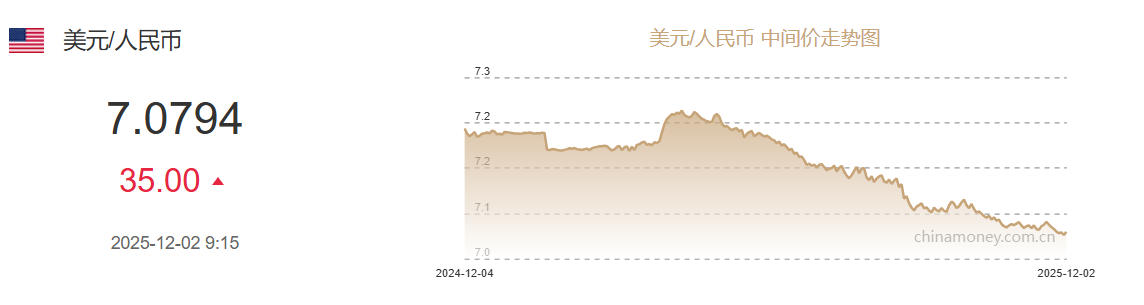
人民币对美元中间价报7.0794 调贬35个基点
Zhong Guo Jing Ji Wang· 2025-12-02 01:28
Core Points - The central viewpoint of the news is the recent depreciation of the Chinese yuan against the US dollar, with the exchange rate reported at 7.0794 yuan per dollar, a decrease of 35 basis points from the previous trading day [1]. Exchange Rate Summary - The People's Bank of China has authorized the publication of the interbank foreign exchange market rates, with the yuan's exchange rates against various currencies detailed, including: - 1 USD = 7.0794 CNY - 1 EUR = 8.2113 CNY - 100 JPY = 4.5495 CNY - 1 HKD = 0.90880 CNY - 1 GBP = 9.3451 CNY - 1 AUD = 4.6292 CNY - 1 NZD = 4.0512 CNY - 1 SGD = 5.4576 CNY - 1 CHF = 8.7915 CNY - 1 CAD = 5.0539 CNY - 1 MOP = 1.1339 CNY - 1 MYR = 0.58373 CNY - 1 RUB = 10.9857 CNY - 1 ZAR = 2.4155 CNY - 1 KRW = 207.92 CNY - 1 AED = 0.51913 CNY - 1 SAR = 0.53051 CNY - 1 HUF = 46.3742 CNY - 1 PLN = 0.51484 CNY - 1 DKK = 0.9095 CNY - 1 SEK = 1.3363 CNY - 1 NOK = 1.4319 CNY - 1 TRY = 5.99926 CNY - 1 MXN = 2.5875 CNY - 1 THB = 4.5236 CNY [2].
升破7.07!人民币对美元汇率续创去年10月中旬以来新高
Sou Hu Cai Jing· 2025-12-01 10:40
Core Viewpoint - The Chinese Yuan (CNY) continues to appreciate against the US Dollar (USD), reaching new highs not seen since mid-October of the previous year, driven by various economic factors and market expectations. Exchange Rate Performance - On December 1, the CNY/USD spot exchange rate broke the 7.07 mark, peaking at 7.0650, marking a new high since mid-October of the previous year. The closing rate was 7.0725, an increase of 69 basis points from the previous trading day, also setting a new closing high since mid-October [1] - The onshore CNY/USD central parity rate was reported at 7.0759, up 30 basis points, the highest since October 14, 2024 [4] Economic Factors Influencing Appreciation - The macro team at GF Securities noted that the CNY's accelerated appreciation is more endogenous, particularly as the USD remained relatively strong in November. Key reasons include: - A joint arrangement reached during economic discussions in Kuala Lumpur at the end of October, reducing uncertainties in China's export environment [5] - The "14th Five-Year Plan" draft emphasizes economic development and aims for a significant increase in the consumption rate, which positively influences market expectations for the CNY [5] - The central bank's issuance of 450 billion CNY in central bank bills in Hong Kong supports the strengthening of the CNY [5] - The fourth quarter typically sees a peak in corporate foreign exchange settlements, with strong export performance leading to concentrated demand for CNY conversion [5] Market Expectations - According to Industrial Research, the CNY is expected to maintain its appreciation momentum from late November, with potential opportunities arising from fluctuations in the A-share market and external risk sentiment, as well as the anticipated interest rate cuts by the Federal Reserve [6]
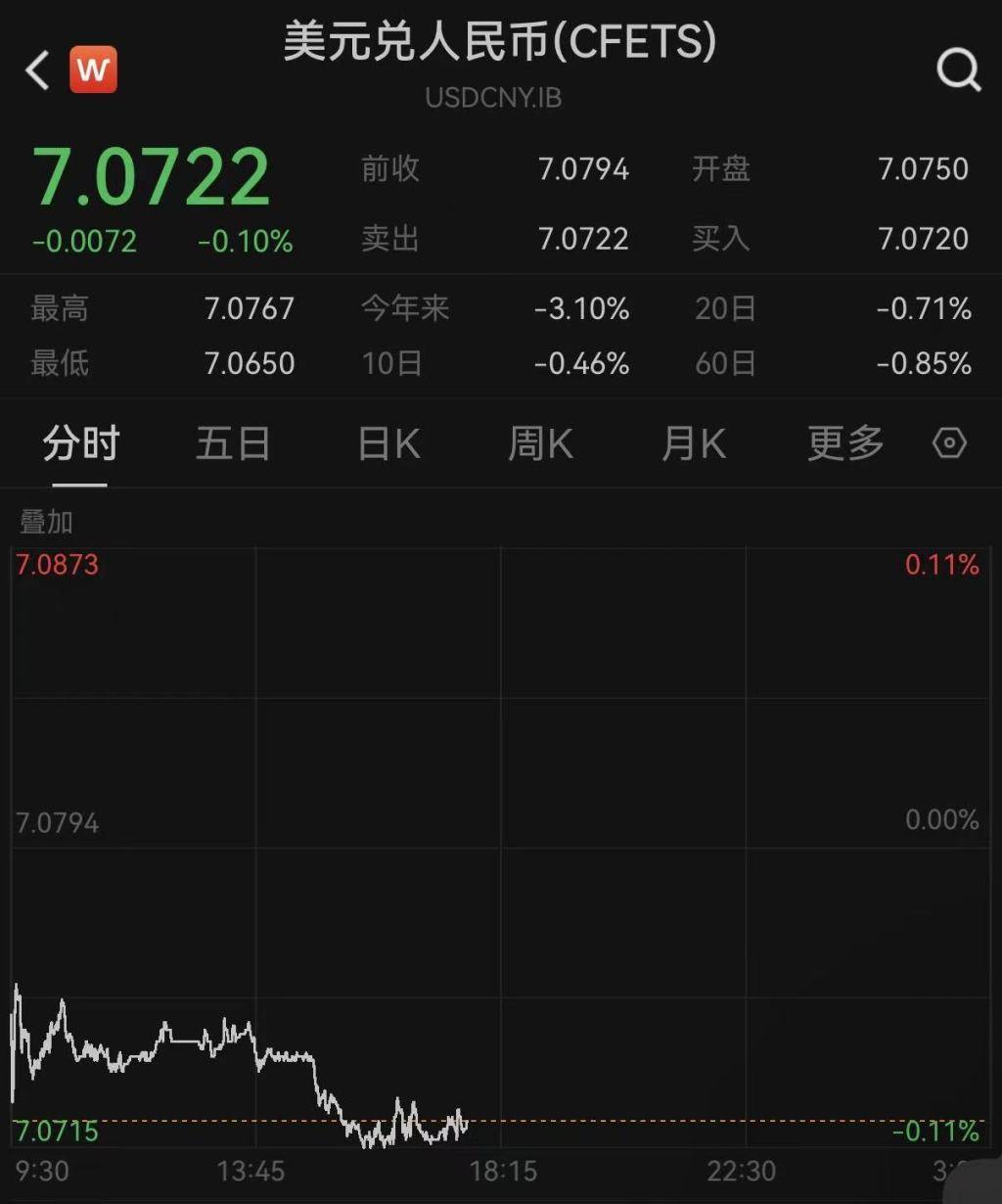
人民币对美元中间价年内大涨近1000点
21世纪经济报道· 2025-12-01 09:55
Core Viewpoint - The article discusses the recent strengthening of the Renminbi (RMB) against the US dollar, attributing it to changes in the Federal Reserve's interest rate expectations, the resilience of the domestic economy, and the attractiveness of China's capital markets to international investors [1][2]. Group 1: Factors Influencing RMB Strength - The first reason for the RMB's recent strength is the changing expectations regarding the Federal Reserve's interest rate cuts, with an 80% probability of a rate cut in December [1]. - The second factor is the robust performance of the domestic economy, which has shown resilience despite global trade challenges, particularly from US tariff policies [2]. - The third reason is the strong performance of China's capital markets, which have attracted international capital, supported by both internal economic stability and external expectations of US rate cuts [2]. Group 2: Future Outlook and Policy Directions - The central bank's report emphasizes two key points for future exchange rate policy: enhancing the RMB's role as an "automatic stabilizer" and preventing excessive volatility [2]. - The expected trend for the RMB is a "stable yet slightly strong" outlook, supported by the anticipated weakening of the US dollar and strong year-end demand for RMB [2]. - The article warns that potential risks include the Federal Reserve's rate cuts falling short of expectations, stronger-than-expected US economic data, or a significant rebound in the US dollar index, which could disrupt the market [3].

人民币汇率大涨:这次有何不同?如何影响我们?|财经早察
2 1 Shi Ji Jing Ji Bao Dao· 2025-12-01 08:36
Core Viewpoint - The recent strengthening of the Renminbi (RMB) against the US dollar is attributed to changes in the Federal Reserve's interest rate expectations, resilient domestic economic performance, and a robust capital market attracting international investment [1][2]. Group 1: Factors Influencing RMB Strength - The first reason for the RMB's recent strength is the shift in expectations regarding the Federal Reserve's interest rate cuts, with an 80% probability of a rate cut in December [1]. - The second factor is the resilience of the domestic economy, which has maintained solid production levels despite global trade challenges, enhancing market confidence in China's export capabilities [1][2]. - The third reason is the strong performance of the domestic capital market, which has increased its attractiveness to international investors, supported by both internal economic stability and external expectations of US rate cuts [2]. Group 2: Future Outlook and Policy Directions - The central bank's report indicates a clear future policy direction for the RMB, emphasizing the need for the currency to act as an "automatic stabilizer" and to avoid excessive volatility [2]. - The expected trend for the RMB is a "stable yet slightly strong" outlook, driven by external support from potential US rate cuts and internal demand for currency exchange at year-end [2]. - Despite the positive outlook, potential risks include the possibility of the Federal Reserve's actions not meeting expectations, strong US economic data, or a significant rebound in the US dollar index, which could disrupt the market [3].
金融期货早评-20251201
Nan Hua Qi Huo· 2025-12-01 02:49
Report Industry Investment Ratings No information provided in the given content. Core Views of the Report - Domestic industrial enterprise profit growth is currently dragged down by the "weak volume and price" situation, with significant marginal decline. In the short - term, it will face pressure and maintain a weak oscillation. In the long - term, it is expected to enter a repair channel in 2025 [2]. - The upward space of the US dollar index is limited, and it will maintain a high - level oscillation in the short - term. The release of November non - farm payroll data and the determination of the Fed chair candidate will test its resilience [2]. - The RMB exchange rate will likely show a complex pattern of depreciation trend (appreciation of the RMB against the US dollar) and volatility risks coexisting within the year. In the short - term, it will be robust and strong, but the appreciation speed may slow down, and the two - way fluctuation will be more obvious [4][5]. - The stock index trading atmosphere is sluggish and is expected to continue to oscillate in the short - term. In the long - term, the logic of valuation repair driven by liquidity easing remains unchanged [6][7]. - The mid - term outlook for treasury bonds is not pessimistic. Although the market is weak due to rumors, the economic fundamentals suggest that interest rates will remain low for some time, waiting for monetary policy signals [8]. - The container shipping European line futures are expected to maintain a weak oscillation in the short - term, with geopolitical trends as the key variable [11][12]. - Precious metals prices are expected to continue rising in the long - term, driven by central bank gold purchases and investment demand. In the short - term, low inventory and potential demand release will increase the upward elasticity of prices [14][16]. - Copper prices are expected to continue to break through at the end of the year. The impact of PMI data and US ADP employment changes on market sentiment should be noted [17][20]. - Aluminum is expected to oscillate strongly in the short - term, mainly affected by macro - sentiment and the rise of copper and silver. Alumina will run weakly, and cast aluminum alloy will oscillate strongly [20][21]. - Zinc prices are expected to continue to build a bottom, with short - term strong oscillation due to supply contraction and demand decline [23]. - Nickel and stainless steel will maintain a wide - range oscillation, with a downward trend due to weak fundamentals. Tin prices will maintain a high - level oscillation, and it is recommended to enter the market on dips [23][25]. - Carbonate lithium prices will be in a game range, waiting for a driving force. It is recommended to avoid chasing high prices near 100,000 yuan/ton and seize opportunities to build positions on dips [26][27]. - Industrial silicon will be in a weak supply - demand situation, with short - term oscillation and long - term value for position building on dips. Polysilicon trading is shifting to the game between warehouse receipts and positions, and position risks should be noted [28][31]. - Lead prices are expected to oscillate between 16,900 - 17,300 yuan, with strong support at 16,700 yuan [32]. - Steel prices are expected to oscillate strongly, with the operating range of rebar at 3,000 - 3,300 yuan and hot - rolled coil at 3,200 - 3,500 yuan. Attention should be paid to the destocking speed and downstream consumption [33][35]. - Iron ore prices are expected to maintain a high - level oscillation, with short - term valuation repair. It is recommended to take profits on long positions at high prices [36][37]. - Coking coal and coke prices are under pressure. For coking coal, short - term short positions can be held, and long positions can be considered for the far - month contract after a stable signal. For coke, it is not recommended to blindly participate in the downward market [38][39]. - Ferrosilicon and ferromanganese are expected to oscillate weakly due to high inventory and weak demand [40][41]. - Crude oil prices will continue to oscillate, with a long - term downward trend due to supply - surplus pressure. Attention should be paid to OPEC+ policy implementation and the progress of Russia - Ukraine peace talks [43][45]. - LPG prices are supported by supply - demand conditions and the external market, although the domestic LPG valuation is relatively high [47][48]. - PX - PTA prices may fall back after the departure of speculation funds. It is recommended to consider building long positions on dips, with attention to maintenance plans and blending oil dynamics [49][53]. - MEG prices have a weakened downward drive, and it is recommended to sell call options. The long - term supply - surplus situation remains unchanged [55][57]. - Urea prices are expected to continue to oscillate, with the downside space supported and the upside pressured [58][59]. - PP prices are supported by the cost side. Attention should be paid to the PDH device operation status and basis changes [60][63]. - PE prices are expected to continue to oscillate after a rebound. Attention should be paid to the spot situation and basis changes [64][65]. - Pure benzene and styrene prices are affected by device maintenance. Pure benzene shows a near - weak and far - strong pattern, while styrene shows a near - strong and far - weak pattern [66][68]. - High - sulfur fuel oil cracking is expected to decline, and low - sulfur fuel oil cracking may rebound after the stabilization of Dar Blend discount [69][70]. - Asphalt prices will maintain a weak oscillation in the short - term, with attention to winter storage policies [71][72]. - Rubber and 20 - number rubber prices are expected to oscillate strongly [73]. Summary by Relevant Catalogs Financial Futures - **Macro**: China's November official manufacturing PMI rebounded to 49.2, and the high - tech manufacturing PMI remained above 50 for 10 consecutive months. The US "Black Friday" sales increased by 4.1% year - on - year, and the AI traffic soared by 600%. The US - Ukraine negotiation was considered "productive" [1]. - **RMB Exchange Rate**: The on - shore RMB against the US dollar closed at 7.0794 on the previous trading day, up 12 points. The RMB against the US dollar central parity rate was 7.0789, down 10 points. The RMB exchange rate is expected to show a complex pattern of appreciation and volatility risks [3][4]. - **Stock Index**: The trading atmosphere is sluggish, and it is expected to oscillate in the short - term. In the long - term, the logic of valuation repair driven by liquidity easing remains unchanged [6][7]. - **Treasury Bonds**: The mid - term outlook is not pessimistic. Although the market is weak due to rumors, the economic fundamentals suggest that interest rates will remain low for some time, waiting for monetary policy signals [7][8]. - **Container Shipping European Line**: The futures are expected to maintain a weak oscillation in the short - term, with geopolitical trends as the key variable [11][12]. Commodities Non - ferrous Metals - **Gold & Silver**: Precious metals prices are expected to continue rising in the long - term, driven by central bank gold purchases and investment demand. In the short - term, low inventory and potential demand release will increase the upward elasticity of prices [14][16]. - **Copper**: Copper prices are expected to continue to break through at the end of the year. The impact of PMI data and US ADP employment changes on market sentiment should be noted [17][20]. - **Aluminum Industry Chain**: Aluminum is expected to oscillate strongly in the short - term, mainly affected by macro - sentiment and the rise of copper and silver. Alumina will run weakly, and cast aluminum alloy will oscillate strongly [20][21]. - **Zinc**: Zinc prices are expected to continue to build a bottom, with short - term strong oscillation due to supply contraction and demand decline [23]. - **Nickel, Stainless Steel**: Nickel and stainless steel will maintain a wide - range oscillation, with a downward trend due to weak fundamentals [23][24]. - **Tin**: Tin prices will maintain a high - level oscillation, and it is recommended to enter the market on dips [25]. - **Carbonate Lithium**: Carbonate lithium prices will be in a game range, waiting for a driving force. It is recommended to avoid chasing high prices near 100,000 yuan/ton and seize opportunities to build positions on dips [26][27]. - **Industrial Silicon & Polysilicon**: Industrial silicon will be in a weak supply - demand situation, with short - term oscillation and long - term value for position building on dips. Polysilicon trading is shifting to the game between warehouse receipts and positions, and position risks should be noted [28][31]. - **Lead**: Lead prices are expected to oscillate between 16,900 - 17,300 yuan, with strong support at 16,700 yuan [32]. Black Metals - **Rebar & Hot - Rolled Coil**: Steel prices are expected to oscillate strongly, with the operating range of rebar at 3,000 - 3,300 yuan and hot - rolled coil at 3,200 - 3,500 yuan. Attention should be paid to the destocking speed and downstream consumption [33][35]. - **Iron Ore**: Iron ore prices are expected to maintain a high - level oscillation, with short - term valuation repair. It is recommended to take profits on long positions at high prices [36][37]. - **Coking Coal & Coke**: Coking coal and coke prices are under pressure. For coking coal, short - term short positions can be held, and long positions can be considered for the far - month contract after a stable signal. For coke, it is not recommended to blindly participate in the downward market [38][39]. - **Ferrosilicon & Ferromanganese**: Ferrosilicon and ferromanganese are expected to oscillate weakly due to high inventory and weak demand [40][41]. Energy and Chemicals - **Crude Oil**: Crude oil prices will continue to oscillate, with a long - term downward trend due to supply - surplus pressure. Attention should be paid to OPEC+ policy implementation and the progress of Russia - Ukraine peace talks [43][45]. - **LPG**: LPG prices are supported by supply - demand conditions and the external market, although the domestic LPG valuation is relatively high [47][48]. - **PTA - PX**: PX - PTA prices may fall back after the departure of speculation funds. It is recommended to consider building long positions on dips, with attention to maintenance plans and blending oil dynamics [49][53]. - **MEG - Bottle Chip**: MEG prices have a weakened downward drive, and it is recommended to sell call options. The long - term supply - surplus situation remains unchanged [55][57]. - **Urea**: Urea prices are expected to continue to oscillate, with the downside space supported and the upside pressured [58][59]. - **PP**: PP prices are supported by the cost side. Attention should be paid to the PDH device operation status and basis changes [60][63]. - **PE**: PE prices are expected to continue to oscillate after a rebound. Attention should be paid to the spot situation and basis changes [64][65]. - **Pure Benzene & Styrene**: Pure benzene and styrene prices are affected by device maintenance. Pure benzene shows a near - weak and far - strong pattern, while styrene shows a near - strong and far - weak pattern [66][68]. - **Fuel Oil**: High - sulfur fuel oil cracking is expected to decline, and low - sulfur fuel oil cracking may rebound after the stabilization of Dar Blend discount [69][70]. - **Asphalt**: Asphalt prices will maintain a weak oscillation in the short - term, with attention to winter storage policies [71][72]. - **Rubber & 20 - number Rubber**: Rubber and 20 - number rubber prices are expected to oscillate strongly [73].
三大人民币汇率指数小幅下挫,人民币汇率中长期或稳中有升
Zhong Guo Jin Rong Xin Xi Wang· 2025-12-01 02:45
Core Viewpoint - The Chinese yuan's exchange rate indices have declined, reflecting a broader trend influenced by expectations of a Federal Reserve interest rate cut and changes in market sentiment towards the dollar [1][5]. Group 1: Exchange Rate Indices - The CFETS yuan exchange rate index reported at 97.92, down 0.3% week-on-week [1][2]. - The BIS currency basket yuan exchange rate index stood at 104.47, decreasing by 0.19% [1][2]. - The SDR currency basket yuan exchange rate index was at 92.46, with a weekly decline of 0.14% [1][2]. Group 2: Market Influences - The dollar index experienced a decline of 0.71% over the week, falling below the 100 mark, influenced by weak U.S. retail data and heightened expectations for a Fed rate cut [5]. - The yuan strengthened against the dollar, with the onshore yuan closing at 7.0740, up 310 basis points (0.51%) for the week, and the offshore yuan at 7.0713, up 341 basis points (0.48%) [5]. - The yuan's central parity rate against the dollar was adjusted to 7.0789, an increase of 86 basis points for the week [5]. Group 3: Analyst Insights - Analysts attribute the yuan's strength to the Fed's anticipated rate cut, with the probability of a December cut rising from 35.4% to 85.4% within a week [5]. - The chief macro analyst at Guotai Junan noted a trend reversal in foreign trade enterprises' currency settlement preferences, contributing to the yuan's appreciation [6]. - The chief economist at Zhongyin Securities highlighted that the yuan's resilience amidst global economic uncertainties reflects a combination of factors, including a recovering Chinese economy and a weakening dollar [6]. Group 4: Future Outlook - Analysts predict that the yuan's exchange rate will be influenced by the dollar's performance and U.S.-China trade relations, with expectations of continued moderate appreciation [7]. - The chief economist at Qianhai Kaiyuan Fund anticipates a long-term upward trend for the yuan against the dollar, suggesting a potential break below 7 and a return to the 6 range by next year [8].
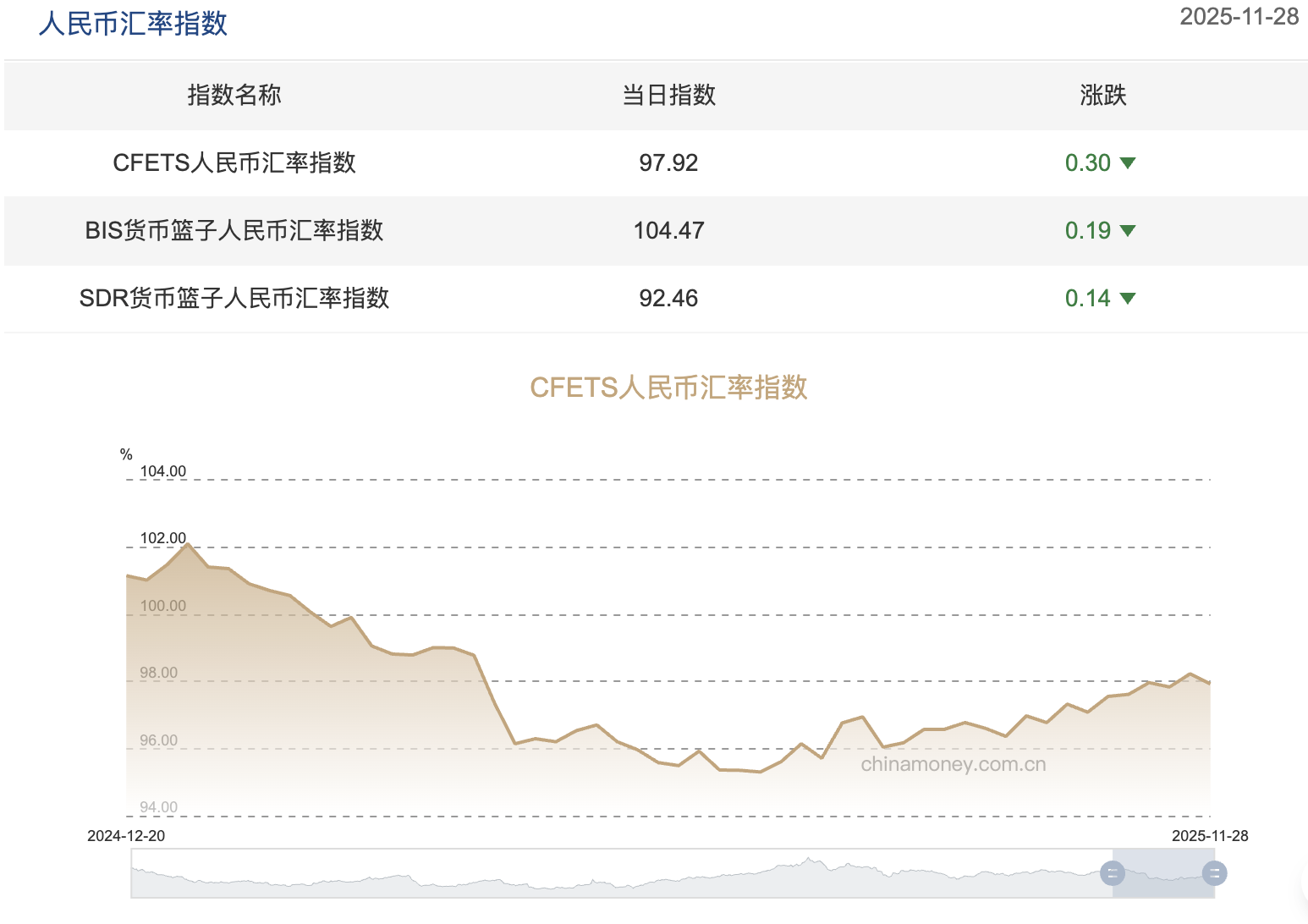
人民币市场汇价(12月1日)
Xin Hua Wang· 2025-12-01 01:54
新华社北京12月1日电 中国外汇交易中心12月1日受权公布人民币对美元、欧元、日元、港元、英 镑、澳元、新西兰元、新加坡元、瑞士法郎、加元、澳门元、林吉特、卢布、兰特、韩元、迪拉姆、里 亚尔、福林、兹罗提、丹麦克朗、瑞典克朗、挪威克朗、里拉、墨西哥比索及泰铢的市场汇价。 12月1日人民币汇率中间价如下: 100美元 707.59人民币 100欧元 820.52人民币 100日元 4.5331人民币 100港元 90.877人民币 100英镑 936.16人民币 100澳元 463.02人民币 100新西兰元 405.35人民币 100新加坡元 545.69人民币 100瑞士法郎 880.13人民币 100加元 506.21人民币 100人民币113.43澳门元 100人民币58.391马来西亚林吉特 100人民币1095.81俄罗斯卢布 100人民币241.99南非兰特 100人民币20750韩元 100人民币51.934阿联酋迪拉姆 100人民币53.039沙特里亚尔 100人民币4651.04匈牙利福林 100人民币51.614波兰兹罗提 100人民币91.03丹麦克朗 100人民币133.6瑞典克朗 1 ...
人民币对美元中间价报7.0759 上调30个基点
Zhong Guo Jing Ji Wang· 2025-12-01 01:54
Core Viewpoint - The central point of the news is the adjustment of the Chinese yuan (RMB) exchange rate against the US dollar, with the midpoint rate set at 7.0759, reflecting an increase of 30 basis points from the previous trading day [1]. Exchange Rate Summary - As of December 1, 2025, the exchange rates for various currencies against the RMB are as follows: - 1 USD = 7.0759 RMB - 1 EUR = 8.2052 RMB - 100 JPY = 4.5331 RMB - 1 HKD = 0.90877 RMB - 1 GBP = 9.3616 RMB - 1 AUD = 4.6302 RMB - 1 NZD = 4.0535 RMB - 1 SGD = 5.4569 RMB - 1 CHF = 8.8013 RMB - 1 CAD = 5.0621 RMB - 1 MOP = 1.1343 RMB - 1 MYR = 0.58391 RMB - 1 RUB = 10.9581 RMB - 1 ZAR = 2.4199 RMB - 1 KRW = 207.50 RMB - 1 AED = 0.51934 RMB - 1 SAR = 0.53039 RMB - 1 HUF = 46.5104 RMB - 1 PLN = 0.51614 RMB - 1 DKK = 0.9103 RMB - 1 SEK = 1.3360 RMB - 1 NOK = 1.4302 RMB - 1 TRY = 6.00787 RMB - 1 MXN = 2.5854 RMB - 1 THB = 4.5432 RMB [2].