硬科技

Search documents
四季度以来私募调研聚焦电子元件等领域
Zheng Quan Ri Bao· 2025-12-04 16:15
Group 1 - The fourth quarter is a critical period for private equity funds to realize performance and capture investment opportunities for the coming year, with research becoming a primary method for exploring new opportunities [1] - As of December 4, a total of 2,280 private equity institutions conducted 13,000 research sessions in the fourth quarter, with sectors like electronic components, medical devices, and integrated circuits being the most popular [1] - Private equity firms are optimistic about the A-share market in 2026 and are actively adjusting their portfolios through research to ensure more rational asset allocation and maximize product returns [2][3] Group 2 - Leading private equity firms are actively conducting research, with several top firms ranking high in the number of sessions, including Guangdong Zhengyuan, Hongyun, and Shanghai Gao Yi, among others [2] - The active research by private equity firms signals a positive outlook on the A-share market and a focus on understanding industry developments and verifying company operations to achieve higher returns [2] - The demand for deep research and precise stock selection is increasing as the market shifts towards performance realization, particularly in the technology sector [3] Group 3 - Technology stocks, particularly in sectors like electronic components, medical devices, and integrated circuits, are favored by private equity firms, with companies like Luxshare Precision and Aibo Medical being researched over 100 times [3][4] - The electronic components sector has seen strong upward momentum this year, benefiting from multiple favorable factors such as AI hardware, semiconductor domestic substitution, and automotive electronics [4] - The focus on sectors with growth potential and profit certainty is expected to help private equity funds achieve excess returns, aligning with their criteria for asset selection [4]




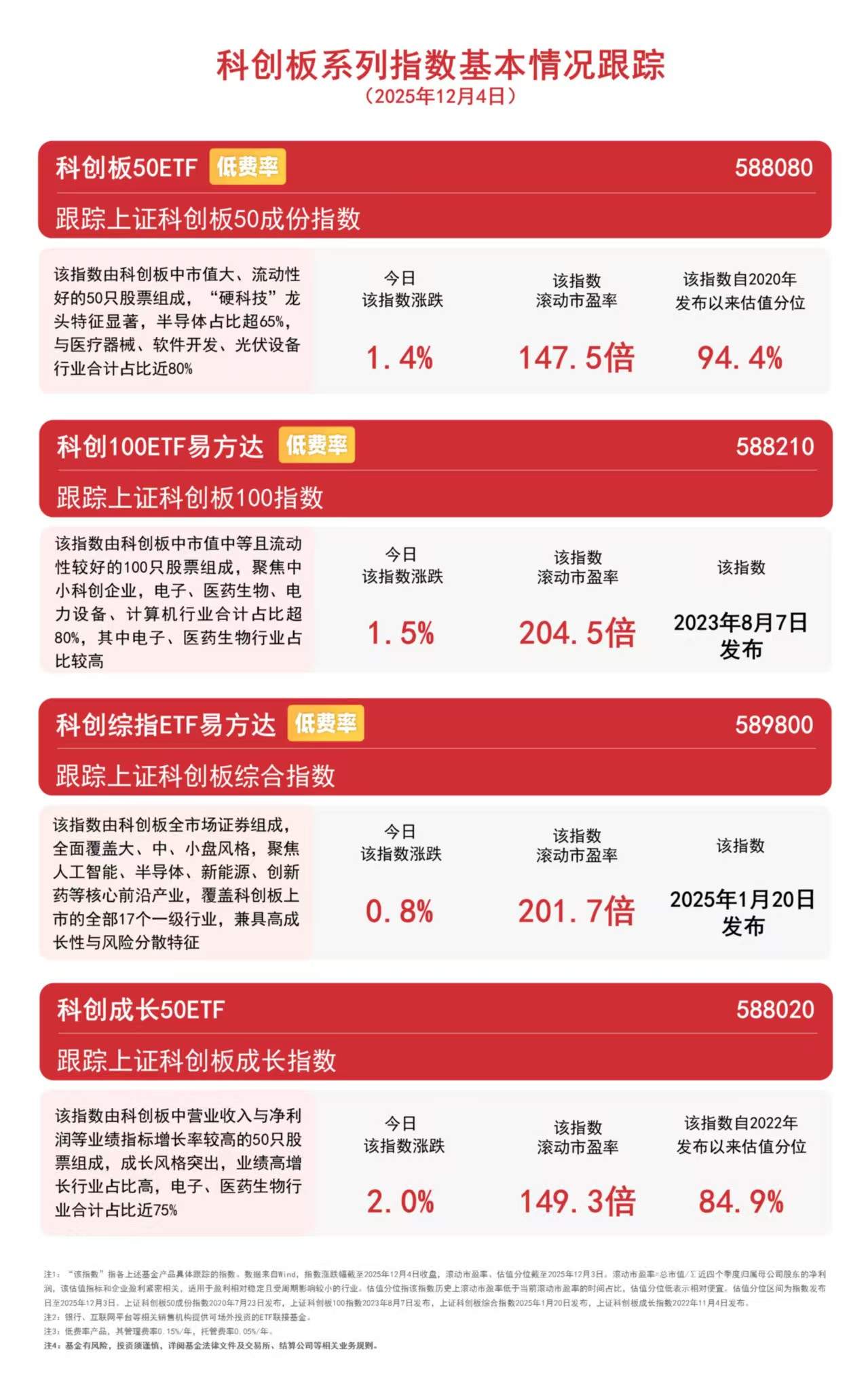
科创板50指数低开高走上涨1.4%,科创板50ETF(588080)助力一键打包“硬科技”龙头企业
Mei Ri Jing Ji Xin Wen· 2025-12-04 13:22
Group 1 - The "hard technology" sector is showing active performance, with notable strength in robotics concept stocks, including DeMa Technology rising over 13% and other companies like Buke Gel and Green Harmonics increasing over 5% [1] - The semiconductor sector also saw significant gains, with Hongwei Technology up over 9%, Zhongke Lanyun up over 8%, and Huahong Company up over 6% [1] - The overall indices showed positive movement, with the Sci-Tech Growth Index increasing by 2.0%, the Sci-Tech 100 Index rising by 1.5%, the Sci-Tech 50 Index up by 1.4%, and the Sci-Tech Comprehensive Index gaining 0.8% [1] Group 2 - The Sci-Tech 50 ETF tracks the Sci-Tech 50 Index, which consists of 50 large-cap stocks from the Sci-Tech board, with over 65% of its composition in semiconductors and nearly 80% in total across related industries [3] - The Sci-Tech 100 ETF focuses on 100 medium-cap stocks, with over 80% of its composition in electronics, biomedicine, and power equipment sectors, highlighting a strong emphasis on electronic and biomedicine industries [3] - The Sci-Tech Comprehensive Index ETF covers all market securities on the Sci-Tech board, focusing on core industries such as artificial intelligence, semiconductors, new energy, and innovative pharmaceuticals, providing a diversified risk profile [4]

看涨
第一财经· 2025-12-04 11:44
2025.12. 04 A股三大指数呈明显分化走势,全天震荡加剧, 沪指低开后探底回升, 险守3870点关键支撑, 而深成指、创业板指则震荡上行, 技术面上, 沪指失守5日均线, 上方3900点构成压力。 454家上涨 38745 涨跌停比 0H 2 3 个股仍呈普跌格局,但局部热点爆发力度较强。 盘面上,大消费走弱,零售、餐饮、白酒、电商方 向跌幅靠前;铝业、黄金、稀土、房地产行业表 现不振,商业航天、机器人、半导体概念股走 强。 资金情绪 主力资金净流出 两市成交额 ● 万亿元▼ 7.25% 散户资金净流入 机构谨慎偏积极,聚焦政策催化的高景气赛道,资金向人形机器人、商业航天、半导体等硬科技领域集中, 借市场震荡进行结构性加仓,同时对消费、AI应用等估值偏高或需求疲软的板块进行减仓;散户呈"跟随 性布局"特征,部分散户跟风买入硬科技相关板块龙头标的,与主力资金流向形成一定共振,而对调整中 的消费板块则普遍持观望态度,显示市场在分化中仍具备一定的自我修复能力。 散户情绪 75.85% HB7 足花 游 f PE VA 上证指数 10月9日 e a manufacturers a 今天你冲了还是撤了? 两市成 ...

吴世春:新的独角兽企业创始人,都是张一鸣、王兴这样的小镇青年
创业家· 2025-12-04 10:15
Core Viewpoint - The article discusses the current state and future prospects of angel investing in China, emphasizing the importance of patience and long-term vision in the investment landscape, particularly in the context of emerging technologies like AI and hard tech. Group 1: Investment Landscape - The investment environment has become challenging, with difficulties in fundraising and high costs of customer acquisition, leading to longer exit cycles for investments [3][4]. - Previously, companies like Li Auto and NIO went public within a few years, but now the average time for an IPO in China has extended to around 12 years [4]. - Despite the challenges, angel investing can still be a profitable venture in China for those with sufficient patience [5]. Group 2: Investment Logic - The first investment logic is to focus on "unicorn tigers," which are companies that can dominate their market rather than just being another player [7][9]. - The second logic emphasizes investing in "small-town youth," who are seen as more dedicated and less likely to chase fleeting trends, thus fostering long-term growth [10][11][13]. - The third logic involves ensuring alignment of people, projects, timing, and valuation, as missing the right timing can lead to lost investment opportunities [14]. Group 3: Portfolio and Future Prospects - The company has invested in over 600 enterprises, with around 70 achieving profitability close to A-share listing standards, and expects about 20 companies to go public by 2026 [14][15]. - The focus on AI and new productive forces is seen as a key area for future investment, with a belief in a 20-year bull market for technology innovation in China [14].

股份行AIC扩容提速,行业发展步入“快车道”|银行与保险
清华金融评论· 2025-12-04 08:59
Core Viewpoint - The article discusses the expansion and transformation of Asset Investment Companies (AICs) in China, highlighting their evolving role in supporting technological innovation and addressing the challenges faced by commercial banks in their traditional profit models [2][4][5]. Group 1: Policy and Regulatory Framework - In March 2025, the National Financial Supervision Administration issued a notice to support qualified commercial banks in establishing AICs, leading to an increase in the number of bank-affiliated AICs to nine by October 2025 [2]. - The initial policy goal for AICs was to facilitate the conversion of bank debt to equity, helping companies reduce leverage and optimize capital structures [4]. Group 2: AIC's Evolving Role - AICs are now tasked with supporting technological innovation and the development of new productive forces, expanding their business scope beyond traditional debt-to-equity conversions to direct equity investments [4]. - The establishment of AICs is seen as a structural tool to enhance financial support for technology-driven enterprises, addressing the financing gaps faced by these companies due to their asset-light nature [6]. Group 3: Financial Performance and Market Position - As of October 2025, the total number of bank-affiliated AICs has grown to nine, with seven officially operating and managing a total of 174 funds [8]. - The five major AICs reported a combined asset scale of 6,169 billion yuan, representing 0.315% of the total assets of the five major banks, with a year-on-year growth of 5.1% [10]. - The net profit of these AICs reached 71.91 billion yuan in the first half of 2025, accounting for 1.12% of the total net profit of the five major banks [10].

2026年资本市场将真正成为服务实体经济、推动产业升级的核心引擎
Sou Hu Cai Jing· 2025-12-04 07:35
Core Insights - The global capital markets are expected to undergo structural changes by 2026, driven by domestic financial market developments, particularly in market capitalization management and mergers and acquisitions [1] Group 1: Market Capitalization Management - By 2026, market capitalization management will evolve from a passive compliance tool to a core strategy for companies to actively build long-term value [2] - The shift is influenced by a restructuring of traditional valuation systems and a deepening regulatory focus on enhancing the quality of listed companies, alongside a transition from retail to institutional investor dominance [2] - Companies will need to engage more deeply with media and develop personalized investor relations to effectively communicate their strategic value and align market demands with corporate strategies [2] Group 2: Mergers and Acquisitions - Mergers and acquisitions will transition from mere scale expansion to becoming a key method for companies to construct industrial ecosystems and achieve leapfrog development [3] - This shift is driven by ongoing policy incentives, urgent strategic upgrades, and opportunities arising from global supply chain restructuring due to geopolitical tensions [3] - The focus of M&A activities will increasingly target "hard technology" sectors such as semiconductors, computing power, and artificial intelligence, facilitating both scale expansion and the establishment of technological barriers [3] Group 3: Role of Local State-owned Enterprises - Local state-owned enterprises are expected to transition from being financial investors to becoming industrial organizers by 2026 [4] - This strategic shift involves acquiring control of listed companies to attract high-quality firms with core technologies or market channels, thereby enhancing regional economic resilience and competitiveness [4] - The new model of capital empowerment linked to industrial introduction will help local governments overcome traditional investment challenges, promoting a more integrated industrial ecosystem [4] Group 4: Specialized M&A Funds - Specialized M&A funds focusing on specific technology sectors or industrial chain segments are anticipated to emerge, facilitating resource integration and governance optimization [5] - These funds will create a pool of high-quality acquisition targets, driving the refined restructuring of industrial chains and enhancing the capital market's role in supporting the real economy and industrial upgrades [5]
中科创星创始合伙人米磊:硬科技领域现有的投资规模还远远不够
Zheng Quan Ri Bao Wang· 2025-12-04 06:40
Core Insights - The investment trend in the venture capital industry emphasizes "early investment, small investment, long-term investment, and hard technology" [1] - Zhongke Chuangxing has invested in over 550 hard technology companies since its establishment in 2013, managing funds exceeding 14 billion yuan [2] - The company has developed a unique investment philosophy called Knowledge Value Investment (ESK), focusing on economic, knowledge, and social value [3] Investment Strategy - Zhongke Chuangxing's investment strategy integrates research institutions, early-stage investment, entrepreneurial platforms, and post-investment services [1] - The ESK philosophy evaluates projects based on their economic viability, technological uniqueness, and positive societal impact [3] - The firm aims to explore cutting-edge technologies and believes that innovation cannot be planned but must be pursued through venture capital [3] Sector Focus - The company has made significant investments in the commercial aerospace sector, being an early supporter in this field since 2015 [4] - Key challenges in commercial aerospace include insufficient rocket capacity and high satellite manufacturing costs, which need to be addressed through technological innovation [4] - Future investment directions include artificial intelligence, quantum technology, and synthetic biology, among others [4] Financial Support - The development of hard technology is hindered by insufficient financial support, highlighting the need for increased venture capital [5] - Zhongke Chuangxing advocates for the establishment of a "Zheng Guo Qu" system in technology finance to enhance support for quality tech startups [6] - The company emphasizes the importance of channeling long-term capital from banks and insurance funds into the venture capital sector to support the growth of hard technology startups [6]
四家民营股权投资机构完成科创债发行
Jin Rong Shi Bao· 2025-12-04 01:48
Group 1 - The launch of the technology innovation bonds on May 7 has received a positive market response, with active participation from technology companies and private equity institutions [1] - A total of 930 million yuan has been successfully issued and listed by four private equity institutions, supported by risk-sharing tools [1] - The application of risk-sharing tools is a core innovation in this bond issuance, addressing concerns of both issuers and investors, thereby filling a critical gap in the financing chain for technology innovation [1] Group 2 - The investor types for the recent technology innovation bonds include risk-sharing tools, banks, wealth management subsidiaries, and securities firms, indicating a diverse investor structure and high subscription multiples [2] - Nearly 300 companies have issued technology innovation bonds in the interbank market, including around 250 technology companies and nearly 50 private equity institutions [2] - The current technology innovation bonds have expanded scale and reduced costs compared to earlier pilot programs, effectively addressing challenges such as small scale, short duration, and difficulty in obtaining guarantees [2] Group 3 - The long-term structure design of "5+5" aligns with the duration requirements of many local government guidance funds in the venture capital field, enhancing the willingness of social limited partners (LPs) to participate [3] - The issuance of technology innovation bonds has introduced an intangible asset guarantee, replacing the previous requirement for physical asset guarantees, which reflects market recognition of quality fund managers' business models [3] - This new financing path is tailored to the characteristics of light asset operations in the venture capital industry, opening up new opportunities for funding [3]
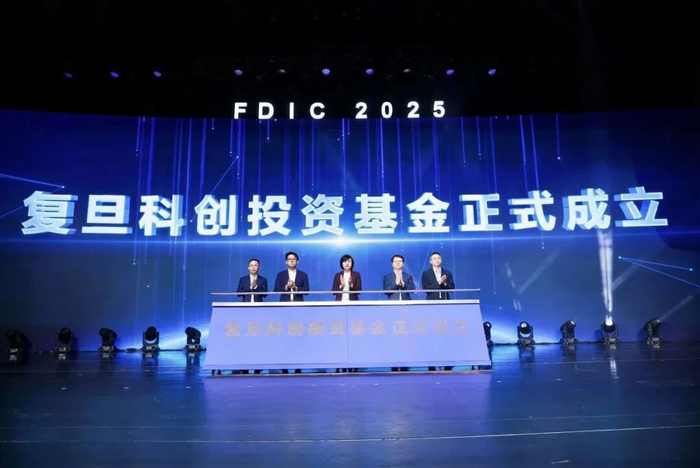
复旦科创海外投资基金启动,首期目标规模为一亿美元
Guo Ji Jin Rong Bao· 2025-12-03 11:59
Core Insights - The 2025 Fudan Science and Technology Innovation Conference emphasizes Fudan University's commitment to fostering a collaborative ecosystem for technology transfer and industrialization, aiming to enhance its service capabilities for national and regional development [1] Group 1: Fudan University's Vision and Goals - Fudan University aims to deepen fundamental research to support scientists in exploring uncharted territories [1] - The university seeks to cultivate interdisciplinary talents with scientific literacy, industry vision, and entrepreneurial spirit [1] - Fudan plans to promote cross-disciplinary integration to break down barriers and build a collaborative innovation ecosystem [1] - The university emphasizes the importance of global collaboration to contribute Chinese wisdom and Fudan's strength to global technological progress [1] Group 2: Shanghai Guotou Company's Role - Shanghai Guotou Company focuses on "fund management + innovation incubation," targeting early-stage investments in hard technology and future industries [2] - The company aims to create a "tropical rainforest" style innovation ecosystem, integrating innovation chains, industry chains, capital chains, and talent chains [2] - Shanghai Guotou will collaborate with Fudan University to enhance innovation application scenarios and develop a model of "innovation + entrepreneurship + venture capital" [2] Group 3: Investment Funds Established - The Fudan Science and Technology Innovation Fund has been established to support outstanding scientists in transforming top-tier technological achievements and expanding market-leading innovation projects [4] - The Fudan Overseas Investment Fund has launched with an initial target size of $100 million, aiming to attract international enterprises and talents interested in China's development [6] - This fund focuses on early-stage projects in life health, artificial intelligence, and new energy materials, aiming to empower the commercialization of original technologies from Fudan's core research institutions [6]

10亿元!“复旦系”基金加码科创
Shang Hai Zheng Quan Bao· 2025-12-03 11:52
Core Insights - The Fudan Science and Technology Investment Fund has been established with a total scale of 1 billion yuan, aimed at supporting the transformation of top scientific achievements by outstanding scientists within the Fudan ecosystem [1][3] - This new fund is positioned as a direct investment fund, marking a shift from "ecological building" to "frontline empowerment" in the field of technology achievement transformation [3][4] - The fund will focus on the top 5% of scientific achievements, concentrating resources on truly valuable and disruptive results [4][5] Investment Strategy - The fund will create a high-precision "Fudan Science and Technology Map" covering over 6,000 Fudan researchers, facilitating precise matching of capital with technological achievements [3][4] - It aims to invest in early-stage projects, including angel rounds, Pre-A rounds, and A rounds, particularly in the fields of life health, artificial intelligence, and new energy materials [7][9] - The fund will not only invest in Fudan's own research outcomes but also in projects from Fudan alumni and other disruptive frontier projects [4][5] Global Expansion - The Fudan Overseas Investment Fund has been launched with an initial target size of 100 million USD, aiming to attract international enterprises and talents interested in China's development [5][7] - This fund will support the internationalization of Fudan's research achievements and local innovative enterprises, enhancing China's influence in the global technology landscape [7][9] Research and Development Initiatives - The establishment of the Zuqin Innovation Transformation Research Institute aims to cultivate top entrepreneurial talents and transform leading scientific achievements [9][10] - The institute has set a "4×100" development goal for the next five years, focusing on nurturing 100 top entrepreneurial talents and transforming 100 top scientific achievements annually [9][10] - It will also build future innovation centers in areas such as quantum computing and brain-machine interfaces, and create a multi-functional support platform for technology transfer [10][11]