
教育公平

Search documents
AI光影·新疆七十年|耕耘希望田野 新疆教育硕果盈枝
Yang Shi Wang· 2025-10-30 13:02
Core Points - Xinjiang's education has undergone a historic transformation from "having schools" to "having good schools" over the past seventy years [2] - The region now boasts modern campuses, with a kindergarten for every 106 children and a primary school for every 817 students, while the gross enrollment rate for high school has reached 97.74% [2] Group 1 - The development of a professional and culturally aware teaching workforce is underway, serving as both knowledge transmitters and guardians of dreams [2] - Vocational education is closely aligned with industry needs, ensuring a seamless connection between skilled talent and job opportunities [2] - Higher education has seen qualitative improvements, particularly in southern Xinjiang, establishing a comprehensive education system that supports regional development [2] Group 2 - Xinjiang is actively enhancing educational cooperation with Central Asian countries, creating a bridge for cultural exchange [2] - The region is characterized as a fertile ground of hope, where knowledge illuminates the path to achieving dreams and education lays the foundation for the future [2] - Xinjiang is confidently writing a magnificent chapter in the development of education in the new era [2]
聚焦“十五五”规划建议丨稳步扩大免费教育范围 探索延长义务教育年限
Xin Hua Wang· 2025-10-29 00:40
Core Viewpoint - The Central Committee's proposal emphasizes the expansion of free education and the exploration of extending compulsory education duration, aiming to enhance the quality and accessibility of education in China [1][2]. Group 1: Education Policy Developments - The proposal outlines specific measures to improve various levels of education, including enhancing basic education quality, expanding resources for general high schools, and improving special and vocational education [2]. - The initiative aims to ensure that educational achievements benefit all citizens more equitably, promoting social fairness and justice through education [2]. Group 2: Impact on Society - The expansion of free preschool education is expected to benefit approximately 12 million children, marking a significant step towards educational equity and reflecting the high-quality development of education in China [1]. - The shift in public demand for education has evolved from merely having access to education to seeking high-quality educational experiences, which presents new requirements for the development of compulsory education [1].
聚焦“十五五”规划建议|稳步扩大免费教育范围 探索延长义务教育年限
Xin Hua She· 2025-10-28 17:09
Core Viewpoint - The Central Committee's proposal emphasizes the expansion of free education and the exploration of extending compulsory education duration, aiming to enhance the quality and accessibility of education in China [1][2] Group 1: Education Policy Developments - The proposal aims to steadily expand the scope of free education and explore extending the years of compulsory education, which is expected to provide more equitable and high-quality educational public services [1] - The current education system has achieved basic balance across 2,895 counties, ensuring equal access to education for children [1] Group 2: Educational Needs and Expectations - There is a shift in public demand for education from merely having access to education ("having schools") to a desire for quality education ("having good schools"), indicating new expectations for the development of compulsory education [1] - The implementation of free preschool education this autumn is expected to benefit approximately 12 million people, reflecting a commitment to educational equity and high-quality development [1] Group 3: Specific Educational Initiatives - The proposal includes specific measures for various levels of education, such as improving basic education quality, expanding resources for general high schools, and enhancing special and vocational education [2] - These initiatives are designed to ensure that educational development benefits all citizens more equitably, promoting social fairness and justice through education [2]
AI何以点亮乡村课堂
Zhong Guo Qing Nian Bao· 2025-10-26 23:05
Core Viewpoint - The application of artificial intelligence (AI) in education is accelerating, but it risks exacerbating the educational imbalance between urban and rural areas, as urban students have significantly higher access to AI devices and resources compared to their rural counterparts [1] Group 1: Urban vs. Rural Education Disparities - There is a notable gap in the ownership, usage frequency, and understanding of AI devices between urban and rural students, with urban minors having a significantly higher penetration of AI learning devices [1] - Experts express concerns that the rapid integration of AI in education may deepen the existing educational inequalities between urban and rural areas [1] Group 2: Teacher Adaptation and AI Integration - Teachers at a rural school in Nanjing are actively incorporating AI into their teaching methods to enhance student engagement and learning outcomes, with one art teacher using AI to animate students' artwork, thereby expanding their creative horizons [2] - A language teacher utilizes AI to analyze students' reading audio, allowing for targeted interventions to improve their pronunciation and reading skills [3] - Teachers are increasingly learning AI skills to enrich their teaching methods and ensure that rural students do not fall behind their urban peers [3] Group 3: Innovative Teaching Methods - AI is being used to create interactive and engaging learning experiences, such as using virtual reality (VR) for chemistry experiments, which has significantly increased student interest and participation [6][7] - The introduction of AI tools has transformed traditional teaching approaches, allowing for more hands-on and practical learning experiences that resonate with students [8][9] Group 4: Cultural Heritage and AI - AI is being leveraged to revive and teach traditional cultural knowledge, with students using AI to create and interact with virtual representations of cultural artifacts, thus enhancing their understanding and appreciation of local heritage [10][12] - The integration of AI in art and craft classes has enabled students to bring their creative ideas to life, fostering a sense of ownership and innovation in their learning process [11][12] Group 5: Educational Equity Initiatives - The Nanjing education authorities are focusing on promoting educational equity between urban and rural areas by utilizing AI technology to enhance classroom interaction and teaching methods [12] - The efforts aim to bridge the digital divide and address the structural contradictions between urban and rural education systems, ultimately fostering a more equitable educational landscape [12]
让优质教育人人可享
Jing Ji Ri Bao· 2025-10-25 23:28
Core Viewpoint - The 20th Central Committee of the Communist Party emphasizes the importance of providing satisfactory education for the people, indicating a shift from merely having access to education to ensuring quality education [1] Group 1: Educational Reforms - There is a growing demand from the public for educational equity and quality, prompting continuous curriculum reform and teaching innovation [1] - The school has established deep partnerships with several schools in Xinjiang, facilitating the exchange of teachers and management staff for on-the-job learning [1] - Collaborative online research activities are conducted to develop region-specific courses, enhancing educational philosophies and methods among teachers [1] Group 2: Future Initiatives - The school aims to strengthen its educational foundation by integrating moral education into all teaching processes [1] - Plans include deepening classroom reforms, promoting project-based learning, and interdisciplinary teaching [1] - The school is exploring digital transformation and the use of artificial intelligence to tailor education to individual needs [1] - There is a focus on leading and supporting other schools through shared experiences and management assistance to foster collective development [1]
东营市加快建设高质量教育体系,增进民生福祉
Qi Lu Wan Bao Wang· 2025-10-23 10:01
Core Viewpoint - The East Ying City government emphasizes the importance of education as a fundamental aspect of public welfare, aiming to enhance the quality and accessibility of education by 2025, ensuring that all children can benefit from quality education and contribute to a better future [3][6]. Group 1: Educational Development Initiatives - The East Ying City Education Bureau is committed to fostering a high-quality education system with local characteristics, focusing on enhancing the educational experience for all citizens [3][4]. - A comprehensive moral education framework is being implemented, integrating ideological and political education across all educational levels, with initiatives such as the establishment of a guidance center for integrated ideological education [4][5]. - The city is promoting a "Five Educations" approach, which includes moral, intellectual, physical, aesthetic, and labor education, ensuring a well-rounded development for students [4][5]. Group 2: Equity and Accessibility in Education - The East Ying City Education Bureau is actively working to improve educational equity by optimizing resource allocation and ensuring that all families benefit from educational advancements [6][7]. - Initiatives such as the "Universal Preschool Education Guarantee Action" aim to provide free education for preschool children, benefiting over 20,000 children and achieving high enrollment rates [6][7]. - The city is also focusing on enhancing the quality of compulsory education, with measures to ensure that all eligible children are enrolled in schools, achieving a stable increase in student numbers [7][8]. Group 3: Support for Special Education - The city has established mechanisms to support the enrollment of disabled children, achieving a 100% placement rate for eligible children [8]. - Financial support for special education has been increased, with per-student funding rising to 9,000 yuan, and efforts are being made to improve the quality of existing special education institutions [8]. Group 4: Community and Parental Involvement - The East Ying City Education Bureau is fostering a collaborative educational environment by engaging families and communities in the educational process, promoting a holistic approach to student development [5][9]. - Initiatives to enhance teacher welfare and professional development are being implemented, including recognition programs and reduced non-teaching burdens [9][10]. Group 5: Safety and Health in Schools - The city is prioritizing student health and safety through comprehensive food safety measures and campus security enhancements, including significant investments in safety infrastructure [10]. - A focus on mental health education is being established, with the creation of psychological support stations and screening mechanisms for students [5][10]. Group 6: Future Goals - East Ying City aims to align its educational strategies with national goals for educational excellence, planning for the next phase of educational development to ensure high-quality outcomes [10].

“免中考”通道开了,但门该向谁敞开?——成都12年贯通试点背后的公平之问
Sou Hu Cai Jing· 2025-10-21 10:25
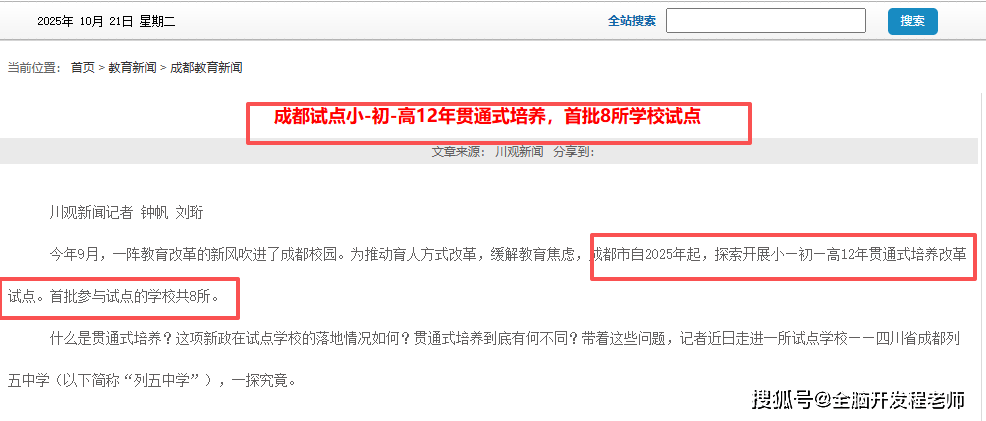
Core Viewpoint - The Chengdu Education Bureau announced a pilot program for a "12-year integrated education" system starting in 2025, allowing some students to bypass the high school entrance exam, raising concerns about educational equity and access for all families [1][2][7] Group 1: Educational Reform and Its Implications - The "12-year integrated" pilot program may primarily benefit students from established educational groups, creating a potential "green channel" that could limit access for others [2][8] - Historical precedents, such as Beijing's "nine-year integrated system," have shown that similar reforms can lead to increased housing prices and further entrench educational inequities [2][9] Group 2: Equity Concerns - The program raises questions about who qualifies for the "direct access" to high school, with concerns that access may be determined by factors such as school attended, family background, and financial resources [8][9] - The emphasis on "process evaluation" could lead to subjective assessments that favor families with more resources, potentially undermining the fairness of the selection process [9][10] Group 3: Long-term Effects and Challenges - Entering the "integrated class" does not guarantee a smooth educational journey, as students may face challenges in transitioning out of a highly structured program if their interests change [10][14] - The risk of a "dual-track" system could emerge, where some students enjoy privileges while others remain in traditional pathways, eroding public trust in educational fairness [10][14] Group 4: Recommendations for Fair Implementation - Transparency in admissions processes, including clear criteria and public oversight, is essential to prevent favoritism and ensure equitable access [17] - A diverse range of opportunities should be established to include students from various backgrounds, ensuring that the program does not favor only those from affluent families [18] - A dynamic mechanism allowing students to adjust their educational paths based on interests and abilities should be implemented to avoid long-term labeling and pressure [19] - Resources must be equitably distributed to improve educational quality across all schools, not just those at the top [20]
“十四五”成绩单丨向社会输送人才5500万 高质量教育托举强国梦想
Yang Shi Wang· 2025-10-15 16:32
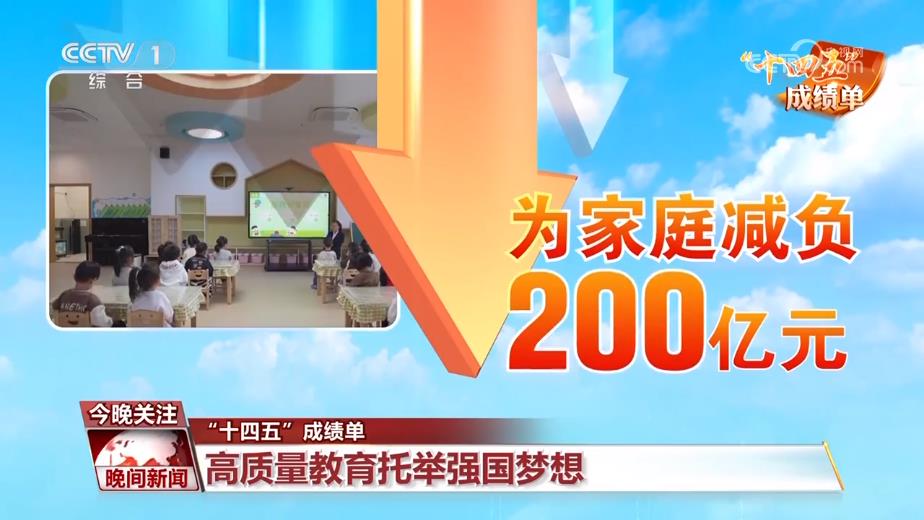
Core Insights - The "14th Five-Year Plan" has yielded significant achievements in China's education sector, emphasizing equitable access and high-quality development [1][3][5] Group 1: Early Childhood Education - Approximately 12 million children are exempt from childcare fees this autumn, reducing family burdens by 20 billion yuan, supported by a gross enrollment rate of 92% in preschool education [3] - The plan aims to enhance the inclusivity of early childhood education, contributing to a more equitable educational landscape [1] Group 2: Compulsory Education - A historic leap in balanced development of compulsory education has been achieved, with 2,895 districts reaching basic balance by 2021 and an additional 246 districts expected to achieve quality balance by the end of 2024 [3] - Measures such as group-based schooling, teacher exchanges, and targeted assistance have been implemented to narrow inter-school disparities [3] Group 3: Higher Education - The gross enrollment rate in higher education has increased from 51.6% in 2019 to 60.8% currently, marking a significant step towards universal access [5] - A total of 123.5 million students from rural and impoverished areas have been admitted through special enrollment plans for key universities [5] - During the "14th Five-Year Plan" period, higher education has produced 55 million graduates, with "Double First-Class" universities responsible for over 90% of the training of urgently needed high-level talents [5] Group 4: Vocational Education - The vocational education sector has established 63 new vocational universities and formed 150 industry-education integration entities, supplying over 70% of new high-skilled talents for modern industries over five years [7] - The commitment to providing equitable and quality education for every child remains a priority, with ongoing efforts to strengthen the foundation for building a strong education nation [7]
“被需要”是一种幸福(暖闻热评)
Ren Min Ri Bao· 2025-10-12 22:10
Core Viewpoint - The article highlights the dedication of retired professor Liu Xiaosheng, who has been providing free English tutoring to children in a rural community for over a decade, emphasizing the importance of education and community support in fostering children's dreams and aspirations [1][2]. Group 1: Educational Impact - Liu Xiaosheng has been teaching English to hundreds of children in a rural area, using innovative teaching methods and dedicating significant time to improve their language skills [1]. - His efforts have led to noticeable transformations in students, with some gaining the confidence to express themselves and even gaining admission to prestigious universities [1]. Group 2: Community and Cultural Influence - Liu's work has fostered a sense of community, encouraging local families to support each other in their children's education, thus enhancing the overall social fabric of the area [3]. - The presence of dedicated educators like Liu Xiaosheng contributes to a cultural shift towards valuing education, which is seen as a vital tool for breaking the cycle of poverty [3]. Group 3: Systemic Changes in Education - Recent initiatives aimed at improving the distribution of quality educational resources to rural areas are underway, including special teaching positions and programs for retired educators [3]. - The article calls for further systemic improvements to ensure equitable access to education, highlighting the need for supportive policies and community engagement to enhance rural education [3].
再见,流动儿童学校
2 1 Shi Ji Jing Ji Bao Dao· 2025-10-11 11:20
Core Viewpoint - The report indicates that by 2025, many schools specifically for migrant children will have completed their historical mission, marking a significant shift in China's education landscape [1][3]. Group 1: Background and Evolution - Migrant children's schools emerged in the early 1990s due to a surge in migrant workers and their children's educational needs, constrained by policies requiring local residency for school enrollment [2]. - Over 30 years, these schools addressed the educational challenges faced by migrant children, but changing demographics and policies have led to a decline in their numbers, with many schools expected to close by 2025 [3][4]. Group 2: Current Status and Future Outlook - As of 2024, Shanghai has only 33 migrant children's schools, with significant closures anticipated in the coming years, while Beijing retains fewer than 20 [3]. - The implementation of new urbanization strategies and the push for equitable public education have contributed to the decline of these schools, with many cities easing residency requirements for education [4]. Group 3: Contributions and Innovations - Despite their challenges, migrant children's schools have made historical contributions to educational equity, although many faced issues like poor conditions and high fees [5]. - Some schools have attempted innovative educational practices, such as integrating sports and vocational training, but these efforts remain fragmented and lack a cohesive model [6][7]. Group 4: Policy and Access - Over 97% of migrant children are now enrolled in public or government-subsidized schools, reflecting improvements in access to education [8]. - However, barriers still exist, such as residency requirements and the need for points-based enrollment systems, which complicate access for many migrant families [8][9]. Group 5: Transition to Secondary Education - The transition from compulsory education to secondary schooling remains a significant concern, with policies not yet fully aligned to support migrant children's continued education in urban areas [9]. - Future efforts must focus on reducing barriers in the transition process and enhancing support systems for migrant children to ensure their educational development [9]. Group 6: Societal Perspective - The need for basic public services, including education for migrant populations, is emphasized as a fundamental right rather than a special privilege [10].