
消费贷贴息政策

Search documents
公募解读消费贷贴息政策:消费板块或迎来一轮大机遇
Zhong Guo Ji Jin Bao· 2025-08-15 00:24
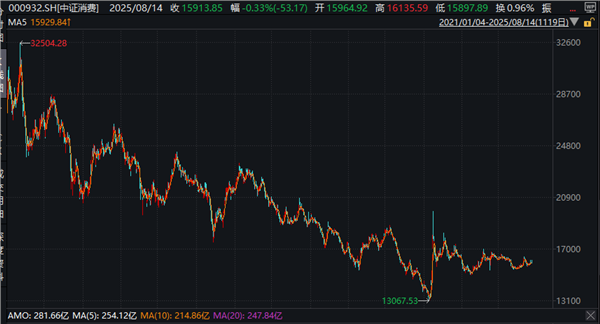
【导读】公募解读消费贷贴息政策:消费板块或迎来一轮大机遇,"服务型消费"有望率先受益 "消费板块或许正在迎来一场重大机遇,甚至可以说史诗级机遇。"一位公募人士说。 日前,个人消费贷领域"国补"正式出台,为消费市场注入一剂"强心针",也引发对大消费板块投资机会 的讨论。 从二级市场表现看,年初至今,消费板块并未跟随大盘强势反弹,表现疲软。而此前大消费已经连跌四 年,以中证消费指数为例,从2021年最高点下跌到2024年的最低点,该指数区间跌幅接近六成。 消费贷贴息定向"输血",能否激活消费复苏引擎?是带来脉冲刺激还是可持续性复苏?受访公募认为, 预计后续消费支持力度将持续加强,与系统性提振内需的政策相结合,进一步激活经济增长内在动能。 随着利好政策的释放和估值的修复,目前处于低估洼地的消费也将迎来复苏周期,当前的配置价值值得 重视。 有望释放消费需求潜力 国泰基金认为,服务业多为中小企业和个体工商户,受信贷等因素影响大,贴息可降低融资成本,助力 其可持续经营,进而提升服务供给能力。从居民角度来看,个人消费贷款贴息能降低信贷成本,提高居 民消费意愿和能力,促进消费市场活力释放。 短期内需有望成为主线 基金公司普遍 ...

消费贷贴息“定向”经办 更多金融机构期盼入围
Shang Hai Zheng Quan Bao· 2025-08-14 18:23
Core Insights - The new consumer loan interest subsidy policy has been implemented, with 23 financial institutions selected to participate, providing an opportunity for these institutions to expand their consumer loan business with government support [2][3] - The policy aims to ensure that the subsidy benefits reach a wide range of consumers, including both online and offline channels, by including various types of financial institutions [3][4] - There is potential for the policy to expand in the future, allowing more financial institutions to benefit from the subsidies [8][9] Group 1: Participating Institutions - The 23 selected institutions include 6 state-owned banks, 12 joint-stock banks, and 5 other consumer loan providers, indicating a focus on larger, well-managed entities [3] - The inclusion of consumer finance companies in the first batch of subsidy recipients is a notable highlight of the policy [3] - Local banks that did not qualify for the subsidies expressed disappointment, fearing loss of competitive pricing advantages [4] Group 2: Policy Implications - The subsidy is expected to influence the consumer credit market structure, potentially increasing market share for participating banks, particularly state-owned and joint-stock banks [4] - The policy is designed to prevent misuse and ensure that subsidies are used for genuine consumer spending, with strict monitoring of loan fund flows [5][6] - Financial institutions must enhance their management practices to comply with the new requirements, including simplifying processes and effectively monitoring loan usage [6][7] Group 3: Future Prospects - There is room for the subsidy policy to expand, with potential evaluations and adjustments to the participating institutions and coverage [8][9] - Local governments are encouraged to implement their own subsidy measures to support consumer loans, as seen in recent initiatives in Sichuan province [8]

“消费板块或迎来一场重大机遇”
Zhong Guo Ji Jin Bao· 2025-08-14 14:33
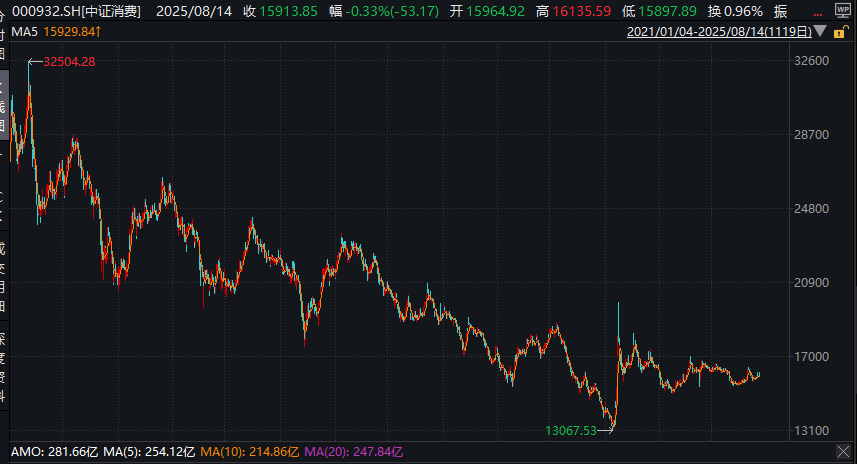
Core Viewpoint - The introduction of the personal consumption loan interest subsidy policy is expected to create significant opportunities in the consumer sector, particularly benefiting "service-oriented consumption" [1][2]. Policy Impact on Consumer Sector - The new "national subsidy" for personal consumption loans aims to stimulate the consumption market, which has been underperforming, with the consumer index dropping nearly 60% from its peak in 2021 to its lowest point in 2024 [2]. - Fund companies believe that the subsidy policy will enhance consumer demand and support economic growth by reducing credit costs and stimulating both supply and demand [4][6]. Short-term and Long-term Prospects - The subsidy policy is expected to have a short-term impact on demand, particularly in sectors like automotive and home appliances, while also fostering long-term growth in emerging consumption areas such as education and tourism [9][8]. - The consumer sector is currently viewed as undervalued, with a significant opportunity for recovery as the market sentiment has reached a low point [11]. Structural Opportunities - Despite the overall market rebound, the consumer sector has lagged, with a year-to-date decline of 2.11% in the consumer index as of August 14 [11]. - The current valuation of the consumer sector has dropped to below 20 times earnings, indicating potential for recovery as market perceptions may be overly pessimistic [11]. Broader Economic Implications - The subsidy policy is not only focused on consumption but also aims to rebalance the entire domestic demand chain, potentially benefiting banks and technology service providers as well [14]. - Banks are expected to benefit from increased retail lending demand and reduced credit risk due to the subsidy policy, which may lead to a positive cycle of growth in loan volumes and asset quality [14][15].
“消费板块或迎来一场重大机遇”
中国基金报· 2025-08-14 14:33
Core Viewpoint - The consumer sector is expected to experience a significant opportunity due to the introduction of the personal consumption loan interest subsidy policy, which is seen as a "strong shot in the arm" for the consumption market [2][4]. Summary by Sections Consumer Loan Interest Subsidy Policy - The newly introduced interest subsidy policy aims to stimulate consumer demand and is expected to work in conjunction with broader policies to boost domestic demand, thereby enhancing economic growth [4][6]. - The policy is designed to lower the cost of consumer loans, thereby reducing repayment pressure on residents and increasing their consumption capacity [6][8]. Impact on Consumer Demand - The policy is anticipated to release pent-up consumer demand, particularly benefiting sectors such as automotive and home appliances, as well as service consumption [9][10]. - The subsidy is expected to have a significant short-term impact on large consumer upgrades, while also fostering long-term growth in emerging consumption areas like education and tourism [9][10]. Market Performance and Investment Opportunities - The consumer sector has underperformed in the market, with the CSI Consumer Index down 2.11% year-to-date as of August 14 [11]. - Despite the overall market rally, the consumer sector remains undervalued, with current valuations dropping below 20 times earnings, indicating potential structural investment opportunities [11][12]. Broader Economic Implications - The policy is not only focused on the consumer sector but also aims to rebalance the entire domestic demand chain, potentially benefiting banks and technology service providers as well [13][14]. - Banks are expected to benefit from increased retail lending demand and reduced credit risk, while a resurgence in consumer activity may enhance transaction volumes for payment and local service platforms [15].

消费板块或迎来一场重大机遇
Zhong Guo Ji Jin Bao· 2025-08-14 14:30
Group 1 - The introduction of the personal consumption loan subsidy policy is seen as a significant opportunity for the consumer sector, potentially leading to a major recovery [1][2] - The consumer sector has underperformed, with the CSI Consumer Index dropping nearly 60% from its peak in 2021 to its lowest point in 2024 [2] - The subsidy policy is expected to stimulate both supply and demand, enhancing economic growth and activating the consumption recovery engine [4][5] Group 2 - The subsidy policy aims to reduce credit costs for consumers, thereby increasing their spending capacity and willingness, which is crucial for boosting domestic demand [5][6] - The policy is designed to be precise and inclusive, targeting various sectors to stimulate consumption, particularly in automotive, home appliances, and service industries [6][7] - The consumer sector is currently viewed as undervalued, with a significant opportunity for investment as market sentiment has reached a low point [8] Group 3 - The policy is expected to benefit not only the consumer sector but also banks and technology service providers, as it aims to rebalance the entire domestic demand chain [10][11] - Banks are likely to see increased retail lending demand and reduced credit risk due to the subsidy policy, which could lead to a positive cycle of growth [10] - The revival of consumer activity is anticipated to boost transaction-related services, benefiting local life platforms and technology service providers [11]

华西证券:大盘股领涨国产算力链表现领先,后续关注两个方面
Mei Ri Jing Ji Xin Wen· 2025-08-14 00:20
Group 1 - The market is strengthening, with large-cap stocks leading the rally, and domestic computing power chains showing strong performance [1] - Attention is drawn to two aspects: the growth rate of financing balances, which may indicate that leveraged funds are in an unfavorable position, and the potential for low-position sectors to rebound [1] - The consumer sector, currently at a low position, may also experience a rebound due to favorable policies on consumer loan interest subsidies [1] Group 2 - If the rebound in low-position sectors is accompanied by a decline in the anti-involution and infrastructure mainline, caution is advised regarding potential market volatility [1] - The market turnover remains at a level of 1.9 trillion yuan, and if the market continues to rise but turnover decreases, it may signal the nearing end of the rally [1]

影响市场重大事件:我国卫星互联网低轨卫星成功发射;央行数据 7月末广义货币(M2)余额同比增长8.8%
Mei Ri Jing Ji Xin Wen· 2025-08-13 23:08
Monetary Policy and Financial Data - As of the end of July, the broad money supply (M2) reached 329.94 trillion yuan, showing a year-on-year growth of 8.8%, up from 8.3% at the end of June [1] - In the first seven months, RMB loans increased by 12.87 trillion yuan, with household loans rising by 680.7 billion yuan and corporate loans increasing by 11.63 trillion yuan [2] - RMB deposits increased by 18.44 trillion yuan in the first seven months, with household deposits contributing 9.66 trillion yuan [7] - The average weighted interest rate for interbank borrowing in July was 1.45%, which is lower than the previous month and the same period last year [11] Cross-Border Transactions - In July, the cross-border RMB settlement amount under the current account was 1.57 trillion yuan, with goods trade accounting for 1.15 trillion yuan [4] Government Financial Support - The National Development and Reform Commission has allocated 188 billion yuan in special long-term bonds to support equipment renewal, impacting over 8,400 projects and driving total investment exceeding 1 trillion yuan [5] Consumer Financing - The interest rate for consumer loan subsidies has been reduced to around 1%, significantly lowering financing costs for consumers and stimulating demand [8] Technological Advancements - China successfully launched a low Earth orbit satellite internet group, enhancing its capabilities in satellite internet technology [3] Virtual Power Plant Development - Guangzhou has announced a development plan for virtual power plants, aiming for a connection capacity of 2 million kilowatts by the end of 2025, with annual financial support not exceeding 10 million yuan [9][10] IPO Activity - Bullish, a cryptocurrency trading platform, is set to raise $1.11 billion through its IPO, with shares priced at $37 each and over 20 times oversubscription [6]
消费贷贴息政策“落地有声”
Qi Lu Wan Bao· 2025-08-13 21:21
Core Viewpoint - The implementation of subsidy policies for service industry loans and personal consumption loans aims to stimulate consumption and activate the market through fiscal and financial collaboration [1][2]. Group 1: Policy Implementation - The "Implementation Plan for Subsidy Policies for Service Industry Loan Entities" and "Implementation Plan for Fiscal Subsidies for Personal Consumption Loans" were officially issued on August 12 [1]. - Agricultural Bank of China and Zhejiang Merchants Bank were among the first to respond, announcing the implementation of interest subsidies for personal consumption loans starting from September 1, 2025 [1]. - Bank of China committed to strictly executing the subsidy policies and ensuring that the benefits reach service industry entities in eight consumption sectors, including catering, health, and tourism [1][2]. Group 2: Bank Responses - Several banks, including China Construction Bank and Minsheng Bank, announced they would provide interest subsidies for loans signed between March 16 and December 31, aimed at improving consumption infrastructure and service supply capabilities [1]. - Banks emphasized the optimization of processing procedures and simplification of application requirements to enhance service quality and expedite policy implementation [2]. Group 3: Focus Areas - The core of the subsidy policy is to boost consumption by accurately addressing demand in key consumption areas such as automobiles, home appliances, and cultural tourism [2]. - The focus is also on small and micro enterprises in the service industry, particularly in sectors like catering and childcare, to identify financing needs and provide targeted loan support [2].
9月起个人消费贷款可享财政贴息 怎么操作?速看→
Guo Ji Jin Rong Bao· 2025-08-13 15:58
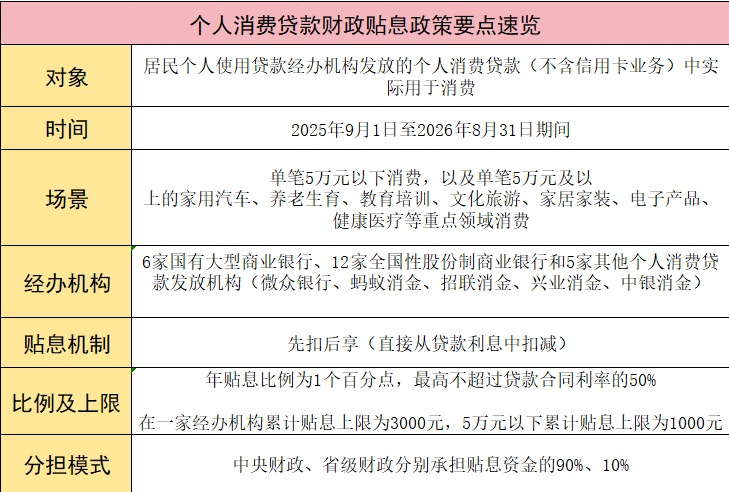
Core Viewpoint - The implementation of the personal consumption loan interest subsidy policy aims to reduce the cost of consumer loans for residents, thereby stimulating consumption and supporting economic growth from September 1, 2025, to August 31, 2026 [1][6]. Summary by Relevant Sections Policy Overview - The policy applies to personal consumption loans issued by financial institutions, excluding credit card transactions, and is designed to subsidize interest for loans used for consumption [1][2]. - The participating institutions include 6 large state-owned commercial banks, 12 national joint-stock commercial banks, and 5 other consumer loan providers [2][3]. Subsidy Mechanism - The subsidy will be applied directly to the loan interest, with a maximum annual subsidy rate of 1%, not exceeding 50% of the loan contract interest rate [3][4]. - Each borrower can receive a total subsidy of up to 3000 yuan for qualifying consumption amounts of 300,000 yuan, with a limit of 1000 yuan for single loans under 50,000 yuan [4][5]. Targeted Consumption Areas - The policy covers various consumption scenarios, including daily expenses under 50,000 yuan and significant purchases such as home appliances, vehicles, education, and healthcare [3][4]. Implementation and Management - The process for applying and managing the subsidy will be streamlined to reduce the burden on borrowers, with financial institutions responsible for verifying eligible transactions [5][6]. - Borrowers must authorize institutions to access transaction information to qualify for the subsidy, although this is voluntary [5]. Economic Impact - The policy is expected to lower consumer loan costs, thereby enhancing the willingness and ability of residents to use financial leverage for consumption, which is crucial for boosting domestic demand and economic confidence [1][6]. - It is anticipated that the policy could stimulate hundreds of billions to over a trillion yuan in additional consumption, depending on its implementation and participation [7][8]. Future Considerations - There may be adjustments to the subsidy rate, coverage, and participating institutions based on the policy's effectiveness after implementation [7]. - Coordination between monetary and fiscal policies is recommended to maximize the impact of the subsidy and other related consumer support measures [7][8].
重磅利好!机构发声:“有望迎来补涨行情”
Sou Hu Cai Jing· 2025-08-13 15:32
Group 1 - The core viewpoint of the article emphasizes that the recent implementation of personal consumption loan interest subsidy policies is expected to boost consumer stocks, leading to a potential rebound in the market [1][2][4] - The policies are designed to lower the cost of personal loans, thereby reducing the financial burden on consumers and stimulating demand in key sectors such as automobiles, home appliances, and electronic products [3][4][7] - Investment institutions are optimistic about the performance of both traditional and emerging consumer sectors, indicating a broad interest in various sub-sectors within the consumer market [5][6][7] Group 2 - The personal consumption loan subsidy policy specifically targets large and small consumer expenditures, with a maximum subsidy of 500 yuan for large purchases and a direct 1% interest subsidy for smaller purchases [3][4] - The policies are seen as part of a broader strategy to stimulate economic growth and consumer demand, addressing concerns over supply-side excess and weak demand [3][4][5] - Investment managers are focusing on sectors that are likely to benefit from these policies, including traditional consumer goods, services, and new consumption trends such as cultural products and smart home technology [7][8]