
科技创新与产业创新深度融合

Search documents
畅通经济循环 凝聚创新合力——看中国经济之“融”
Ren Min Ri Bao· 2025-08-17 01:05
Group 1: Industry Integration - The emphasis on deep integration of technological innovation and industrial innovation is highlighted, showcasing the importance of aligning technological advancements with industry needs to achieve value enhancement from "technological breakthroughs" to "industrial value addition" [2][3] - The success of Suzhou Green's harmonic drive technology, which has broken foreign monopolies, exemplifies the vitality of the integration between the innovation chain and the industrial chain, contributing to high-quality development [2] - The development of high-temperature alloy materials by China Steel Research, utilizing AI to significantly reduce R&D time, demonstrates the potential of innovative approaches in enhancing industrial capabilities [3] Group 2: Market Integration - The push for a unified national market aims to optimize market competition and eliminate barriers to resource flow, enhancing the resilience and vitality of the Chinese economy [7][8] - The establishment of a national unified market construction guideline aims to create a fair competitive environment by regulating local government behaviors and preventing excessive competition [11] - The improvement of logistics and transportation infrastructure, such as the reduction of transportation costs by 30% and time efficiency by 35%, facilitates smoother market connections across regions [9][10] Group 3: Internal and External Trade Integration - The integration of internal and external trade is crucial for constructing a new development pattern and promoting high-quality growth, as demonstrated by the expansion of Spring Snow Food Group's market share both domestically and internationally [12][13] - The establishment of Hainan Free Trade Port is set to enhance the connection between domestic and international markets, attracting global resources and facilitating trade [14] - Continuous efforts to improve the investment environment and streamline foreign investment processes are aimed at stabilizing and enhancing the quality of foreign investment in China [16]


畅通经济循环 凝聚创新合力 ——看中国经济之“融”
Ren Min Ri Bao· 2025-08-16 08:57
Industry Integration - The emphasis on deep integration of technological innovation and industrial innovation is highlighted, showcasing the vitality of the innovation chain and industrial chain [2] - The success of Suzhou Green's harmonic drive technology demonstrates the potential for domestic companies to break foreign monopolies through continuous innovation [2] - The integration of innovation and industry aims to achieve value enhancement from technological breakthroughs to industrial upgrades [2] High-Quality Technology Supply - China Steel Research has utilized AI to significantly reduce the R&D time for new high-temperature alloy materials from over 10 years to as little as 1 year [3] - The country ranks second globally in R&D investment, with over 36 trillion yuan, and leads in international patent applications [3][4] Corporate Innovation Leadership - The collaboration between China Three Gorges Group and Dongfang Electric Group has led to the development of the world's largest offshore wind turbine, marking a significant leap in the offshore wind power sector [5] - Policies encouraging R&D expense deductions and financial support for major technological tasks are designed to empower enterprises as the main drivers of technological innovation [5] Technology Application and Transformation - The establishment of innovation zones has attracted numerous tech companies, showcasing a significant accumulation of innovative resources and patents [6] - Various initiatives are being implemented to streamline the commercialization of technological achievements, enhancing the pathways for innovation to reach the market [6] Market Integration - The push for a unified national market aims to optimize market competition and eliminate barriers to resource flow [7] - The establishment of a national market construction guideline aims to create a fairer competitive environment for businesses [12] Infrastructure Connectivity - The logistics sector has seen improvements, with a 30% reduction in transportation costs and a 35% increase in efficiency due to upgraded sorting and delivery systems [9] - The establishment of a normalized electricity trading mechanism has facilitated smoother cross-network electricity transactions [10] External Trade Integration - The integration of domestic and international markets is crucial for high-quality development, as demonstrated by the Spring Snow Food Group's expansion into both domestic and international markets [13][14] - The establishment of the Hainan Free Trade Port is expected to enhance the flow of quality resources and promote a dual market linkage [16] Foreign Investment Attraction - The implementation of a transparent and predictable policy environment aims to stabilize and enhance foreign investment [17] - The removal of restrictions on foreign investment in the manufacturing sector and the expansion of service industry openings are part of the strategy to attract global capital [17]
周红波主持召开全国高校生物医药区域技术转移转化中心(江苏南京)建设工作座谈会
Nan Jing Ri Bao· 2025-08-16 01:46
Core Viewpoint - The establishment of the National University Biomedicine Regional Technology Transfer and Transformation Center in Nanjing is a significant initiative to promote the deep integration of technological innovation and industrial innovation, leveraging Nanjing's educational and scientific resources [1][3]. Group 1: Meeting Insights - Representatives from various universities and companies shared insights on the transformation of scientific achievements, emphasizing the need for a liaison system between universities and local governments, reform in the confirmation of scientific achievements, and the establishment of specialized technology transfer service institutions [2]. - Suggestions were made to enhance the entire chain of transformation services, including strengthening concept verification and pilot testing, sharing equipment, and promoting innovative drugs into hospitals and prescriptions [2]. - There were calls for expanding open innovation through high-level international cooperation and attracting high-caliber talent [2]. Group 2: Financial Support and Investment - Financial institutions were encouraged to increase early, small, long-term, and hard technology investments, with a focus on creating a diversified, sequential investment matrix tailored to different stages of enterprise growth [2]. - The need for greater tolerance for early-stage investments was highlighted to support the growth of innovative companies [2]. Group 3: Future Development Plans - The city leadership emphasized the importance of creating an effective operational mechanism for the technology transfer center, aiming to foster a vibrant innovation ecosystem that allows scientists, entrepreneurs, and financiers to complement each other [3]. - Continuous reform in education, technology, and talent systems is deemed essential for enhancing planning, building platforms, and improving functionalities to create an environment conducive to innovation and efficient transformation of results [3].
人民日报:因地制宜发展新质生产力—— “武汉造”攀高逐新活力足
Ren Min Ri Bao· 2025-08-16 01:38
Core Viewpoint - The article emphasizes the importance of developing new productive forces in Wuhan, highlighting the city's efforts in promoting high-quality development through technological innovation and industrial transformation [15][16]. Group 1: Economic Development and Policy - The article discusses the significant role of private enterprises in China's economic reform and development, emphasizing the need for policies that support their growth and ensure equal opportunities in the market [2][3]. - It highlights the favorable political, economic, and social environments for the development of private enterprises, encouraging them to seize opportunities for growth [2][3]. Group 2: Technological Innovation and Industry Transformation - Wuhan's high-tech manufacturing industry saw a year-on-year increase of 15.7% in added value, accounting for 24.6% of the total industrial added value [15]. - The article mentions the successful development of a new energy vehicle by Dongfeng Motor Corporation, which is set to launch next year, showcasing the city's advancements in automotive technology [16]. - The article also highlights the growth of the optical electronics industry in Wuhan, with significant investments and innovations leading to a robust industrial ecosystem [17]. Group 3: Future Industry and Emerging Technologies - Wuhan is focusing on the development of future industries, particularly in the field of brain-computer interfaces, with significant breakthroughs in clinical applications [18]. - The city aims to establish itself as a national leader in 13 key areas, including brain-computer interfaces and humanoid robots, through targeted technological advancements and application expansions [18].


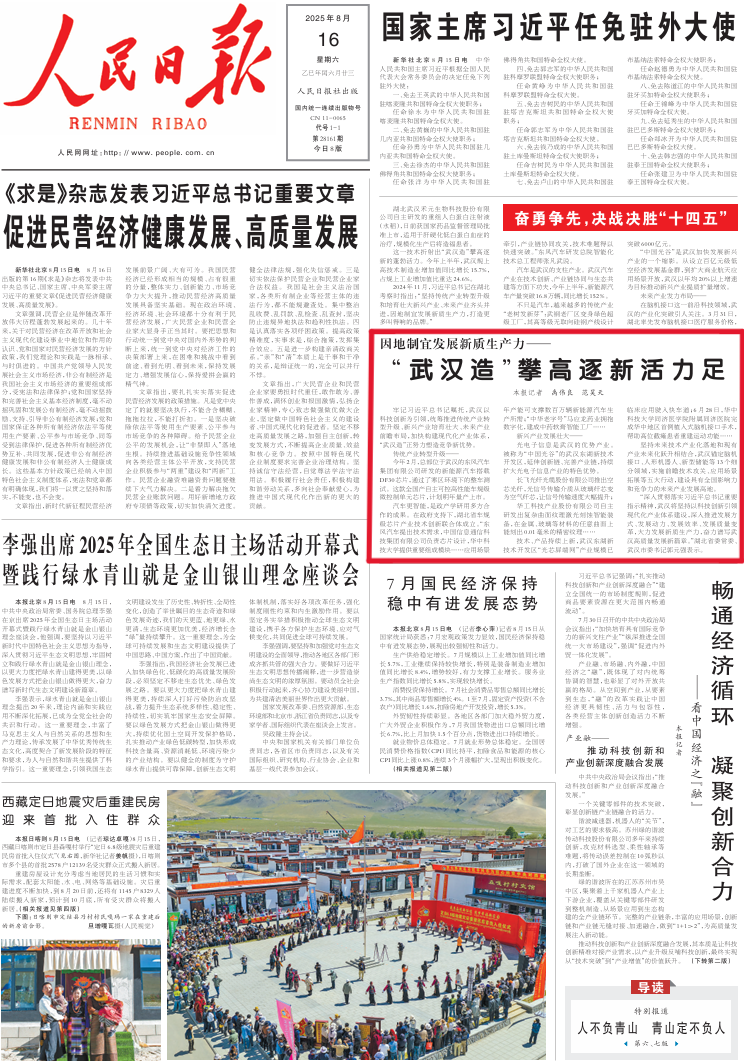
畅通经济循环 凝聚创新合力
Ren Min Ri Bao· 2025-08-16 00:40
Industry Integration - The emphasis on deep integration of technological and industrial innovation is highlighted, showcasing the importance of aligning technological advancements with industry needs to achieve value enhancement from "technological breakthroughs" to "industrial value addition" [2][3] - The success of Suzhou Green's harmonic drive technology demonstrates the vitality of the integration between the innovation chain and the industrial chain, breaking foreign monopolies and enhancing competitiveness [2] - The development of high-temperature alloy materials by China Steel Research through AI technology significantly reduces the R&D timeline, showcasing the efficiency of modern methods in supporting industrial innovation [3] Market Integration - The push for a unified national market aims to optimize market competition and eliminate barriers to resource flow, enhancing the resilience and vitality of the Chinese economy [7][8] - The establishment of a national market construction guideline aims to create a transparent and fair competitive environment, ensuring that local governments do not engage in detrimental competition [11] - The improvement of logistics and transportation infrastructure has led to a reduction in transportation costs by 30% and an increase in efficiency by 35%, facilitating smoother resource flow across regions [9][10] Internal and External Trade Integration - The integration of domestic and foreign trade is crucial for constructing a new development pattern, with companies like Chunxue Food Group expanding both international and domestic markets [12][13] - The establishment of Hainan Free Trade Port is set to enhance the connection between domestic and international markets, attracting global resources and promoting dual empowerment [14][16] - Continuous efforts to improve the investment environment and attract foreign capital are underway, with measures such as zero tariffs for least developed countries and the removal of restrictions in the manufacturing sector [16][17]
畅通经济循环 凝聚创新合力
Ren Min Wang· 2025-08-15 22:09
Industry Integration - The Chinese government emphasizes the deep integration of technological innovation and industrial innovation, aiming to enhance the synergy between technology and industry to achieve value elevation from "technological breakthroughs" to "industrial value addition" [2][3] - The Suzhou-based company, Green Harmonic Drive Technology Co., has made significant advancements in the harmonic reducer technology, breaking the long-standing foreign monopoly by achieving a transmission error control within 10 arc seconds [1][2] Market Integration - The Central Political Bureau of the Communist Party of China highlights the importance of advancing the construction of a unified national market to optimize market competition order and eliminate barriers to resource flow [7][8] - The establishment of a national unified market is supported by improved market infrastructure and regulations, which aim to create a fairer competitive environment for various business entities [11][12] External Trade Integration - The government is focused on promoting the integration of domestic and foreign trade, which is crucial for building a new development pattern and driving high-quality growth [12][13] - Companies like Spring Snow Food Group are expanding their international market share while simultaneously increasing their domestic sales, demonstrating the dual focus on both domestic and international markets [12][13]
畅通经济循环凝聚创新合力 ——看中国经济之“融”
Ren Min Ri Bao· 2025-08-15 21:59
Group 1: Industry Integration - The emphasis on deep integration of technological innovation and industrial innovation is highlighted, showcasing the vitality of the innovation chain and industrial chain [2] - The breakthrough in key components, such as the harmonic reducer, demonstrates the successful integration of technology and industry, enhancing the overall industrial chain [2] - The development of high-temperature alloy materials through AI technology significantly reduces the R&D time from over 10 years to about 1-3 years, showcasing efficiency in innovation [3] Group 2: Market Integration - The push for a unified national market aims to optimize market competition and eliminate barriers to resource flow, enhancing economic resilience and vitality [7] - The establishment of a national unified market construction guideline aims to create a more transparent and fair competitive environment for various business entities [11] - The improvement of logistics infrastructure and the reduction of transportation costs by 30% while increasing efficiency by 35% demonstrate the effectiveness of market integration efforts [9] Group 3: Internal and External Trade Integration - The integration of internal and external trade is crucial for building a new development pattern and promoting high-quality development, as seen in the case of Chunxue Food Group expanding both domestic and international markets [12] - The relationship between internal and external trade integration and expanded openness is emphasized, indicating that they support and drive each other [13] - The establishment of the Hainan Free Trade Port is expected to enhance the connection between domestic and international markets, facilitating the flow of quality resources [14]
聚焦中央政治局会议|科技创新和产业创新深度融合发展
Jin Rong Shi Bao· 2025-08-08 07:42
Group 1: Technology and Industry Integration - The meeting of the Central Political Bureau emphasized the deep integration of technological innovation and industrial innovation to enhance productivity and economic structure optimization [1] - Experts suggest that enterprises should increase high-quality technology supply and accelerate the transformation rate of technological achievements to improve industrial competitiveness [1][3] - The integration of technology and industry is seen as essential for building a modern industrial system, utilizing labor, data, technology, and platforms effectively [3] Group 2: Company Innovations and Applications - TCL showcased leading products in smart terminals, semiconductor displays, and artificial intelligence at the Chain Expo, highlighting applications in various sectors [2] - TCL is actively promoting AI applications in both B-end and C-end markets, enhancing production efficiency and user experience through AI technologies [2] - Haier's KaoSi carbon model significantly improved energy efficiency for clients, achieving a 30% energy saving for a steel company [4] Group 3: Financial Support for Innovation - TCL's R&D investment exceeded 60 billion yuan from 2019 to 2024, while Haier's R&D expenditure accounted for 4.14% of its revenue in 2023 [5] - The need for a virtuous cycle between technology, industry, and finance is emphasized to support high-quality technology supply and digital transformation [5][6] - Financial institutions are encouraged to embed themselves in the innovation chain to enhance resource allocation and accelerate the large-scale transformation of technological achievements [6]


张林山:厚植产业沃土滋养科创种苗
Jing Ji Ri Bao· 2025-08-08 00:00
如何实现真正的深度融合?首要一点,在于以产业需求为导向,牵引科技创新的航向。科技创新不 应是实验室中的"孤芳自赏",而应精准锚定产业跃升的痛点与前沿趋势。无论是突破高端芯片、基础软 件、高端装备等"卡脖子"难题,还是前瞻布局人工智能、生物制造、商业航天、低空经济等未来产业新 赛道,都需要科技力量与产业需求的紧密耦合。比如,深圳一家燃气具企业,其研发中心就设在工厂顶 楼,工程师们透过玻璃即可看见生产线运转。这种"楼上创新、楼下创业"的模式,让研发人员直面市场 反馈,新材料热效率突破110%的"不可能"极限,正是需求牵引下创新火花的璀璨迸发。 深度融合的动能,更在于推动创新要素在产业生态中的高效流转与优化配置。这要求我们拆除阻碍 要素流动的无形之墙,打造科技、产业、金融相互滋养的良性循环。北京中关村、上海张江、粤港澳大 湾区等科创高地,正通过建设概念验证中心、完善科技金融服务体系、支持龙头企业牵头组建创新联合 体等举措,努力构建"基础研究+技术攻关+成果产业化+科技金融+人才支撑"的全过程创新生态链。 深度融合的沃土,离不开深化改革这把"金钥匙"。唯有通过改革,才能破除那些阻碍科技与产 业"琴瑟和鸣"的体制机制坚 ...
厚植产业沃土滋养科创种苗
Jing Ji Ri Bao· 2025-08-07 22:50
Group 1 - The core viewpoint emphasizes the need for deep integration of technological innovation and industrial innovation to achieve high-quality development and address current economic risks and challenges [1][4] - The integration of technology and industry is not merely a parallel process but should be a symbiotic relationship, akin to roots and branches, requiring the removal of barriers to facilitate this connection [1][3] - The article highlights the importance of aligning technological innovation with industrial needs, ensuring that research and development are driven by market demands and pain points [2][4] Group 2 - The article discusses the necessity of creating a conducive environment for the efficient flow and optimal allocation of innovation elements within the industrial ecosystem, which includes dismantling invisible barriers and fostering a virtuous cycle among technology, industry, and finance [2][3] - It stresses that deep integration requires reform as a key to breaking down institutional barriers that hinder the synergy between technology and industry, including optimizing resource allocation and enhancing intellectual property protection [3][4] - The ultimate goal of promoting deep integration is to cultivate new emerging pillar industries with global influence, thereby enhancing international competitiveness and ensuring sustainable economic growth [3][4]