科技创新与产业创新融合

Search documents
透过多维度数据看生机与活力 长江经济带发展十年交出亮眼“答卷”
Yang Shi Wang· 2026-01-05 16:10
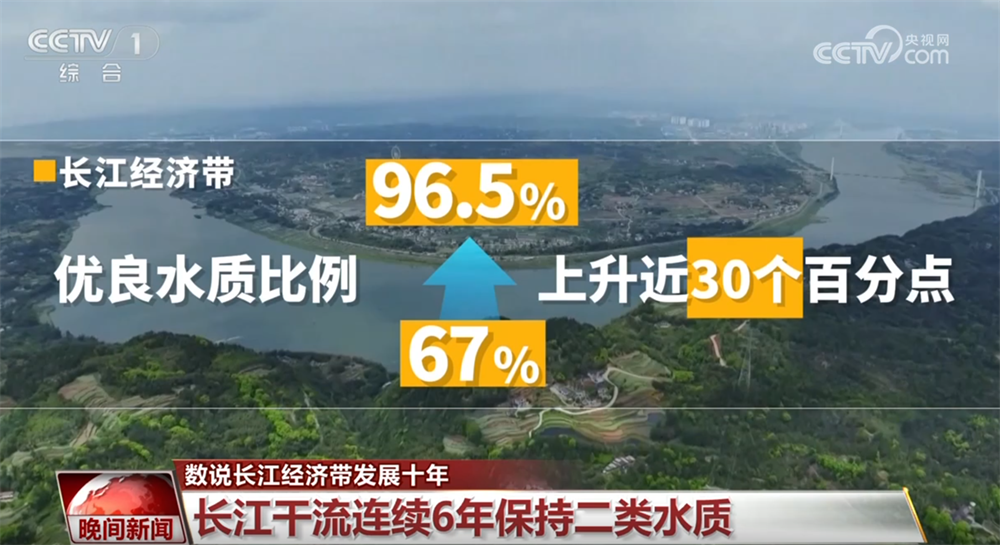
Core Viewpoint - The development of the Yangtze River Economic Belt over the past decade has focused on ecological protection while promoting high-quality development, resulting in significant improvements in environmental quality and economic growth [1]. Environmental Protection - The water quality of the Yangtze River mainstream has maintained Class II quality for six consecutive years, with the proportion of good water quality in the Yangtze Economic Belt increasing from 67% to 96.5%, a rise of nearly 30 percentage points [2]. - Over 1,361 illegal docks have been removed, and more than 90% of black and odorous water bodies in cities at or above the county level have been eliminated [4]. - The total phosphorus concentration in the Yangtze River basin has decreased by over 40% compared to 2015 [4]. Economic Development - The GDP of the Yangtze Economic Belt has more than doubled over the past decade, increasing its share of the national economy from 42.2% to 47.3% [11]. - The per capita disposable income of residents has risen from 23,000 yuan to 44,000 yuan, representing a growth of 91% [11]. Transportation and Infrastructure - The length of high-grade navigable waterways in the Yangtze River system has increased from 8,000 kilometers to 11,500 kilometers, and the cargo throughput of mainline ports has grown by 71% to reach 4.2 billion tons, maintaining the top position among inland rivers globally [8]. - The capacity for navigation has significantly improved, allowing 50,000-ton vessels to reach Nanjing and 10,000-ton vessels to reach Wuhan [11]. Innovation and Industry - The integration of technological and industrial innovation has been accelerated, with the establishment of international technology innovation centers in Shanghai and other regions, fostering the growth of emerging and future industries, including world-class clusters in automotive manufacturing and electronic information [6].

常州市委书记王剑锋:打造“国际化智造名城、长三角创新高地”
Yang Zi Wan Bao Wang· 2026-01-05 06:09
Core Viewpoint - Changzhou is transforming its industrial foundation into new productive forces, aiming to become an "International Intelligent Manufacturing City" while balancing tradition and innovation for high-quality development [1]. Group 1: Economic Performance - Over the past decade, Changzhou's economic growth averaged 7% annually, with a 6.4% growth rate during the "14th Five-Year Plan" period, achieving a GDP exceeding 1 trillion yuan two years ahead of schedule and a per capita GDP surpassing 200,000 yuan [2]. - The city contributes 7% of the provincial fiscal revenue and 8% of the GDP with only 4% of the area and 6% of the population [2]. Group 2: Industrial Innovation - Changzhou has established a "1028" industrial system, enhancing its competitiveness and participating in the construction of five national industrial clusters, with the new energy industry nearing 900 billion yuan and high-tech industries accounting for nearly 60% [2][4]. - The goal for the "15th Five-Year Plan" is to elevate industrial scale to 3 trillion yuan, focusing on new energy, intelligent equipment, and new materials, with a target of over 1.2 trillion yuan for the new energy sector by 2030 [4]. Group 3: Technological Development - The city is prioritizing the integration of technological and industrial innovation, with plans to enhance local innovation platforms and align higher education with industry needs [4][5]. - Changzhou aims to support the growth of over 30,000 enterprises, including 5 trillion-level, 50 hundred-billion-level, and 500 ten-billion-level companies, fostering a collaborative innovation ecosystem [5]. Group 4: Artificial Intelligence Strategy - Changzhou is focusing on artificial intelligence as a key area for enhancing productivity across various industries, with plans to establish a robust AI ecosystem by 2028, targeting a core industry scale of over 40 billion yuan [7]. - The strategy includes building high-level AI platforms, supporting enterprise R&D, and developing demonstration scenarios in smart manufacturing, smart energy, and smart healthcare [7]. Group 5: Urban Development and Integration - The city is committed to transforming its urban landscape through systematic restructuring, focusing on optimizing spatial layouts, promoting urban renewal, and enhancing rural-urban integration [9]. - Changzhou aims to complete over 50% of urban village renovations within ten years, benefiting over 30,000 residents and attracting over 30 billion yuan in investments [9]. Group 6: Future Outlook - The "15th Five-Year Plan" presents multiple strategic opportunities for Changzhou, including the national push for a new development pattern and the integration of the Yangtze River Economic Belt and the Yangtze River Delta [10][11]. - The city is positioned as a significant center in the Yangtze River Delta and a national advanced manufacturing base, focusing on industrial strength, green transformation, and innovation-driven development [11].
2026年是“十五五”开局之年 今年宏观经济十大看点汇总
Zheng Quan Shi Bao· 2026-01-05 00:34
Group 1: Fiscal Policy - The fiscal deficit and government bond issuance scale are expected to increase in 2026 to support economic activities during the start of the "14th Five-Year Plan" [3] - The fiscal deficit is projected to be no less than 4.06 trillion yuan, maintaining a deficit rate of at least 4% [3] - New special bonds may rise from 4.4 trillion yuan in 2025 to nearly 5 trillion yuan in 2026 to support major project construction [3] Group 2: Monetary Policy - Monetary policy is expected to remain moderately loose to promote reasonable price recovery, with a CPI target set around 2% for 2026 [4] - Traditional monetary policy tools like reserve requirement ratio cuts and interest rate reductions will have flexible timing and rhythm [4] - Structural monetary policies will focus on expanding domestic demand, supporting technological innovation, and aiding small and medium enterprises [4] Group 3: Consumption and Income - Expanding domestic demand, particularly boosting consumption, is a primary task for 2026 [5] - The "Urban and Rural Residents Income Increase Plan" aims to enhance consumer capacity and willingness [6] - Policies will be optimized to adapt to changing consumption structures, directing subsidies towards service consumption areas [6] Group 4: Investment and Infrastructure - Fixed asset investment growth is targeted to stabilize, with infrastructure investment expected to accelerate due to new major projects [7] - Government investment will increase through various funding sources, including special bonds and policy financial tools [7] - Manufacturing investment, particularly in high-tech and equipment manufacturing, is anticipated to grow rapidly [7] Group 5: Real Estate Market - The real estate market will focus on "de-stocking" as a primary task, with policies to support both supply and demand [8] - Local governments will adjust real estate policies to remove unreasonable purchase restrictions and enhance housing fund support [8] - Efforts will be made to improve the market supply-demand relationship through better management of existing properties [8] Group 6: Capital Market Reforms - Comprehensive reforms in the capital market will focus on supporting technological innovation and enhancing market inclusivity [9][10] - Policies will aim to create a multi-layered market system to meet diverse investor needs and promote long-term investments [10] - Regulatory measures will be strengthened to prevent financial misconduct and enhance market stability [10] Group 7: Unified Market and Competition - The construction of a unified national market will accelerate, with new regulations to address "involution" in competition [11] - Capacity regulation in key industries will be enhanced to phase out outdated capacities and support new quality capacities [11] - Local government economic activities will be standardized to prevent irregularities in investment incentives [11] Group 8: Technological and Industrial Innovation - The integration of technological and industrial innovation will be a key focus, with an emphasis on practical applications of new technologies [12] - The expansion of international technology innovation centers in major regions will facilitate resource integration and innovation [12] - Regional coordinated development will be promoted to enhance new quality productivity across different areas [12] Group 9: State-Owned Enterprise Reforms - A new round of state-owned enterprise reforms will focus on optimizing the layout of state-owned economies and modernizing corporate governance [13][14] - Strategic mergers and acquisitions will be promoted to enhance resource allocation efficiency [14] - Digital transformation initiatives will be launched to support innovation in key industries [14] Group 10: Social Welfare and Employment - Employment will be prioritized, with policies aimed at stabilizing jobs and increasing labor income [15] - Measures will include expanding loans for job retention and enhancing unemployment insurance [15] - The income distribution system will be improved to raise labor compensation and establish a more robust social safety net [15]
新年开工首日 北京推新政提速建设中试平台
Xin Lang Cai Jing· 2026-01-04 23:12
Core Viewpoint - Beijing aims to establish a robust pilot testing platform system by 2030, focusing on industries such as healthcare, new materials, and intelligent equipment, to enhance the integration of technological and industrial innovation [1][2]. Group 1: Pilot Testing Platforms - Beijing has identified 146 pilot testing platforms, which are crucial for transitioning new products from the trial phase to production [1][3]. - The city plans to establish 10 national-level and 50 municipal-level pilot testing platforms by 2030 to support the modernization of its industrial system [1][2]. Group 2: Policy Measures - The Beijing Development and Reform Commission has released a set of measures aimed at enhancing pilot testing service capabilities, which includes 14 specific policy initiatives [3][4]. - The new measures emphasize the independent legal entity reform of pilot testing platforms, particularly in leading industries such as artificial intelligence, healthcare, and green technology [3][4]. Group 3: Financial Support - Financial support for new independent pilot testing platforms has been increased, with investment subsidies of up to 45% for fixed assets [4]. - For new projects in key industries, subsidies are set at 35% with a maximum of 100 million yuan, and for emerging technology sectors, the support is 25% with a cap of 50 million yuan [3][4]. Group 4: Ecosystem Development - The measures aim to create a more comprehensive ecosystem for the transformation of scientific achievements into productive forces, enhancing the overall innovation landscape in Beijing [4].
北京怀柔发布首批“机遇清单” 七大重量级重点实验室和创新服务平台揭牌
Zhong Guo Xin Wen Wang· 2026-01-04 13:38
中新网北京1月4日电北京市怀柔区2026年优化营商环境暨高质量发展推进大会4日在怀柔科学城开幕, 集中发布了一系列营商环境创新举措、首批"机遇清单",10个重大项目签约,7个重量级重点实验室和 创新服务平台揭牌,助力企业在怀柔安心投资、专心创业、舒心发展。 "暖心怀"智慧服务体系全面升级 本次大会以"暖心赢在怀,科创向未来"为核心主题。开幕式上,《怀柔区进一步优化营商环境工作措 施》正式发布,聚焦政务、市场、法治、人文四大环境攻坚突破,推出20条靶向性创新举措。怀柔区将 探索制定各领域投资审批流程图,为社会投资类项目实现"拿地即开工"创造条件;加快推动国高新、专 精特新、首升规等政策实现"免申即享",区级政策兑现周期由年度压缩至半年,实现"易申快享"。同 时,利用大数据手段"按业务寻技术、依技术找企业",精准对接怀柔科学城科研设施产出与技术需求, 搭建技术转化撮合平台,破解资本服务匹配度低、成果转化存在断点等问题。 "这些措施精准聚焦怀柔区在政务服务协同效率、政策落地精准性、产业技术转化衔接等关键环节的薄 弱点,通过制度创新和技术赋能,将显著提升区域营商环境竞争力,为企业发展注入新动能。比如,我 们针对政务服 ...
常熟开启“江南福地”现代化建设新篇章
Su Zhou Ri Bao· 2026-01-04 02:08
Core Viewpoint - The article discusses the recent meeting of the Changshu Municipal Committee, which approved the proposal for the 15th Five-Year Plan, outlining the overall requirements, main goals, and key tasks for the city's development, marking a new chapter in the modernization of Changshu as a "Jiangnan blessed land" [1] Group 1: Development Goals - Changshu has established the "4832" development goals, aiming for a regional GDP of over 400 billion, industrial output exceeding 800 billion, and general public budget revenue reaching 30 billion, with a total industrial investment of 200 billion over five years [1] - By the end of the 15th Five-Year Plan, Changshu aims to enhance its comprehensive strength, upgrade its industrial structure, and improve the well-being of its citizens [1] Group 2: Key Tasks - The city will focus on building competitive industrial clusters, promoting the integration of technological and industrial innovation, and accelerating the establishment of a high-level socialist market economy [1] - There will be an emphasis on expanding high-level opening up, modernizing agriculture and rural areas, and ensuring the improvement of people's livelihoods [1] - The plan includes accelerating the green transformation of economic and social development and enhancing the stability of the city [1]
2025年资本市场“江苏板块”交出亮丽答卷
Zhong Guo Jin Rong Xin Xi Wang· 2025-12-31 03:30
Core Viewpoint - The expansion of the "Jiangsu sector" in the capital market is highlighted by the listing of Xinguangyi Electronics Co., Ltd. on the Shenzhen Stock Exchange, marking a significant contribution to Jiangsu's economic strength and its effective use of capital markets to empower the real economy [1] Group 1: Company Overview - Xinguangyi was established in 2004 in Suzhou and specializes in the research, production, and sales of high-performance special functional materials [1] - The company has broken the technological monopoly of foreign enterprises in fields such as anti-overflow special films and strong resistance special films, becoming a leading enterprise in the domestic market with the highest market share [1] Group 2: Industry Development - Jiangsu has cultivated a "1650" industrial system, focusing on the integration of technological and industrial innovation, and has established a tiered structure of enterprises from small and medium-sized technology companies to listed companies [2] - As of now, Jiangsu has nurtured 22,000 provincial-level specialized and innovative small enterprises and 3,022 national "little giant" enterprises, which serve as important sources for future listings [2] Group 3: Capital Market Initiatives - Jiangsu has proactively engaged with domestic stock exchanges to establish comprehensive cooperation mechanisms, enhancing the ability of various enterprises to utilize multi-level capital markets [2] - In December 2024, Jiangsu signed strategic cooperation agreements with major stock exchanges to support venture capital roadshows, nurture listing candidates, and improve financing tools for local governments and enterprises [2] Group 4: Future Outlook - The number of newly listed companies and those on the "New Third Board" in Jiangsu continues to rank among the top in the country, indicating an ongoing optimization of the sector structure and improved financing efficiency [3] - Jiangsu aims to strengthen departmental collaboration and enhance services throughout the lifecycle of listed companies, promoting both quantity and quality in the capital market [3]
中国经济圆桌会丨专家:把科技进步成果转化为经济增长内生动力
Xin Hua Wang· 2025-12-30 12:09
新华社北京12月30日电(记者张晓洁、申铖)中国财政科学研究院院长杨志勇在新华社12月30日推 出的"中国经济圆桌会"大型全媒体访谈节目中表示,进一步强化企业创新主体地位,把科技进步成果转 化为经济增长内生动力,让老百姓更好享受到经济社会发展的红利。 中央经济工作会议提出,"坚持创新驱动,加紧培育壮大新动能""围绕发展新质生产力,推动科技 创新和产业创新深度融合"。 他表示,科技创新最终要服务于经济主战场,要看到社会需求和市场需求。强化企业创新主体地 位,是更好发挥市场在资源配置中的决定性作用的应有之义,有利于以优质的商品和服务适应市场需 求、满足社会期待,通过技术、商业模式等多方面创新,促进供给与需求的良性互动,以消费提振畅通 经济循环。 【纠错】 【责任编辑:邱丽芳】 "企业是科技和经济紧密结合的重要力量,要充分发挥企业创新主力军作用,进一步激发科技创新 的内生动力。"杨志勇说。 ...
广东:深入实施提振消费专项行动 加大对重大项目和民生项目的投资力度
Zheng Quan Shi Bao Wang· 2025-12-30 11:55
人民财讯12月30日电,12月30日,中国共产党广东省第十三届委员会第八次全体会议暨省委经济工作会 议在广州召开。 会议强调,要突出抓改革、促开放,在推动粤港澳大湾区建设上迈出新步伐,发挥好主力军和火车头作 用,深化与港澳的合作,不断做深做实大湾区"一点两地"全新定位;深化改革攻坚,着力深化营商环境 改革,激发各类经营主体活力,抓好改革试点示范,充分释放改革效能;坚定不移扩大高水平开放,深 入实施"粤贸全球"计划,统筹好高质量"引进来"和高水平"走出去",稳步推进制度型开放,加强与海南 的相向而行,更好服务国家对外开放大局。要突出扩内需、优供给,在畅通经济循环上迈出新步伐,深 入实施提振消费专项行动,加大对重大项目和民生项目的投资力度,切实增强内需的主动力和稳定锚作 用;深入实施新一轮重点产业链高质量发展行动,推动传统产业焕新发展、新产业(300832)新赛道加 快培育、服务业扩能提质,加快构建以先进制造业为骨干的现代化产业体系;强化科技创新引领支撑, 纵深推进粤港澳大湾区国际科技创新中心、综合性国家科学中心、高水平人才高地建设,推动科技创新 和产业创新深度融合、互促双强。 ...
外贸发展韧性如何延续?丨落实会议部署 问答中国经济
证券时报· 2025-12-30 03:15
Core Viewpoint - China's merchandise trade exports have shown a year-on-year growth rate of 6.2% in the first 11 months, exceeding initial expectations despite high tariffs imposed by certain countries, reflecting the resilience brought by the long-term transformation and upgrading of the manufacturing sector and diversification of trade partners [1] Group 1: Export Performance - The export structure of China has improved, with "China Manufacturing" becoming a preferred choice for more trade partners. In the first 10 months, the export growth rates for intermediate goods and capital goods were 9.7% and 6% respectively, contributing 5.6 percentage points to overall exports [1] - Intermediate goods accounted for 47.4% of total exports in the first three quarters, an increase of 2 percentage points from the end of last year [1] Group 2: Trade Partner Diversification - The manufacturing sector's strength is a key support for export growth, while the diversification of trade partners provides greater flexibility to counter external shocks. Exports to the U.S. fell by 18.3%, but exports to non-U.S. markets such as Africa, ASEAN, India, the EU, the UK, Latin America, and Australia maintained high growth [2] - The meeting between the Chinese and U.S. presidents in Busan yielded positive results, leading to a more optimistic outlook for foreign trade in the coming year, despite ongoing trade protectionism and unilateralism [2] Group 3: Future Economic Strategies - The integration of technological and industrial innovation remains a crucial task for the upcoming economic work, with plans to enhance the self-controllability of industrial chains and implement high-quality development actions [3] - Service trade exports grew by 14.3% in the first 10 months, with knowledge-intensive services increasing by 9.5% and travel services by 52.5% [3] Group 4: Domestic Market and Trade System - Building a strong domestic demand market is essential for countering external shocks and achieving a balanced import-export structure. Measures include improving income distribution systems and enhancing social security to boost consumer spending [4] - China actively supports the multilateral trade system and has proposed initiatives to stabilize and develop the World Trade Organization's work, reflecting a commitment to open cooperation and regional trade agreements [4]