
普惠金融

Search documents
产融携手共绘五篇新章 北上协密集调研三家银行解码金融高质量发展
Zhong Guo Zheng Quan Bao· 2025-12-08 13:12
Core Viewpoint - The Beijing Listed Companies Association (北上协) is conducting a series of research activities focused on "high-quality financial development and the five major topics," engaging with major banks to explore how financial institutions can empower the real economy through various financial innovations [1][6]. Group 1: Beijing Bank - Beijing Bank prioritizes technology finance as its "first strategy" and emphasizes specialized and innovative enterprises as its "number one project" [2]. - The bank's board secretary highlighted that technological innovation is a core driver for reshaping the global economic landscape and that finance plays a crucial role in supporting technological innovation and industrial upgrades [2]. - The association's secretary-general expressed the importance of high-quality financial development as a support for national economic growth and encouraged listed companies to leverage financial market resources for innovation [2]. Group 2: Agricultural Bank - Agricultural Bank focuses on serving rural revitalization, with 40% of its loans and 44% of its deposits located in county areas [3]. - The bank is committed to urban business development while maintaining a collaborative operational model between urban and rural areas [3]. - The discussions during the research highlighted the bank's practices in technology finance and digital transformation, clarifying the direction for collaboration between enterprises and financial institutions [3]. Group 3: Postal Savings Bank - Postal Savings Bank aims to serve agriculture, rural areas, and small and medium-sized enterprises, enhancing service quality and creating new development momentum [4]. - As of Q3 2025, the bank reported positive growth in revenue and profit, with a net interest margin of 1.68% and a non-performing loan ratio of 0.94%, indicating strong performance in the industry [4]. - The bank's strategy focuses on aligning financial resources with key areas of economic development in the capital [4]. Group 4: Financial Development Strategies - The association emphasizes the need for financial companies to focus on strategic planning, risk prevention, technology empowerment, international cooperation, and talent development to ensure long-term growth [5]. - The "five major topics" are seen as essential for enhancing the quality of service to the real economy and mitigating systemic risks [6]. Group 5: Future Directions - The implementation of the "five major topics" is expected to transform banking service models, shifting from traditional collateral-based assessments to a focus on technology and future potential [6]. - Suggestions from company representatives include optimizing risk assessment models for technology finance and enhancing green finance standards [7]. - The association plans to continue facilitating high-quality exchanges and training sessions to foster collaboration among listed companies [7].



交通银行深圳分行发布“鹏城助康贷”
Ren Min Wang· 2025-12-08 12:56
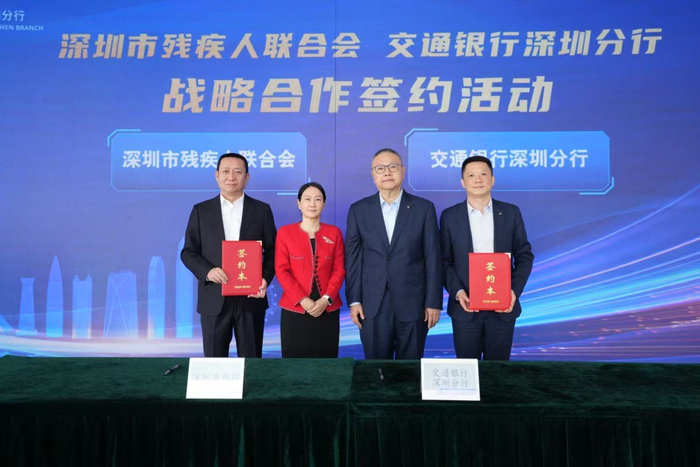
Group 1 - The core viewpoint of the article is the strategic cooperation between the Bank of Communications Shenzhen Branch and the Shenzhen Disabled Persons' Federation to launch the "Pengcheng Assistive Loan" financial product aimed at supporting enterprises and rehabilitation institutions for the disabled [2] - The "Pengcheng Assistive Loan" product is designed to address the financing difficulties faced by rehabilitation service institutions for the disabled by providing dedicated credit limits, preferential interest rates, and green approval channels [2] - The cooperation includes signing agreements with multiple assistive organizations, ensuring timely and convenient financial support for the first batch of beneficiary institutions [2] Group 2 - The president of the Bank of Communications Shenzhen Branch emphasized that this cooperation is a key step in fulfilling social responsibility and promoting inclusive finance [2] - The bank plans to deepen collaboration with the Shenzhen Disabled Persons' Federation and various assistive organizations, continuously improving the "Pengcheng Assistive Loan" product system and expanding service coverage [2] - The initiative aims to explore more precise financial solutions for assisting the disabled, providing a replicable "Shenzhen experience" for national cooperation in assistive finance [2]


从破冰到重构,锁定这场金融论坛,解锁普惠金融新路径!
Bei Jing Shang Bao· 2025-12-08 10:23
Core Insights - Inclusive finance is transitioning from "incremental expansion" to "quality improvement and efficiency enhancement," becoming a key topic in the financial sector to fulfill social responsibilities and stimulate market vitality [1][3] Group 1: Current Trends in Inclusive Finance - The financial needs of small and micro enterprises, individual businesses, rural areas, and vulnerable groups represent both a "pain point" for the real economy and a "focal point" for inclusive finance [3] - A multi-layered support system for inclusive finance has been established, covering monetary policy tools, fiscal interest subsidies, and differentiated regulatory assessments [3] - Innovations from various financial institutions, including banks and consumer finance companies, are enhancing the service efficiency of consumer finance [3][4] Group 2: Challenges and Market Dynamics - The banking sector is experiencing pressure from market changes, with challenges in identifying new clients and increasing competition leading to a saturated market [4] - Insurance companies face difficulties in accurately pricing inclusive health insurance products due to a lack of data support [4] - The consumer finance sector is caught in a dilemma of "internal competition and risk coexistence," with some institutions lowering loan rates and relaxing risk control standards to capture market share, leading to issues like "multiple borrowing" and "over-lending" [4] Group 3: Future Directions and Events - The 2025 Beijing Financial Forum special report on inclusive finance will be released, addressing the latest policy directions and showcasing breakthroughs in product design and service models across various financial institutions [4] - The forum will also feature discussions on how to navigate the "red sea" of competition and explore new opportunities in consumer finance, leveraging advanced technologies like big data and artificial intelligence [6][9] - The next decade is expected to focus on the reconstruction of inclusive finance, emphasizing "precision," "sustainability," and "ecosystem" development [9]
微业贷正规吗? 微众银行依托数字风控,为小微企业融资纾困
Sou Hu Cai Jing· 2025-12-08 09:24
Core Viewpoint - The financing needs of small and micro enterprises are increasingly characterized by "short, small, frequent, and urgent" demands, necessitating efficient and convenient financial services to support liquidity and competitiveness [1] Group 1: Product Innovation - WeBank launched the first online unsecured working capital loan product "Weiyedai" in 2017 to effectively meet the financial needs of small and micro enterprises [1] - "Weiyedai" features include no collateral required, no paper documentation needed, flexible borrowing options, and 24/7 online approval, quickly becoming a new financing choice for small enterprises [1] Group 2: Risk Control System - WeBank has established a dual-dimensional digital risk control system that integrates personal credit data of business owners with operational data of enterprises [3] - The pre-loan credit assessment system utilizes credible third-party data from tax, business, credit, judicial, and electricity sources to evaluate the creditworthiness of enterprises [3] - The system includes models for behavior scoring and monitoring during and after the loan process to address issues of information asymmetry and credit assessment difficulties [3] Group 3: Impact and Reach - As of June 2025, "Weiyedai" has reached 30 provinces/regions, with over 6 million enterprise customers applying and a cumulative credit amount of 1.7 trillion yuan [5] - More than 70% of customers have annual revenues below 10 million yuan, and about 50% are first-time borrowers with no prior credit history [5] - The data highlights that "Weiyedai" significantly enhances the accessibility of financing for small and micro enterprises, promoting inclusive finance [5]

广东重磅发布,23次提及金融,信息量大
2 1 Shi Ji Jing Ji Bao Dao· 2025-12-08 05:34
Core Viewpoint - The Guangdong "14th Five-Year" planning proposal emphasizes the strategic role of finance in supporting technological innovation, industrial upgrading, and high-quality development, integrating finance into the construction of a strong technological province [1][3]. Financial Strategy and Innovation - Finance is positioned not just as a resource allocation tool but as a core engine driving technological self-reliance and new development momentum [3]. - The proposal outlines a comprehensive innovation chain that includes "basic research + technological breakthroughs + results transformation + technology finance + talent support" to enhance regional innovation system efficiency [3]. Investment and Capital Development - The document details the creation of an innovative entrepreneurial investment and financing system, fostering high-quality venture capital institutions, and guiding capital towards early, small, long-term, and hard technology investments [3][4]. - It emphasizes the need for collaboration between finance, fiscal policy, and state-owned assets to strengthen government investment fund systems and enhance the effectiveness of fund utilization [4]. Financial Sector Growth - The proposal envisions the construction of a "financial strong province," promoting the development of technology finance, green finance, inclusive finance, pension finance, and digital finance [4]. - It encourages national financial institutions to increase resource allocation in Guangdong and deepen strategic cooperation with large domestic and foreign financial institutions [4]. Market and Investment Dynamics - The proposal aims to leverage government investment to stimulate private sector participation in major projects, enhance private investment activity, and increase the proportion of private investment [4]. - It calls for reforms in the investment and financing system to broaden diversified investment channels and establish a market-driven investment growth mechanism [4]. Risk Management - The proposal highlights the importance of preventing and mitigating risks associated with real estate and small financial institutions to maintain economic and financial security [4].

从“资金输血”到“生态赋能”,宁波银行重塑普惠金融新范式
2 1 Shi Ji Jing Ji Bao Dao· 2025-12-08 02:09
Core Insights - The article emphasizes the importance of inclusive finance in supporting small and micro enterprises, which are crucial for employment stability and economic vitality [1][8] - Ningbo Bank has developed a comprehensive inclusive finance service system, moving from merely providing funds to offering integrated support for businesses [1][8] Group 1: Financing Solutions - Ningbo Bank has launched a series of credit products such as "Small Micro Loan" and "Easy Loan" to address the financing challenges faced by small and micro enterprises, allowing them to access funds without traditional collateral requirements [2][3] - The "Small Micro Loan" product utilizes big data to create a scientific credit evaluation system, offering credit limits up to 3 million yuan and significantly improving financing efficiency [2][3] - In the first half of 2025, "Small Micro Loan" provided over 38 billion yuan in credit support to more than 20,000 small and micro enterprises [2] Group 2: Financial Management and Digital Solutions - Ningbo Bank promotes a "No Repayment Renewal Loan" policy to alleviate the cash flow issues faced by small enterprises, simplifying the renewal process through digital channels [3][4] - The "Financial Manager" service integrates various financial systems to enhance fund management efficiency for enterprises [4] - The "Lightning Check" feature of the Financial Manager allows real-time tracking of payment statuses, improving operational efficiency by 70% for businesses [5] Group 3: International Business and Risk Management - Ningbo Bank has developed the "Foreign Exchange Manager" platform to provide comprehensive foreign exchange services for over 60,000 cross-border enterprises, integrating advanced technologies [5][6] - The bank offers professional services in exchange rate management and asset allocation, helping businesses mitigate risks and reduce financial costs [6] Group 4: Comprehensive Support for Innovation - The "Bobo Zhiliao" platform provides a one-stop solution for enterprises, integrating resources and expert support to address challenges such as carbon emissions compliance [6][7] - Ningbo Bank focuses on supporting technology-driven enterprises by facilitating the transformation of research outcomes into practical applications [7][8] - The bank organizes events to foster collaboration between academia and industry, enhancing the technological capabilities of enterprises [7][8] Group 5: Commitment to Inclusive Finance - Ningbo Bank aims to build a sustainable ecosystem by extending financial services beyond mere funding to include resource integration and professional support [6][8] - The bank is committed to exploring new models and pathways for high-quality development in inclusive finance [8]

中小银行“关闭潮”,才刚刚开始
吴晓波频道· 2025-12-08 00:29
Core Viewpoint - The Chinese banking industry is experiencing a significant wave of closures and mergers, particularly among small and medium-sized banks, driven by regulatory pressures and deteriorating profitability [3][4][12]. Group 1: Current Trends in Banking - As of November 28, 2025, 368 banks have been deregistered due to regulatory approvals for mergers or dissolutions, surpassing the total for the previous year and indicating a rapid acceleration in closures [2][4][5]. - The trend shows a stark increase in closures: 27 in 2022, 64 in 2023, 192 in 2024, and over 300 in 2025 within less than a year [5]. - Village banks are particularly affected, with several merging into larger banking institutions, marking a shift in the banking landscape [6][8]. Group 2: Reasons for Bank Closures - The primary reason for the closure of small banks is the continuous decline in profitability, exacerbated by macroeconomic factors such as slowing economic growth, real estate market risks, and the impact of the pandemic [12][18]. - Traditional profit models of small banks, heavily reliant on real estate and local infrastructure, are collapsing, while new economic sectors are less accessible to these banks [13][14]. - The net interest margin for small banks has significantly decreased, with rural commercial banks reporting a net interest margin of 1.72% in Q2 2024, while the non-performing loan ratio reached 3.14%, indicating unsustainable operations [15][18]. Group 3: Impact on Inclusive Finance - The closures raise concerns about the future of inclusive finance, particularly for grassroots entrepreneurs in rural areas who rely on local banks for credit [9][26]. - Small banks previously served as a crucial financial resource for individuals without substantial collateral or credit histories, facing challenges in accessing traditional financing [26][31]. - As of the end of 2024, small banks held total assets of 57.91 trillion yuan, with agricultural loans amounting to 13.11 trillion yuan, highlighting their role in supporting rural economies [27]. Group 4: Future of Banking Services - The restructuring of small banks is not merely a reduction but aims for quality improvement, with larger banks stepping in to fill the service gap [31][34]. - Large banks are increasingly focusing on rural financing, with a significant rise in the proportion of inclusive loans from state-owned banks, which increased by 19.3% from 2019 to 2025 [35][38]. - The competitive landscape is shifting, with large banks offering lower interest rates and better services, enhancing the overall quality of financial services available to consumers [38][44]. Group 5: Consumer Implications - Depositors need not worry about the safety of their funds, as larger banks will inherit the assets and liabilities of the dissolved small banks [40][42]. - The entry of larger banks into rural markets is expected to lower loan rates, benefiting borrowers significantly [43][44]. - The digital transformation brought by larger banks will improve service efficiency and accessibility, addressing previous shortcomings of small banks [44][46].

河南“十五五”规划建议:稳步扩大债券发行规模 完善企业上市培育体系
Zheng Quan Shi Bao Wang· 2025-12-07 23:56
人民财讯12月8日电,中共河南省委关于制定河南省国民经济和社会发展第十五个五年规划的建议发 布,其中提到,积极推动现代金融高质量发展。做优做强金融体系,推进地方法人金融机构立足地方、 专注主业、完善治理、错位发展,支持在豫金融机构提供多元化服务。用好多层次资本市场,稳步扩大 债券发行规模,完善企业上市培育体系,提升中原股权交易中心功能作用,积极推进资金入豫,引育长 期资本、耐心资本。大力发展科技、绿色、普惠、养老、数字金融,健全同科技创新相适应的"政银担 保投"联动机制,发展绿色金融市场和碳市场,健全针对民营、小微和涉农主体的普惠金融服务机制, 加大对健康产业、养老产业等的金融支持,加强金融机构数字化转型和数字经济金融服务。健全地方金 融监管体系。完善并购、破产、置换、资产证券化等政策。 ...
深耕新三板“苗圃” 培育创新“小巨人”企业——证券行业服务科技创新调研之财信证券样本
Shang Hai Zheng Quan Bao· 2025-12-07 18:11
Core Viewpoint - The article highlights the role of financial institutions, particularly Caixin Securities, in supporting innovative small and medium-sized enterprises (SMEs) like Diya Environment and Jiashengde through capital market access, enabling their growth and development in specialized technology sectors [6][10]. Group 1: Company Overview - Diya Environment, established in 2006, has developed a proprietary biotechnological method for treating landfill leachate, holding 33 patents and 8 software copyrights [7]. - Jiashengde is a leading domestic producer of electronic-grade specialty resins, crucial for semiconductor packaging and applications in aerospace and new energy vehicles [8][9]. Group 2: Financing Challenges - Diya Environment faced significant financing difficulties, including short-term loans for long-term projects and limited financing channels due to its asset-light model [7]. - Jiashengde also encountered funding challenges, particularly in proving its technological advantages in a highly specialized market [9]. Group 3: Capital Market Engagement - Diya Environment turned to the New Third Board (NTE) for equity financing, successfully listing in March 2023 and raising over 25 million yuan through targeted stock issuance [8]. - Jiashengde completed its NTE listing in March 2023, aided by a systematic technical validation process that helped it gain market recognition [9]. Group 4: Growth and Development - Diya Environment's growth trajectory includes multiple stages of capital market engagement, from regional equity markets to the NTE, enhancing its production capacity and market reach [10]. - Jiashengde's listing on the NTE has significantly improved its brand image and market credibility, facilitating talent acquisition and industry collaboration [14]. Group 5: Service Model of Financial Institutions - Caixin Securities has developed a comprehensive service model for innovative SMEs, providing not just financing but also governance and operational support throughout the companies' growth cycles [11][12]. - The firm has established a specialized investment fund and expanded its market services to better support the unique needs of technology-driven SMEs [11]. Group 6: Impact of Capital Market - The NTE has become a vital platform for SMEs, with 158 new companies listed in the first half of the year, marking a 50% increase year-on-year [9]. - The article emphasizes the importance of a multi-tiered capital market system in nurturing innovative SMEs, with the NTE serving as a crucial link for companies aiming for higher market levels [12][18].

易纲:普惠金融发展要继续体现包容性
Qi Huo Ri Bao Wang· 2025-12-07 16:51
(文章来源:期货日报网) 中国人民银行党委委员、副行长陆磊在年会上表示,强大的货币以币值稳定为计量标准,以全球金融市 场共识公认为客观标志,以面向智能化数字化为时代要求。人民币已体现上述特征,并具备持续提升优 势地位的潜质。期待各方利用好中国金融学会的平台,在全球金融治理改革、经济发展潜力因素、人工 智能发展影响等领域形成更多有影响力的新成果。(鲍仁) 本报讯据中国人民银行消息,12月6日上午,2025中国金融学会学术年会暨中国金融论坛年会在北京开 幕。本次年会主题为"走中国特色金融发展之路,助力中国式现代化"。 中国金融学会理事会会长易纲作题为《锚定高质量发展构建中国特色现代金融体系》的主旨演讲。他指 出,在党中央的坚强领导下,中国金融业始终坚持以人民为中心,服务经济建设和社会发展大局,实现 了历史性跨越,取得卓越成就。在全面建设社会主义现代化国家新征程中,普惠金融发展要继续体现包 容性,充分做到"以人民为中心",坚持商业可持续的原则,以金融"活水"惠及普通百姓。绿色金融发展 要逐步减少碳排放的负外部性并不断收窄绿色溢价,以市场化方式动员社会资本积极参与,共同推动全 经济领域绿色低碳转型。 ...