
A股市场

Search documents
蜂拥进场!主力坐不住了,这个板块刚刚被基金扫货逾12亿元
Sou Hu Cai Jing· 2025-07-12 04:46
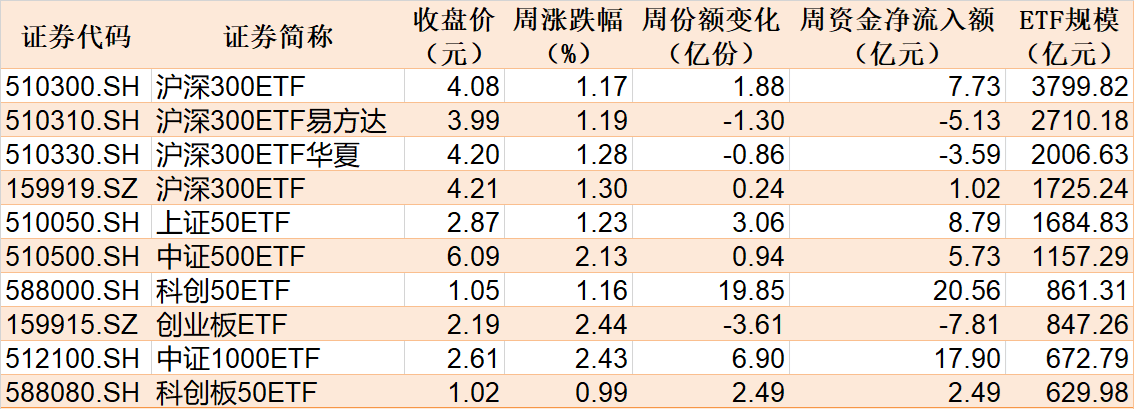
Group 1 - The stock indices collectively rose this week, with the Shanghai and Shenzhen stock markets seeing a net inflow of approximately 4 billion yuan into stock ETFs and cross-border ETFs [1][4]. - The total trading volume for the Shanghai and Shenzhen stock markets reached 7.37 trillion yuan, with the Shanghai market accounting for 3 trillion yuan and the Shenzhen market 4.37 trillion yuan [2]. - Major indices saw significant gains, with the Shanghai Composite Index closing at 3510.182 points, up 1.09% for the week, and the Shenzhen Component Index closing at 10696.1 points, up 1.78% [2]. Group 2 - In terms of industry-specific ETFs, coal, chip, and banking ETFs attracted significant inflows, with coal ETFs seeing a net inflow of 12.24 billion yuan, chip ETFs 12.03 billion yuan, and banking ETFs 11.04 billion yuan [5][6]. - The coal ETF recently experienced a substantial increase in investment, with its share surpassing 5.5 billion, marking a historical high [7]. - Analysts predict that coal prices may stabilize and recover due to seasonal demand increases and a slowdown in production growth, despite a pessimistic outlook for the industry in 2025 [9]. Group 3 - The top ten index ETFs collectively saw a net inflow of 47.69 billion yuan this week, with the Sci-Tech 50 ETF alone attracting 20.56 billion yuan [4]. - There was a notable outflow from gaming and healthcare-related ETFs, with gaming ETFs losing 4.32 billion yuan and healthcare ETFs losing 3.84 billion yuan [6]. - The Hong Kong Securities ETF achieved a trading volume close to 100 billion yuan, with several related ETFs reaching new highs in trading volume [10][12].

股票私募“重仓出击”释放看多A股信号
Zheng Quan Ri Bao· 2025-07-11 16:44
Group 1 - The core viewpoint is that private equity funds are showing strong optimism towards the A-share market, with stock private equity positions reaching a high of 77.36% as of July 4, indicating a bullish sentiment [1][2] - The increase in positions among large private equity funds (over 10 billion) is particularly notable, with their position index soaring to 83.26%, the highest in nearly 93 weeks [1] - Factors driving this bullish sentiment include improved policy environment, historical low market valuations, and rapid development in emerging industries such as artificial intelligence and new consumption [1] Group 2 - Over 60% of stock private equity funds have positions above 80%, while more than 20% maintain positions between 50% and 80%, indicating a high overall holding level [1] - The trend of increasing positions among large private equity funds reflects a strong bullish signal, with over 70% of these funds holding positions above 80% [2] - The average return for private equity funds in the first half of the year was 8.32%, with stock strategy products performing particularly well, achieving an average return of 10.00% [2]
WindTalk资管大咖谈|野村东方国际证券肖令君:A股市场与长期投资
野村东方国际证券· 2025-07-11 09:36
Group 1 - The core viewpoint of the article is that the A-share market is in the early stages of a transition from a bear to a bull market, supported by low valuations and policy backing, with significant long-term growth potential driven by new economic transformations and long-term capital inflows [2][4][6] Group 2 - A-shares are currently at historically low valuations, with the CSI 300 index PE at 13 times and PB at 1.3 times, indicating a favorable price-performance ratio compared to other asset classes [4][5] - The market is positioned similarly to the 2013-2014 period, where significant adjustments have occurred, and both policy support and investor sentiment are improving, laying the groundwork for a bull market [5][6] Group 3 - The Chinese government is focusing on expanding domestic demand through a combination of supply-side policies and demand-side stimulus, addressing the core obstacle of weak income growth expectations [8] - The structural differences between the Chinese and Japanese markets highlight that China is less likely to experience a balance sheet recession, with the current phase being characterized by the rise of new economies such as renewable energy and AI [9] Group 4 - Policy measures are enhancing the capital market's functionality, with long-term capital and stabilization funds entering the market, improving supply-demand dynamics [11] - The market structure is shifting towards new economies, with sectors like renewable energy and AI gaining traction, while consumer spending is transitioning from material to emotional consumption [12] Group 5 - Long-term investment strategies emphasize pricing, allocation, and professional management, advocating for a focus on reasonable valuations and avoiding short-term speculative trading [14] - The overall trend for A-shares is upward, supported by low valuations and policy benefits, encouraging investors to adopt a contrarian and long-term perspective to capitalize on new economic opportunities [14]

百亿股票私募仓位指数达83.26% 创年内新高
Zheng Quan Shi Bao Wang· 2025-07-11 04:26
Group 1 - The stock private equity position index has risen to 77.36% as of July 4, 2025, indicating a 2.07 percentage point increase from the previous week, approaching a new high for the year [1] - The position index for billion-level stock private equity has reached 83.26%, a significant increase of 3.3 percentage points, marking a new high for the year [1] - Over 60.66% of stock private equity positions are at full capacity, with 21.73% at moderate levels, indicating that more than 80% of stock private equity is at half capacity or above [1] Group 2 - Recent active accumulation by stock private equity, especially billion-level private equity, reflects a strong confidence in the long-term positive outlook of the capital market [2] - The supportive logic for private equity accumulation includes favorable policy environments, with recent policies improving market expectations and investor confidence [2] - Current A-share market valuations are below historical averages, providing valuable investment opportunities for value investors [2] Group 3 - The overall risk premium in the stock market remains high, with total market value/residential deposits at historical lows, indicating potential for long-term revaluation of A-shares [3] - Certain sectors, such as consumption and technology, show strong driving forces, creating structural investment opportunities [3]
A股开盘,沪指开涨0.05%,深证成指开涨0.06%,创业板指开涨0.02%。
news flash· 2025-07-11 01:27
Market Opening Summary - The A-share market opened with the Shanghai Composite Index rising by 0.05% [1] - The Shenzhen Component Index increased by 0.06% at the opening [1] - The ChiNext Index saw a slight increase of 0.02% [1]

A股市场多个主要指数创阶段新高 专家解读
Zheng Quan Shi Bao Wang· 2025-07-09 13:56
Group 1 - A-shares market indices showed strong performance on July 9, with several indices reaching new highs, including the Shanghai Composite Index surpassing 3500 points, hitting a peak of 3512.67 points, the Shenzhen Component Index reaching 10656.58 points, and the ChiNext Index peaking at 2204.64 points, marking significant milestones since early 2025 [1][2] - The overall market has demonstrated a positive trend over the past three months, with high trading activity reflected in the continuous trading volume exceeding 1 trillion shares and transaction amounts surpassing 1.2 trillion yuan for 12 consecutive trading days [1][2] - Factors driving the recent strength in the A-shares market include improved domestic economic growth momentum, a better-than-expected GDP growth rate in Q1, and a supportive monetary policy from the central bank, leading to a decline in risk-free interest rates [1][2] Group 2 - The release of the new "National Nine Articles" has led to ongoing reforms in the domestic capital market, boosting investor confidence and expectations for long-term capital inflows [2] - Positive developments in the US-China relations, the Federal Reserve nearing a potential interest rate cut, and government initiatives to combat "involution" have also contributed positively to the A-shares market [2] - Looking ahead, the optimistic outlook for the A-shares market is expected to continue, contingent on the persistence of favorable economic fundamentals, including export performance and the real estate market [2]
市场分析:金融传媒行业领涨,A股小幅震荡
Zhongyuan Securities· 2025-07-09 13:04
Investment Rating - The industry is rated as "stronger than the market," indicating an expected increase of over 10% in the industry index relative to the CSI 300 index over the next six months [17]. Core Viewpoints - The A-share market experienced slight fluctuations with a high opening and subsequent consolidation, with notable performance in cultural media, traditional Chinese medicine, liquor, and banking sectors, while insurance, non-ferrous metals, shipbuilding, and wind power equipment sectors lagged [3][4][8]. - The average price-to-earnings ratios for the Shanghai Composite Index and the ChiNext Index are 14.37 times and 38.95 times, respectively, which are at the median levels over the past three years, suggesting a suitable environment for medium to long-term investments [4][16]. - The market is expected to maintain a steady upward trend in the short term, with a focus on sectors such as finance, cultural media, pharmaceuticals, and engineering construction for investment opportunities [4][16]. Summary by Sections A-share Market Overview - On July 9, the A-share market faced resistance at 3512 points, with the Shanghai Composite Index closing at 3493.05 points, down 0.13%, and the Shenzhen Component Index at 10,581.80 points, down 0.06% [8][9]. - The total trading volume for both markets was 15,276 billion, above the median of the past three years [4][16]. Future Market Outlook and Investment Recommendations - The report suggests a balanced strategy to optimize portfolio structure amid market fluctuations, focusing on growth stocks with expected strong mid-year performance and reasonable valuations [4][16]. - The report emphasizes the importance of monitoring policy changes, capital flows, and external market conditions [4][16].
股指日报:放量上涨,市场情绪明显好转-20250708
Nan Hua Qi Huo· 2025-07-08 14:09
股指日报 股指期货日报 2025年7月8日 王梦颖(Z0015429)、廖臣悦 (F03120676) 投资咨询业务资格:证监许可【2011】1290号 放量上涨,市场情绪明显好转 市场回顾 今日股指集体收涨,以沪深300指数为例,收盘上涨0.84%。从资金面来看,两市成交额回升2452.97亿元。 期指均放量上涨。 重要资讯 1. 美国总统特朗普接连在社媒上公布其对多个国家发出的关税信函,截至目前,其已对14个国家发出最新的 关税税率威胁。此前,美国白宫表示,特朗普将签署行政令,把关税谈判截止日期推迟至8月1日。 股指日报期指市场观察 | | IF | IH | IC | IM | | --- | --- | --- | --- | --- | | 主力日内涨跌幅(%) | 1.00 | 0.69 | 1.62 | 2.01 | | 成交量(万手) | 9.4888 | 4.6496 | 9.3001 | 21.7782 | | 成交量环比(万手) | 2.7418 | 1.3708 | 3.78 | 8.1468 | | 持仓量(万手) | 25.6893 | 8.8094 | 23.4225 | 34. ...
A股开盘,沪指开涨0.04%,深证成指开跌0.04%,创业板指开跌0.03%。
news flash· 2025-07-08 01:29
A股开盘,沪指开涨0.04%,深证成指开跌0.04%,创业板指开跌0.03%。 ...
市场分析:金融电力行业领涨,A股小幅震荡
Zhongyuan Securities· 2025-07-07 11:59
Investment Rating - The industry is rated as "stronger than the market," indicating an expected increase of over 10% in the industry index relative to the CSI 300 index over the next six months [18]. Core Viewpoints - The A-share market experienced slight fluctuations with financial, electric power, real estate, and electric grid equipment sectors performing well, while biopharmaceuticals, medical services, precious metals, and gaming sectors lagged [2][3][8]. - The average price-to-earnings ratios for the Shanghai Composite Index and the ChiNext Index are 14.26 times and 38.33 times, respectively, which are at the median levels over the past three years, suggesting a suitable environment for medium to long-term investments [3][17]. - The market is expected to maintain a steady upward trend in the short term, with a focus on sectors that exceed performance expectations in mid-year reports and have reasonable valuations [3][17]. Summary by Sections A-share Market Overview - On July 7, the A-share market faced resistance at 3474 points, with the Shanghai Composite Index closing at 3473.13 points, up 0.02%, while the Shenzhen Component Index fell by 0.70% [8][9]. - The total trading volume for both markets was 12,272 billion, which is above the median of the past three years [3][17]. Future Market Outlook and Investment Recommendations - The report suggests a balanced strategy to optimize portfolio structure amid market fluctuations, with a focus on financial, electric power, electric grid equipment, and household light industry sectors for short-term investment opportunities [3][17]. - The ongoing mild recovery of the Chinese economy, driven by consumption and investment, is expected to support market stability [3][17].