
科技金融

Search documents
“十四五”时期 金融支持科技创新取得明显成效
Ren Min Ri Bao Hai Wai Ban· 2025-12-03 07:09
会议提出,党的二十届四中全会对未来五年的发展作出顶层设计和战略擘画,要求加快高水平科技 自立自强,引领发展新质生产力,大力发展金融"五篇大文章",为"十五五"科技金融工作指明了方向。 各有关部门要深入学习贯彻全会精神,突出科技创新的引领作用,加快构建与科技创新相适应的科技金 融体制,持续深化金融供给侧结构性改革,推动科技、产业、金融良性循环,为建设科技强国提供坚实 支撑。 会议强调,明年是"十五五"开局之年,各有关部门要扎实推进各项工作任务落实,常态化运行科技 金融统筹推进机制,强化科金协同、央地联动,进一步优化政策措施。发挥好科技创新和技术改造再贷 款政策作用,高质量建设债券市场"科技板",促进私募股权投资和创业投资"募投管退"循环,强化科技 保险高质量发展,引导和推动金融资源科学高效配置,加强对金融机构"五篇大文章"工作成效评估,完 善融资对接、信息共享、知识产权转化运用等配套机制,助力高水平科技自立自强。 人民日报海外版北京12月2日电(记者徐佩玉)中国人民银行、科技部等部门近日联合召开科技金 融统筹推进机制第一次会议。 会议认为,"十四五"时期各有关部门紧密协作,央地协同发力,金融支持科技创新取得明显 ...
破局科创融资难!多方合议 “轻资产” 企业成长密码
2 1 Shi Ji Jing Ji Bao Dao· 2025-12-03 07:04
Group 1 - The strategic importance of technology finance is increasingly highlighted, with the central financial work conference in 2023 emphasizing it as a key driver for high-level technological self-reliance and strength [1] - Experts agree that technology finance has evolved beyond simple capital supply to become a core hub for resource integration, risk diversification, and the transformation of technological achievements [2] - The characteristics of technology enterprises, such as being "light asset, lack of collateral, and high risk," present challenges to traditional credit evaluation systems, necessitating the development of financial service models tailored to their needs [3] Group 2 - Financial institutions need to adapt to the development patterns of technology industries to achieve a win-win situation between financial value and industrial value [2] - The discussion highlighted the need for a full-cycle, accompanying financial service ecosystem to address the significant differences in funding and resource demands at various stages of technology enterprise development [3][4] - The concept of "patient capital" is becoming an essential part of the full-cycle service ecosystem, with financial institutions expected to deeply engage in industry scenarios to match the evolving needs of enterprises [4] Group 3 - The integration of financial and technological innovation is driven by the high investment, long cycle, and high-risk characteristics of hard technology industries, necessitating collaborative support from various types of capital [4] - The financing paths for hard technology enterprises often begin with venture capital in the initial stages and evolve to include diversified financial tools, with equity financing remaining a crucial support [5] - Continuous funding, particularly from patient capital, is essential for strategic emerging industries like commercial aerospace and satellite internet, which require sustained investment due to high technical barriers and long infrastructure development cycles [5]
破局融资难、助力绿色转型,宁波银行凭什么?
Sou Hu Cai Jing· 2025-12-03 06:52
Group 1: Digital Transformation and Financial Services - Ningbo Bank leverages digital transformation to enhance financial services, enabling small businesses to apply for loans quickly and receive funds on the same day [2] - The bank has introduced a range of credit products tailored for small enterprises, addressing their unique financing challenges by reducing reliance on collateral [6][7] - A comprehensive financial service platform has been developed, integrating various functionalities to streamline processes for businesses [7] Group 2: Support for Technology and Innovation - Ningbo Bank has established industry funds to support technology-driven enterprises, facilitating their growth and development [3][4] - The bank's initiatives have led to the successful establishment of multiple industry funds, totaling 4.37 billion yuan, focusing on advanced sectors like robotics and high-end manufacturing [4][5] - A dedicated technology finance department is set to be established to provide lifecycle services for tech enterprises, enhancing support for innovation [5] Group 3: Green Finance Initiatives - The bank is actively promoting green finance by converting environmental benefits into financial value through data-driven solutions [8][9] - Services like "波波知了" have been introduced to help companies monitor energy consumption and improve efficiency, contributing to cost savings [8] - The bank has developed a green finance management system that incorporates ESG requirements into its credit management processes [9] Group 4: Commitment to Sustainable Development - Ningbo Bank is committed to investing 5% of its annual revenue into technology and digital product development, positioning itself as a leader among publicly listed banks [11] - The bank has implemented innovative financial solutions to assist businesses in optimizing their operations and reducing costs [11][12] - Ongoing efforts are focused on enhancing service delivery to meet the diverse needs of clients, thereby fostering sustainable economic growth [12]


(投资中国)汇丰以15亿美元信贷资金支持中国内地科创企业
Zhong Guo Xin Wen Wang· 2025-12-03 06:38
Core Insights - HSBC Bank (China) has launched "HSBC Innovation Finance," the first financial service brand focused on serving technology innovation enterprises in mainland China, with a total of $1.5 billion in credit funds to support these companies [1][2] Group 1: Financial Services for Innovation Enterprises - The new service aims to provide comprehensive financial support to innovative companies in technology, life sciences, and healthcare sectors, particularly those backed by venture capital or private equity [1] - HSBC will assess various factors such as core technology, patent barriers, and market prospects to offer tailored financial services, including operational funds, capital expenditures, treasury management, and financing arrangements [1] Group 2: Strategic Vision and Market Position - The president and CEO of HSBC Bank (China) highlighted that China's vibrant innovation ecosystem has led to the emergence of global leaders in several new industries, and the next five years will see accelerated technological innovation [2] - "HSBC Innovation Finance" is part of HSBC Group's strategy following the acquisition of the UK subsidiary of Silicon Valley Bank, with a global team of over 900 innovation finance experts across active innovation markets like China, the UK, the US, Singapore, and India [2]

12月6日,广州,第五届21世纪金牌分析师榜单即将发布
2 1 Shi Ji Jing Ji Bao Dao· 2025-12-03 06:32
Core Points - The Chinese capital market is at a critical stage of development planning, seeking clear direction amidst ongoing changes [1] - The "5th Century Golden Analyst Awards" will be announced on December 6, aiming to systematically review the research achievements and trends in the capital market over the past year [1] - The awards cover two main categories, reflecting the breadth and depth of research, including traditional fields and emerging sectors like robotics and innovative pharmaceuticals [1][2] Group 1 - The awards include the "Industry Analyst Award," which encompasses 33 subfields, including macroeconomics and fixed income [1] - New awards such as "Best Research Institution for Practicing Financial Five Articles" aim to align research efforts with national strategic directions in technology finance, green finance, inclusive finance, pension finance, and digital finance [1][2] - The "Best Think Tank Research Institution" award encourages institutions to conduct continuous and systematic research in macro strategy and industrial policy [2] Group 2 - The event will be part of the "Southern Finance International Forum," extending the awards ceremony into a broader communication platform [2] - The main forum theme will be "The Power of Consensus - Innovation Surge, China's Asset Revaluation," facilitating high-level discussions [2] - Multiple parallel meetings will be held, creating diverse dialogue opportunities for analysts, investment institutions, and listed companies [2]

第二批民营股权投资机构科创债发行,信用债和城投债发行规模环比分别下降15%和10%
Xin Lang Cai Jing· 2025-12-03 06:25
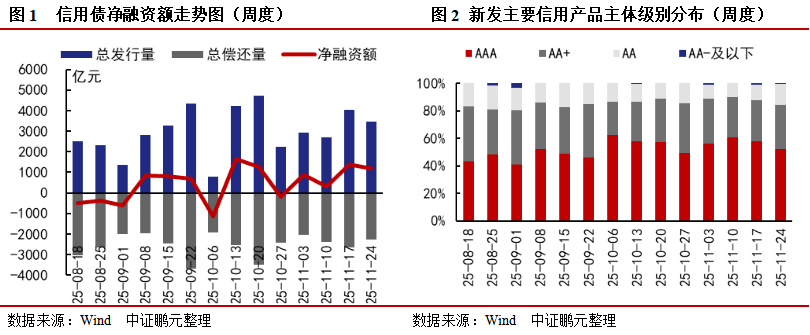
Key Points - The issuance scale of non-financial corporate credit bonds decreased by 15% week-on-week, with municipal bonds down 10% transitioning from net financing to net repayment, while real estate bonds increased by 35% with net financing up 1.7 times [1][48][53] - The average issuance rate of public corporate bonds and spreads widened, while medium-term notes, private bonds, and short-term financing showed mixed performance [1][21][67] - The total bond transaction volume decreased by 2% compared to the previous week, with credit bonds accounting for 15% of the total, down 0.5% [1][27] - The yield on 10-year government bonds rose by 2.5 basis points to 1.84%, with yields on government and credit bonds increasing across the board [1][29] - The yield on municipal investment bonds increased across all ratings [1][38] - There were 27 rating adjustments for non-financial corporate bonds last week, with no new credit risk events reported [1][41][50]

科技金融激活长三角地区创新动能
Zhong Guo Jin Rong Xin Xi Wang· 2025-12-03 05:53
Core Insights - The Yangtze River Delta is one of the most dynamic and innovative regions in China, with 48% of companies listed on the Sci-Tech Innovation Board coming from this area [1] - Technology companies have diverse financing needs at different stages of their lifecycle, which challenges banks to enhance their service capabilities and support for business growth [1] Group 1: Financial Support for Technology Companies - Agricultural Bank of China (ABC) Shanghai Branch approved a comprehensive credit of 100 million yuan for Zhefu Intelligent Systems to alleviate funding pressure as the company experiences rapid growth in orders [1] - ABC Suzhou Branch established a green channel for a biotech company, providing an additional credit of 200 million yuan to accelerate new drug development, which led to the successful approval of a new drug [2] - ABC Zhejiang Branch utilized an innovative dual pledge model of patent and trademark rights to provide a loan of nearly 20 million yuan to a high-tech company facing funding challenges due to continuous R&D investments [3] Group 2: Innovative Financing Models - ABC's approach has evolved from traditional asset evaluation to recognizing intellectual property, allowing for more flexible financing solutions [3] - The bank's smart evaluation model assesses a company's technological capabilities, enabling differentiated credit limits based on technology rather than just asset flow [3] - As of now, ABC's technology loan balance in the Yangtze River Delta exceeds 1.5 trillion yuan, with an increase of over 250 billion yuan this year, indicating a solid path for financial support of technological innovation [3]

加码科技金融支持 汇丰首推专属服务 以15亿美元信贷资金助力创新提速
Di Yi Cai Jing· 2025-12-03 05:20
Core Insights - HSBC China has launched "HSBC Innovation Finance," the first financial service brand focused on serving technology innovation enterprises among foreign banks, with a total of $1.5 billion in credit funds to support domestic tech innovation companies in leading China's innovative economic development [1][2] Group 1: Financial Services and Support - The new service will provide comprehensive financial support throughout the lifecycle of tech enterprises, including operational funding, capital expenditures, treasury management, and financing arrangements, tailored to the unique characteristics of light-asset and innovative business models [2] - HSBC aims to leverage its global resources and expertise to support innovation companies in technology, life sciences, and healthcare, focusing on startups and high-growth companies backed by venture capital or private equity [1][2] Group 2: Market Position and Growth - HSBC's Innovation Finance brand was launched following the acquisition of the UK subsidiary of Silicon Valley Bank in 2023, and it currently has a team of over 900 innovation finance experts globally, covering active innovation markets such as mainland China, Hong Kong, Singapore, India, and the UK and US [2] - Since the brand's launch, the customer base has grown by over 60%, indicating strong market demand for specialized financial services in the tech innovation sector [2] Group 3: Industry Trends and Data - China's position in the global innovation landscape is improving, with the World Intellectual Property Organization's 2025 Global Innovation Index Report ranking China 10th globally, marking its first entry into the top ten [3] - According to the Hurun Research Institute's 2025 Global Unicorn List, China has 343 unicorn companies, ranking second globally, just behind the United States, highlighting the vibrant growth of tech innovation enterprises in the country [3]
“融资+融物”之桥铺就科创通途
Jin Rong Shi Bao· 2025-12-03 02:05
Core Viewpoint - The financing leasing industry is leveraging its unique advantages of "financing + physical assets" to support industrial renewal and corporate transformation, with a focus on technology as the core engine for industrial upgrading and the cultivation of new productive forces [1] Group 1: Industry Characteristics - Characteristic One: New Scenarios as Highlights - Financial leasing companies are innovating financial products and services to expand into new business areas such as energy storage, intelligent computing centers, and low-altitude aircraft, providing strong financial support for the transformation and innovative development of the real economy [2] - The focus has shifted from traditional manufacturing to emerging industries, particularly in sectors like computing infrastructure, energy storage, low-altitude economy, biomedicine, industrial robots, semiconductor equipment, and new materials [2] - Emphasis is placed on "adaptation" and "deep cultivation" rather than merely copying existing models, with personalized financing solutions being developed for specific scenarios in the tech sector [2] Group 2: Business Growth and Investment - Financial leasing companies like交银金租 have successfully entered new business scenarios such as cold chain storage, new drug development, integrated circuits, and GPU chip computing, achieving over 60 billion yuan in technology leasing business over the past three years, involving more than 300 tech enterprises [3] - The industry is increasingly penetrating emerging fields, with new projects being launched in renewable energy and information technology, such as国银金租's recent announcement to purchase photovoltaic power station equipment for 1.22 billion yuan [3] Group 3: Ecosystem Support - Characteristic Two: Good Ecosystem as Guarantee - The development of tech leasing in the financing leasing industry requires not only deep engagement from enterprises but also supportive policies, market collaboration, and risk-sharing mechanisms [5] - The establishment of the "New Quality Production and Financing Ecosystem Alliance" by industry associations, commercial banks, and financial leasing companies aims to create a comprehensive support system for financing leasing institutions and tech enterprises [5] Group 4: Risk Management - Characteristic Three: Strict Risk Control as Bottom Line - The complexity and uncertainty of risks in the tech finance sector necessitate an urgent upgrade of risk control systems, especially given the rapid technological iterations and asset-light characteristics of tech enterprises [6][7] - Financing leasing institutions are encouraged to establish a risk management system centered on leased assets and enhance their management capabilities through technology [7] - A shift from "passive compliance" to "active management" is recommended, integrating compliance into all business processes to build trust and secure low-cost funding [7] Group 5: Future Outlook - The industry anticipates the establishment of a more robust, resilient, and collaborative ecosystem for tech leasing, aiming to provide a full-cycle funding bridge for tech enterprises from R&D to industrialization, thereby injecting lasting momentum into the cultivation of new productive forces [8]
锚定金融强国目标 以证券力量护航“十五五”高质量发展 访中信建投证券股份有限公司党委副书记、总经理金剑华
Jin Rong Shi Bao· 2025-12-03 02:02
"十五五"时期是基本实现社会主义现代化的关键时期。随着党的二十届四中全会审议通过"十五五"规划 建议,清晰的战略路径已然铺就。在这一历史进程中,金融血脉如何更精准地服务实体经济,资本市场 如何更高效地赋能新质生产力,成为关系全局的重要议题。 在战略方向上,"十五五"规划建议提出"加快建设金融强国",证券行业需立足资本市场枢纽定位,推动 科技、资本与产业高效循环,为实体经济提供更加精准有效的金融服务。 "截至2025年10月末,中信建投(601066)证券累计服务国家级专精特新及制造业单项冠军企业超2100 家,'小巨人'IPO保荐数量稳居市场前列,北交所IPO保荐数量及承销金额持续领先。未来,我们还将继 续加大投入,为新质生产力发展贡献更大力量。"正值中信建投证券股份有限公司(以下简称"中信建投 证券")成立20周年之际,《金融时报》独家专访了中信建投证券股份有限公司党委副书记、总经理金 剑华。这份服务科技创新的高质量"成绩单",是中信建投证券过往成果的总概括,也是未来继续深耕科 创金融、服务国家战略决心的体现。 在功能定位上,"十五五"规划建议提出"积极发展股权、债券等直接融资,稳步发展期货、衍生品和资 产 ...
