
大模型

Search documents
发布文心大模型5.0正式版!百度涨超4%重上160港元,创近3年新高
Ge Long Hui· 2026-01-22 04:11
Core Viewpoint - Baidu Group's stock price increased by 4.6% to HKD 160.9, reaching a new high since February 2023, following the official release of its Wenxin Model 5.0 [1] Group 1: Product Development - Baidu officially launched the Wenxin Model 5.0, which is based on native multimodal modeling and features 2.4 trillion parameters [1] - The new model supports understanding and output of various types of information, including text, images, audio, and video [1] - Wenxin Model 5.0 is now available for use on Baidu's Qianfan platform, and has been integrated into other Baidu AI products such as Wenxin Yiyan, Baidu Huibo Xing, and Wenxin Assistant [1]
港股午评:恒指跌0.1%,科技股分化,三桶油继续上涨,黄金股集体回调
Ge Long Hui· 2026-01-22 04:04
Market Performance - The Hong Kong stock market showed a high open but low close trend in the morning session, with the Hang Seng Index down by 0.1%, the Hang Seng China Enterprises Index down by 0.34%, and the Hang Seng Tech Index down by 0.4% [1] Sector Movements - Technology stocks exhibited mixed performance, with Baidu rising over 4% following the release of its Wenxin large model version 5.0, while Xiaomi fell nearly 2%, hitting a new low for the phase [1] - The International Energy Agency (IEA) raised its global oil demand forecast, leading to gains in the three major oil companies [1] - Military, coal, paper, and gaming stocks were generally active in the market [1] Commodity and Other Stocks - Gold prices experienced a pullback due to a reversal by Trump, resulting in a decline in gold-related stocks and a general downturn in non-ferrous metal stocks [1] - Lithium battery and insurance stocks were broadly sluggish [1]
百度大会现场嘉宾对话罗永浩数字人:节奏生硬 机械感明显
Feng Huang Wang· 2026-01-22 03:56
Core Insights - The core focus of the article is the launch of Baidu's Wenxin 5.0 model, which features significant advancements in AI capabilities, including multimodal understanding and output across various formats [1] Group 1: Product Launch - Baidu officially released the Wenxin 5.0 model, which is based on native multimodal modeling [1] - The model boasts 2.4 trillion parameters, enhancing its ability to understand and generate text, images, audio, and video [1] - Wenxin 5.0 is now available for use on Baidu's Qianfan platform and has been integrated into other Baidu AI products such as Wenxin Yiyan, Baidu Huibo Xing, and Wenxin Assistant [1] Group 2: User Interaction - During a live demonstration at the Wenxin Moment conference, a media representative interacted with a digital version of Luo Yonghao, testing its realism [1] - The digital persona was rated 70 out of 100 by the media representative, while it self-rated at 85, indicating a perceived gap in its naturalness and fluidity [1]


美团App升级AI搜索功能“问小团”,搭载美团自研的LongCat模型
Xin Lang Cai Jing· 2026-01-22 03:17
Core Viewpoint - Meituan has launched an updated version of its app (12.51.202) featuring the "Ask Meituan" AI search function, aimed at enhancing user experience by providing accurate local information for decision-making [1][2][3] Group 1: App Update Features - The new "Ask Meituan" AI search function allows users to quickly obtain accurate decision-making information when searching for merchants and products [1][2] - The app upgrade includes a new banner advertisement slogan, changing from "Your Helper for a Beautiful Life" to "Ask Meituan, All Arranged" [1][2] Group 2: AI Functionality - The AI search function is built on Meituan's robust local information infrastructure, designed to meet users' needs for local life information services [3][5] - "Ask Meituan" utilizes Meituan's self-developed LongCat model and integrates various mainstream large models to better fulfill diverse user tasks [3][5] - The AI can handle both clear commands and vague long sentences, providing users with rapid and accurate information based on merchant addresses, operating hours, store facilities, and extensive user reviews [3][5]



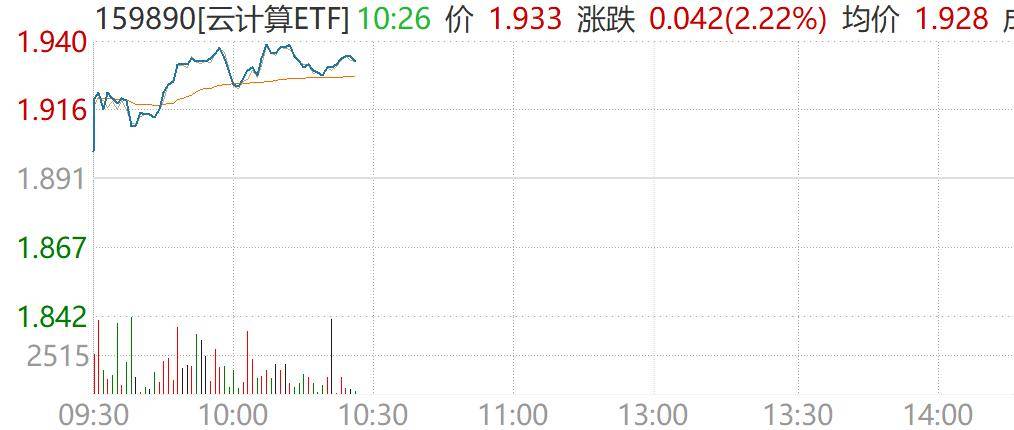
大模型竞争白热化催化算力需求,云计算ETF(159890)盘中涨超2%,深信服大涨超13%!
Sou Hu Cai Jing· 2026-01-22 02:54
Group 1 - The domestic computing power sector experienced significant gains, with companies like Deepin Technology rising over 13% and several others increasing by more than 5% [1] - The cloud computing ETF (159890) saw a 2.22% increase and has recorded a net inflow of 152 million yuan over the past eight trading days, indicating heightened investor interest [1] Group 2 - With the launch of GLM-4.7, the user base for GLM Coding Plan has rapidly increased, leading to a temporary strain on computing resources, prompting the company to accelerate capacity expansion [3] - Intel and AMD announced a price increase of 10%-15% for server CPUs, signaling a potential industry shift towards a dual demand driven by AI, marking a turning point in the sector [3] - The emergence of reasoning models has unlocked approximately 10 times the computational potential compared to traditional models, shifting the demand for computing power from solely training to a dual focus on training and reasoning [3] Group 3 - Domestic general-purpose GPUs are evolving from "usable" to "user-friendly," with continuous breakthroughs in technology and architecture, significantly narrowing the gap with international competitors [4] - The smart computing scale in China is expected to maintain a compound annual growth rate of 57% from 2020 to 2028 [4] - The cloud computing ETF (159890) tracks the CSI Cloud Computing and Big Data Theme Index, covering leading companies across various sectors, providing a comprehensive solution for the AI computing power era [4]

20天,北京独角兽估值涨超35亿
阿尔法工场研究院· 2026-01-22 00:08
Core Viewpoint - The article discusses the rapid valuation increase of AI large model companies in China, particularly focusing on MoonshotAI, which has seen its valuation rise significantly in a short period, reflecting the evolving landscape of the AI industry and the implications for investment strategies [4][5][6][20]. Group 1: Valuation Changes - In just 20 days, MoonshotAI's valuation increased by approximately 3.5 billion RMB, reaching around 48 billion RMB after a recent funding round [7][14]. - The company completed a $500 million Series C funding round on December 31, 2025, with a post-money valuation of about $4.3 billion [14]. - The valuation adjustments in the primary market are influenced by the recent public listings of AI companies like Zhiyuan AI and MiniMax, which have established a new pricing framework for the industry [20][22]. Group 2: Company Strategy - MoonshotAI has adopted a restrained approach to its IPO timeline, focusing on model iteration and product refinement rather than rushing to market [8][9]. - The company was founded in early 2023 during a challenging market period, emphasizing a technology-driven approach without immediate product offerings [12]. - The initial funding rounds were primarily aimed at building a core team and computational resources, with a focus on developing foundational model capabilities [13]. Group 3: Product Development - The AI assistant Kimi, launched in the second half of 2023, serves as a testing ground for MoonshotAI's model capabilities, focusing on long text processing and complex data understanding [16][17]. - The product strategy for Kimi is designed to validate model performance in real-world applications, creating a feedback loop for continuous improvement [17][19]. - Unlike competitors, MoonshotAI has chosen to concentrate resources on a single product, allowing for deeper development and refinement of its model capabilities [19]. Group 4: Market Dynamics - The recent public listings have shifted market focus from computational power to model and application capabilities, affecting investment strategies in the AI sector [23][24]. - Companies that have successfully integrated AI capabilities into existing products, such as Kingsoft Office and Yonyou Network, are gaining investor attention due to their stable customer bases [24]. - The transition of AI companies to public markets signifies a move from a "technology explosion phase" to a "mid-stage industrialization," where long-term pricing power is determined by model iteration and product efficiency [24][26].
奥尔特曼会晤中东投资者:OpenAI拟启动超500亿美元融资计划
Sou Hu Cai Jing· 2026-01-21 23:30
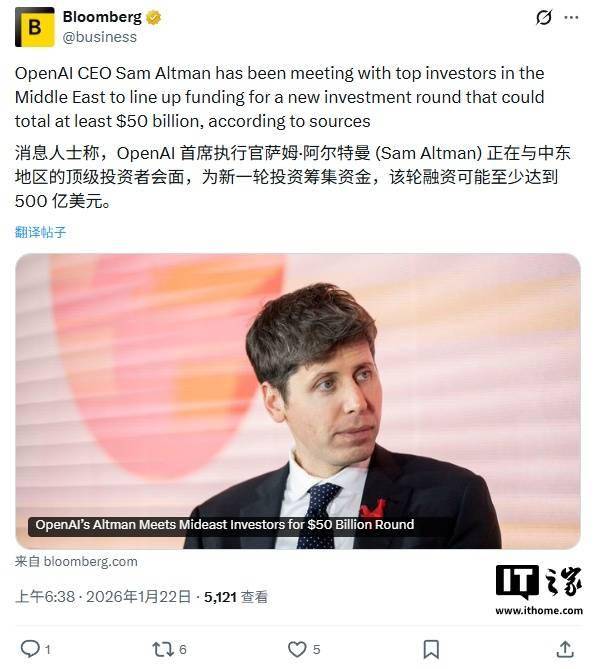
IT之家 1 月 22 日消息,据彭博社今日报道称,OpenAI CEO 萨姆 · 奥尔特曼(Sam Altman)近期一直在 与中东地区投资者展开接触,试图为公司新一轮融资铺路。 消息人士表示,此次融资规模可能达到或超过 500 亿美元(IT之家注:现汇率约合 3486.58 亿元人民 币)。该轮融资若顺利完成,OpenAI 的整体估值或将升至约 7500 亿至 8300 亿美元(现汇率约合 5.23 万亿至 5.79 万亿元人民币)。 消息人士称,奥尔特曼近日与包括阿布扎比国家支持基金在内的多家重要投资机构进行了会谈。相关谈 判仍处于早期阶段,具体融资金额和条件尚未最终确定,后续仍可能出现调整。除中东投资者外, OpenAI 近期也与亚马逊就至少 100 亿美元(现汇率约合 697.32 亿元人民币)的融资展开过讨论。 OpenAI 方面拒绝就相关消息置评。《The Information》此前亦报道称,该公司曾探讨在约 7500 亿美元 估值水平下,筹集数百亿美元资金的可能性。 近年来,OpenAI 已多次通过融资来应对人工智能研发所需的高昂成本,包括算力芯片、数据中心建设 以及高端人才投入。尽管尚未实 ...
新模型引爆需求,国产大模型龙头算力“告急”
Xuan Gu Bao· 2026-01-21 23:18
Group 1 - The launch of GLM-4.7 has led to a rapid increase in users for GLM Coding Plan, causing temporary strain on computing resources, with users experiencing throttling errors and slower model speeds during peak hours [1] - In 2024, the computing service expenses for the company are projected to be 1.553 billion yuan, accounting for over 70% of R&D expenditures, a trend expected to continue into the first half of 2025 [1] - Major tech companies like Microsoft and Google are optimistic about their capital expenditure guidance for 2026, with a total expected to reach 596.4 billion USD, a 47% year-on-year increase, indicating a sustained rise in AI computing and infrastructure investments [1][2] Group 2 - The PCB industry is entering a new cycle driven by AI, with both demand and prices expected to rise, while cooling technologies for AI GPU racks are increasingly favoring liquid cooling solutions [2] - Companies like Qingyun Technology and Chuangye Heima are collaborating with Zhiyu to provide computing resources and explore new AI service models, leveraging their respective strengths in customer resources and advanced model technologies [3]
国泰海通|轻工:智能眼镜产品力系列深度一:AR的崛起,不是偶然
国泰海通证券研究· 2026-01-21 13:50
Core Insights - The smart glasses industry is expected to enter a rapid growth phase, with related companies poised to benefit from an upturn in market conditions [1] Group 1: Product Launches and Innovations - Meta and EssilorLuxottica launched the new smart glasses, Ray-Ban Meta, featuring improved audio-visual quality and integration with Meta's Llama3 model [1] - Ray-Ban Meta includes live streaming capabilities and seamless connectivity with Meta's social platforms like Facebook and Instagram, expanding its application scenarios [1] Group 2: Supply Chain and Market Dynamics - The supply chain for AI glasses is more extensive than traditional eyewear, involving numerous hardware and software suppliers, including chip manufacturers and ODM/OEM firms [2] - The entry of various players into the AI glasses market includes mobile manufacturers, internet companies, XR firms, traditional eyewear brands, and 3C companies, with XR startups collaborating closely with traditional eyewear manufacturers [2] Group 3: Sales Growth and Market Trends - Domestic sales of AI glasses are projected to reach 210,000 units by Q3 2025, reflecting a quarter-on-quarter growth of approximately 200%, driven by brands like Xiaomi and Ray-Ban Meta [3] - Xiaomi's AI glasses are expected to surpass total sales of 300,000 units by the end of 2025, with ongoing software optimizations enhancing user experience [3] - The high pricing of Alibaba's Quark AI glasses has led to strong demand, with initial pre-sales exceeding 5,000 units and a significant increase in secondary market prices [3] - Ray-Ban Meta's global sales are projected to reach 1.12 million units by Q3 2025, with a nearly 50% quarter-on-quarter growth [3]

可灵AI月活突破1200万,日均收入较去年12月提升约30%
Xin Lang Cai Jing· 2026-01-21 12:20
1月21日,智通财经记者获悉,快手旗下视频生成大模型可灵AI月活跃用户数(MAU)已突破1200万。 今年1月截至目前,可灵AIApp端付费用户规模较去年12月增长约350%,日均收入水平较12月日均提升 约30%。SensorTower数据显示,可灵AI在GooglePlay与AppleStore的艺术/设计类目中,在40余个国家和 地区下载量排名第一。(智通财经记者 范佳来) ...
