
产业结构优化

Search documents
企业入围中国500强 门槛479.6亿
Nan Fang Du Shi Bao· 2025-09-15 23:10
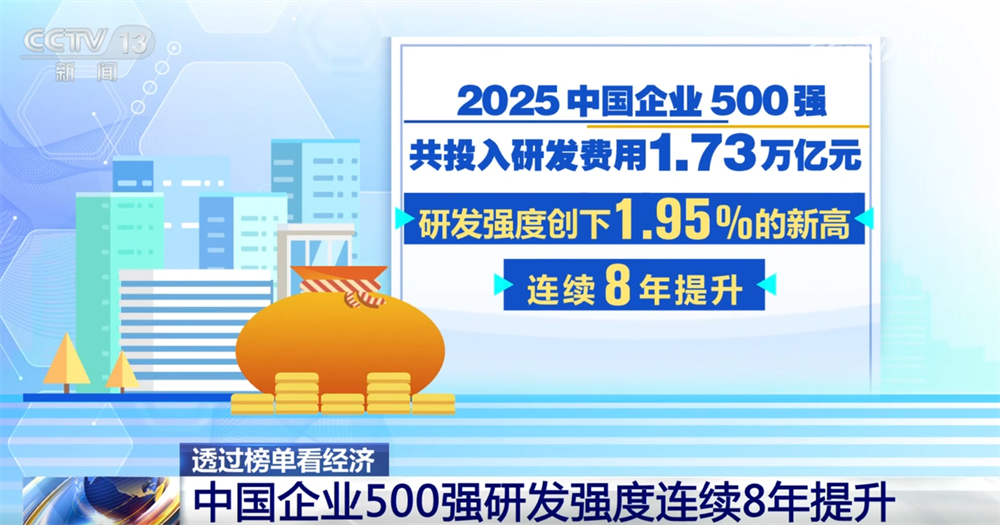
Core Insights - The "China Top 500 Enterprises" list was released for the 24th consecutive time, highlighting the growth and performance of major companies in China for the year 2024 [1] Group 1: Revenue and Financial Performance - Total revenue of the top 500 enterprises reached 110.15 trillion yuan, showing an increase compared to the previous year [2] - The threshold for entry into the list rose for the 23rd consecutive year to 47.96 billion yuan, an increase of 579 million yuan [2] - Total assets amounted to 460.85 trillion yuan, reflecting a growth of 7.46% [2] - The number of enterprises with revenues exceeding 100 billion yuan increased to 267, with 15 companies surpassing 100 billion yuan in revenue [2] - The net profit attributable to the parent company reached 4.71 trillion yuan, a growth of 4.39%, with a net profit margin of 4.27%, up by 0.17 percentage points [2] Group 2: Research and Innovation - Research and development (R&D) investment reached 1.73 trillion yuan, with an R&D intensity of 1.95%, marking an 8-year consecutive increase [3] - The total number of valid patents held by the top 500 enterprises reached 2.2437 million, an increase of 214,000 patents or 10.54% from the previous year [3] - The number of invention patents rose to 1.0396 million, an increase of 150,000 or 16.86%, with invention patents accounting for 46.33% of all patents, up by 2.50 percentage points [3] Group 3: Industry and Regional Distribution - The list included 39 new or re-entering companies, with the automotive and logistics sectors contributing the most, adding 6 new entrants [3] - The distribution of the top 500 enterprises spans 30 provinces, with Beijing, Zhejiang, Guangdong, Shandong, and Jiangsu having the highest number of companies [5] - Guangdong had 54 companies on the list, with Shenzhen contributing 27, representing half of the province's total [5] - More than half of the companies from Guangdong are private enterprises, including major players like Huawei and Tencent [5]
中国企业500强揭晓! 营收超千亿元企业达267家
Shang Hai Zheng Quan Bao· 2025-09-15 19:09
Group 1 - The "2025 China Top 500 Enterprises" list reflects the robust development of various enterprises and indicates the long-term positive fundamentals of the Chinese economy, with the entry threshold rising to 47.96 billion yuan and net profit reaching 4.71 trillion yuan, a year-on-year increase of 4.39% [1][2] - The total revenue of the top 500 enterprises in 2024 is projected to be 11.015 trillion yuan, with total assets amounting to 46.085 trillion yuan, representing a year-on-year growth of 7.46% [1][2] - The overall scale of the top 500 enterprises has reached a new level since the 14th Five-Year Plan, with the entry threshold increasing by over 8.7 billion yuan and total revenue and total assets growing by more than 22% and 34% respectively [1][3] Group 2 - Innovation is identified as the lifeblood of enterprise development, with the average R&D intensity of the listed enterprises reaching a new high of 1.95%, and nine companies, including Ctrip Group and Huawei, exceeding 10% [2][3] - The total number of valid patents held by the listed enterprises has reached 2.2437 million, with invention patents increasing for six consecutive years to 1.0396 million [2][3] - The number of enterprises in advanced manufacturing sectors has increased to 32, with a notable rise in strategic emerging industries, while the number of enterprises in coal mining and real estate has decreased [3][4] Group 3 - The number of private enterprises in the top 500 has generally increased, with state-owned and private enterprises nearly evenly represented, at 251 and 249 respectively [3][4] - The top 500 enterprises are urged to move beyond being large but not strong, emphasizing the need for substantial efforts to build world-class enterprises [3][4] - The expectation is for the top 500 enterprises to play a leading role in driving innovation and high-quality development, contributing significantly to the Chinese economy [4]
2025中企500强出炉:北京稳坐“第一城”,华为研发最猛
2 1 Shi Ji Jing Ji Bao Dao· 2025-09-15 11:18
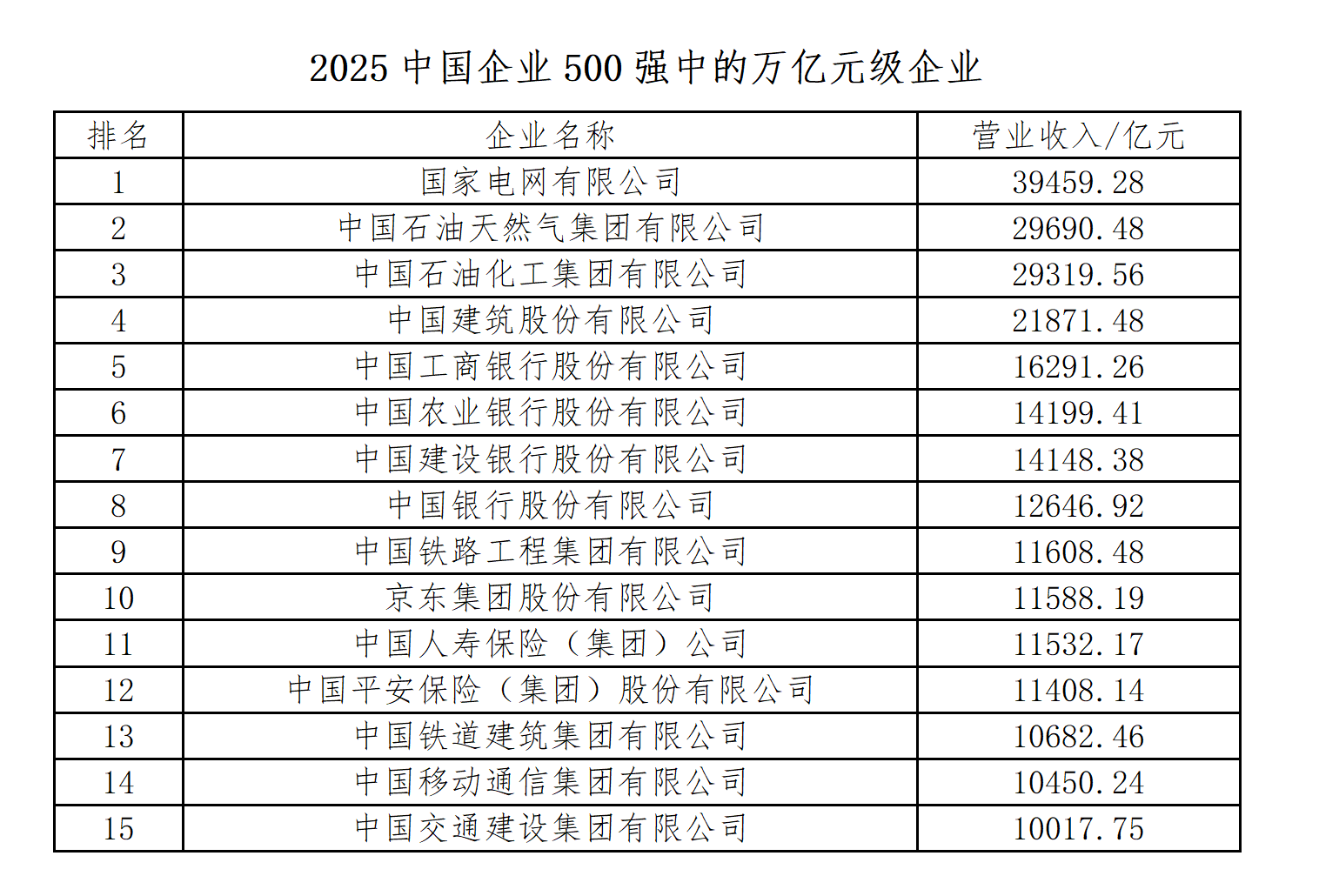
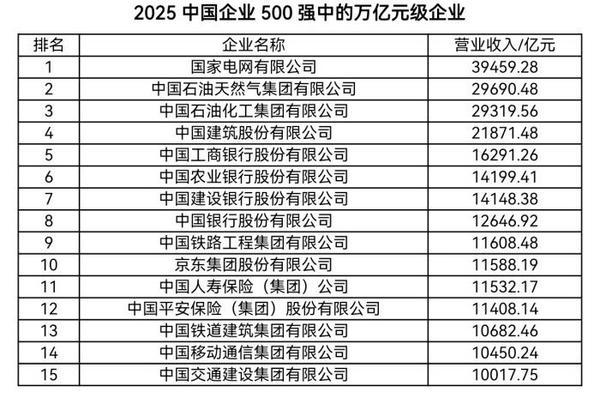
Core Insights - The "China Top 500 Enterprises" list was released for the 24th time, highlighting the significant role of large enterprises in observing China's economic trends [1] - JD Group is the only private enterprise in the top ten, indicating a notable presence of state-owned enterprises in the list [1][3] - The threshold for entering the 2025 list is set at 47.96 billion yuan, an increase of 579 million yuan from the previous year [1][5] Group 1: Company Rankings and Financial Performance - The top ten companies in the 2025 list include State Grid, China National Petroleum, Sinopec, China State Construction, and several major banks [3] - There are 15 companies with revenues exceeding 100 billion yuan, with State Grid leading at over 3 trillion yuan [6] - The total revenue of the top 500 enterprises reached 11.015 trillion yuan, a 22.62% increase from the previous year [5][6] Group 2: Regional Distribution and Growth - The 2025 list features companies from 30 provinces, with Beijing, Zhejiang, and Guangdong having the highest number of entries [4][10] - The number of companies from eastern regions decreased by 9, while central regions saw an increase of 12 [4] - The overall scale of the top 500 enterprises has steadily grown, with total assets reaching 46.085 trillion yuan, a 34.13% increase [5] Group 3: Research and Development - The top 500 enterprises invested 1.73 trillion yuan in R&D, achieving a record R&D intensity of 1.95%, marking an 8-year consecutive increase [7][8] - Huawei leads in R&D spending with 179.69 billion yuan, followed by BYD and China State Construction [8][9] - The number of patents held by these enterprises increased significantly, with a notable rise in invention patents [7] Group 4: Industry Trends and Future Outlook - The data indicates a significant increase in advanced manufacturing enterprises, with a shift towards strategic emerging industries [14] - Companies are encouraged to invest in AI, biomanufacturing, and green energy to drive future economic growth [14] - The restructuring of industries is evident, with a decrease in real estate and an increase in sectors like new energy and semiconductor manufacturing [13][14]






透过“2025中国企业500强榜单”看经济 “一增一减”显示产业结构持续优化
Yang Shi Wang· 2025-09-15 08:20
Group 1 - The core viewpoint of the article highlights the continuous growth and innovation of China's top 500 enterprises, with a significant increase in revenue and R&D investment [1][2][7] - The 2025 China Top 500 Enterprises achieved a total revenue of 110.15 trillion yuan, with the entry threshold rising to 47.96 billion yuan, marking a year-on-year increase of 579 million yuan [1] - The number of enterprises with revenue exceeding 100 billion yuan reached 267, indicating a robust performance among large companies [1] Group 2 - The R&D expenditure of the 2025 China Top 500 Enterprises totaled 1.73 trillion yuan, with a record R&D intensity of 1.95%, marking an increase for eight consecutive years [2] - The total number of valid patents held by the 2025 China Top 500 Enterprises reached 2.2437 million, an increase of 214,000 from the previous year, with invention patents accounting for 46.33% of all patents [4] - The number of new or re-entering companies in the 2025 China Top 500 was 39, with the automotive and logistics sectors seeing the most significant growth [9]
2025中国企业500强发布 15家企业营收超万亿元
Zhong Guo Xin Wen Wang· 2025-09-15 07:50
Core Insights - The "2025 China Top 500 Enterprises" list shows a positive development trend, with the entry threshold reaching 47.96 billion yuan, an increase of 579 million yuan, marking the 23rd consecutive rise [1][2] - The total revenue of the top 500 enterprises reached 110.15 trillion yuan, showing an increase compared to the previous year [2] - The total assets of these enterprises amounted to 460.85 trillion yuan, reflecting a growth of 7.46% [2] Revenue and Profitability - The total net profit attributable to the parent company for the top 500 enterprises was 4.71 trillion yuan, an increase of 4.39%, with a net profit margin of 4.27%, up by 0.17 percentage points [2] - There are 15 enterprises with revenues exceeding 100 billion yuan, with State Grid Corporation leading at 3.94 trillion yuan, approaching the 4 trillion yuan mark [4][3] R&D and Innovation - The top 500 enterprises invested a total of 1.73 trillion yuan in R&D, achieving a research intensity of 1.95%, the highest in eight years [5] - The number of valid patents held by these enterprises reached 2.2437 million, an increase of 214,000, or 10.54% from the previous year [5][6] Industry Structure - The number of enterprises in advanced manufacturing and modern service industries has increased, with 39 new or re-entering companies in the top 500 [7] - The contribution to total revenue growth from manufacturing, services, and other industries was 40.48%, 40.29%, and 19.23%, respectively, indicating balanced development [7] Regional Distribution - The top 500 enterprises are distributed across 30 provinces, with the highest numbers in Beijing (79), Zhejiang (56), and Guangdong (54) [8][9] Productivity Improvement - The per capita revenue for the top 500 enterprises was 3.4938 million yuan, continuing a nine-year upward trend, while per capita net profit reached 149,300 yuan, an increase of 9,800 yuan from the previous year [10]

以设备更新为支点 持续释放内需潜力
Sou Hu Cai Jing· 2025-09-14 00:55
Group 1 - The core viewpoint is that large-scale equipment updates are significantly driving investment growth and optimizing industrial structure, with over 8,400 projects supported by special bonds leading to total investments exceeding 1 trillion yuan [1] - From January to July this year, investment in equipment and tools increased by 15.2% year-on-year, outpacing overall investment growth by 13.6 percentage points, contributing to a 2.2 percentage point increase in total investment [1] - The demand for technology upgrades and equipment renewal is high across multiple industries, with machinery and equipment procurement in industrial enterprises expected to grow by 9.8% year-on-year from April 2024 to July 2025 [1][2] Group 2 - Equipment updates are not merely replacements but involve technological innovation, enhancing product competitiveness and production efficiency, which helps in exploring new market opportunities [2] - The digital transformation in the industrial sector has led to an 85.4% penetration rate of digital R&D design tools and a 67.7% rate of numerical control in key processes among large-scale industrial enterprises [2] - The equipment update process aligns with low-carbon development trends, reducing energy consumption costs while promoting a high-quality supply-demand cycle in the economy [2] Group 3 - Companies are hesitant to invest in equipment updates due to concerns over high costs, long cycles, and slow returns, indicating a need for enhanced policy support and financial incentives [3] - The government is focusing on strengthening fiscal and tax policies to stimulate equipment updates, with a projected annual market demand exceeding 5 trillion yuan for large-scale equipment updates [3] - Effective implementation of supportive policies is essential to unleash the potential for equipment updates, thereby driving effective investment and expanding domestic demand for high-quality economic development [3]
惠达卫浴拟出售广西新高盛100%的股权及债权 优化产业结构
Zhi Tong Cai Jing· 2025-09-04 09:31
Core Viewpoint - The company Huida Sanitary Ware (603385.SH) plans to publicly transfer 100% equity and debt of its subsidiary, Guangxi Xingaosheng Thin Ceramic Co., Ltd., in response to the ongoing adjustments in the real estate market and to optimize its industrial structure [1] Group 1: Company Actions - The company intends to publicly transfer its holdings in Guangxi Xingaosheng, which includes a debt amounting to 132 million yuan (approximately 19.2 million USD) and another debt of 138 million yuan (approximately 19.6 million USD) [1] - Guangxi Xingaosheng is identified as a high-tech enterprise focused on the research, design, production, and sales of thin ceramic slate products [1] Group 2: Market Context - The real estate market has entered a deep adjustment phase, leading to liquidity pressures among property developers [1] - Currently, Guangxi Xingaosheng is in a state of suspension of production, indicating challenges within the sector [1] Group 3: Strategic Implications - The transaction aims to adjust and optimize the company's industrial structure, integrate enterprise resources, reduce management costs, and enhance asset operational efficiency and quality [1]

惠达卫浴(603385.SH)拟出售广西新高盛100%的股权及债权 优化产业结构
智通财经网· 2025-09-04 09:30
Group 1 - The company Huida Sanitary Ware (603385.SH) announced that its subsidiary Beiliu Xingshengda New Materials Co., Ltd. plans to publicly transfer 100% equity and debt of Guangxi Xingaosheng Thin Ceramic Tile Co., Ltd. [1] - The amount of the first debt (Target Debt 1) is 132 million yuan, and the amount of the second debt (Target Debt 2) is 138 million yuan, both due by June 30, 2025 [1] - Guangxi Xingaosheng is a high-tech enterprise focused on the research, design, production, and sales of ceramic thin slate products, currently in a state of suspension [1] Group 2 - The real estate market has entered a deep adjustment phase, leading to liquidity pressures for developers [1] - The transaction aims to adjust and optimize the company's industrial structure, integrate enterprise resources, reduce management costs, and improve asset operation efficiency and quality [1]
北京经开区“十四五”GDP年均增长9.6%
Bei Jing Shang Bao· 2025-09-04 09:24
Core Insights - Since the beginning of the 14th Five-Year Plan, Beijing Economic-Technological Development Area (BDA) has achieved an average annual GDP growth rate of 9.6%, surpassing 360 billion yuan, with a remarkable growth rate of 12.3% in the first half of this year, ranking first among national-level economic development zones in terms of growth rate and contributing over 15% to the city's economic growth [1][1][1] Economic Performance - The industrial sector in BDA has shown significant performance, with total industrial output exceeding 600 billion yuan, accounting for 25.8% of the city's total; the area, which occupies only 1.37% of Beijing's land, contributes nearly 40% of the city's industrial added value [1][1] - In the first half of this year, industrial growth in BDA reached 15.6%, with leading industries such as high-end automobiles, integrated circuits, and electronic information all experiencing growth rates exceeding 20% [1][1] Structural Optimization - The industrial structure in BDA is continuously optimizing, with the ratio of secondary to tertiary industries adjusting from 65:35 in 2020 to 59:41 in 2024, indicating a 6 percentage point increase in the service sector's share [1][1] - In the first half of this year, revenue from the information service industry grew by 23.8%, retail and wholesale sales increased by 25.4%, and net income from the financial sector saw a growth of 31.4% [1][1] Investment and Innovation - Fixed asset investment in the region has grown at an average annual rate of over 28%, maintaining a scale of over 100 billion yuan for three consecutive years, with both total industrial investment and growth rate ranking first in the city [1][1] - Corporate R&D investment has increased by an average of 18.8% annually, with total R&D investment consistently ranking second in the city, reflecting strong innovation vitality and growth potential [1][1]
中经评论:从电力消费“图谱”看产业结构之变
Sou Hu Cai Jing· 2025-08-28 23:37
Core Insights - In July, China's total electricity consumption reached 1.02 trillion kWh, marking an 8.6% year-on-year increase and setting a global record for monthly electricity usage [1] - The growth in electricity consumption reflects significant changes in China's economic structure and growth dynamics, with the energy consumption increment during the 14th Five-Year Plan period being 1.5 times that of the 13th Five-Year Plan [1] Group 1: Electricity Consumption Trends - High temperatures significantly contributed to the increase in residential electricity usage, with urban and rural residential consumption rising by 18% year-on-year, and six provinces experiencing over 30% growth [1] - Industrial electricity consumption is recovering, with high-tech manufacturing and equipment manufacturing sectors showing a growth rate of 4.6%, surpassing the average manufacturing growth rate by 2.3 percentage points [2] - The electricity consumption of the new energy vehicle manufacturing sector grew by 25.7%, indicating a shift towards high-value-added industries [2] Group 2: Structural Changes in Energy Consumption - The optimization of industrial structure is evident in the electricity consumption patterns, with traditional high-energy-consuming industries showing stable growth while high-tech sectors lead the way [2] - The rapid growth of electricity consumption in digital economy infrastructures, such as data centers and 5G bases, highlights the diversification and resilience of China's economic structure [2] Group 3: Green Energy and Innovation - The proportion of non-fossil energy in electricity generation is steadily increasing, with wind and solar power growth exceeding the overall electricity consumption increase [3] - The demand for electricity from green low-carbon industries, such as new energy vehicles and photovoltaic sectors, is expected to grow significantly, with projections indicating a 34.3% increase in electricity consumption for new energy vehicle manufacturing in 2024 [3] Group 4: Future Outlook - The electricity consumption in China is expected to continue growing, driven by economic recovery and industrial upgrades, with an emphasis on improving the structure and quality of growth [4] - Understanding the changes in electricity consumption patterns is crucial for grasping the challenges and opportunities in the context of high-quality development [4]